
Heat Treatment of Metals: Process, Purpose, and Effects
Heat treatment of metals is a controlled manufacturing process used to modify the mechanical properties and internal microstructure of metal components through precisely managed heating and cooling cycles. Unlike forging or machining processes that focus primarily on geometry, heat treatment directly determines performance characteristics such as strength, hardness, toughness, and dimensional stability.
In industrial manufacturing, heat treatment is widely applied to forged and machined components where predictable performance and long-term reliability are required. This article explains what heat treatment of metals is, how the process works, common methods, relevant standards, and why heat treatment is critical in industrial applications.
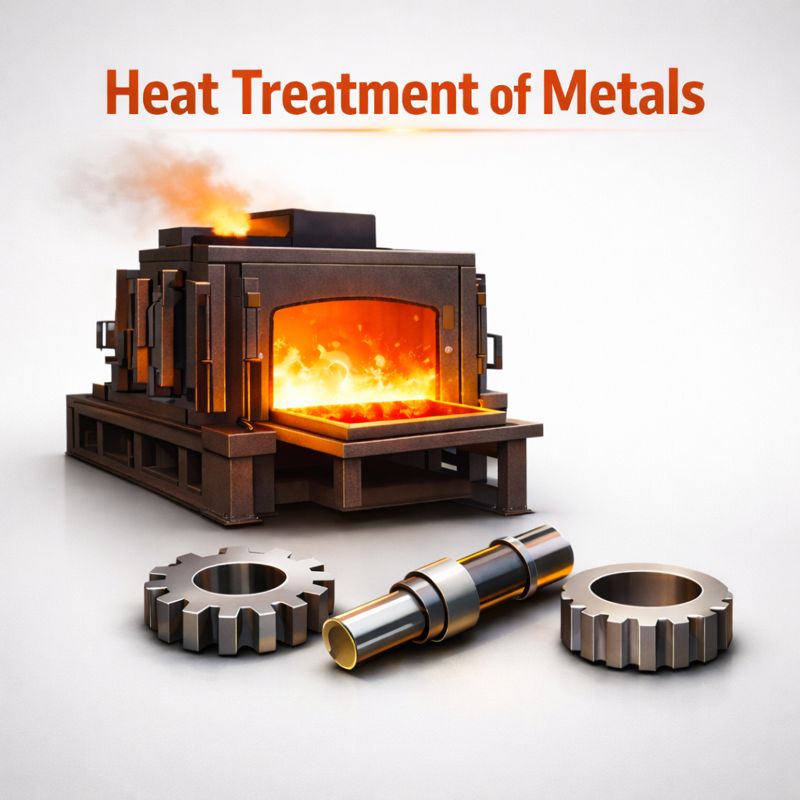
What Is Heat Treatment of Metals
Heat treatment of metals refers to a series of thermal operations in which metal components are heated to a specified temperature, held for a controlled period, and then cooled under defined conditions. The objective is to modify the metal’s microstructure in order to achieve desired mechanical properties.
Rather than being a single step, heat treatment is a systematic metallurgical process that must be matched to material grade, component geometry, and service requirements. Proper heat treatment improves consistency and repeatability across production batches.
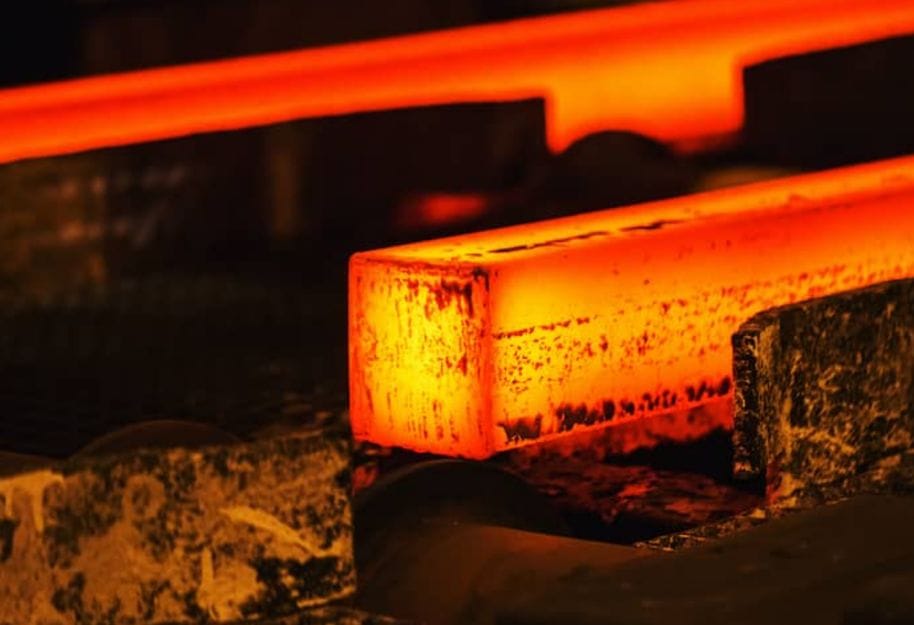
Purpose of Heat Treatment in Metals
The purpose of heat treatment in metals is to achieve a controlled and application-specific balance of mechanical properties that cannot be obtained through forming or machining alone. By modifying the internal microstructure, heat treatment enables metals to meet performance and reliability requirements under real service conditions.
Typical objectives of heat treatment include:
- Improving strength and hardness to support load-bearing applications
- Enhancing toughness and fatigue resistance for cyclic or impact loading
- Relieving residual stress generated during forging or machining
- Stabilizing material behavior to maintain dimensional accuracy during service
For OEM manufacturers and procurement teams, heat treatment is commonly evaluated as a critical step for quality control, risk reduction, and long-term performance assurance.
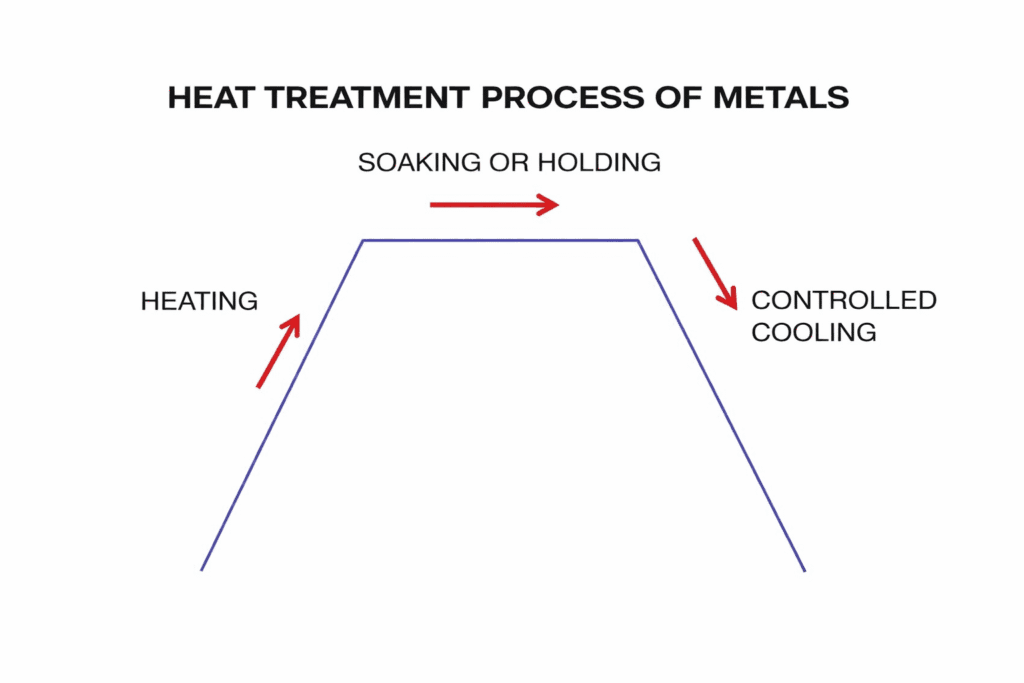
Heat Treatment Process of Metals
Heating Stage
During the heating stage, metal components are gradually raised to a target temperature suitable for the material grade. Controlled heating minimizes thermal stress and ensures uniform temperature distribution throughout the component.
Soaking and Holding
Once the target temperature is reached, the metal is held for a defined period to allow internal structural transformations to occur uniformly. This stage is essential for achieving stable mechanical properties.
Cooling Stage
The cooling stage determines the final microstructure of the metal. Cooling methods may range from slow furnace cooling to rapid quenching, depending on the required balance between hardness and toughness.
Heat Treatment Methods for Metals
Several heat treatment methods are commonly used in industrial applications, each selected based on functional requirements rather than as standalone solutions:
- Annealing – improves ductility and machinability
- Normalizing – refines grain structure and improves uniformity
- Quenching – significantly increases hardness
- Tempering – adjusts hardness and toughness after quenching
Heat Treatment Quality Control and Property Verification
Heat treatment quality control ensures forged components achieve stable strength and predictable performance. Controlled heating and cooling regulate grain structure and internal uniformity, which directly affect load capacity and dimensional stability.
Quality verification includes tensile strength, yield strength, hardness testing, and metallographic inspection. These checks confirm that heat-treated parts meet engineering standards and perform reliably in service.
Consistent heat treatment is critical for OEM production, where strength stability and long-term reliability are key quality requirements.
Importance of Heat Treatment for Forged Components
Heat treatment is critical for forged components because it stabilizes internal structure and ensures predictable mechanical performance. Without proper heat treatment, forged parts may suffer from inconsistent strength and dimensional instability.
Key reasons heat treatment is essential for forged components:
Stabilizes microstructure — prevents internal stress and structural weakness
Improves strength consistency — ensures uniform mechanical properties
Enhances dimensional stability — reduces distortion during service
Preserves forging grain flow — maintains fatigue resistance advantages
Extends service life — improves long-term industrial reliability
When forging and heat treatment are properly coordinated, components achieve both structural integrity and predictable performance required for OEM applications.
Common Heat Treatment Standards Used in Industry
In industrial manufacturing, heat treatment processes are commonly referenced against internationally recognized standards to ensure consistent material performance and quality control. These standards provide technical frameworks rather than fixed processing parameters, allowing heat treatment practices to be adapted to specific applications.
Commonly referenced standards by region include:
- ASTM standards (North America)– Define material conditions, heat treatment requirements, and mechanical property testing methods
- ISO standards (International)– Provide general guidelines for heat treatment practices and quality management systems
- EN / DIN standards (Europe)– Specify material states, heat treatment conditions, and inspection criteria
- GB standards (China)– Cover material grades and heat treatment practices aligned with international equivalents
In practice, final heat treatment requirements are typically defined by engineering drawings, material specifications, and service conditions.
Why Heat Treatment Is Critical in Industrial Applications
In industrial manufacturing, heat treatment is not an isolated step but an integrated part of the forging and machining process. It is used to control material behavior, reduce distortion, and achieve predictable mechanical performance that aligns with design and downstream processing requirements.
When properly integrated into the manufacturing sequence, heat treatment improves production consistency and long-term reliability. It helps reduce batch-to-batch variation, stabilize machining results, and support effective quality assurance and risk control for OEM projects.
Conclusion
Heat treatment of metals is a fundamental process for achieving controlled mechanical performance and long-term reliability in industrial applications. When properly integrated with forging and machining operations, heat treatment helps stabilize material behavior, reduce production risk, and ensure consistent performance across batches.
If you have an application or project that involves heat treatment requirements, you are welcome to contact us with drawings or technical details for a free quotation and technical evaluation.