
FAQs About Custom Forging
Every forging project is different.
Some customers are looking for a supplier that can handle both forging and machining. Others need help with material selection, heat treatment, inspection requirements, or drawing review before production begins.
To make the sourcing process easier, we have compiled answers to the questions most frequently raised by procurement teams, engineers, and OEM manufacturers. If you cannot find the information you need, our engineering team is always available to review your project.
Frequently Asked Questions
Company & Custom Services
Weforging is a manufacturing company specializing in custom forgings and CNC machined components. Our production capabilities include forging, machining, heat treatment, inspection, and project management, allowing us to control quality and lead time throughout the process.
Yes. We manufacture forged and machined components according to customer drawings, specifications, and performance requirements. Most projects are customized for OEM applications.
Yes. Our engineering team reviews material selection, forging feasibility, machining allowances, and critical tolerances before production begins.
For new projects, many customers prefer to validate assembly fit, machining strategy, or field performance before committing to larger volumes. We regularly support prototype and pilot production runs as part of that process.
Yes. Product marking, laser engraving, labels, and customized packaging can be provided according to project requirements.
Materials & Manufacturing
The majority of our projects use carbon steel, alloy steel, and stainless steel grades. Material selection is usually based on load conditions, wear resistance, toughness requirements, and machining considerations rather than cost alone.
Depending on product geometry and production volume, we provide closed die forging, open die forging, ring rolling, and hot forging processes.
We manufacture everything from small precision forgings to larger structural components used in mining and heavy equipment applications. Capacity is evaluated according to material, geometry, machining requirements, and annual demand.
Yes, most projects include machining after forging. This helps control dimensional consistency and simplifies supplier management for customers who prefer receiving finished components rather than forged blanks.
Heat treatment requirements vary significantly between applications. Depending on project specifications, processes such as normalizing, quenching and tempering, induction hardening, or other heat treatment routes can be arranged.
Quality Control & Inspection
Quality control begins with raw material verification and continues through forging, machining, heat treatment, final inspection, and shipment.
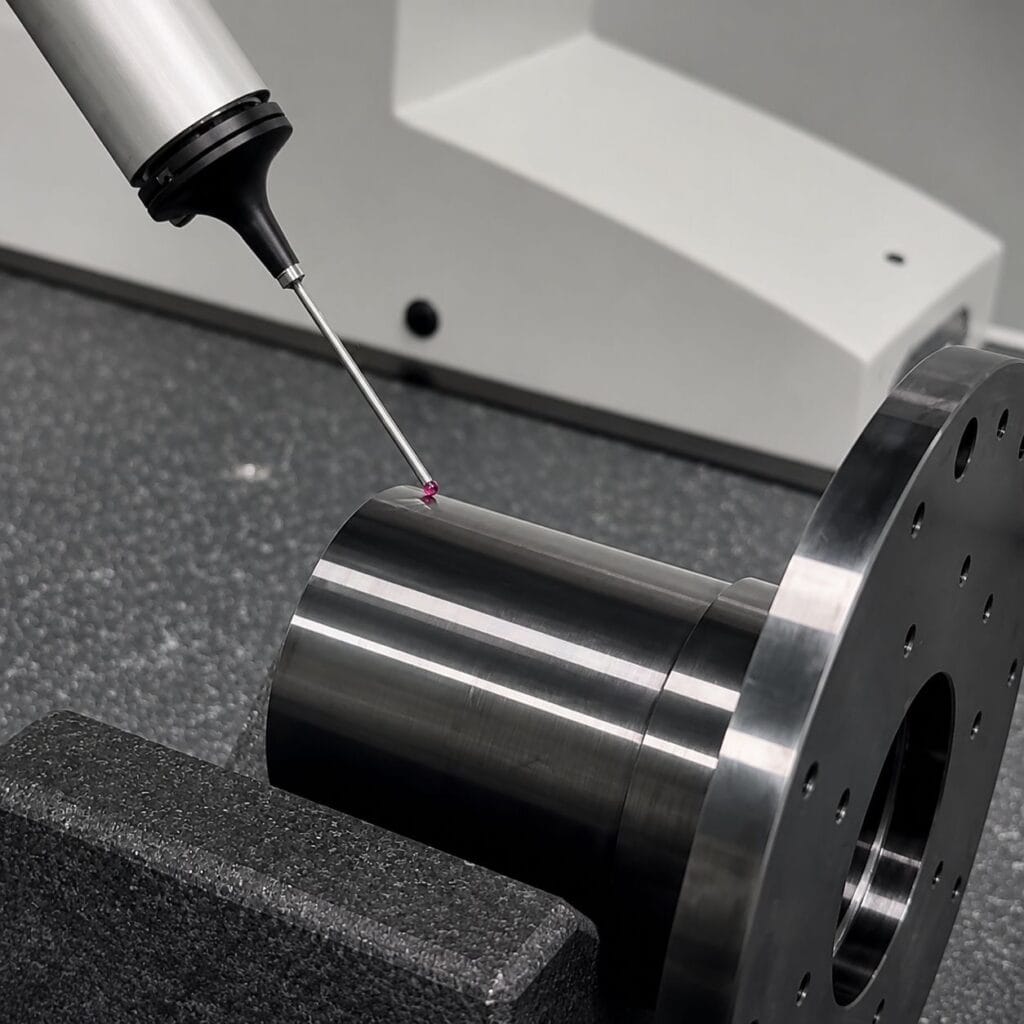
Inspection capabilities include CMM measurement, hardness testing, dimensional inspection, and non-destructive testing depending on project requirements.
For safety-critical or highly loaded components, non-destructive testing is often specified by customers. UT and MT inspections can be performed according to drawing requirements or applicable standards.
Dimensional verification depends on the requirements of each project. For components with critical fits, bearing seats, concentricity requirements, or complex geometries, inspections can be carried out using CMM equipment in our 22°C temperature-controlled measurement room.
A controlled measurement environment helps improve repeatability and reduces the influence of temperature variation on inspection results.
Material certificates are commonly supplied together with inspection records and other project documentation. Specific document packages can be prepared according to customer requirements.
Traceability starts from incoming material and continues throughout forging, machining, heat treatment, and inspection. Material heat numbers and production records are linked to each batch whenever traceability is required by the project.
Lead Time & Project Support
For a precise quotation, please provide: drawings (2D or 3D), material grade, heat treatment requirements, critical tolerances, batch quantity, and expected delivery. If available, include your intended production environment or assembly constraints. This ensures we can evaluate feasibility, tooling, and cost accurately.
Lead time depends on forging complexity, size, tooling availability, heat treatment cycles, and batch volume. For example, standard medium-sized steel forgings (5–50 kg) typically require 4–6 weeks from drawing approval to finished product. Large or complex parts may require 8–12 weeks. Lead times are confirmed during quotation with detailed schedule.
Yes. For urgent orders, we prioritize production within available capacity, use existing tooling when possible, and can arrange overtime or additional shifts. Typical expedited projects achieve delivery 20–30% faster than standard schedules, depending on product size and complexity.
Yes. Weforging exports to Europe, North America, Australia, and other international markets. We provide full documentation including MTC, heat numbers, and shipping certificates to ensure customs clearance and traceability.
Yes. Early engineering review can improve forging feasibility, reduce machining time, prevent potential defects, optimize material use, and shorten lead times. Our team can provide suggestions on fillets, wall thickness, grain flow, and tolerance adjustments based on forging and machining experience.
Why Work With Weforging?
At Weforging, we combine forging, CNC machining, heat treatment, and quality inspection into one coordinated manufacturing process. This integrated approach helps reduce communication gaps, improve consistency, and support demanding OEM projects.
Need a Quote for Your Forging Project?
Send us your drawing, material specification, and quantity requirements.
Our engineering team will review your project and provide a quotation with manufacturing recommendations.