
Tensile Testing for Forgings: What the Results Mean
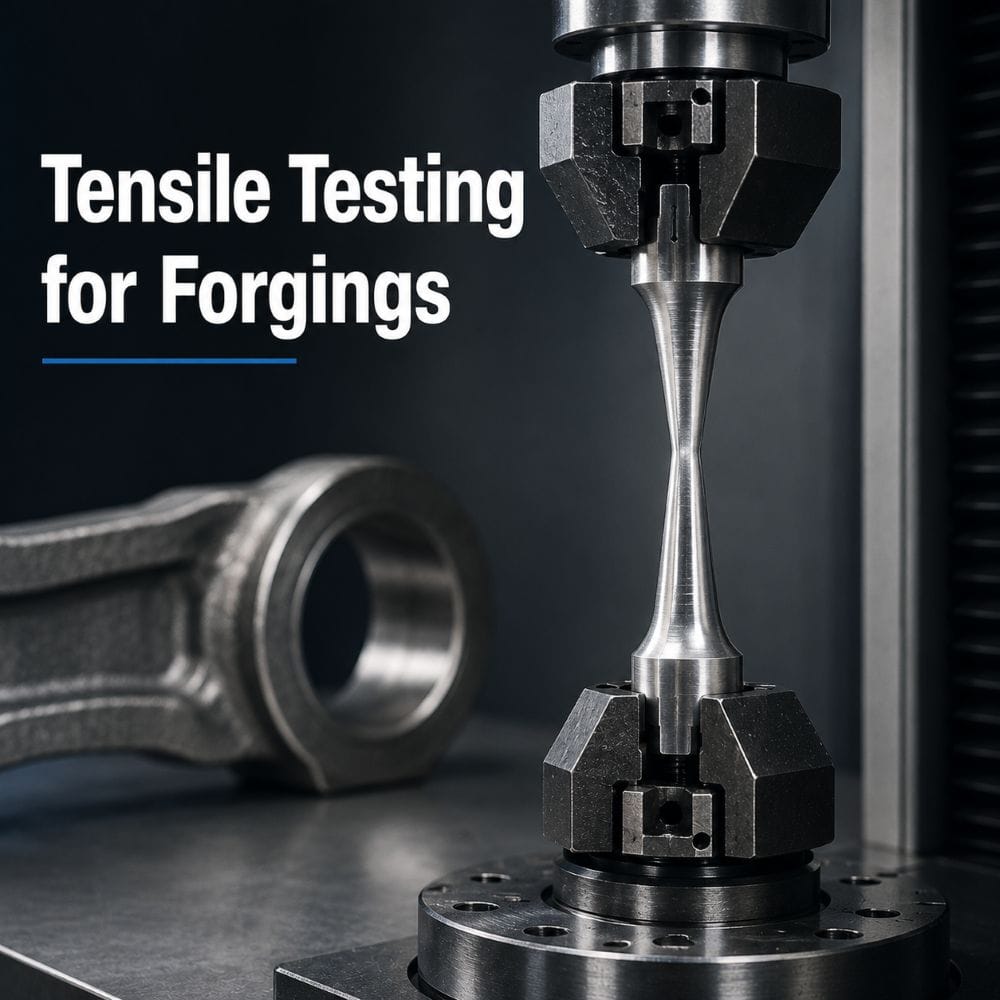
Tensile testing for forgings is used to verify the mechanical properties of steel forgings under controlled tensile loading. A prepared specimen is pulled until deformation and fracture, showing how the material responds to tensile stress.
The test typically reports four key results: yield strength, ultimate tensile strength (UTS), elongation, and reduction of area. Together, these values describe the strength and ductility of forged steel and provide the basis for interpreting tensile test results.
For engineers, quality teams, and buyers, these results should be evaluated with the material grade, heat-treatment condition, specimen location, and applicable specification to determine whether a forging meets its mechanical-property requirements.
What Is Tensile Testing for Forgings?
Tensile testing is a destructive mechanical test used to measure how a forging behaves under axial tensile load. A machined specimen is loaded until it deforms and eventually fractures.
A tensile test typically determines four key properties:
- Yield strength— when permanent deformation begins
- Ultimate tensile strength (UTS)— the maximum engineering stress reached
- Elongation— how much the specimen extends before fracture
- Reduction of area— how much the cross-section decreases at fracture
Together, these properties describe the strength and ductility of the tested forging material.
Why Is Tensile Testing Important for Steel Forgings?
Chemical composition identifies the steel grade, but it does not by itself confirm the final mechanical performance of a forging. Forging deformation, section size, and heat treatment can all affect the properties achieved in the finished material.
Tensile testing helps verify whether a steel forging meets specified requirements for strength and ductility, while also supporting evaluation of heat-treatment effectiveness and production consistency.
For buyers, the practical question is not simply whether a tensile test was performed, but whether the reported results apply to the correct material condition and meet the specified acceptance requirements.
How Is a Tensile Test Performed on a Forging?
A tensile specimen is taken from a specified location in the forging and machined to the required dimensions. Its original gauge length and cross-sectional dimensions are measured before testing.
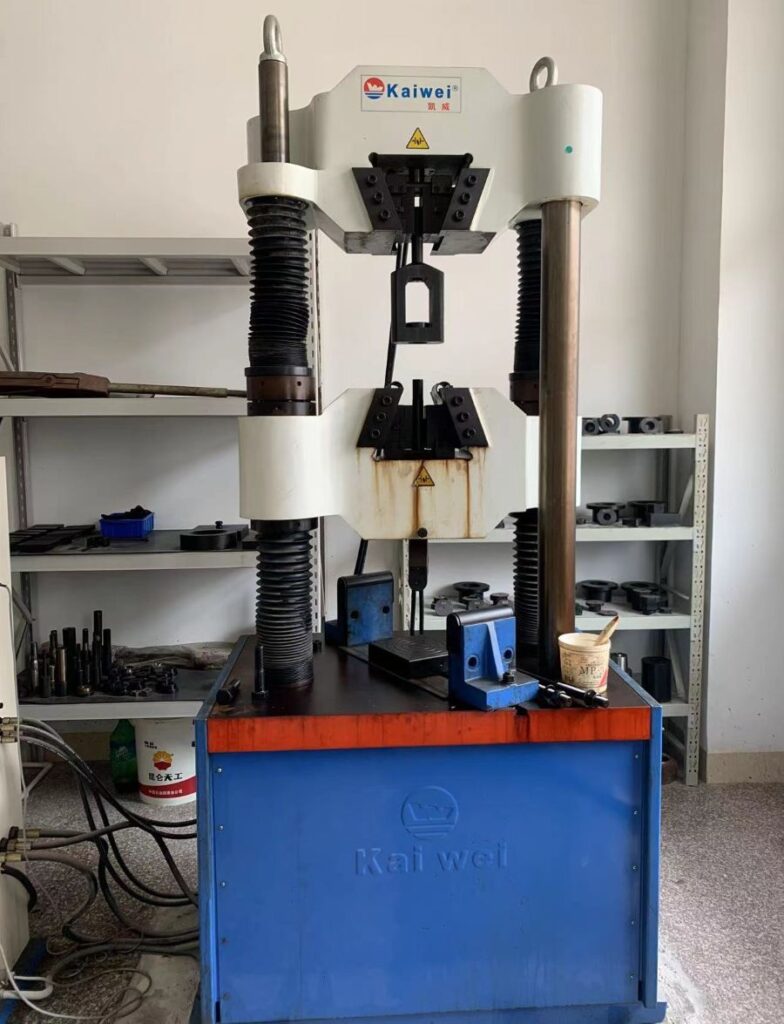
The specimen is mounted in a tensile testing machine and subjected to controlled axial loading until fracture. Load and deformation are recorded to establish the material’s stress-strain response.
The resulting data are used to determine yield strength, UTS, elongation, and reduction of area. Sampling location and orientation should follow the applicable specification, drawing, or inspection plan.
How to Read Tensile Test Results for Forged Steel?
Tensile test results are best read as two groups of properties: strength and ductility. While yield strength and UTS describe how the material responds to tensile stress, elongation and reduction of area show how much plastic deformation occurs before fracture. Together, these values provide a more complete view of the material’s tensile behavior.
Test Result | What It Measures | What It Tells You |
Yield Strength | Onset of permanent deformation | Resistance to permanent deformation |
UTS | Maximum engineering stress | Maximum tensile strength reached |
Elongation | Increase in gauge length | Overall ductility |
Reduction of Area | Cross-section decrease at fracture | Local ductility |
A useful review does not ask which value is “best.” It asks whether each required property meets its specified criterion and whether the overall strength-ductility balance is appropriate for the specified material condition.
Yield Strength
Yield strength marks the stress at which permanent deformation begins. Below this level, deformation is mainly elastic; after yielding, the material will not fully return to its original dimensions once the load is removed.
For steels without a distinct yield point, a specified proof strength, commonly based on a 0.2% offset, may be reported.
In service, yield strength is especially relevant where permanent deformation must be controlled.
Ultimate Tensile Strength (UTS)
Ultimate tensile strength (UTS) is the maximum engineering stress reached during a tensile test. It occurs after yielding as the specimen continues to plastically deform.
UTS is useful for confirming specified strength, but a higher value is not automatically evidence of a better forging. It still needs to be evaluated with ductility and the applicable material requirements.
Elongation
Elongation measures the increase in gauge length after fracture and is commonly used to evaluate overall ductility.
Higher elongation generally indicates that the material can sustain more plastic deformation before breaking. However, elongation values should be compared under consistent specimen geometry, gauge length, and test requirements.
A passing UTS result cannot replace a specified elongation requirement.
Reduction of Area
Reduction of area measures the decrease in cross-sectional area at the fracture location and indicates local ductility during the final stage of deformation.
Elongation reflects deformation over the gauge length, while reduction of area focuses on deformation concentrated near the fracture. Reading both values together gives a more complete picture of ductility.
How to Read a Forging Tensile Test Report?
A tensile test report becomes useful when the specified requirement and actual result can be compared directly. The values below are illustrative only and are not universal acceptance criteria for steel forgings.
Property | Illustrative Requirement | Test Result | Evaluation |
Yield Strength | ≥ 450 MPa | 485 MPa | Pass |
UTS | 620–780 MPa | 695 MPa | Pass |
Elongation | ≥ 16% | 18% | Pass |
Reduction of Area | ≥ 40% | 47% | Pass |
Illustrative example only. Actual acceptance values depend on the applicable material and product specification.
In this example, all four properties meet their respective requirements. However, the important point is not that 695 MPa is a “good” UTS. It is that the value falls within the specified range while the required ductility values are also satisfied.
Before accepting the report, confirm that the material grade, heat-treatment condition, specimen information, and test standard correspond to the component being purchased.
Tensile Strength vs Yield Strength in Forgings
Yield strength and tensile strength describe different stages of material behavior and should not be used interchangeably.
Property | Yield Strength | Ultimate Tensile Strength |
Represents | Start of permanent deformation | Maximum engineering stress |
Occurs | At the onset of plastic deformation | After yielding |
Engineering relevance | Resistance to permanent deformation | Maximum strength under tensile loading |
A forging can have high UTS while still failing a yield-strength or ductility requirement. For this reason, a higher UTS does not necessarily mean better overall forging performance. Instead, the relevant question is whether the specified combination of strength and ductility has been achieved.
What Can Affect Tensile Test Results?
Two forgings made from the same nominal steel grade do not necessarily produce identical tensile results. Specimen location and orientation, section size, forging deformation, and heat-treatment condition can all affect the measured properties.
A difference in tensile values should therefore be reviewed together with the test conditions and material condition rather than treated immediately as a material defect.
Does Specimen Location Affect Tensile Test Results?
Yes. Large or complex forgings may not have identical mechanical properties at every location or orientation.
Depending on the forging and specification, tensile specimens may be taken longitudinally, transversely, or tangentially. Section thickness, local forging reduction, grain flow, and heat-treatment response can contribute to differences in measured properties.
A result is meaningful only when the specimen is taken from the required location and orientation. For procurement review, confirm that the reported specimen information matches the applicable specification or inspection plan.
How Does Heat Treatment Affect Tensile Test Results?
Heat treatment for forgings changes the microstructure of forged steel and can significantly alter the balance between strength and ductility.
As a result, normalizing, quenching, and tempering can change yield strength, UTS, elongation, and reduction of area. The final properties also depend on the steel grade, section size, and specific heat-treatment parameters.
Therefore, a tensile result should be evaluated against the specified heat-treatment condition rather than simply compared with another result from the same nominal steel grade.
Which Standards Apply to Tensile Testing for Forgings?
The applicable tensile test method depends on the material and product specification. For steel forgings, ASTM A370 and ASTM E8/E8M are commonly referenced.
Standard | Main Scope | Typical Relevance |
ASTM A370 | Mechanical testing of steel products | Referenced by many steel material and product specifications |
ASTM E8/E8M | Tension testing of metallic materials | General method for determining tensile properties |
However, an important distinction is that a test-method standard is not the same as an acceptance specification. ASTM A370 and ASTM E8/E8M primarily define how tensile testing is performed; they do not establish one universal tensile requirement for every forging.
Instead, acceptance values normally come from the applicable material or product specification, drawing, purchase order, or customer requirement.
How Are Tensile Test Results Evaluated for Forging Acceptance?
Forging acceptance is based on comparing the measured yield strength, UTS, elongation, and reduction of area with the corresponding specified requirements.
The review should also confirm that the material grade, heat-treatment condition, specimen location, and test method match the applicable specification or purchase documentation.
Forging acceptance is based on comparing the measured yield strength, UTS, elongation, and reduction of area with the corresponding specified requirements.
At the same time, the review should confirm that the material grade, heat-treatment condition, specimen location, and test method match the applicable specification or purchase documentation.
There is no single tensile-strength value that defines an acceptable forging for every application. Therefore, meeting one mechanical-property requirement does not compensate for failing another specified property. For example, even if UTS meets the requirement, the forging may still fail tensile acceptance when elongation is below the specified minimum.
Why Do Forgings Fail Tensile Testing?
A forging fails tensile testing when yield strength, UTS, elongation, or reduction of area falls outside the specified acceptance criteria. The cause may relate to the material condition, heat treatment, forging or section effects, or specimen and testing factors.
The failure pattern can help determine where the investigation should start:
| Failure Pattern | First Areas to Review |
|---|---|
| Low yield strength + low UTS | Material condition, heat-treatment records |
| UTS passes but elongation fails | Heat treatment, ductility, specimen/test conditions |
| Results vary by location | Sampling position, section size, heat-treatment response |
| Unexpected isolated failure | Specimen preparation, test records, traceability |
These are investigation starting points, not definitive root-cause diagnoses.
A failed result should trigger a root-cause review rather than an immediate retest. Review the tensile data, specimen information, heat-treatment records, and material traceability before determining whether the result represents the forging itself.
What Should Buyers Check on a Forging Tensile Test Report?
For sourcing and quality review, do not stop at the word “Pass.” A useful report should contain enough information to connect the test result to the material and forging being supplied.
Buyers should check:
- material grade and heat number
- heat-treatment condition
- specimen location and orientation, where required
- test method or standard
- specified and actual mechanical-property values
- material traceability
A passing result has limited purchasing value if it cannot be linked to the correct material condition, specification, and batch.
This is more useful when comparing suppliers than simply comparing tensile-strength numbers.
What Happens If a Forging Fails a Tensile Test?
A failed tensile result should be reviewed before the affected material or production batch is accepted or released.
The investigation may include:
- verifying specimen identity and dimensions
- confirming test conditions and records
- checking material and heat-number traceability
- reviewing heat-treatment records
- confirming whether retesting is permitted
- determining the disposition of the affected batch
Retesting should follow the governing specification and should not be used simply to replace a failed result.
Any retest, corrective action, or batch disposition should remain traceable to the affected material.
Conclusion
Tensile testing for forgings evaluates both strength and ductility. Yield strength and UTS describe strength behavior, while elongation and reduction of area describe how the material deforms before fracture.
These results only become meaningful when they are connected to the correct material grade, heat-treatment condition, specimen information, test method, and acceptance requirements.
The key question is not whether a forging has the highest tensile strength, but whether all specified properties are satisfied under the correct material and test conditions.