
Custom Robot Joint Components Manufacturer
Weforging manufactures custom robot joint components to OEM customer drawings, integrating forging, heat treatment, CNC machining and inspection within one controlled manufacturing route. We manufacture steel gear rings, rotor components, shafts, flanges, hubs and other load-bearing or transmission parts for industrial robot joints, robotic joint assemblies and precision motion systems.
For OEM buyers, approving one sample is only the first step. In practice, repeat production also depends on consistent material, controlled heat treatment, stable machining processes and inspection of critical features.
By managing key processes from raw material and forged blank through final machining and inspection, Weforging supports material-to-finished-part traceability while reducing handoffs between separate forging, heat-treatment and machining suppliers.
Send us your 2D drawing, 3D model, material specification, critical tolerances and expected quantity for a manufacturing review.
Custom Components for Robot Joint Systems
Components used in industrial robot joints require different combinations of strength, dimensional accuracy, alignment and surface condition, depending on their function within the joint assembly.
Weforging focuses on custom metal components manufactured to OEM drawings, rather than standard off-the-shelf robot parts.
Components we manufacture include forged and machined gear rings, shafts, gear shafts, flanges, hubs, rotor components and other load-bearing or transmission parts. However, the appropriate manufacturing route depends on the part geometry, material, mechanical requirements, tolerances and production volume.
Component Type | Typical Manufacturing Route | Key Manufacturing Focus |
Robot Joint Rotor Core / Rotor Components | Forging + Heat Treatment + CNC | Coaxiality, mating interfaces, dimensional stability, bearing locations, thin-wall features |
Shafts / Gear Shafts | Forging + Heat Treatment + CNC | Runout, shaft interfaces, mechanical properties |
Flanges | Forging + CNC Machining | Mounting faces, bolt patterns, runout |
Hubs | Forging + CNC Machining | Bore accuracy, concentricity, mating surfaces |
Transmission Components | Forging + Heat Treatment + CNC | Strength, alignment, repeatability |
Custom OEM Components | Process selected to drawing requirements | Drawing-defined critical features and inspection requirements |
For components where a forged blank is required, Weforging can combine custom forging with heat treatment and precision CNC machining within one manufacturing route.
One Supplier from Forging to Finished Robot Joint Component
For OEM buyers, sourcing forging, heat treatment and CNC machining from separate suppliers means managing multiple production schedules, quality interfaces and process handoffs. If machining allowance, heat-treatment distortion or a critical dimension becomes an issue, identifying where it originated can require additional coordination between suppliers.
For steel robot joint components that require both closed-die forging and precision-machined features, Weforging can manage the major manufacturing stages within one production route. As a result, the forged blank, heat-treatment condition, machining operations and inspection results remain connected throughout production.
Material Selection → Raw Material Inspection → Forging → Heat Treatment → Material Performance Testing → Rough Machining → Precision CNC Machining → CMM / Dimensional Inspection → Finished Component
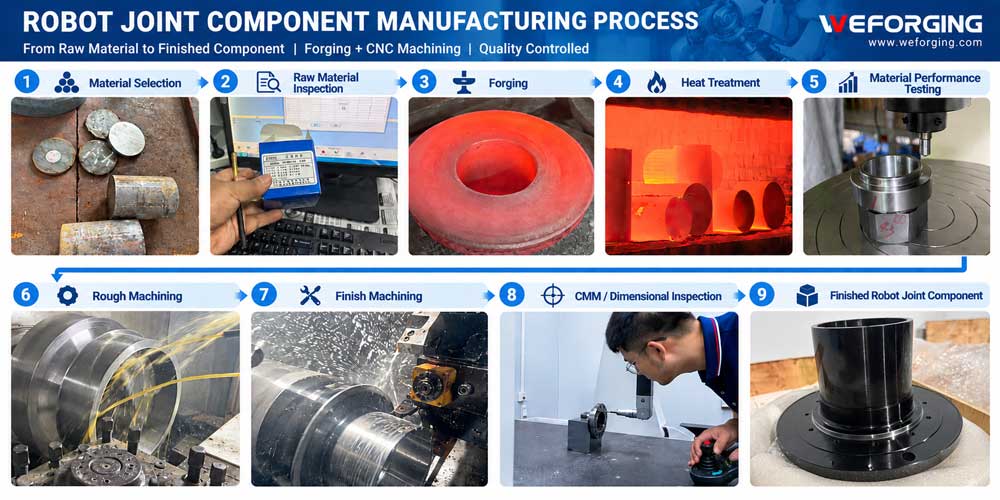
This keeps the forged blank, heat-treatment condition, machining operations and inspection results connected throughout production.
For procurement teams, the value is not simply having fewer suppliers. It means fewer production handoffs, clearer process responsibility and better visibility from raw material to finished component.
Robot Joint Rotor Core: Manufacturing Case & Process Engineering
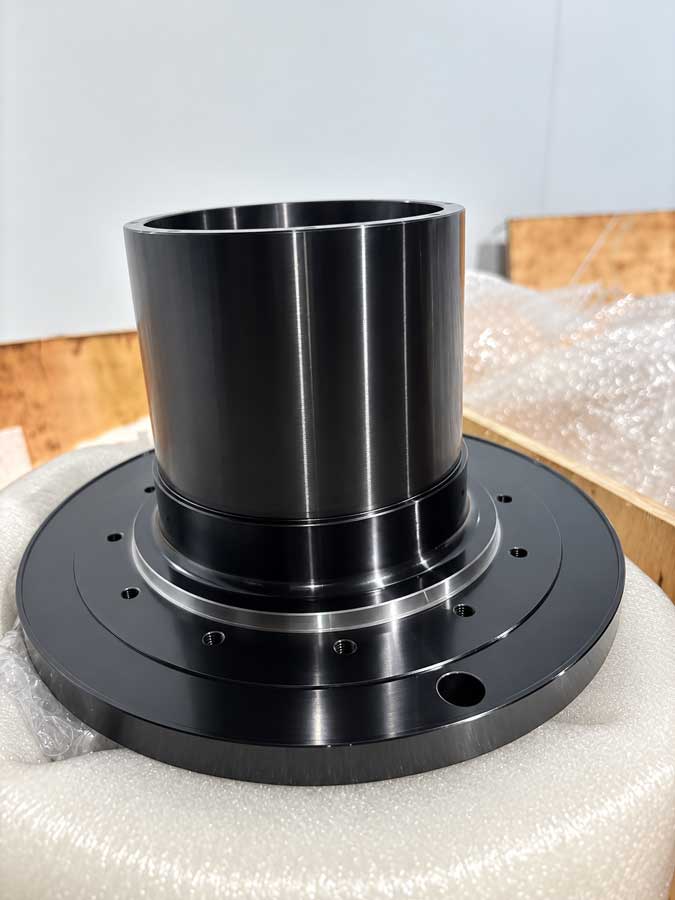
This robot joint rotor core shows why manufacturing a precision component involves more than following a drawing and completing a sequence of machining operations. At Weforging, the manufacturing route is reviewed around the material, part geometry, critical tolerances, assembly relationships and final application requirements.
This robot joint rotor core is a thin-walled component with critical requirements for concentricity and related geometric tolerances. During process development, the main challenge was not simply achieving the required dimensions through CNC machining, but maintaining the component’s geometry after material removal, stress redistribution and surface treatment.
Therefore, Weforging adjusted the production route according to how the component behaved during actual manufacturing.
Why Normalizing and Stress-Relief Annealing Were Both Required
The two heat-treatment stages serve different purposes.
Normalizing after forging refines the grain structure and establishes a suitable material condition for subsequent machining. After rough machining, however, material removal can release and redistribute residual stress—an important consideration for a thin-walled component with tight concentricity requirements.
For this reason, stress-relief annealing is performed after rough machining before the component moves into semi-finish and final machining. The purpose is to reduce the risk of dimensional movement during the later production stages.
What 24-Hour Stabilization and CMM Inspection Revealed
After semi-finish machining, the component is allowed to stabilize for 24 hours before being transferred to a temperature-controlled CMM room for geometric inspection.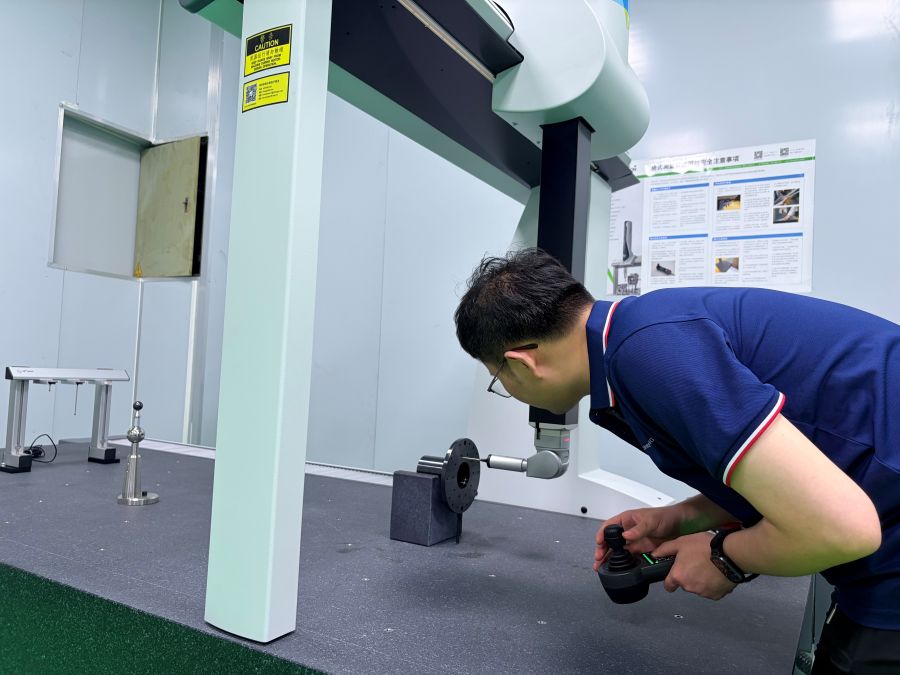
However, this verification revealed a significant difference between the dimensions observed during machining and those measured after stabilization. As residual stress redistributed, the rear section of the internal bore opened outward, causing roundness and concentricity to exceed the drawing requirements.
Instead of correcting the measured dimensions alone, the team reviewed residual stress, machining sequence, CNC program and tooling conditions. The process was adjusted and repeatedly verified until the required geometric tolerances could be maintained after stabilization.
This matters because a bore can meet its nominal diameter while still failing the geometric relationships required for bearing alignment and assembly.
Why Black Oxide Was Selected Before Final Machining
The original surface-treatment plan called for phosphating. Because this thin-walled component is sensitive to dimensional change, Weforging reviewed how the finishing process could affect geometric stability and recommended black oxide before final machining.
After surface treatment, the bearing-related features are finish-machined so that their critical dimensions and geometric relationships are controlled at the final machining stage.
In this project, the manufacturing route was therefore determined not only by individual drawing dimensions, but by how heat treatment, residual stress, machining and surface treatment interact before final assembly.
A dimensional deviation or deformation does not always originate from the operation where it is detected. The cause may be related to the material condition, heat treatment, residual stress, machining sequence, process design, measurement method or temperature during inspection.
For this reason, Weforging reviews the manufacturing route as a connected process rather than treating forging, heat treatment, machining and inspection as separate operations. This makes it possible to identify where a problem develops and adjust the relevant process before the component moves into repeat production.
How We Maintain Traceability from Material to Finished Component
For repeat production, a finished robot joint component should remain connected to the manufacturing records behind it. At Weforging, this connection is maintained through project and batch records linking the finished part to the material, forging, heat treatment, machining and inspection data generated during production.
Record | What Can Be Traced |
Material Grade & Heat Number | Steel grade and raw-material batch used for production |
Material Certificate / Test Records | Material chemistry and specified mechanical properties where required |
Forging Batch | Forged blanks produced within the same manufacturing lot |
Heat-Treatment Batch | Heat-treatment condition and associated batch records |
Machining Lot | Machining records associated with the production batch |
Inspection Records | Results for drawing-defined dimensions and critical geometric features |
Part / Batch Identification | Finished-part identification where marking is specified |
This allows traceability to work in both directions. For example, production records follow the component from raw material to finished part, while a finished batch can also be traced back through its inspection, machining, heat-treatment and material records.
Where required by the project, batch identification or laser marking can maintain this connection on the finished component.
If a question arises during assembly, repeat production or a later quality review, the relevant batch records can be checked to determine which material was used, how the batch was processed and what inspection results were recorded.
For long-term OEM programs, this provides a controlled manufacturing history that can be referenced when the same component returns for repeat production.
How We Control Quality & Process Consistency in Series Production
Producing one acceptable sample does not automatically guarantee stable series production. The challenge is to keep the approved result consistent when the same component moves into repeat production.
At Weforging, this starts with first-part verification, control of drawing-defined critical features and continued checks during production.
Material & Mechanical Property Verification
For forged robot joint components, dimensional inspection alone does not verify whether the material and heat-treatment condition meet the required mechanical properties. Where specified by the drawing or project, Weforging can verify impact toughness, tensile and yield strength, and hardness using test samples taken from the relevant material or production batch.
Weforging checks these results against the applicable material and project requirements before the component moves further through the controlled production route.
First-Part Verification
Before series production, the operator checks the first completed part against the drawing and inspection requirements. Quality personnel then independently verify critical dimensions and geometric features using CMM or other appropriate measuring equipment where required.
If the results do not agree, production does not simply continue with a machine offset. Instead, the team reviews the measurement method, datum setup, machining program, tooling and process conditions to identify the source of the difference.
Once verified, the approved first part, released drawing and confirmed process settings provide the manufacturing reference for subsequent production.
Critical Feature Control
Inspection is based on the drawing and the function of the component. Therefore, the same level of attention is not applied blindly to every dimension; control focuses on the features that affect fit, alignment and assembly.
Critical Feature | Why It Matters |
bearing seats | Bearing fit and alignment |
Coaxiality & Runout | Relationship between rotating features |
Shaft Interfaces | Fit and alignment with mating components |
Mounting Faces | Assembly position and stability |
Bolt-Hole Positions | Alignment during assembly |
Mating Surfaces | Fit between connected components |
This is particularly important for robot joint components. A part may meet several individual size tolerances and still create an assembly problem if the geometric relationship between critical features is incorrect.
Keeping the Process Stable in Repeat Production
After the first part is approved, inspection continues at defined points during production rather than relying only on final inspection.
We select inspection points according to the component and drawing requirements, with particular attention to changes caused by tool wear, setup variation or process drift. If a critical feature begins to move away from the approved condition, the process can be reviewed before the deviation develops into a batch-level problem.
The objective is not to inspect quality into the finished part, but to keep the manufacturing process stable enough to reproduce the approved result across subsequent batches.
Reducing Supplier Handoffs, Lead-Time Risk & Procurement Complexity
For an OEM buyer, the cost of a component is not limited to its unit price. When forging, heat treatment and machining are sourced separately, each supplier adds another production schedule, purchase order, logistics step and technical interface to manage.
In addition, drawing changes and quality issues can make this more complicated. A machining problem may originate from forging allowance or heat-treatment distortion.
With an integrated manufacturing route, feedback can move directly between forging, heat treatment, machining and inspection, giving procurement and engineering teams one main manufacturing interface for the component.
This does not mean every integrated project will automatically have a shorter lead time. Tooling, material availability, part complexity and order quantity still affect the production schedule.
The practical advantage is fewer supplier handoffs, clearer responsibility and better visibility of production status. When a drawing changes or a manufacturing issue occurs, fewer interfaces make coordination easier and reduce uncertainty around the delivery schedule.
From OEM Drawing to Repeat Production
A custom robot joint component starts with a review of the drawing and project requirements. Before quotation and process planning, Weforging reviews the information that can affect how the part will be manufactured, inspected and supplied.
RFQ & Drawing Review
For an initial manufacturing review, we typically review the available 2D drawing, 3D CAD model, material specification, heat-treatment requirements, critical tolerances, surface treatment, inspection requirements and expected production quantity.
This information is used to assess manufacturing feasibility, identify critical requirements and determine an appropriate production route before tooling or production begins.
From Sample Approval to Production Release
Once the manufacturing route has been agreed, a sample or first article can be produced for dimensional, material and other specified verification.
After approval, the confirmed drawing, manufacturing requirements and inspection criteria become the basis for production. Detailed first-part and process controls are then applied during series production.
Managing Repeat Orders & Drawing Revisions
A repeat order is not released simply because the component has been manufactured before. The current drawing revision and applicable manufacturing requirements need to be confirmed against the approved production basis.
If the drawing or another critical requirement has changed, Weforging reviews the affected manufacturing and inspection steps before releasing the new batch.
This keeps repeat orders aligned with the latest approved technical requirements, rather than relying only on records from the previous batch.
Why OEM Buyers Work with Weforging for Robot Joint Components
For custom robot joint components, the value of an integrated supplier is not simply having forging and CNC machining available in one place. What matters is how these processes are connected around the requirements of the finished component.
Weforging supports OEM projects in three practical areas:
Engineering the Manufacturing Route
Forging, heat treatment, machining, surface treatment and inspection are planned around the material, geometry and critical requirements of the component. This integrated approach makes it easier to trace a dimensional or process issue across different manufacturing stages. The rotor core case above shows how this can help identify and address dimensional stability issues before repeat production.
Maintaining Control into Repeat Production
Approved requirements are carried into subsequent batches through material and batch identification, process records, first-part verification and inspection of drawing-defined critical features.
Reducing Manufacturing Interfaces
At the same time, managing the main production stages through one manufacturing interface reduces handoffs between separate suppliers. It also gives procurement and engineering teams a clearer route for technical feedback and production coordination.
For a new project, send us your 2D drawing or 3D model, material specification, critical requirements and expected quantity. Weforging can review the component and proposed manufacturing route before quotation.