
Robot Parts: Types, Materials & OEM Manufacturing
By Weforging Technical Team | Updated October , 2026
Robot parts include structural components, joints, shafts, transmission parts, actuators, sensors and end-of-arm tooling. Among these, shafts, hubs, flanges and other mechanical components often require precision metal manufacturing to meet their loading and assembly requirements.
For industrial OEM projects, choosing between CNC machining and forging followed by CNC machining depends on the part’s geometry, material properties, critical tolerances and production volume. The right process must support both component performance and repeatable manufacturing.
This guide explains the main types and materials of industrial robot parts, how manufacturing processes are selected, and what OEM buyers should consider when sourcing custom metal components.
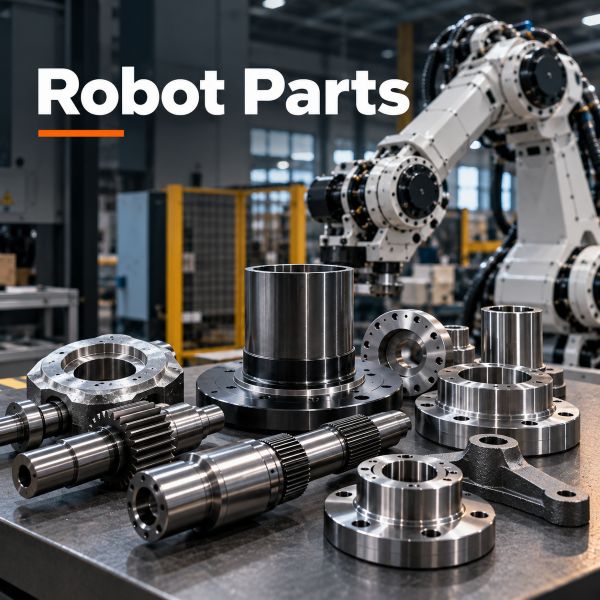
Key Takeaways: Industrial Robot Parts
- Robot parts have different mechanical requirements. Shafts, hubs, flanges and rotor components must meet application-specific requirements for strength, stiffness, dimensional accuracy and, where necessary, wear resistance.
- Material selection depends on operating conditions. Carbon steel, alloy steel, stainless steel and aluminum alloys are selected according to loads, environmental exposure, weight and component function.
- Manufacturing processes should match the component. CNC machining produces precise dimensions and assembly features. For suitable steel parts, forging followed by CNC machining combines a shaped blank with accurate finished geometry.
- Repeat production requires consistent process control. Material verification, controlled manufacturing, inspection and traceability help maintain consistency between approved samples and subsequent OEM production batches.
What Are the Main Parts of an Industrial Robot?
Industrial robots contain structural, joint, transmission, actuation, tooling and control components. These parts can be grouped by their functions within the robot system.
Component Group | Typical Robot Parts | Main Function |
Structural components | Bases, arm links, frames, brackets | Support loads and provide rigidity |
Joint components | Hubs, flanges, joint housings, rotor components | Support joint assemblies and maintain positioning |
Transmission components | Shafts, gear shafts, gears, couplings | Transmit torque and motion |
End-of-arm tooling | Grippers, adapters, tool mounts | Handle workpieces and tools |
Actuation components | Servo motors, actuators, drive assemblies | Provide the driving force for motion |
Sensing and control | Encoders, sensors, controllers | Monitor conditions and control robot motion |
Not all robot parts require the same manufacturing methods. Electrical and control components involve specialized production, while mechanical parts such as shafts, hubs, flanges and transmission components often require precision metal manufacturing.
For OEM engineers and buyers, these mechanical components must be evaluated according to loading conditions, assembly interfaces and dimensional accuracy requirements.
Which Robot Parts Require Precision Metal Manufacturing?
Robot parts that transmit torque, support rotating assemblies or connect moving structures often require precision metal manufacturing. Typical examples include shafts, gear shafts, hubs, flanges and rotor components. Their manufacturing requirements depend on loads, assembly interfaces and specified tolerances.
A shaft may require accurate bearing seats and controlled runout. For a flange, the relationship between the mounting face, locating diameter and bolt-hole positions is important. A hub may need precise bore geometry and alignment with its mating shaft.
For OEM buyers, meeting individual dimensional tolerances is not always sufficient. Geometric tolerances, datum references and the relationships between mating features must also be verified against the drawing to ensure proper assembly.
Weforging manufactures custom robot joint components to OEM drawings, with forging and CNC machining processes selected according to the part’s geometry, material and performance requirements.
Materials Used for Industrial Robot Parts
Industrial robot parts commonly use carbon steel, alloy steel, stainless steel and aluminum alloys. Material selection depends on component loads, weight, operating conditions and required mechanical properties. For example, a lightweight robot arm structure and a heavily loaded transmission shaft have different material requirements.
Material | Typical Robot Applications | Selection Considerations |
Carbon steel | Brackets, bases, selected shafts | Strength, cost, machinability |
Alloy steel | Shafts, gear shafts, loaded transmission parts | Strength, fatigue resistance, heat-treatment response |
Stainless steel | Components exposed to moisture or corrosive environments | Corrosion resistance, strength, material grade |
Aluminum alloys | Arm links, housings, lightweight brackets | Low weight, stiffness requirements, machinability |
For steel components, grades such as AISI/SAE 1045 and 4140 may be considered depending on the required strength, toughness and heat-treatment condition. However, material grade alone does not establish finished-part performance.
For OEM procurement, drawings and specifications should define the applicable material standard, required material condition and any necessary mechanical testing. These requirements help suppliers select a suitable manufacturing route and verify that production parts meet the approved specifications.
How Are Robot Parts Manufactured?
Custom metal robot parts can be manufactured by CNC machining, forging or a combination of both. The appropriate route depends on the OEM drawing, part geometry, material requirements, critical tolerances and production volume.
CNC machining produces precise dimensions and assembly features. Forging creates shaped blanks for suitable steel components. When required, heat treatment and CNC machining can be integrated into the production route to achieve the specified material condition and finished-part accuracy.
CNC Machining for Precision Robot Parts
CNC turning and CNC milling are used to manufacture precision robot parts with drawing-defined features such as bearing seats, bores, mounting faces and bolt-hole patterns.
For prototypes, small batches or suitable component designs, CNC machining can serve as the primary manufacturing process without a dedicated forging stage.
For OEM production, machining plans should consider datum selection, setup sequence and the relationships between critical features. Bearing seats, locating diameters and mounting surfaces must meet the drawing’s dimensional and geometric tolerances to support accurate assembly and repeatable production.
Forging for Load-Bearing Robot Components
Forging may be suitable for load-bearing steel robot components such as shafts, hubs, flanges and selected transmission parts. The decision depends on component geometry, mechanical requirements and expected production volume.
For suitable designs, custom forging produces shaped blanks that may reduce material removal during subsequent machining. In repeat OEM production, closed die forging can provide consistent blank geometry using dedicated tooling.
However, forging requires an evaluation of tooling investment, production quantity and machining allowances. The finished component’s mechanical properties also depend on material selection, forging conditions and heat treatment—not the forging process alone.
Integrating Forging, Heat Treatment and CNC Machining
For suitable steel robot parts, integrating forging, heat treatment and CNC machining allows material requirements, manufacturing stages and final dimensions to be managed within one coordinated production route.
Forging produces the initial blank, heat treatment establishes the specified material condition, and CNC machining creates the required dimensions and assembly features. The sequence is planned around the OEM drawing, machining allowances and potential dimensional changes during heat treatment. The resulting machined forgings must meet the finished-part specifications.
For repeat OEM production, this integrated approach reduces the need to coordinate separate suppliers and helps maintain consistent process control. Where required, material heat numbers, production batches, heat-treatment records and inspection results can be linked to support traceability and investigation of production deviations.
How to Choose Between Forging and CNC Machining for Robot Parts
The choice between CNC machining and forging followed by CNC machining depends on part geometry, material requirements, critical tolerances and production volume.
For prototypes and small batches, CNC machining is often the more practical option because it avoids dedicated forging tooling. However, for suitable steel components produced in repeat batches, forging followed by CNC machining may improve material utilization and reduce unnecessary machining.
The following table outlines manufacturing routes that OEM buyers can evaluate for different robot components.
Robot Part | Manufacturing Route to Evaluate | Key Considerations |
Precision shafts | CNC machining or forging + CNC machining | Loads, bearing seats, runout, volume |
Gear shafts | CNC machining or forging + CNC machining | Material properties, shaft geometry, production quantity |
Hubs | CNC machining or forging + CNC machining | Bore accuracy, blank geometry, volume |
Mounting flanges | CNC machining or forging + CNC machining | Mounting faces, hole positions, volume |
Rotor components | CNC machining or forging + CNC machining; heat treatment as specified | Geometry, dimensional stability, assembly interfaces |
Custom steel brackets | CNC machining or forging + CNC machining, where suitable | Loading, geometry, tooling cost |
For OEM buyers, the lowest initial manufacturing cost is not always the lowest repeat-production cost. The process should be evaluated against tooling investment, material use, machining requirements and expected order quantities.
These are starting points rather than fixed rules. Final process selection should follow a review of the OEM drawing, material specification and production requirements.
What Quality Requirements Matter for Robot Parts?
Quality requirements for precision metal robot parts typically include dimensional accuracy, geometric tolerances, material verification and controlled inspection. The specific acceptance criteria depend on the OEM drawing, component function and operating conditions.
For shafts, hubs, flanges and rotor components, inspection may cover bearing fits, runout, mounting-face flatness and hole positions. Steel parts may also require hardness or mechanical testing to verify specified material properties.
For repeat OEM production, quality control should extend beyond final inspection. At Weforging, first-part verification includes checks by the machine operator followed by independent inspection before proceeding with batch production. Weforging then performs in-process inspections and final checks according to the component’s requirements.
Where traceability is specified, material heat numbers, production batches, heat-treatment records and inspection results can be linked to the relevant parts or batches. This helps investigate deviations and maintain consistency between approved samples and subsequent production orders.
Manufacturing Example: A Custom Robot Rotor Component
Weforging manufactured a custom steel robot rotor component using forging, heat treatment and CNC machining. The part features a cylindrical thin-wall section, a mounting flange and precision assembly interfaces. Controlling dimensional changes during machining was a key manufacturing challenge.
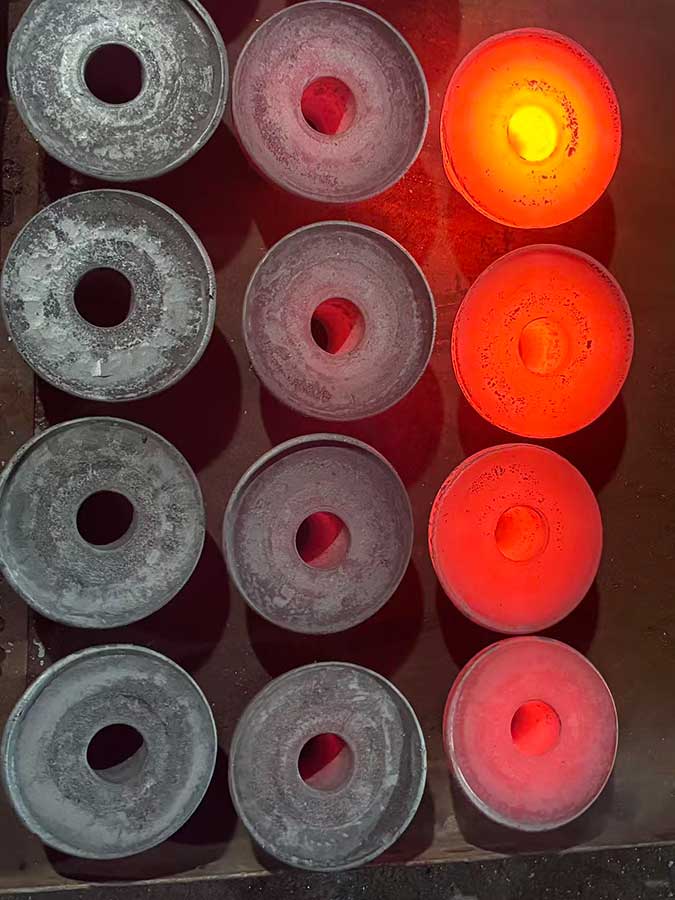
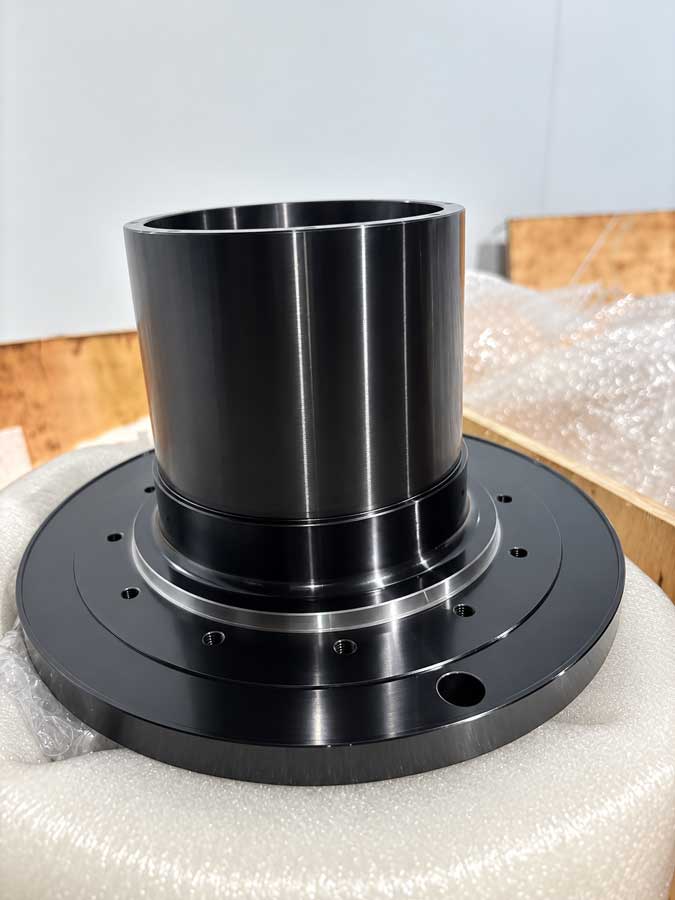
Image caption: Steel forged blanks (left) and a finished CNC-machined robot rotor component (right), manufactured by Weforging.
The thin-wall geometry required careful planning of machining operations and inspection conditions. During process development, dimensional deviations were identified, leading to adjustments in machining operations, tooling and CNC programs.
After semi-finish machining, the component was allowed to rest for approximately 24 hours before critical dimensions were verified using a CMM under controlled temperature conditions. These steps supported the development of a more repeatable manufacturing process.
For OEM buyers, this case illustrates why thin-wall robot components require more than a final dimensional check. Manufacturing sequence, dimensional stability and inspection conditions must be considered together to maintain consistency in repeat production.
For further process details, see Weforging’s Robot Joint Components manufacturing case.
What Should OEM Buyers Specify for Custom Robot Parts?
When requesting a quotation for custom robot parts, OEM buyers should provide the engineering drawing, material specification, critical tolerances, required quantity and inspection requirements. These details help the manufacturer assess production feasibility, select a suitable manufacturing route and prepare an accurate quotation.
RFQ Information | Why It Matters |
2D drawing; 3D model where available | Define geometry, dimensions and design requirements |
Material grade and specification | Confirm the material standard and required condition |
Critical dimensions and geometric tolerances | Identify assembly interfaces and functional requirements |
Heat treatment and surface finish | Define required material condition and surface properties |
Inspection and documentation requirements | Establish acceptance criteria and required inspection records |
Prototype, batch and annual volumes | Support process selection, tooling and cost evaluation |
Drawing revision and delivery requirements | Confirm the design version and project schedule |
If the manufacturing route is not yet defined, buyers can request a technical review of CNC machining versus forging followed by CNC machining. The selection should consider part geometry, material requirements, production quantity and tooling investment.
For repeat OEM orders, sample approval, revision control and any required traceability or inspection documentation should be agreed upon before production. This helps suppliers prepare more reliable quotations. It also reduces the risk of differences between approved samples and subsequent production batches.
Conclusion: Sourcing Custom Robot Parts
Selecting the right manufacturing process for custom robot parts requires evaluating component loads, material properties, critical tolerances and production volume. CNC machining is practical for many precision components, while forging followed by CNC machining may be suitable for selected steel parts and repeat OEM production.
For OEM buyers, process selection is only part of the decision. A reliable manufacturing plan must also address inspection requirements, material traceability and consistency between approved samples and subsequent production batches.
Weforging manufactures custom metal components to OEM drawings, combining forging, heat treatment, CNC machining and inspection according to project requirements. If you are sourcing custom robot parts, send us your drawings, material specifications and expected quantities for a manufacturing feasibility review and quotation.