
Machined Forgings: Why OEMs Combine Forging and CNC Machining
Machined forgings are forged components that undergo CNC machining to achieve the final dimensions, tolerances, features, and surface requirements defined on an OEM drawing. They may be supplied as rough-machined blanks or as fully machined, inspected parts ready for assembly.
For OEM projects, the value of combining forging and machining goes beyond using fewer suppliers. Machining allowance, datum strategy, heat-treatment sequence, and forged geometry can all affect machining stability, scrap risk, and final dimensional accuracy.
This guide explains where machined forging projects commonly go wrong, when integrated manufacturing makes sense, and what buyers should evaluate before sourcing a finished forged component.
What Are Machined Forgings?
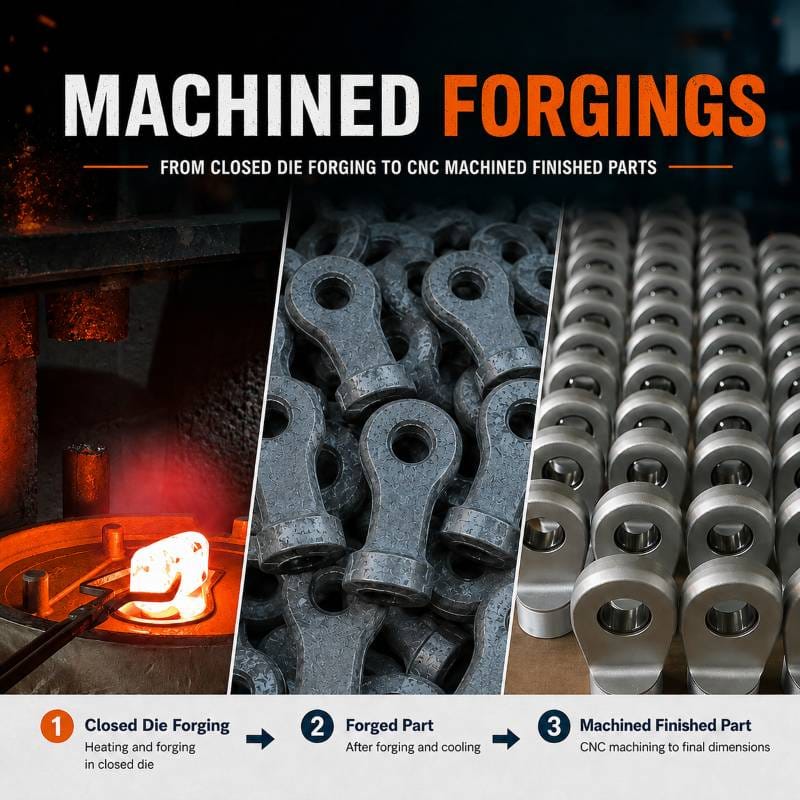
A machined forging first obtains its basic geometry and mechanical properties through custom forging, then undergoes machining to achieve the dimensions and functional features required on the finished drawing.
A typical route is:
Raw Material → Forging → Heat Treatment → Rough Machining → Finish Machining → Inspection → Finished Component
The sequence may change according to material, geometry, distortion risk, and tolerance requirements.
A forged blank still needs substantial downstream work. A fully machined forging, by contrast, may already include finished bores, threads, bearing seats, sealing surfaces, holes, or other critical features.
For shafts, hubs, flanges, rings, gear blanks, and other load-bearing OEM components, this approach combines forged material performance with the dimensional control provided by CNC machining.
Forged Blank vs. Rough-Machined vs. Fully Machined: Which Should You Buy?
The right supply condition depends on how the OEM plans to manage machining, inspection, logistics, and manufacturing responsibility.
Supply Condition | Supplier Delivers | Buyer Still Manages | Often Suitable When |
As-forged blank | Forged geometry | Machining and dimensional inspection | OEM has established machining capacity |
Rough-machined forging | Forging with selected stock removal or datums | Finish machining and final inspection | Critical finishing remains with the buyer |
Fully machined forging | Component machined to agreed drawing requirements | Incoming verification or assembly | OEM wants fewer process handoffs |
Buying an as-forged blank can make sense when the OEM already has a qualified machine shop or wants to retain control of critical finishing operations.
A fully machined forging is more attractive when machining depends closely on forged geometry. In that case, machining stock, locating surfaces, heat-treatment behavior, and final dimensions can be planned under one manufacturing route.
The lowest forging price is therefore not always the lowest finished-part cost.
Why Do Machined Forging Projects Fail or Cost More Than Expected?
Many machining problems originate before the part reaches a CNC machine. Four issues deserve particular attention during RFQ and process planning.
- Too Little Machining Allowance
If critical surfaces lack sufficient stock, CNC machining may not recover the required geometry or tolerance. The required machining allowance for forgings should be defined from the finished drawing before the forging tooling is finalized.. Excessive stock should also be avoided because it increases machining time, tool wear, and material removal.
- Poor Datum Planning
Forged blanks contain draft, parting lines, scale, and dimensional variation. If machining datums are selected without considering the forged condition, concentricity, runout, position, or feature alignment may become unstable. Locating and clamping strategy should therefore be reviewed while the forging route is still being developed.
- Heat-Treatment Distortion
Heat treatment can change part geometry, particularly on components with uneven sections or tighter final tolerances. If finish machining is completed too early, later heat treatment may move critical dimensions outside specification. The process route should therefore coordinate rough machining, heat treatment, stress relief where required, and final machining.
- Gaps Between Forging and Machining Suppliers
When forging and machining are handled separately, a dimensional issue can become a responsibility issue. The forge may confirm that the blank meets forging tolerance while the machine shop reports insufficient stock or unstable locating surfaces. Integrated manufacturing creates a clearer responsibility path from forged geometry to finished dimensions.
Which Should Come First: Heat Treatment or CNC Machining?
There is no universal sequence. The correct order depends on material, geometry, required mechanical properties, distortion risk, machining difficulty, and final tolerance.
Some machined forged parts are rough-machined before heat treatment to remove excess stock and establish reference surfaces. Final machining can then correct dimensional changes created during heat treatment.
Other parts may be heat-treated before most machining begins when the material condition or production route makes this more suitable.
One common route is:
Forging → Rough Machining → Heat Treatment → Finish Machining → Final Inspection
The important question for an OEM buyer is not simply which process comes first, but whether the supplier has planned heat treatment and machining around the finished drawing.
Why Should OEMs Choose an Integrated Forging and Machining Supplier?
For OEM procurement teams, an integrated forging and machining supplier provides more than purchasing convenience. It creates a more continuous manufacturing chain from raw material to finished component, making traceability, batch consistency, delivery control, and quality responsibility easier to manage.
When forging, heat treatment, machining, and inspection are split among multiple suppliers, the buyer often becomes the process coordinator. Records may be separated, engineering changes must be communicated repeatedly, and a delay or quality issue at one stage can disrupt the entire delivery schedule.
OEM Procurement Pain Point | Value of Integrated Manufacturing |
Material and part traceability | Material heat, forging batch, process, and inspection records can remain connected to the finished part |
Batch quality consistency | Forging, heat treatment, machining, and inspection follow a controlled manufacturing route |
High communication cost | One supplier coordinates drawings, process changes, schedules, and quality issues |
Uncertain lead time | Manufacturing stages can be coordinated under one production plan |
Unclear quality responsibility | Responsibility extends from the forged blank to the finished machined component |
This becomes especially important in repeat production. OEM buyers need more than one batch that passes inspection; they need the material requirements, manufacturing route, machining strategy, inspection method, and documentation to remain controlled from batch to batch.
If a finished part develops a dimensional or mechanical-property issue, connected traceability can help identify the relevant material heat, forging batch, heat-treatment record, machining process, and inspection result without coordinating investigations across several suppliers.
For OEMs purchasing fully machined forgings in repeat quantities, an integrated supplier is therefore generally the lower-risk sourcing choice. The purchasing decision should consider not only unit price, but also traceability, batch consistency, communication cost, delivery reliability, and responsibility for the finished component.
Forged Blank or Fully Machined Part: Which Costs Less Overall?
A forged blank normally has a lower purchase price than a fully machined component, but OEM buyers ultimately pay for a usable finished part rather than an intermediate forging.
A more useful comparison is:
Total Finished-Part Cost = Forging + Logistics + Machining + Inspection + Scrap/Rework Risk + Supplier Coordination
A low-cost blank can become expensive if it must move between suppliers, undergo repeated incoming inspection, or requires unexpected machining because of inconsistent stock.
Fully machined forgings can reduce some of these handoffs, but they are not automatically the lowest-cost choice. OEMs with established in-house machining may still benefit from buying blanks.
The sourcing decision should therefore compare total finished-part cost, quality risk, and manufacturing responsibility, not forging price alone.
How Should OEM Buyers Evaluate a Machined Forgings Supplier?
A supplier assessment should go beyond asking whether a company owns forging presses and CNC machines. The important question is whether those capabilities are connected by a controlled manufacturing plan.
Buyer Question | What to Verify |
Who defines machining allowance? | Finished geometry, forging variation, and machining route are reviewed together |
How are machining datums planned? | A repeatable locating strategy exists for forged blanks |
How are forging and machining reviewed together? | Manufacturing conflicts are identified before tooling or production |
How is heat-treatment distortion managed? | Process sequence reflects final tolerance requirements |
How are critical dimensions verified? | Suitable dimensional inspection and CMM capability are available where required |
Is traceability maintained? | Material and process records can follow the finished component |
Who owns corrective action? | Responsibility for final component quality is clearly defined |
A capable machined forgings supplier should be able to explain these controls in terms of the buyer’s drawing, not simply provide an equipment list.
How Weforging Manages Machined Forgings From Drawing to Final Inspection
At Weforging, forging and machining are planned around the finished OEM component rather than treated as unrelated operations.
A typical project follows:
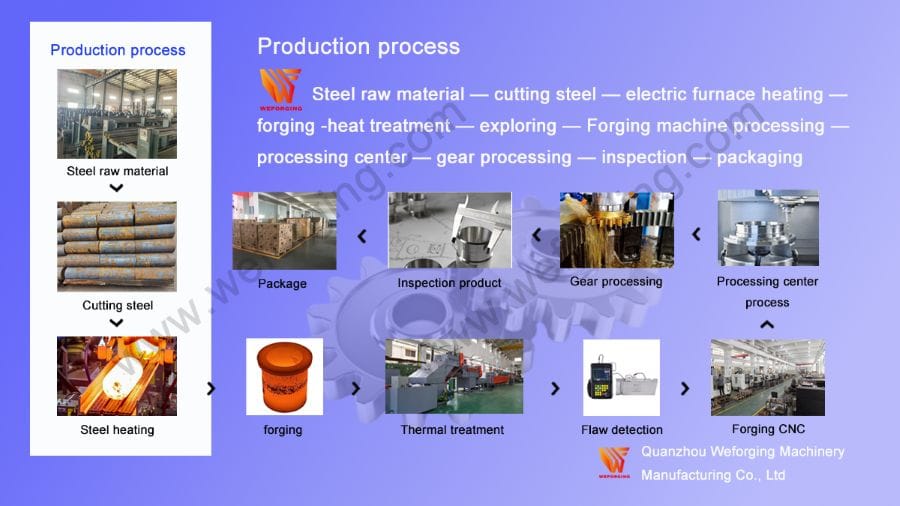
Drawing Review → Forging Planning → Forging → Heat Treatment → CNC Machining → Inspection → Documentation
Reviewing the finished drawing before the forging route is finalized allows machining allowance, locating surfaces, heat-treatment requirements, and critical dimensions to be considered earlier in the process.
Depending on the project, Weforging can supply forged blanks, rough-machined parts, or fully machined forgings. Inspection can include material verification, dimensional inspection, CMM, mechanical testing, and UT or MT where specified.
For repeat OEM production, material and manufacturing records can support traceability from incoming material through the finished component.
The purpose of integrating forging and machining is not simply to perform more operations under one roof. It is to control how those operations affect the final part.
What Should You Send for a Machined Forging RFQ?
A complete RFQ helps the supplier evaluate forging feasibility, machining strategy, inspection requirements, and cost before tooling begins.
RFQ Information | Why It Matters |
2D drawing | Defines tolerances, GD&T, and inspection requirements |
3D model | Supports geometry and manufacturability review |
Material specification | Determines forging and heat-treatment requirements |
Mechanical properties | Helps define process and testing requirements |
Heat treatment | Affects properties, distortion, and machining sequence |
Surface finish | Influences final machining operations |
NDT requirements | Defines the quality-control route |
Annual/batch quantity | Influences tooling and production planning |
Required documentation | Clarifies MTC, FAI, inspection reports, or other records |
Not every project has complete information at the RFQ stage. For an initial feasibility review, a drawing, material specification, estimated quantity, and clearly identified critical requirements are usually enough to begin a technical discussion.
Providing these details early helps identify potential issues with forging geometry, machining allowance, tolerance, or inspection before they become production problems.
What Should OEM Buyers Consider When Sourcing Machined Forgings?
For OEM buyers, sourcing machined forgings should not be based on forging price alone. The more important question is whether the supplier can consistently deliver a finished component that meets the drawing, quality, documentation, and delivery requirements across repeat production.
When forging and machining are closely connected, buyers should evaluate material traceability, batch consistency, machining responsibility, inspection capability, lead-time control, and corrective-action ownership as part of the sourcing decision.
For repeat fully machined forgings, an integrated forging and machining supplier can reduce process handoffs and provide clearer responsibility from raw material through final inspection—helping procurement teams manage both manufacturing risk and total finished-part cost.