
Closed Die Forging: Process, Parts & OEM Applications
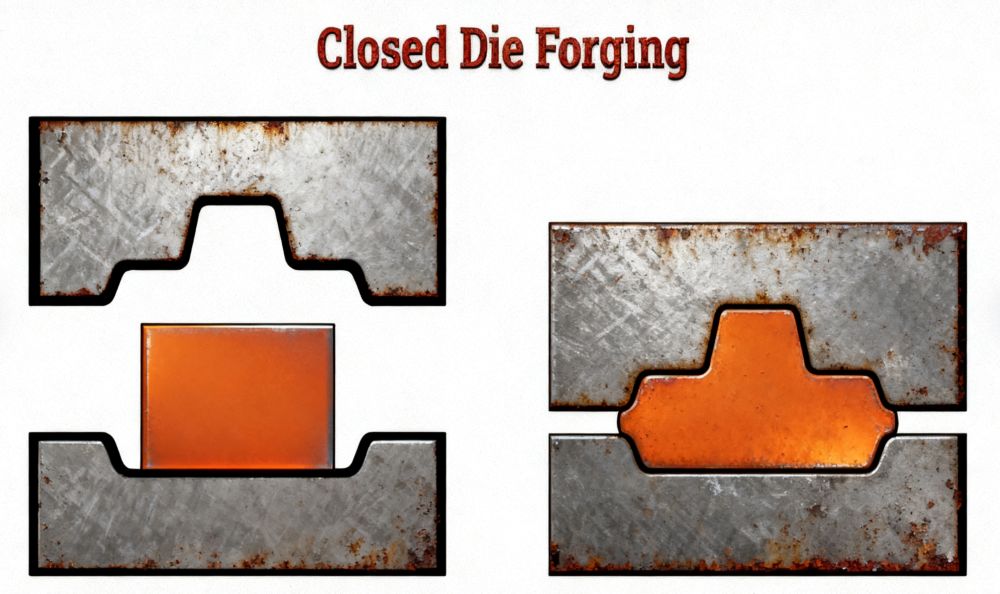
Closed die forging, also known as impression die forging, shapes heated metal between dies containing a defined cavity. Under compressive force, the material flows into the die impression to form a repeatable component geometry.
For OEM parts, the process is commonly considered when grain flow, production consistency and efficient material use are important. Depending on the drawing, the forged blank may then undergo heat treatment, CNC machining and inspection.
However, process selection should also consider the part geometry, material, mechanical requirements, production volume and tooling cost.
What Is Closed Die Forging?
In closed die forging, a heated billet is placed between matched dies containing the required part impression. As the dies close, the metal flows within the cavity and forms the basic geometry of the forged component. Excess material may flow into a flash region around the parting line and is trimmed after forging.
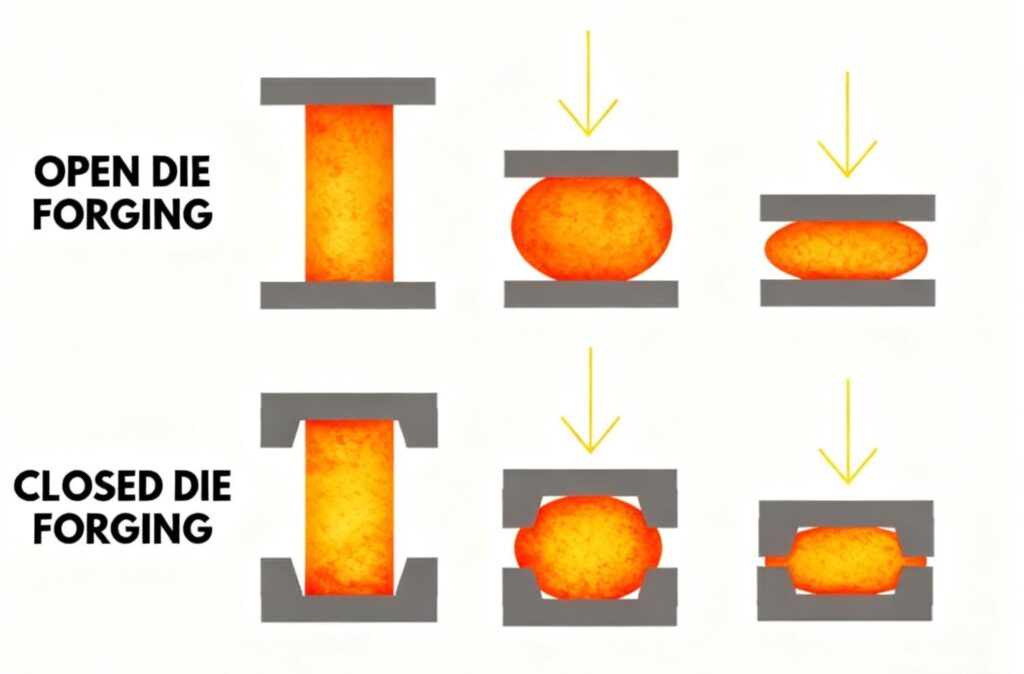
Unlike open die forging, which uses flat or simpler dies, closed die forging uses dedicated die impressions to produce more repeatable and complex shapes.
However, the forged shape is not always the finished part. Bores, threads, bearing seats and other critical features may still require CNC machining to achieve the dimensions and tolerances specified on the OEM drawing.
Closed Die Forging Process (Step-by-Step)
A closed die forging process starts before the billet reaches the forging press. For OEM components, the manufacturing route should connect the drawing, material, die design, forging, heat treatment, machining and inspection requirements from the beginning.
The exact sequence varies by part geometry, material and final delivery condition, but a typical production route includes the following steps.
Drawing and Process Review
Before production, the drawing is reviewed to identify the material grade, critical dimensions, machining requirements, heat treatment, mechanical properties and inspection criteria.
The engineering review also considers parting line, forging allowance, machining stock, draft and die-filling requirements. These factors determine how the forged blank should be designed before tooling is produced.
Raw Material Preparation
The specified material is verified before cutting into billets. Depending on the project, this may include material certificates, grade identification and heat-number traceability.
Billet dimensions and weight are then selected according to the forged geometry and the amount of material required to fill the die cavity.
Billet Heating
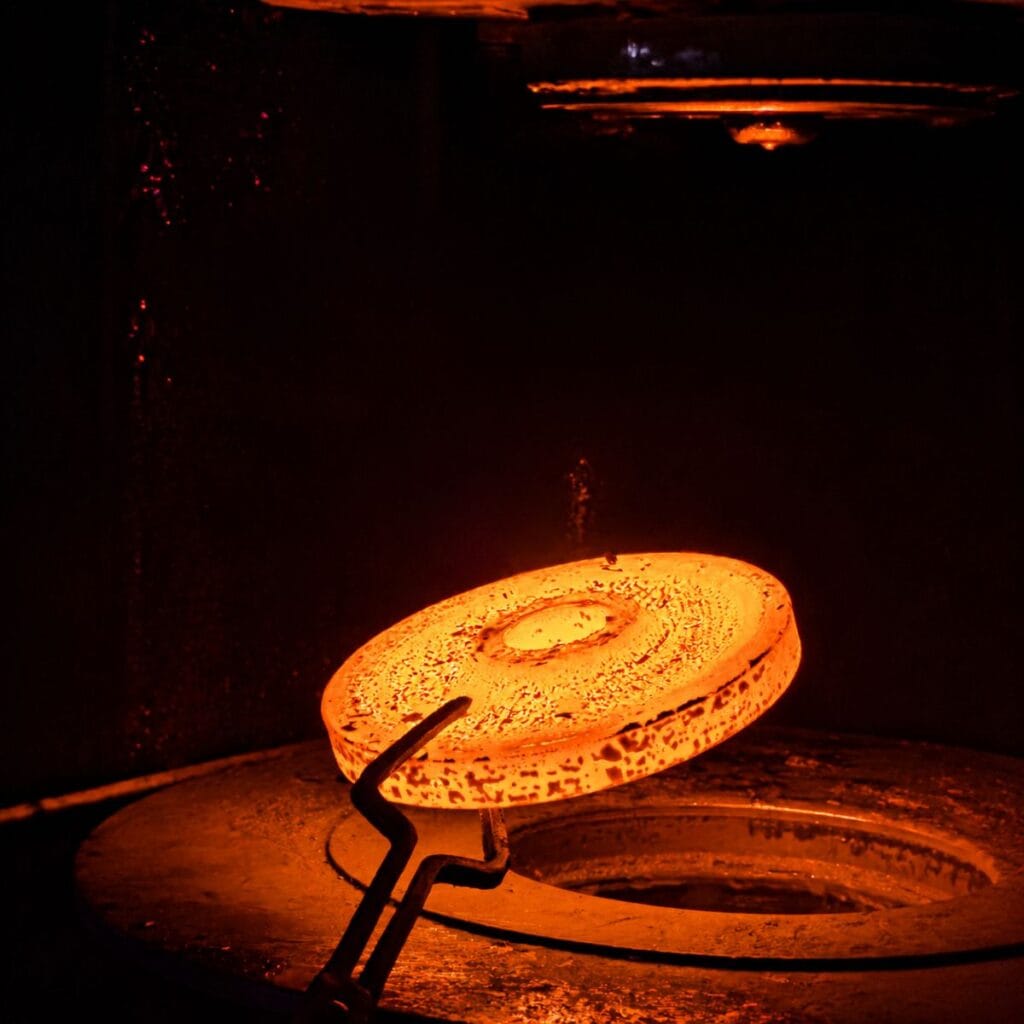
The billet is heated to a suitable forging temperature for the selected material.
Temperature control is important because insufficient heating can reduce formability, while excessive heating may affect surface condition and material properties. The target temperature therefore depends on the steel grade and forging route.
Preforming and Closed Die Forging
For parts with more complex geometry, the billet may first be preformed so that material is distributed closer to the final shape.
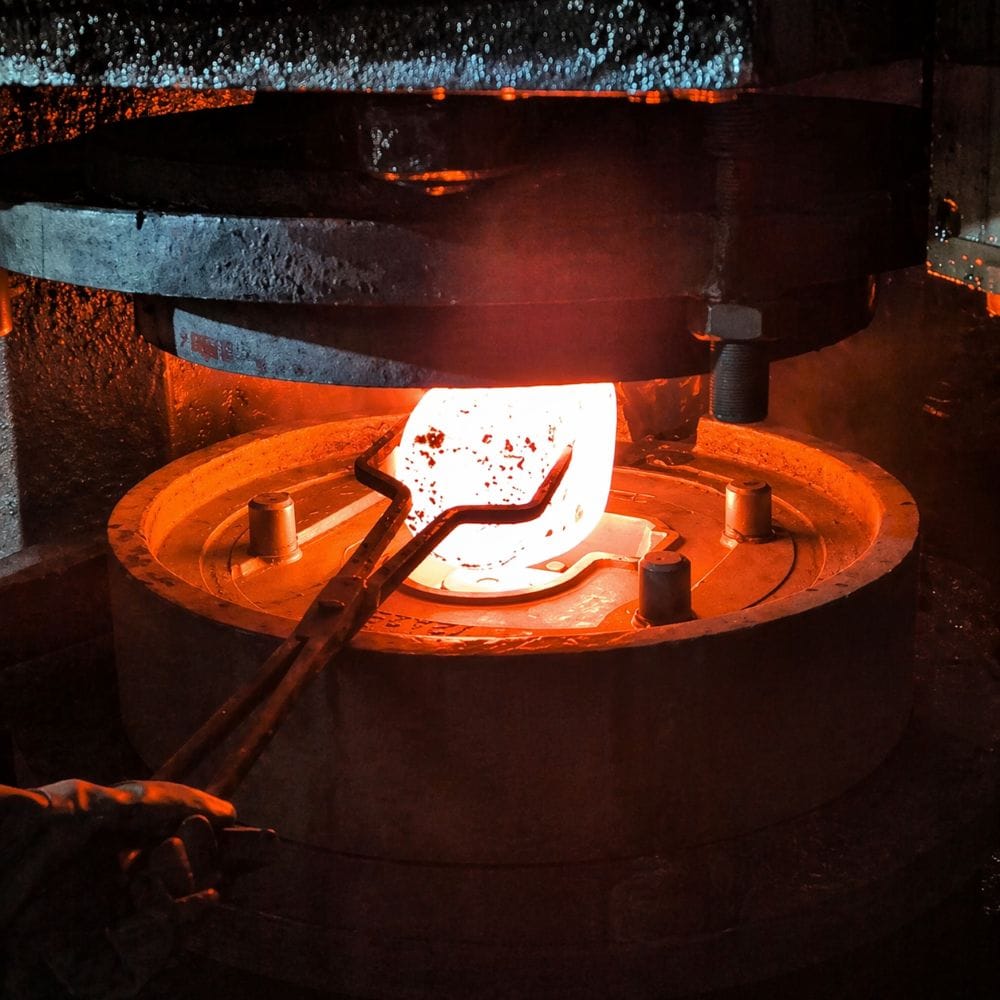
The preform is then placed into matched dies. Under hammer or press force, the metal flows into the die impression and forms the required forged geometry.
Proper preforming and die design help control material flow, die filling and the amount of excess flash.
Flash Trimming and Forging Cleanup
After forging, excess flash is removed from the parting line.
Depending on the component, additional operations may include straightening, surface cleaning or shot blasting before heat treatment or machining.
At this stage, the forged part is still a near-net-shape blank rather than a finished precision component.
Heat Treatment
Heat treatment is selected according to the material grade and required mechanical properties.
Depending on the project, the route may include normalizing, quenching and tempering, or other specified treatments. The objective is to achieve the required combination of strength, hardness, toughness and dimensional stability before final machining.
CNC Machining
Many closed die forgings require machining after forging and heat treatment.
Features such as bores, threads, bearing seats, sealing surfaces, mounting faces and other critical dimensions are machined to the tolerances defined on the OEM drawing.
Planning machining allowance during the forging stage helps reduce unnecessary material removal and creates a more controlled transition from forged blank to finished part.
Inspection and Traceability
Inspection requirements depend on the drawing and application.
Verification may include dimensional inspection, CMM measurement, hardness testing, tensile or impact testing, MT or UT, where specified.
For repeat OEM production, traceability can connect the material heat number, production batch, heat-treatment records and inspection results to the finished component.
This manufacturing route allows closed die forging to be treated not as an isolated forming step, but as part of a controlled process from raw material to finished OEM component.
Advantages of Closed Die Forging
Closed die forging offers several advantages for manufacturing high-strength forged components used in demanding industrial applications.
- High Strength – Improved grain flow enhances strength and fatigue resistance.
- Tight Tolerances – Near-net-shape parts reduce machining and improve consistency.
- Material Flexibility – Suitable for carbon steel, alloy steel, stainless steel, and aluminum.
- Cost Efficiency – Less material waste and fewer machining operations help reduce production costs.
- Reliable Performance – Consistent quality and long service life for OEM components.
Why choose closed die forging? It delivers custom forged components with high strength, precision, and repeatable quality for automotive, construction, mining, energy, and industrial machinery applications.
Applications of Closed Die Forging
Closed die forging is widely used to manufacture high-strength forged components for industries that require reliable mechanical performance, tight tolerances, and long service life.
- Automotive – Gear blanks, crankshafts, connecting rods, axle shafts
- Construction Equipment – Hydraulic cylinder parts, pins, bushings, bearing housings
- Mining Equipment – Crusher components, drive shafts, couplings, wear-resistant parts
- Industrial Machinery – Forged shafts, gears, flanges, transmission components
- Energy & Power Generation – Turbine shafts, flanges, valve and pump components
- Agricultural Machinery – PTO shafts, gear components, axle parts, hitch components
- Rail Transportation – Axle components, couplings, structural forged parts
Closed die forging delivers custom forged components with high strength, excellent fatigue resistance, and consistent quality for demanding OEM applications.
What Materials Can Be Used for Closed Die Forging?
Closed die forging can be used with a range of forgeable metals, including carbon steel, alloy steel, stainless steel and selected non-ferrous alloys. For industrial OEM components, carbon and alloy steels are commonly selected where strength, toughness or heat-treatment response is important, while stainless steels may be specified when corrosion resistance is required.
Material selection should not be based on the forging process alone. The component geometry, mechanical properties, heat treatment, service environment and applicable material standard should be considered together.
For OEM projects, the required material grade should be defined on the drawing or technical specification before the forging route and heat treatment are finalized.
When Is Closed Die Forging the Right Choice?
Closed die forging is commonly considered when a component has:
- Repeat production volumes that justify dedicated tooling
- Geometry suitable for controlled die filling
- Mechanical requirements that benefit from forged material flow
- A need to reduce machining stock compared with machining entirely from bar
- Stable drawing requirements for repeat OEM production
However, it may be less economical for very low quantities, very large simple shapes or projects with frequent design changes, because dedicated tooling requires additional cost and validation.
Closed Die Forging vs. Open Die Forging
Closed die forging uses custom cavity dies to produce complex components with higher dimensional accuracy, while open die forging uses simpler dies for large and less complex parts.
Factor | Closed Die Forging | Open Die Forging |
Die Design | Dedicated dies with shaped impressions | Flat or relatively simple dies |
Part Geometry | Suitable for repeatable, more complex forged shapes | Suitable for simpler shapes and large sections |
Part Size | Common for small to medium-sized forged components, depending on equipment capacity | Common for larger and heavier forgings |
Tooling | Dedicated tooling is normally required | Lower dedicated tooling requirements |
Production Volume | Better suited to repeat production where tooling can be justified | Often suitable for low-volume or large custom forgings |
Forging Allowance | Can produce a shape closer to the finished component | Typically requires more machining stock |
Dimensional Repeatability | Higher repeatability of the forged blank | More dependent on forging sequence and subsequent machining |
Typical Parts | Gear blanks, shafts, hubs, links and other repeat OEM parts | Large shafts, blocks, cylinders and other large forgings |
In general, closed die forging is preferred for complex, repeat-production components requiring higher accuracy and consistent mechanical performance, while open die forging is suitable for large and simple forged parts.
Closed Die Forging vs. Casting: Key Differences
Closed die forging and casting form metal in different ways. Closed die forging shapes heated metal under compressive force between matched dies, while casting pours molten metal into a mold where it solidifies into the required shape.
For OEM buyers, the choice depends on more than strength or unit price. Part geometry, material, mechanical requirements, production volume, tooling, machining and service conditions should all be considered before the manufacturing route is selected.
Factor | Closed Die Forging | Casting |
Forming Method | Heated metal is deformed between shaped dies | Molten metal solidifies inside a mold |
Material Structure | Deformation creates directional grain flow | Properties depend on alloy and solidification control |
Geometry | Suited to repeatable shapes that can be formed and released from dies | Greater freedom for complex shapes and internal cavities |
Internal Features | Limited for enclosed cavities and complex internal passages | Cores can be used to form many internal cavities and passages |
Tooling | Dedicated forging dies are normally required | Tooling depends strongly on the casting process |
Production | Well suited to repeat OEM production when tooling is justified | Suitable production volume varies by casting method |
Machining | Near-net forged blanks can reduce machining stock | Complex cast shapes can reduce machining for some components |
Typical Parts | Shafts, hubs, gear blanks, links and load-bearing components | Housings, valve bodies, pump bodies and complex structural parts |
When Is Closed Die Forging More Suitable?
Closed die forging is commonly considered when a component has stable geometry, repeat production demand and defined mechanical requirements.
The controlled deformation of the material produces directional grain flow, which can be useful for components exposed to high loads, impact or repeated stress. When the forged blank is designed close to the finished geometry, it can also reduce the amount of material removed during subsequent machining.
However, forging does not eliminate CNC machining. Bores, threads, bearing seats, sealing surfaces and other critical dimensions may still need machining to meet the OEM drawing.
For this reason, buyers should evaluate the complete route from forging and heat treatment through CNC machining and final inspection.
When Can Casting Be More Suitable?
Casting becomes more practical when geometry is difficult to produce between forging dies.
Internal cavities, passages, complex contours and integrated structural features can often be produced more directly through casting. This can make casting suitable for parts such as housings, valve bodies and pump bodies where geometry is a major design requirement.
Casting capability also varies considerably by process. Sand casting, investment casting and other methods have different tooling, dimensional and production characteristics.
The decision should therefore be based on the specific casting process and material rather than treating all cast components as having the same properties.
How Do Geometry and Machining Affect the Choice?
Geometry is often one of the first factors to review.
Closed die forging works best when material can flow into the die cavity and the forged part can be removed without problematic enclosed features or undercuts. Casting provides more freedom for internal passages, cavities and complex integrated shapes.
Neither process guarantees a finished part directly from the mold or die. Critical interfaces, threads, bearing seats and close-tolerance dimensions may require CNC machining after either process.
OEM buyers should therefore compare the finished manufacturing route, not simply a forged blank with a cast blank.
How Do Tooling and Production Volume Affect Cost?
Closed die forging normally requires dedicated dies. The tooling investment therefore needs to be evaluated against expected production quantity and the life of the program.
For stable repeat production, the tooling cost can be distributed across multiple batches. Casting also involves tooling, but the investment and production economics vary significantly between sand casting, investment casting and other processes.
A useful cost comparison should include tooling, raw material, machining, heat treatment, inspection and expected production volume rather than unit price alone.
What Should OEM Buyers Consider Before Choosing Forging or Casting?
Before selecting the manufacturing route, define:
- Material and applicable material standard
- Required mechanical properties
- Part geometry and internal features
- Annual or expected production volume
- Tooling requirements
- Machining and dimensional tolerances
- Inspection and testing requirements
- Service conditions and loading
If these requirements are already defined on the OEM drawing, the manufacturer can evaluate whether closed die forging, casting or another manufacturing route is more appropriate.
The decision is not simply forging versus casting. It is which manufacturing route best matches the finished component.
Choosing the Right Closed Die Forging Supplier
Selecting the right closed die forging supplier is essential for ensuring consistent quality, reliable delivery, and long-term project success. When evaluating a closed die forging manufacturer, consider the following capabilities:
- Quality Control – Material traceability and dimensional inspection.
- Engineering Support – Die design and manufacturing optimization for custom forged components.
- Integrated Manufacturing – Closed die forging, CNC machining, heat treatment, and finishing.
- Production Capacity – Support for prototype, low-volume, and high-volume OEM production.
- On-Time Delivery – Stable lead times and dependable supply.
An experienced supplier with integrated manufacturing capabilities can improve product consistency, shorten lead times, and simplify supply chain management.
At Weforging, we provide custom closed die forging services for OEM customers, combining forging, machining, heat treatment, and inspection to deliver precision forged components with reliable quality.
Conclusion
Closed die forging combines strength, dimensional accuracy, and repeatability, making it one of the most trusted manufacturing methods. Its advantages in mass production and safety-critical applications have ensured its position as a cornerstone of modern manufacturing.
At Weforging, we bring together forging expertise, CNC finishing, and strict quality assurance to provide high-performance solutions for industries worldwide.
Contact us today to learn more about our closed die forging services and how we can support your next project.