
On-Time Delivery in Forging: Process & Lead Time
On-time delivery in forging is a critical factor when evaluating forging suppliers. For OEM buyers and engineers, delays can disrupt production schedules, delay assembly processes, and increase inventory pressure across the supply chain.
Compared with machining, forging involves more complex and interdependent processes, including raw material sourcing, tooling design, forging, machining, heat treatment, and inspection. Each stage introduces potential risks that can affect delivery timelines.
Understanding how on-time delivery in forging is achieved — and how suppliers control forging lead time — is essential for reducing uncertainty and ensuring stable long-term supply.
What Is On-Time Delivery in Forging?
On-time delivery in forging refers to a supplier’s ability to deliver finished parts within the agreed timeline while meeting all technical and quality requirements. In forging, delivery performance depends heavily on process coordination rather than speed alone.
Forging involves multiple interdependent stages, including:
- Raw material preparation
- Tooling design and manufacturing
- Forging operations
- Machining and heat treatment
- Final inspection
Each stage depends on the previous one. A delay in any step can affect the entire timeline, making process control essential.
Typical Forging Lead Time for Custom Parts
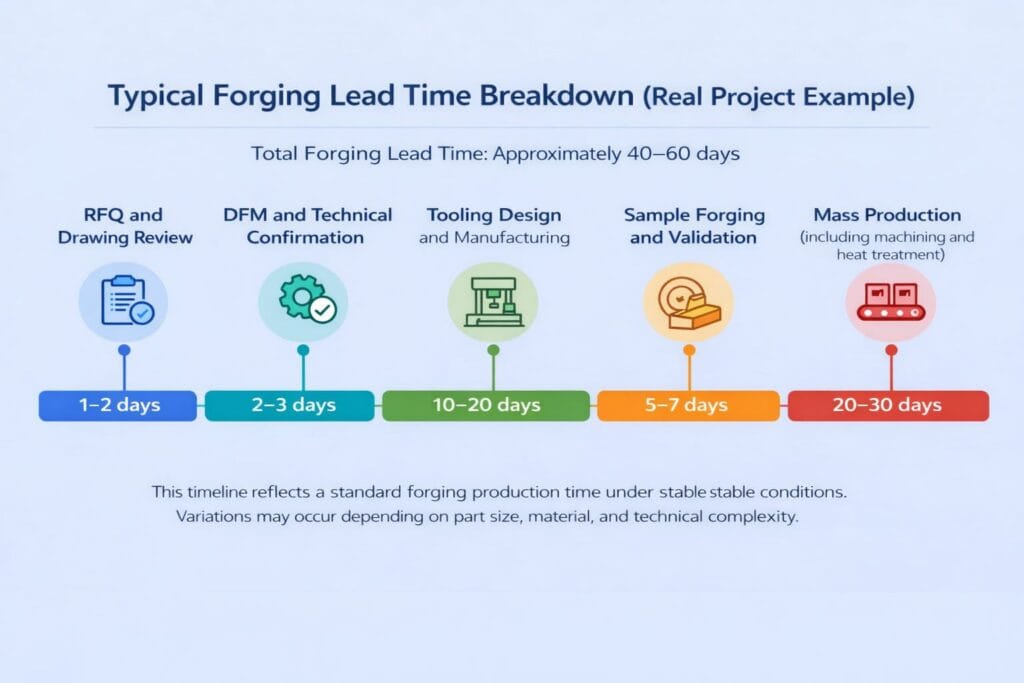
Typical forging lead time for custom parts is generally longer than machining due to additional process steps. Most projects fall within a total lead time of 40–60 days under stable conditions.
A standard timeline includes:
- RFQ & drawing review: 1–2 days
- Process planning: 2–3 days
- Tooling manufacturing: 10–20 days
- Sample validation: 5–7 days
- Mass production: 20–30 days
Understanding this structure helps buyers identify critical stages and manage expectations.
Closed Die vs. Open Die Forging: Which Has a Faster Turnaround?
When comparing closed die forging vs open die forging lead time, the difference mainly comes from tooling and production efficiency.
Closed die forging is slower initially but more efficient for mass production, while open die forging is faster upfront but less efficient overall.
Type | Initial Lead Time | Production Speed | Accuracy | Best Use |
Open Die | Short | Moderate | Lower | Prototype / Low volume |
Closed Die | Longer (tooling) | Fast | High | Batch production |
Open die forging is faster at the early stage because it does not require tooling, making it suitable for prototypes or small batches. However, lower accuracy often means more machining, which can extend the total lead time.
Closed die forging requires initial tooling time, but once completed, it enables faster, more consistent production. It is more efficient for repeat orders and large volumes.
What Factors Affect Forging Lead Time?
Forging lead time is influenced by several key factors that interact with each other.
Main factors include:
- Raw material availability, especially for special alloys
- Tooling complexity and development time
- Forging difficulty and part size
- CNC machining capacity
- Heat treatment scheduling
- Inspection requirements
These factors are interconnected, and delays often occur when multiple factors are not properly managed together.
Why On-Time Delivery Fails in Forging Projects
On-time delivery failures in forging are usually caused by accumulated inefficiencies rather than a single issue.
Common causes include:
- Tooling delays
- Material supply problems
- Poor coordination between suppliers
- Quality issues requiring rework
- Lack of production planning
Most delays are the result of weak process control rather than isolated problems.
The Impact of Delivery Delays on Your Supply Chain
Delivery delays in forging projects can create ripple effects across the entire supply chain. What appears to be a small delay at the supplier level often results in much larger operational consequences for OEM buyers.
The most common impacts include:
- Increased inventory and storage costs due to rescheduling
- Missed market opportunities, especially for time-sensitive products
- Production disruptions in downstream assembly lines
- Loss of customer trust and long-term business risk
For procurement managers, these risks are often more critical than the cost of the part itself. This is why on-time delivery is not just a logistics issue, but a key factor in overall supply chain performance.
How Forging Suppliers Ensure On-Time Delivery
Reliable suppliers ensure on-time delivery through structured management.
Typical practices include:
- Integrated production planning
- In-house forging and machining
- Safety stock for materials
- Parallel processing
- Continuous project tracking
These measures improve consistency and reduce risks.
The Role of Process Control in Delivery Reliability
Process control is a key factor in ensuring reliable on-time delivery in forging. It directly affects how well each production stage is planned, executed, and coordinated.
When key processes are managed internally, suppliers can achieve:
- More accurate production scheduling
- Better coordination between forging, machining, and heat treatment
- Reduced dependency on external subcontractors
In contrast, relying heavily on outsourced processes often introduces risks such as communication delays and scheduling conflicts.
A well-controlled process chain improves predictability and allows faster response to unexpected issues. As a result, suppliers with integrated capabilities typically deliver more stable lead times.
How Quality Inspection Affects Delivery Time
Quality inspection ensures product reliability, but it also directly affects delivery time in forging.
Typical inspection processes include:
- Ultrasonic testing (UT) for internal defects
- Magnetic particle testing (MT) for surface cracks
- Dimensional inspection for tolerance control
If inspection is poorly scheduled, it can create bottlenecks and delay production. At the same time, insufficient inspection may lead to defects and rework, which often causes even longer delays.
A well-planned inspection process helps maintain both quality and stable lead times.
How to Choose a Reliable Forging Supplier
Choosing a reliable supplier is key to ensuring on-time delivery in forging. In practice, delivery reliability depends on process control rather than speed alone.
Key criteria include:
- Integrated capabilities (forging, machining, inspection)
- Relevant experience with similar parts
- Consistent delivery record
- Effective quality control
- Clear and transparent planning
Suppliers with stable processes and better coordination are more likely to deliver on time. Consistency matters more than speed.
How Weforging Guarantees On-Time Delivery
As a fast turnaround forging manufacturer, Weforging focuses on process control and coordination to ensure reliable on-time delivery.
Our approach includes:
- ERP-based tracking to monitor production and keep schedules on track
- Integrated quality control to reduce defects and avoid rework delays
- Fast-track response for urgent orders when shorter lead time is required
By integrating forging, machining, and inspection into one workflow, we improve predictability and reduce delivery risks.
Conclusion
On-time delivery in forging depends on more than production speed. It requires coordinated control across material, tooling, machining, heat treatment, and inspection.
Forging lead time is shaped by process complexity and supplier capability. Suppliers with integrated processes and stable planning typically deliver more reliable timelines.
If you have drawings available, you’re welcome to share them for a quick review. Our team can provide initial feedback on feasibility and lead time, typically within 24 hours.