
Forging Lead Time: How Long from Sample to Mass Production?
For OEM buyers and engineers, understanding forging lead time is essential for project planning, cost control, and supply chain reliability. In industries such as construction machinery and energy systems, forged components are critical load-bearing parts where delivery delays can disrupt production.
Unlike standard parts, custom components involve tooling, forging, heat treatment, machining, and inspection. Each stage affects the overall timeline.
This guide explains the process from sample to mass production, helping you better estimate custom forging lead time and make informed sourcing decisions.
What Is Forging Lead Time?
Forging lead time refers to the total duration from initial inquiry or drawing confirmation to final delivery of finished forged components. It includes both pre-production and production stages.
A complete lead time typically covers:
- Technical review and DFM analysis
- Material procurement and preparation
- Tooling (die) design and manufacturing
- Sample production and validation
- Mass production and post-processing
Compared with machining-only workflows, forging production time involves more upstream preparation, especially tooling and thermal processing, which makes early planning essential.
Forging Sample Development Timeline
The sample stage is often the most critical phase in determining overall forging lead time. During this stage, tooling is developed and process feasibility is validated, which directly impacts subsequent production efficiency.
A typical forging sample to production time begins with die preparation:
Typical timeline:
- Engineering confirmation: 1–3 days
- Tooling design: 2–5 days
- Die manufacturing: 10–20 days
- Sample forging: 1–3 days
- Heat treatment & rough machining: 3–7 days
- Inspection and dimensional validation: 2–3 days
Total sample lead time: 3–6 weeks
For standard parts or projects using existing tooling, the timeline may be shorter. However, complex geometries or tight tolerances (e.g., IT6–IT8) may require additional iterations, extending the overall timeline.
Forging Production Time for Mass Orders
After sample approval, the forging manufacturing lead time becomes more structured and predictable. However, production capacity and scheduling still play important roles.
Typical workflow includes:
- Raw material cutting and heating
- Forging (open-die or closed-die)
- Heat treatment (quenching, tempering, or normalizing)
- CNC machining (turning, milling, drilling)
- Surface finishing and inspection (UT, hardness testing, dimensional checks)
Typical mass production lead time:
- Small batch (≤100 pcs): 2–3 weeks
- Medium batch: 3–5 weeks
- Large batch: 4–8 weeks
For large-diameter rings or heavy forgings, steel forging lead time may increase due to furnace capacity and equipment scheduling.
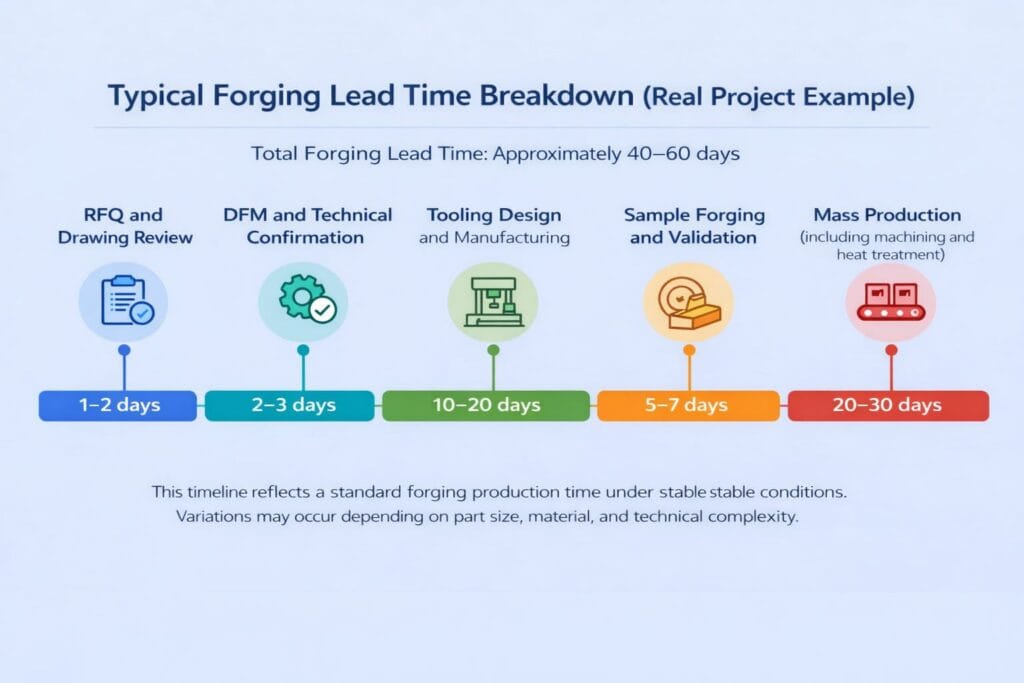
Typical Forging Lead Time Breakdown (Real Project Example)
To better understand forging lead time, it is helpful to look at a real project timeline. Below is a typical schedule for a custom forged component used in industrial equipment:
- RFQ and drawing review: 1–2 days
- DFM and technical confirmation: 2–3 days
- Tooling design and manufacturing: 10–20days
- Sample forging and validation: 5–7 days
- Mass production (including machining and heat treatment): 20–30 days
Total forging lead time: approximately 40–60 days
This structured timeline reflects a standard forging production time under stable conditions. Variations may occur depending on part size, material, and technical complexity.
Key Factors That Affect Forging Lead Time
- Part Complexity
More complex geometries require additional forging steps and machining processes.
- Material Grade
Alloys such as 42CrMo or 38CrNiMoA may require longer procurement and heat treatment cycles.
- Tooling Availability
New tooling increases lead time, while existing dies can significantly shorten it.
- Heat Treatment Requirements
Processes like carburizing or induction hardening add processing time but improve performance.
- Quality Requirements
Strict inspection standards (e.g., 100% UT testing) extend production time.
These variables directly determine forging delivery time and should be evaluated during RFQ.
Common Causes of Forging Lead Time Delays (and How to Avoid Them)
Even with a planned schedule, forging delivery time can be affected by several common issues. Understanding these risks helps buyers make better decisions.
Typical delay factors and solutions:
- Design revisions may add 1–2 weeks
Solution: finalize drawings during early DFM stage - Material shortages may delay 3–7 days
Solution: use standard materials or confirm availability early - Tooling modifications may extend 5–10 days
Solution: optimize die design before production - Heat treatment scheduling may delay 3–5 days
Solution: work with suppliers with in-house facilities
Proactively managing these factors can significantly reduce overall custom forging lead time.
How to Reduce Forging Lead Time
Reducing forging lead time requires coordination between engineering, production, and supply chain.
Effective strategies include:
- Finalizing drawings early to avoid redesign
- Selecting standard material grades
- Using integrated suppliers (forging + machining + testing)
- Running parallel processes where possible
- Establishing clear communication during RFQ
A well-structured supplier can significantly reduce custom forging lead time by eliminating process gaps.
Forging Lead Time vs Cost
Many buyers assume that a shorter forging lead time always results in higher cost. In reality, the relationship is more complex and depends on production strategy and process efficiency.
Key relationships:
- Faster delivery → higher cost due to priority scheduling and resource allocation
- Reusing existing tooling → reduced cost and shorter lead time
- Larger batch sizes → improved efficiency and lower unit cost
- Integrated production → reduced total lifecycle cost and more stable lead time
Balancing cost and forging manufacturing lead time is essential for efficient and sustainable procurement decisions.
Typical Lead Time by Part Type (with Range)
To better estimate forging lead time, it is useful to compare typical timelines across different forged part types. The ranges below reflect common production conditions for custom components and help buyers plan procurement more effectively.
Part Type | Typical Lead Time |
Gear rings (internal & external) | 4–6 weeks |
Flanges | 3–5 weeks |
Large structural rings | 6–10 weeks |
Shafts | 4–8 weeks |
These timelines may vary depending on material grade, part size, heat treatment requirements, and machining complexity. For large or high-precision components, early planning is recommended to ensure stable forging delivery time.
Lead Time for Different Forged Parts
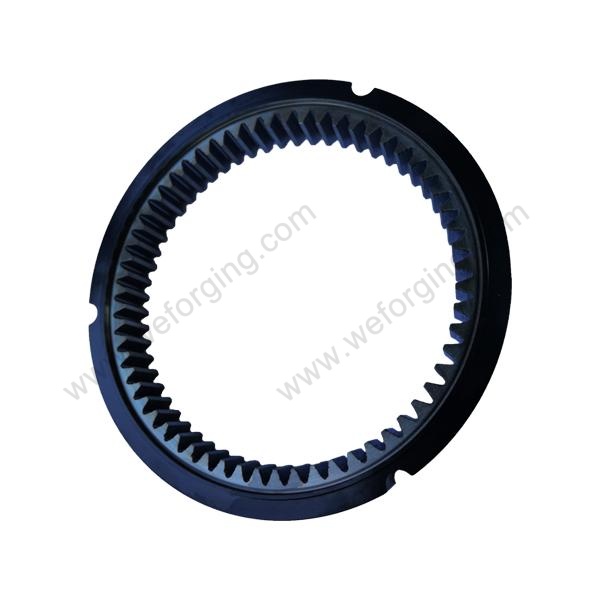
Gear Rings (Internal & External)
Gear rings typically have a moderate forging lead time due to their balanced complexity.
Once tooling is established, production tends to be stable and repeatable.
- Suitable for batch production
- Machining accuracy (gear cutting) may slightly extend timeline
- Common in gearboxes and transmission systems
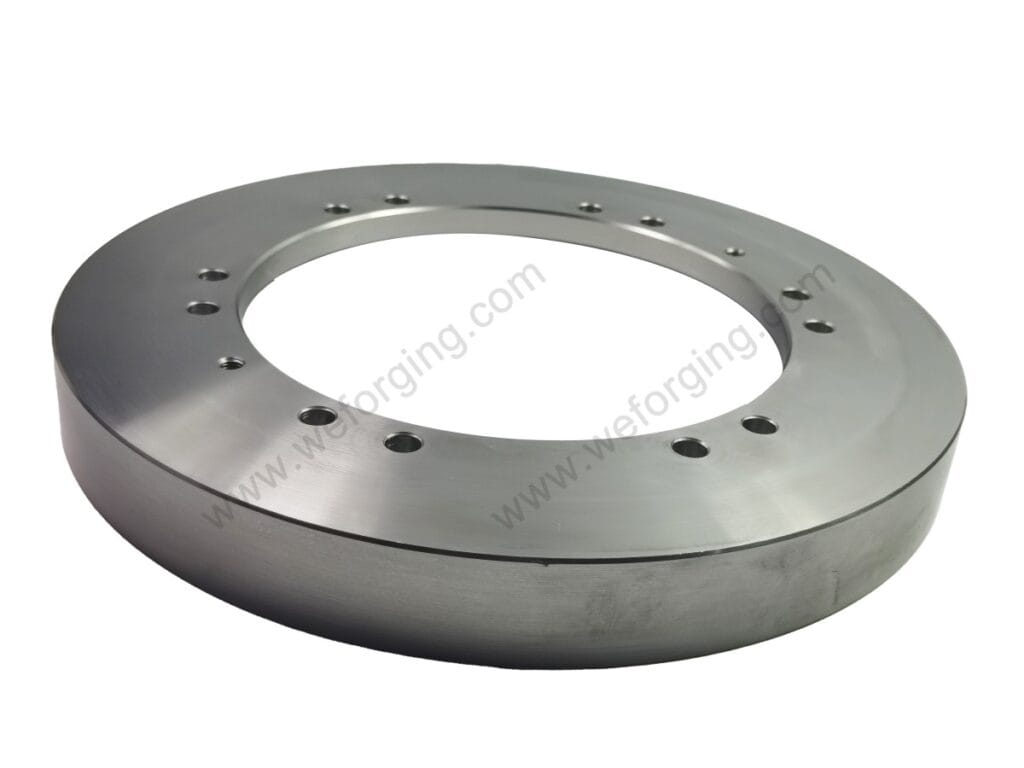
Flanges
Flanges usually offer a shorter lead time, especially when standard materials and dimensions are used.
- Simple geometry reduces forging and machining time
- Widely available materials improve delivery speed
- Ideal for projects with tight schedules

Large Structural Rings
Large rings require longer forging lead time, mainly due to ring rolling and heat treatment processes.
- Rolling process requires specialized equipment
- Longer heating and cooling cycles
- Common in wind energy, heavy equipment, and structural applications
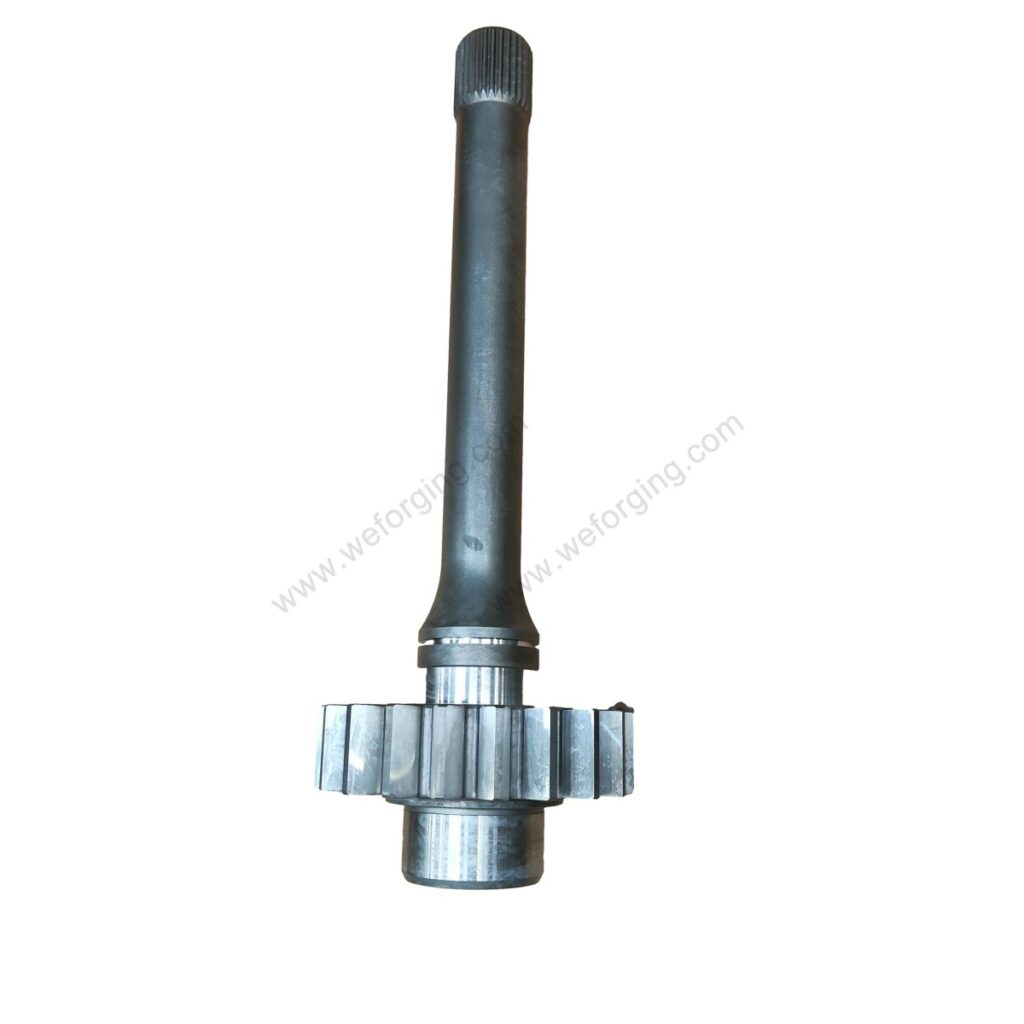
Shafts
Shaft components often have a variable lead time because they are machining-intensive.
- Turning, milling, and threading increase processing time
- Tolerance requirements affect machining duration
- Suitable for customized mechanical assemblies
Key Insight
Ring forging lead time is generally longer than standard forgings due to rolling processes and thermal treatment requirements. Early planning is recommended for large-diameter components.
Our Experience in Controlling Forging Lead Time
With extensive OEM project experience, we understand that forging lead time depends not only on production speed, but also on process coordination and supply chain stability.
Key factors influencing lead time include:
- Integrated processes → reduce waiting time between forging, machining, and heat treatment
- Tooling and DFM optimization → improve sample development efficiency
- Stable material supply → minimize sourcing delays
Under optimized conditions:
- Lead time can be reduced by 10–20% in well-coordinated projects
- Repeat orders can typically maintain delivery within ±5–10% variance, depending on scheduling and material availability
By integrating forging, CNC machining, heat treatment, and inspection in-house, we improve consistency in forging delivery time, especially for large structural and high-precision components.
Conclusion
Understanding forging lead time helps OEM buyers plan projects more effectively and avoid unnecessary delays. From sample development to mass production, each stage affects delivery performance.
More importantly, reliable lead time depends on how well each step is controlled—from tooling and materials to process integration.
If you are evaluating timelines for a new project or comparing suppliers, sharing your drawings or requirements can help clarify feasibility and estimated lead time early on. This often leads to more predictable forging delivery time and smoother project execution.