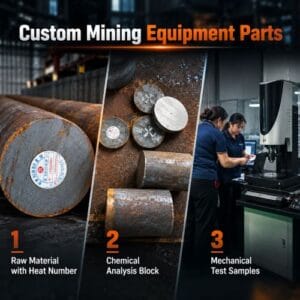
Custom Mining Ground Support Components | Forging & CNC Manufacturer
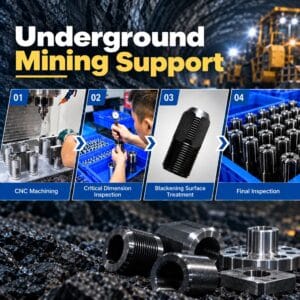
Weforging manufactures custom forged and CNC machined components for mining ground support systems, including rock bolting, cable bolting, roof support, strata support, and other underground support applications. Typical parts include bearing plates, anchor components, heavy-duty nuts, washers, threaded couplings, sleeves, and other non-standard components made to OEM drawings and technical specifications.
For safety-critical ground support applications, we integrate forging, heat treatment, CNC machining, and inspection into one controlled manufacturing route. This gives OEM buyers better control over material traceability, batch consistency, critical dimensions, inspection records, and production schedules, while reducing the coordination required between separate forging and machining suppliers.
Weforging does not position itself as a complete ground support system supplier. Our role is to manufacture the custom load-bearing, anchoring, connecting, and fastening components within these systems—from forged blanks to finished parts ready for assembly.
Custom Components for Mining Ground Support Systems
Weforging manufactures custom metal components for mining ground support systems to OEM drawings and technical specifications. We focus on the load-bearing, anchoring, connecting, and fastening parts used within these systems, supplying forged blanks or fully machined components depending on project requirements.
Ground Support System | Typical Components |
Rock Bolting / Roof Bolting | Rock bolt components, roof bolt components, anchor bolt components, bearing plates, heavy-duty nuts, washers, threaded couplings and sleeves |
Cable Bolting | Cable anchor components, cable bolt heads, bearing plates, couplings and connection components |
Roof Support | Roof bolt components, bearing plates, support plates, heavy-duty nuts and washers |
Strata Support | Anchor components, bolt components, bearing plates, nuts, washers and connecting components |
Ground Support Components | Anchor heads, bearing plates, support plates, heavy-duty nuts, washers, threaded couplings, sleeves and other non-standard components |
Components can be manufactured in carbon and alloy steels, with forging, heat treatment, CNC machining, threading, and inspection coordinated according to the drawing and project requirements.
Manufacturing Processes for Mining Ground Support Components
Manufacturing routes for mining ground support components depend on part geometry, material, loading conditions, mechanical-property requirements, and production volume. Mining forgings are typically used for load-bearing and connecting components where a forged preform provides a suitable starting point for subsequent heat treatment and CNC machining.
Other components may be produced by cold extrusion, stamping, or direct machining from bar stock, depending on the drawing and application requirements.
Manufacturing Route | Typical Ground Support Components | Process Application |
Anchor heads, sleeves, heavy-duty nuts, flanges | Forged preforms are produced close to the required geometry, followed by machining of threads, bores, mating surfaces, and other critical features | |
Cold Forming / Cold Extrusion | Drive nuts | Used to form suitable geometries at room temperature, with secondary machining or finishing where required |
Blanking & Stamping / Forming | Support plates, bearing plates | Plate components are blanked, punched, and formed from steel plate according to the required profile and hole geometry |
Machined from Bar Stock | Anchor heads and selected custom components | Components are machined directly from bar stock when geometry, quantity, material, and technical requirements make this route appropriate |
Selecting the Right Manufacturing Route
The same component can sometimes be manufactured by more than one route. An anchor head, for example, may be hot die forged and CNC machined or machined directly from bar stock.
The preferred route depends on the drawing, geometry, material, required mechanical properties, machining content, and production volume. For repeat OEM programs, Weforging also considers material utilization, process repeatability, tooling requirements, and total manufacturing cost before the production route is finalized.
This process-based approach allows the manufacturing method to be matched to the finished ground support component and its application requirements, rather than forcing every part into a single forming process.
For a broader comparison of manufacturing routes beyond ground support components, see our guide to custom mining equipment parts, including when forging, casting or direct machining may be the better choice.
Why Safety and Reliability Matter in Mining Ground Support
Mining ground support components are part of safety-critical systems used to stabilize underground rock and strata. Components responsible for anchoring, fastening, connection, and load transfer may be exposed to high loads, impact, vibration, and ground movement. Their reliability depends not only on the design, but also on material properties, heat treatment, dimensional accuracy, and consistent manufacturing control. To verify these requirements, Weforging operates an in-house Physical and Chemical Laboratory with testing and inspection equipment for material, mechanical-property, metallographic, and dimensional verification.
By combining laboratory testing with controlled forging, heat treatment, CNC machining, and inspection, Weforging can verify critical requirements before ground support components are released for shipment.
Forged & CNC Machined Parts for Mining Ground Support

Mining forged parts used in ground support systems may require a combination of controlled forging, heat treatment and CNC machining when load, geometry and mechanical-property requirements cannot be met efficiently by machining alone.
Weforging coordinates the complete manufacturing route:
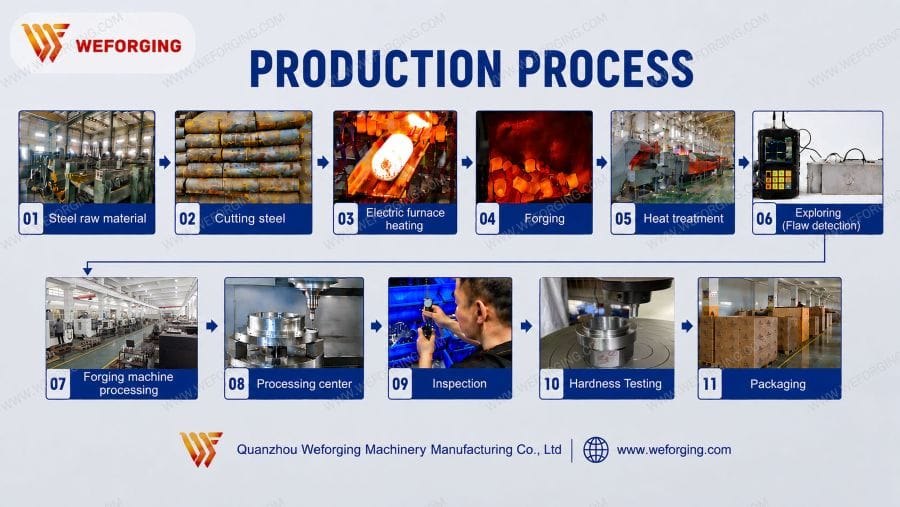
Raw Material → Forging → Heat Treatment → CNC Machining → Inspection → Finished Component
Forging is planned around the final component geometry, material, mechanical-property requirements, machining allowance, and production quantity. Typical applications include alloy and carbon steel forgings, load-bearing parts, connecting components, and near-net-shape forged blanks.
After forging and heat treatment, CNC machining is used to finish critical functional features such as threads, bores, bearing surfaces, mating surfaces, hole positions, critical diameters, tolerances, and required surface finishes.
By planning forging and machining together, the process is built around the finished component rather than treating the forged blank and final machining as separate sourcing activities.
One Supplier from Forging to Finished Component
Using separate suppliers for forging, heat treatment, and machining increases the number of process handoffs that OEM procurement teams must manage. It can also make material traceability, drawing revisions, production scheduling, and quality responsibility more difficult to control.
Weforging integrates these stages into one coordinated manufacturing route.
OEM Sourcing Concern | Weforging Approach |
Multiple supplier handoffs | Forging, heat treatment, CNC machining, and inspection are coordinated within one production route |
Traceability gaps | Material heat numbers are linked to production and inspection records |
Batch variation | Defined process and inspection requirements support repeat production |
Forging / machining mismatch | Forging geometry and machining allowance are reviewed against the finished drawing |
Heat-treatment distortion | Final machining is planned around the required heat-treated condition |
Quality responsibility gaps | Connected manufacturing records provide clearer process visibility |
Lead-time uncertainty | Fewer external handoffs improve production scheduling and status visibility |
For procurement teams, this means fewer suppliers to coordinate, clearer manufacturing responsibility, and better visibility from raw material to finished component.
Materials & Heat Treatment
Material selection for mining ground support components depends on component function, loading, required mechanical properties, heat treatment, and OEM specifications. Weforging works with alloy, medium-carbon, and structural steels, with material requirements reviewed together with forging and machining before production.
Materials Used in Weforging Ground Support Projects
These are examples from ground support components previously manufactured by Weforging. Materials for new projects are selected according to customer drawings and technical specifications.
Depending on the material and drawing requirements, Weforging supports normalizing, annealing, quenching and tempering, and stress relieving. Material grade, heat number, heat-treatment condition, and required mechanical properties are controlled through the manufacturing route.
By integrating forging, heat treatment, CNC machining, and inspection, Weforging maintains clearer material traceability and process control from raw material to finished component.
Testing & Quality Standards for Mining Ground Support Components
Mining ground support components can be subject to high loads, impact, and demanding underground conditions. For OEM projects, material properties and critical dimensions therefore need to be verified against the drawing, material specification, and inspection requirements rather than relying on material certificates alone.
Weforging supports in-house physical and chemical testing together with dimensional inspection. Testing requirements are defined according to the component function, material, heat-treatment condition, customer specification, and applicable quality plan.
In-House Testing & Inspection Capabilities
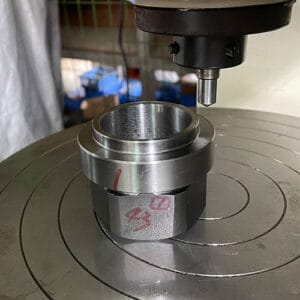
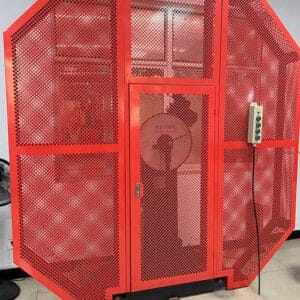
Hardness Testing Impact Testing
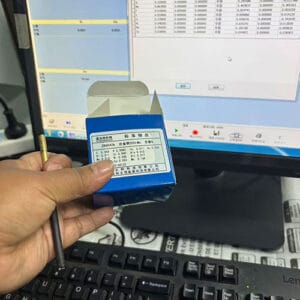
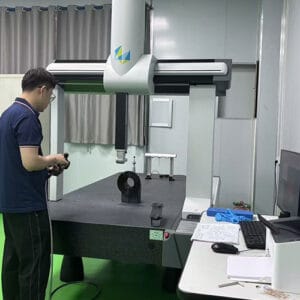
Chemical Composition Analysis CMM Dimensional Inspection
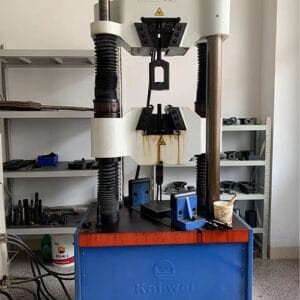
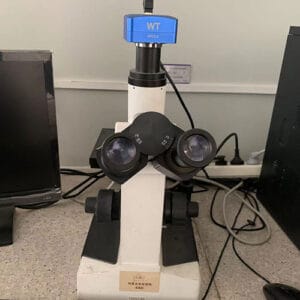
Tensile Test Machine Metallurgical Inverted Microscope
These capabilities allow material, mechanical-property, heat-treatment, and dimensional requirements to be checked at defined stages of production.
Inspection Capabilities for Ground Support Components
Inspection / Test | What It Verifies | Typical Application |
Chemical Composition Analysis | Material chemistry and grade verification | Raw material and heat verification |
Tensile Testing & Yield Testing | Tensile strength, yield strength, and elongation | Mechanical property verification |
Impact Testing | Impact toughness at the specified test condition | Components with specified toughness requirements |
Hardness Testing | Hardness and heat-treatment consistency | Heat-treated components |
Metallographic Examination | Microstructure and heat-treatment condition | When required by specification or quality plan |
CMM Inspection | Critical dimensions and geometric tolerances | CNC machined finished components |
UT / MT | Internal or surface discontinuities | When required by drawing or specification |
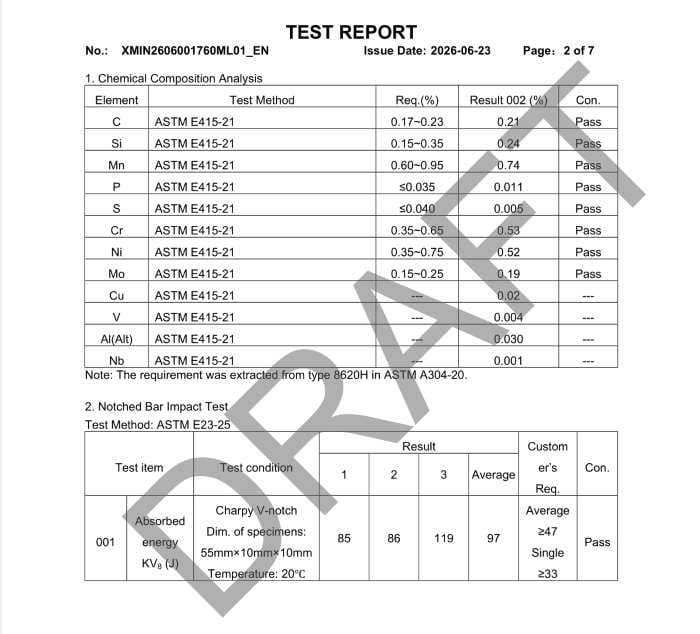
Selected SGS Test Reports
Testing is performed according to the customer drawing, material specification, applicable standards, and inspection plan. Where required, test and inspection results can be linked to the corresponding material heat and production batch, supporting documentation and quality verification for repeat OEM orders.
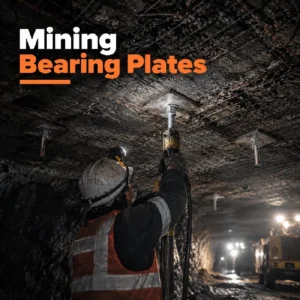
Traceability & Production Consistency
For custom ground support components, traceability should connect the finished production batch with the material and manufacturing records behind it.
Raw Material → Heat Number & MTC → Forging Batch → Heat Treatment → Machining Lot → Inspection Records → Finished Components
Heat numbers and production records allow finished batches to be linked to their source material and relevant manufacturing documentation. If a non-conformance requires investigation, the affected batch can be reviewed against its material, process, and inspection records.
For repeat production, consistency is supported by controlling material specification, forging route, heat treatment, machining allowance, critical features, mechanical properties, and inspection requirements.
The objective is not only to produce one approved sample, but to establish a manufacturing route that can be repeated across future production batches.
From OEM Drawing to Series Production
Weforging supports custom mining ground support components from initial drawing review through repeat production.
01 — Drawing & Specification Review
Review material, tolerances, threads, mechanical properties, heat treatment, NDT, and documentation requirements.
02 — Forging & Process Planning
Evaluate forging feasibility, preform geometry, machining allowance, and the relationship between heat treatment and final machining.
03 — Forging & Heat Treatment
Produce and heat treat components according to the defined manufacturing route.
04 — CNC Machining
Finish threads, bores, bearing surfaces, hole patterns, and other critical features to the final drawing.
05 — Inspection & Documentation
Verify dimensional, material, mechanical-property, and NDT requirements according to the agreed inspection plan.
06 — Series Production
After process approval, the controlled manufacturing route supports repeat production and long-term OEM supply.
Prototype → Process Validation → Series Production → Repeat Supply
Why OEM Buyers Choose Weforging
Weforging combines forging and precision machining for OEMs that require custom metal components supplied as finished and inspected parts.
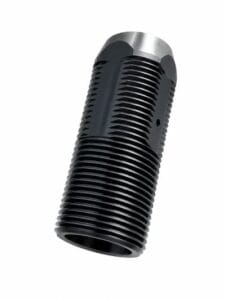
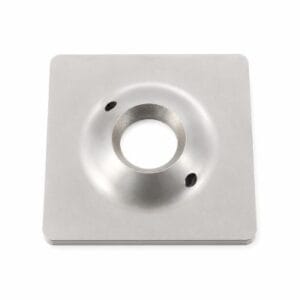
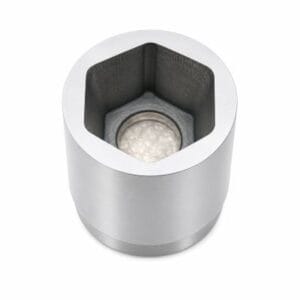
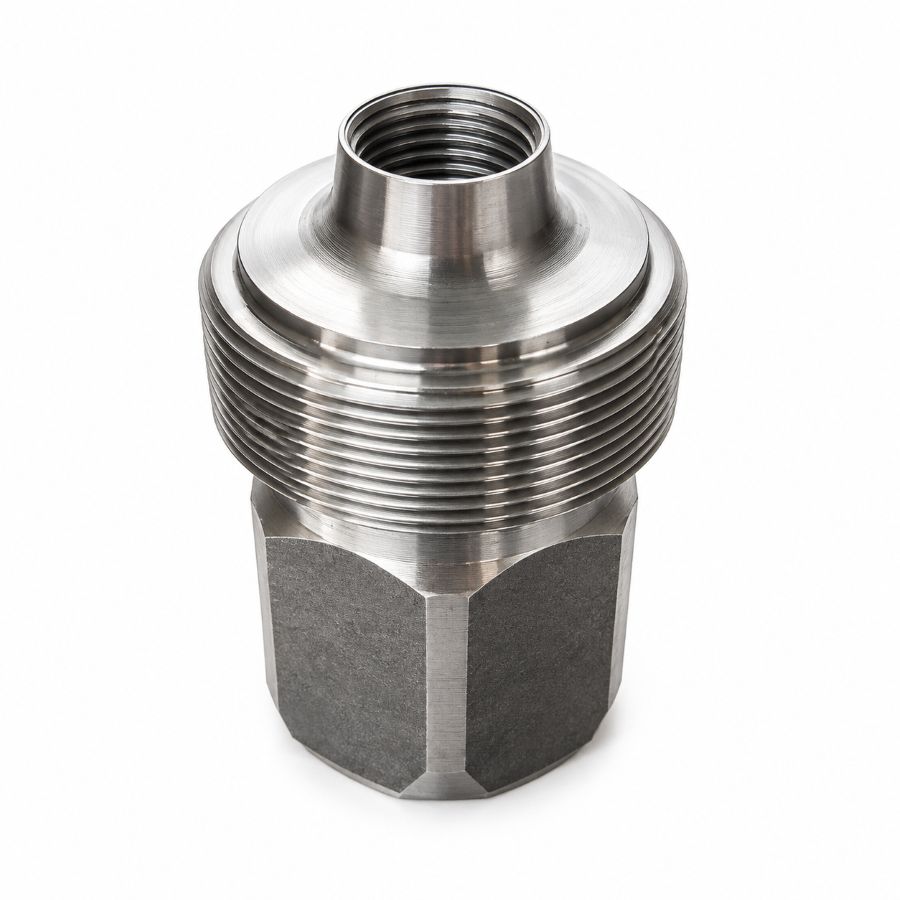
Previous manufacturing experience with ground support components helps reduce uncertainty during drawing review, process selection, tooling development and inspection planning. Weforging has manufactured anchor heads, hex driver sockets, support plates, flanges and other custom components for mining ground support applications.
Integrated Forging & CNC Machining
One coordinated manufacturing route from forged blank to finished component.
Material-to-Part Traceability
Heat numbers and production records support traceability throughout manufacturing.
Consistent Series Production
Defined process and inspection requirements support repeat production across batches.
Engineering & Drawing Review
Material, forging feasibility, machining allowance, heat treatment, critical tolerances, and inspection requirements are reviewed before production.
Inspection & Documentation
CMM, hardness testing, mechanical testing, UT/MT when specified, and supporting quality records.
Reduced Supply Chain Complexity
Fewer supplier handoffs reduce coordination between forging and machining stages.
Prototype to Series Supply
Support for prototypes, low-volume requirements, and repeat OEM production.
Send your 2D/3D drawing, material specification, quantity and inspection requirements for manufacturing review and quotation.


Round Flange