Custom Anchor Head

Please enable JavaScript in your browser to complete this form.
Click or drag files to this area to upload.You can upload up to 10 files.

Table of Contents

Custom Anchor Head Manufacturer | OEM Mining Parts

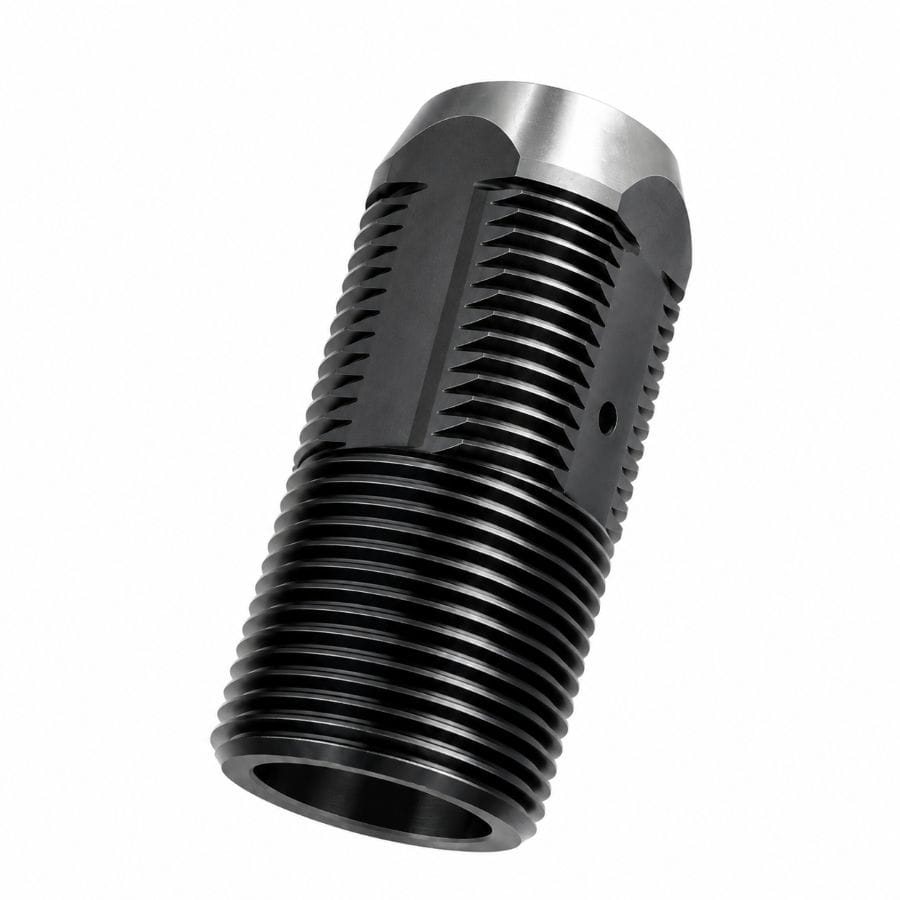
Weforging manufactures custom mining anchor heads for mining ground support systems and anchoring assemblies, produced to OEM drawings rather than fixed catalog dimensions. Anchor heads are typically used as load-bearing or connecting components within rock bolting, roof support, and related underground support applications.

Depending on the part geometry, material, mechanical requirements, and production volume, anchor heads can be manufactured from a forged preform or directly machined from steel bar. CNC turning, milling, drilling, and threading are used to produce threads, connection features, and critical mating surfaces.

Typical material options include 42CrMo4 / AISI 4140 alloy steel, with material grade, heat treatment, tolerances, and inspection requirements defined by the customer drawing.

Custom Anchor Heads Made to OEM Drawings

Mining anchor heads can vary significantly in thread form, external geometry, connection features, and mating dimensions. For this reason, Weforging manufactures them as drawing-specific OEM components rather than fixed standard products.

Custom features can include thread dimensions, external profiles, bores, cross holes, shoulders, mating surfaces, material grades, heat treatment, and surface requirements.

Feature

Custom Options

Thread

Diameter, pitch, effective length, and thread form

External Profile

Round, flats, or drawing-specific geometry

Connection Features

Bores, cross holes, shoulders, and mating surfaces

Material

Carbon steel or alloy steel

Heat Treatment

According to specified mechanical properties

Surface

Machined, blackened, coated, or drawing-specific

Inspection

Critical characteristics defined by the OEM drawing

The customer drawing is the primary manufacturing reference. Before production, the material grade, manufacturing process, heat-treatment and hardness requirements, yield and tensile strength requirements, thread GO/NO-GO gauge acceptance criteria, and corrosion-protection requirements, including specified salt spray test duration, should be clearly defined.

For projects requiring a forged preform, Weforging’s custom forging capabilities can support drawing-based production before final CNC machining.

How Is This Anchor Head Manufactured?

The anchor head shown on this page is manufactured from alloy steel through a controlled forging, machining, and heat-treatment process. The production route is defined around the finished geometry, threaded connection, mechanical properties, and critical dimensional requirements specified in the OEM drawing.

For this part, production begins with forging followed by rough machining. The component is then quenched and tempered to achieve the specified mechanical properties. Final machining, thread inspection, CNC drilling, critical dimension inspection, blackening surface treatment, and final inspection are completed in sequence.

Anchor Head Manufacturing Process
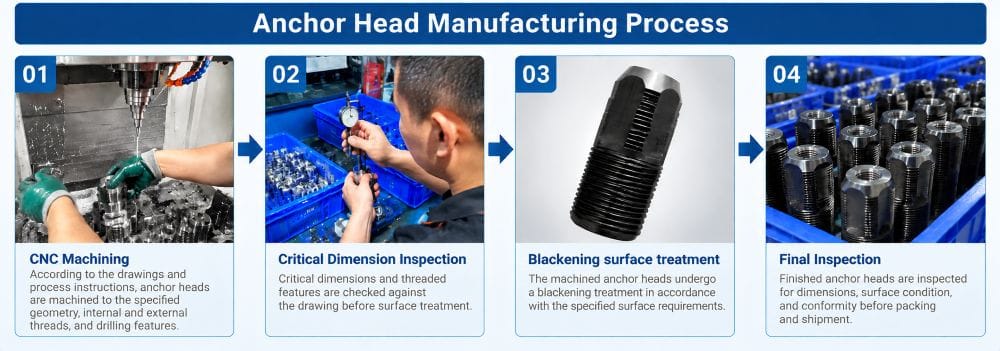
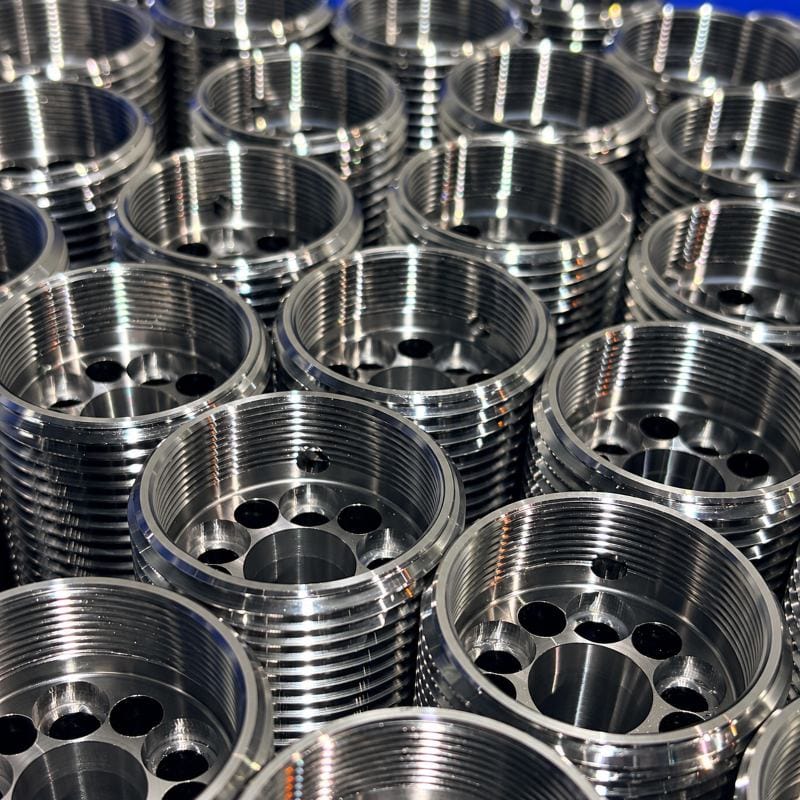
Custom anchor heads after CNC machining, with threads and drilled features manufactured to OEM drawing requirements.

Step

Manufacturing Stage

Key Control

01

Bar Stock Preparation for Forging

Verify material grade, heat number, and required blank dimensions before forging.

02

Rough Machining

Establish the basic geometry and maintain appropriate machining allowance for subsequent finishing operations.

03

Quenching & Tempering

Achieve the specified strength, hardness, and required mechanical properties through quenching and tempering.

04

Mechanical Property Testing

Verify hardness, yield strength, and tensile strength after heat treatment according to the specified requirements.

05

Thread Machining & Inspection

Machine and inspect thread dimensions, pitch, effective length, and fit using the specified acceptance criteria.

06

CNC Machining & Drilling

Machine wrench flats, cross holes, bores, shoulders, and other drawing-defined features.

07

Critical Dimension Inspection

Check critical diameters, lengths, concentricity, hole positions, and mating dimensions against the drawing.

08

Laser Marking for Traceability

Apply permanent identification so the finished part can be traced to the supplier, production order, and serial or batch identification.

09

Blackening Surface Treatment

Apply the specified blackening treatment after machining and dimensional verification.

10

Final Inspection, Ultrasonic Cleaning & Packing

Perform final inspection, ultrasonic cleaning, and packing according to the specified product and shipping requirements.

11

Pre-Shipment Documentation Review

Verify product identification and confirm the required material certificates and inspection reports before shipment.

This production sequence is particularly important for threaded mining components because machining accuracy and heat-treatment condition must be controlled together. Completing dimensional checks both during and after machining helps reduce the risk of thread mismatch, incorrect hole position, or assembly problems in batch production.

Where required, inspection records can be linked to the relevant production batch to support material and process traceability.

Can Anchor Heads Also Be Manufactured Entirely by CNC Machining?

Yes. The manufacturing route depends on the customer’s application requirements. The anchor head shown on this page is produced from a forged bar blank. For other designs, when the geometry is suitable and the production volume does not justify forging, direct CNC machining from steel bar can also be used, subject to customer technical approval.

Material & Heat Treatment for Anchor Heads

For heavy-duty anchor heads, alloy steel may be specified where the component requires a combination of strength, toughness, and heat-treatment response.

For the anchor head shown on this page, 42CrMo4 / AISI 4140 are typical material references for European and North American OEM projects, subject to the applicable drawing and material specification.

Region / Standard

Typical Material Reference

Europe / EN

42CrMo4 / 1.7225

North America

AISI 4140

China / GB

42CrMo / 42CrMoA

Other Requirements

Material specified by the OEM drawing

When specified mechanical properties are required, quenching and tempering (Q&T) can be applied in accordance with the technical requirements.

Final material selection should consider the required strength and toughness, heat-treatment condition, applicable material standards, and the technical requirements of mating components.

Material grades from different standards should not be substituted based on grade designation alone. Chemical composition and mechanical property requirements should be reviewed and confirmed, with any material substitution subject to customer technical approval.

For projects requiring controlled quenching and tempering or other thermal processes, see our heat treatment capabilities for custom forgings and machined components.

CNC Threading & Critical Features

For a machined anchor head, the finished thread and mating geometry directly affect assembly with the corresponding anchoring components.

CNC turning and milling can be used to produce threads, locating diameters, shoulders, flats, bores, cross holes, and other functional features defined on the drawing.

Critical Feature

What Should Be Controlled

Thread

Diameter, pitch, form, and effective length

Thread Start / Runout

Position and transition geometry

Locating Diameters

Size and tolerance

Concentricity

Alignment between threaded and locating features

Shoulders

Position and mating dimensions

Bores

Diameter, depth, and position

Cross Holes

Diameter and positional accuracy

Mating Surfaces

Dimensions and drawing-defined tolerances

For repeat OEM production, characteristics that directly affect fit and interchangeability should be identified as critical dimensions on the drawing or inspection plan.

This allows machining and inspection to focus on the features that matter most to the finished assembly.

What Should Be Checked Before Batch Production?

Before an anchor head enters repeat production, the drawing and inspection plan should identify the characteristics that affect material compliance, assembly, and finished-part consistency.

Typical inspection requirements can include:

Inspection Item

Purpose

Material Verification

Confirm the specified steel grade and material identification

Thread Inspection

Verify thread size, pitch, form, and fit

Critical Dimensions

Confirm mating dimensions and assembly interfaces. Threads and holes are subject to 100% inspection and must pass the specified acceptance criteria before the parts are released to finished-goods inventory.

Hardness Testing

Verify the specified heat-treated condition

Dimensional / CMM Inspection

Check geometry and drawing tolerances

UT / MT

Applied when required by the drawing or purchasing specification

Inspection scope should follow the OEM drawing and project requirements rather than applying the same test plan to every anchor head.

Where specified, material certificates, dimensional inspection reports, hardness results, and relevant NDT records can be supplied with the production batch.

More information about CMM, material verification, UT/MT, hardness testing, and production documentation is available in our quality control and inspection system.

Can You Provide Anchor Head Samples Before Series Production?

Yes. For custom Anchor Head projects, Weforging can provide prototype samples for technical validation and mutual approval before series production.

Even when producing a small quantity is not economically efficient, we are willing to support prototype production. We make this decision based on our responsibility for the product and the customer’s project, with the aim of jointly validating critical technical requirements before moving into series production. The purpose is to verify the feasibility of the complete manufacturing process and to align and confirm the inspection and acceptance criteria between both parties.

Once the material, dimensions, mechanical properties, manufacturing process, and other specified technical requirements have been jointly verified and approved, the accepted sample can be retained as an approved reference sample for subsequent series production.

Future production follows the manufacturing route and key process requirements established during sample validation, helping maintain consistency in both manufacturing process and finished-product requirements between batch-produced Anchor Heads and the approved sample.

For us, a prototype is not simply a small-volume order—it is an important technical reference for controlled series production.

What to Include in an Anchor Head RFQ

For an accurate manufacturing review and quotation, an anchor head RFQ should normally include the drawing, material requirements, critical dimensions, and expected production quantity.

RFQ Information

What to Provide

Drawing

2D drawing and, where available, 3D model

Material

Grade and applicable material standard

Thread

Thread specification and tolerance class

Heat Treatment

Required condition or mechanical properties

Dimensions

Critical dimensions and tolerances

Surface Requirement

Coating, blackening, or other specified treatment

Inspection

Required testing and documentation

Quantity

Prototype quantity, batch size, and estimated annual demand

If the manufacturing route has not yet been specified, Weforging can review the drawing to evaluate whether a forged preform + CNC machining or direct machining from steel bar is more appropriate for the component.

Send your anchor head drawing for manufacturing review and quotation.

Are mining anchor heads standard parts?

Not always. Thread form, dimensions, material, connection geometry, and mechanical requirements can vary between anchoring systems. Weforging manufactures custom anchor heads to OEM drawings rather than limiting production to standard catalog sizes.

Can an anchor head be machined directly from steel bar?

Yes. For suitable geometries and production quantities, direct CNC machining from steel bar can be practical. Forging followed by CNC machining may be considered when the geometry and repeat production volume justify a forged preform.

What material is commonly used for heavy-duty anchor heads?

42CrMo4 or AISI 4140 alloy steel can be considered where higher strength, toughness, and heat-treatment response are required. The final material grade and heat-treatment condition should follow the OEM specification.

What should be inspected on a custom anchor head?

Inspection commonly focuses on material identification, threads, critical mating dimensions, geometry, and heat-treatment condition. Additional testing such as UT or MT can be applied when required by the drawing or project specification.
Scroll to Top