
Custom Forging Services for OEM Industrial Components
Custom forging is widely used in OEM applications requiring high strength, dimensional stability, and long-term reliability. Compared with cast or welded components, forged parts provide improved grain flow, better fatigue resistance, and more stable mechanical performance under heavy-load working conditions.
At Weforging, we provide custom forging services combined with CNC machining, heat treatment, and inspection to support stable OEM production across mining equipment, heavy machinery, energy systems, hydraulic applications, and industrial transmission industries.
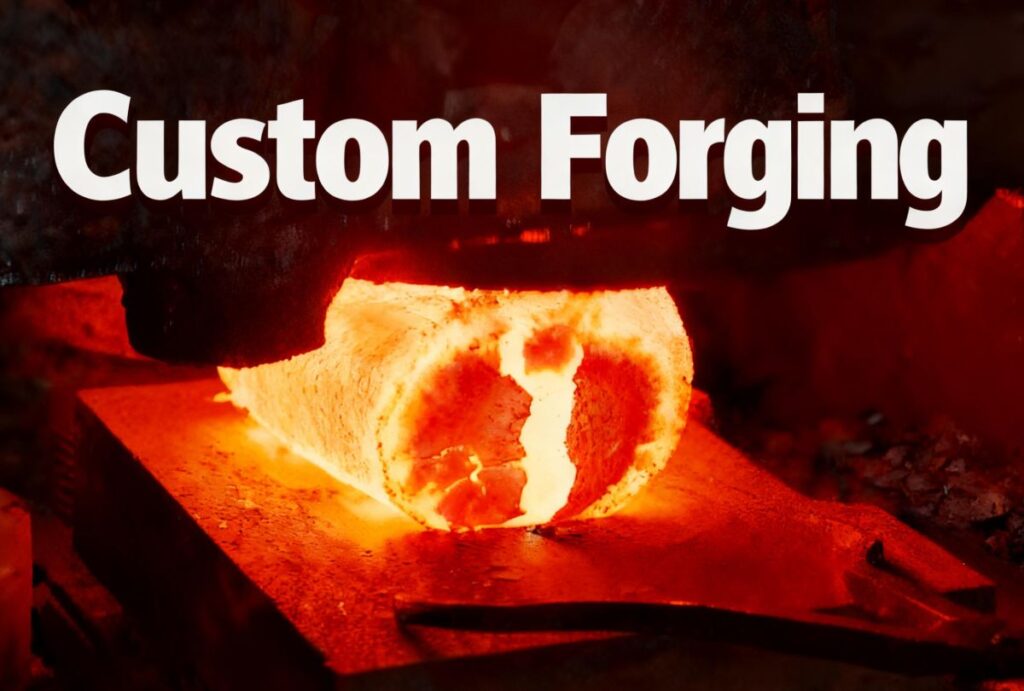
What Is Custom Forging?
Custom forging refers to a tailored metal forming process that produces parts according to specific engineering requirements. Unlike standard production, custom metal forging focuses on material optimization, mechanical strength, and dimensional control.
The process starts with a heated billet shaped under pressure into near-net form. Depending on complexity, parts are often finished through CNC machining. Forging parts feature superior density and eliminate porosity common in casting, making them ideal for shafts, gears, and flanges.
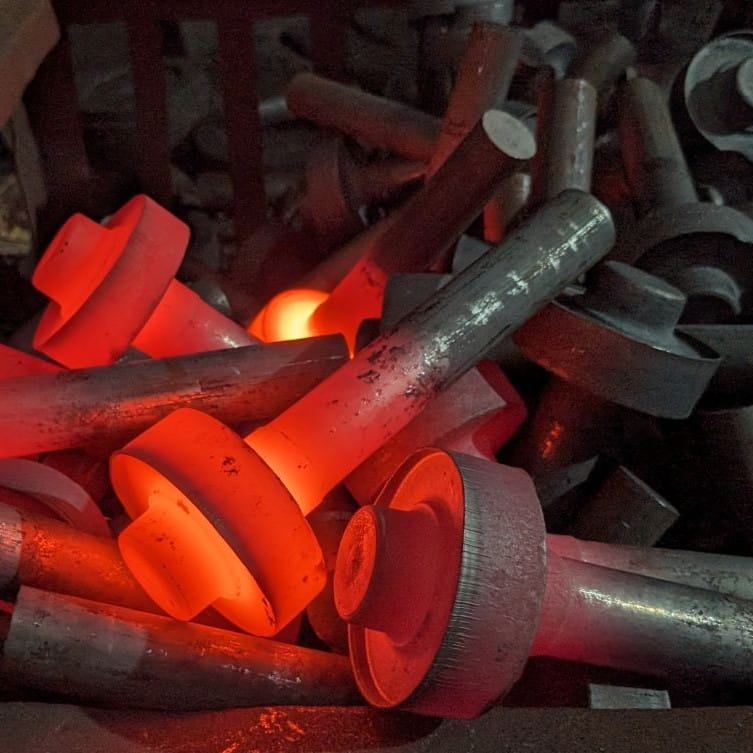
Custom Forging Process Explained
Custom forging production involves multiple coordinated manufacturing stages to ensure mechanical performance, dimensional accuracy, and stable batch consistency for OEM applications.
1. Drawing and Technical Review
OEM drawings, tolerances, material requirements, and application conditions are reviewed before production. Early technical evaluation helps reduce machining mismatch and unnecessary process adjustments later in manufacturing.
2. Material Selection
Carbon steel, alloy steel, stainless steel, or aluminum materials are selected according to strength, wear resistance, corrosion resistance, and downstream machining requirements.
3. Forging Process Planning
Forging methods, billet dimensions, heating temperatures, and machining allowance are evaluated based on component geometry, load conditions, and OEM application requirements.
4. Billet Heating and Forming
Raw materials are heated to suitable forging temperatures and formed through controlled forging equipment to achieve stable grain flow and improved internal density.
5. Heat Treatment
Processes such as quenching, tempering, normalizing, or annealing are applied to optimize hardness, toughness, and mechanical performance according to project specifications.
6. CNC Machining
Precision CNC machining improves dimensional accuracy, assembly compatibility, and surface finish quality for downstream industrial applications.
7. Inspection and Quality Control
UT, MT, hardness testing, dimensional inspection, and CMM measurement are performed according to OEM quality and compliance requirements.
8. Packaging and Delivery
Export packaging, batch identification, and production tracking help improve delivery coordination and supply stability for long-term OEM programs.
Integrated process coordination helps improve dimensional consistency, machining compatibility, and batch repeatability across custom forging production projects.
Materials Used in Custom Forging
Material selection plays a critical role in determining forging performance, machinability, corrosion resistance, and service life.
| Material Type | Common Grades | Typical Applications |
|---|---|---|
| Carbon Steel | 1045, A105, A36 | Shafts, rings, flanges |
| Alloy Steel | 4140, 4340, 8620 | Gears, hubs, heavy-duty components |
| Stainless Steel | 304, 316, 420 | Corrosion-resistant applications |
| Aluminum Alloy | 6061, 7075 | Lightweight industrial components |
Material recommendations are provided according to operating loads, wear conditions, corrosion exposure, and downstream machining requirements.
Why OEM Buyers Choose Custom Forging
Custom forging provides several advantages for industrial OEM applications:
- Better Fatigue Resistance
Improved grain flow helps forged parts withstand repeated loads more effectively than cast components. - Improved Dimensional Stability
Controlled forging and machining help reduce distortion during heat treatment and machining. - Higher Structural Integrity
Forging improves material density and reduces internal porosity for heavy-duty applications. - Reduced Material Waste
Near-net forging reduces unnecessary machining and improves material utilization. - Stable Batch Consistency
Controlled production processes help maintain repeatable quality across OEM production programs. - Better Long-Term Reliability
Longer service life and reduced maintenance risks help lower overall operating costs.
Custom Forging Capabilities
A reliable custom forging manufacturer requires not only forging equipment but also machining, heat treatment, and inspection capabilities.
Weforging provides integrated manufacturing solutions including:
| Capability | Details |
|---|---|
| Forging Methods | Closed die forging, open die forging, ring rolling |
| Materials | Carbon steel, alloy steel, stainless steel |
| Component Weight | 0.05 kg – 150 kg |
| Machining | CNC turning, milling, drilling |
| Heat Treatment | Quenching, tempering, normalizing |
| Inspection | CMM, UT, MT, hardness testing, material analysis |
| Production | Prototype development and serial production |
By combining multiple manufacturing processes under one supply chain, OEM customers can reduce coordination costs and improve production efficiency.
Custom Forging vs Casting and Machining
Selecting the right manufacturing process depends on performance requirements, production volume, and overall project cost. The comparison below highlights the key differences between forging, casting, and machining from bar stock.
| Comparison | Forging | Casting | Machining from Bar |
|---|---|---|---|
| Fatigue Strength | Excellent | Moderate | Good |
| Structural Integrity | Excellent | Moderate | Good |
| Internal Defects | Very Low | Higher | Very Low |
| Material Utilization | Good | Excellent | Lower |
| Dimensional Accuracy | Good (after machining) | Moderate | Excellent |
| Tooling Cost | Moderate | High | Low |
| Best Application | High-load OEM parts | Complex shapes & high volume | Prototypes & low-volume production |
For high-load, impact-resistant, and safety-critical applications, forging is often the preferred manufacturing method.
OEM Forging Solutions Across Industries
Custom forged components are widely used in industries requiring high strength, durability, and long-term reliability.
- Mining Equipment
Forged components help improve impact resistance and service life under abrasive working conditions. - Construction Machinery
Forged shafts, hubs, and structural parts support stable performance under heavy loads. - Wind Energy
Large forged rings and flanges help maintain long-term operational stability. - Hydraulic Systems
Forged sleeves and pressure-related components provide stable mechanical performance and wear resistance. - Industrial Transmission
Forged gears and rotating components support reliable torque transmission and dimensional stability.
Why Choose Weforging for Custom Forging
Weforging focuses on integrated forging and machining solutions for industrial OEM customers.
- Integrated forging and CNC machining capability
- Stable OEM production coordination
- Heat treatment and inspection support
- Prototype and batch production flexibility
- Export experience for industrial forged components
- Dimensional and quality control for long-term supply programs
Our manufacturing process combines forging, machining, heat treatment, and inspection to improve consistency, delivery coordination, and downstream assembly compatibility.
Contact Us
Looking for a reliable custom forging manufacturer for your next project?
Send your drawings, material requirements, specifications, or existing samples. Our engineering team can evaluate your requirements and recommend suitable forging solutions.
Whether you need custom forged gears, shafts, rings, flanges, or other industrial components, Weforging provides complete support from forging development to finished parts.