
Rolled Ring Forging Process: A Step-by-Step Guide
Rolled ring forging is a metal forming process used to produce seamless rings by upsetting, piercing, and rolling a heated billet. During ring rolling, the diameter increases while the wall thickness and height are controlled to achieve the required ring geometry.
Compared with machining a ring entirely from solid stock, the rolled ring forging process can improve material utilization while creating circumferential grain flow. It is widely used for gear blanks, bearing rings, flanges, and other heavy-duty circular components.
This guide explains the main ring forging steps, key process controls, materials, inspection methods, and common OEM applications.
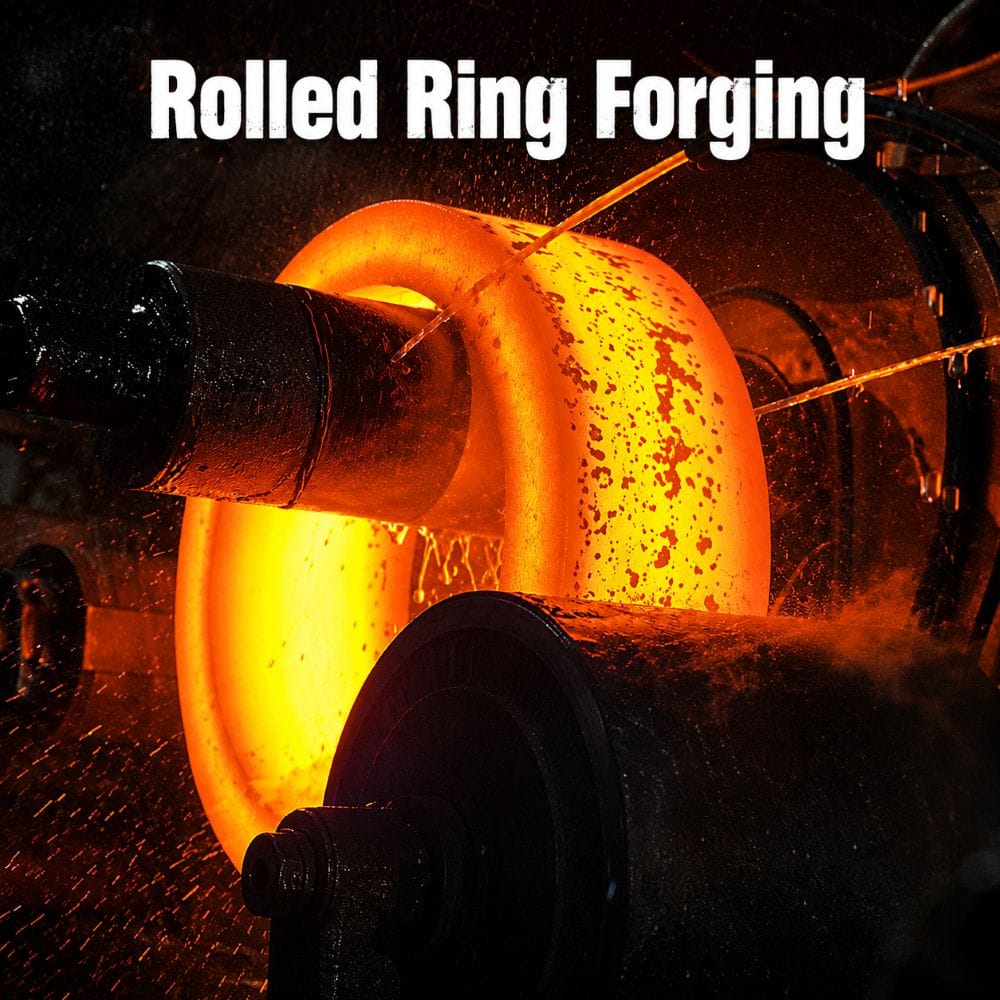
What Is Rolled Ring Forging?
Rolled ring forging, also called ring rolling, produces seamless circular forgings from a heated billet. The billet is upset, pierced to form a hollow blank, and then expanded on a ring rolling mill.
As the ring is rolled, its diameter increases while the cross-section is reduced and controlled. This process is commonly used to produce bearing rings, gear blanks, flanges, structural rings, and heavy-duty transmission components.
What Are the Main Rolled Ring Forging Steps?
The rolled ring forging process typically includes eight stages:
- Material preparation
- Billet heating
- Upsetting
- Piercing
- Ring rolling
- Heat treatment
- CNC machining
- Final inspection
Each stage affects the dimensions, material structure, and final properties of the forged ring.
1. Material Preparation
Material is selected according to the required strength, toughness, wear resistance, heat treatment, and service conditions.
The raw material is then cut into a billet with sufficient volume for upsetting, piercing, ring rolling, and subsequent machining.
2. Billet Heating
The billet is heated to a suitable forging temperature based on the material grade. Uniform heating helps maintain stable material flow during deformation.
Excessive temperature or uneven heating may affect surface condition, grain structure, and forming stability.
3. Upsetting
The heated billet is compressed to reduce its height and increase its cross-sectional area.
This creates the required material distribution for piercing and prepares a stable preform for the following ring rolling operation.
4. Piercing
The center of the upset billet is pierced to create a hollow ring blank.
Piercing accuracy is important because an off-center opening can contribute to uneven wall thickness during subsequent rolling.
5. Ring Rolling
The pierced blank is placed on a ring rolling mill. Radial pressure reduces the wall thickness while progressively increasing the ring diameter.
Axial rolls can also control ring height and face geometry. The target forging dimensions are determined according to the required finished size and machining allowance.
6. Heat Treatment
After ring rolling, heat treatment may be used to achieve the required mechanical properties.
Common treatments include normalizing, annealing, quenching and tempering, and stress relieving. The appropriate process depends on the material grade and application.
7. CNC Machining
Rolled rings are often machined after forging and heat treatment to achieve final dimensions, tolerances, and surface requirements.
Typical operations include turning, boring, drilling, milling, threading, and gear cutting depending on the component design.
8. Final Inspection
Inspection verifies that the forged ring meets the drawing, material specification, and quality requirements.
Typical checks include dimensional inspection, material verification, hardness testing, mechanical testing, and nondestructive testing when required.
How Does Ring Rolling Control the Final Dimensions?
Ring rolling controls the final geometry through coordinated radial and axial deformation.
Radial rolling reduces the wall thickness while increasing the outside and inside diameters. Axial rolling controls ring height and helps maintain the required cross-sectional profile.
Key process parameters include:
- Rolling temperature
- Wall reduction
- Diameter growth
- Ring height
- Roundness
- Rolling speed
- Machining allowance
These parameters are adjusted according to the ring size, material grade, and final component requirements.
Why Is Grain Flow Important in Rolled Ring Forging?
Rolled ring forging creates grain flow that generally follows the circumference of the ring. This material orientation can support good fatigue and impact performance in components exposed to cyclic loading, rotation, or heavy mechanical loads.
However, grain flow is only one factor affecting performance. Material grade, forging reduction, heat treatment, machining, and actual service conditions also need to be considered.
What Materials Are Used for Rolled Ring Forgings?
Carbon steel, alloy steel, and stainless steel are commonly used for rolled ring forgings.
| Material | Typical Grades |
|---|---|
| Carbon Steel | C45, ASTM A105, S355 |
| Alloy Steel | 4140, 4340, 42CrMo4, 34CrNiMo6 |
| Stainless Steel | 304, 316, 316L |
Carbon steel is suitable for many general mechanical applications, while alloy steel is often selected when higher strength, toughness, or fatigue resistance is required.
Material selection should ultimately be based on the drawing, operating conditions, heat treatment, and required mechanical properties.
Rolled Ring Forging vs Casting
Both forged and cast rings are used in industrial applications, but their manufacturing methods create major differences in mechanical performance and reliability.
| Factor | Rolled Ring Forging | Casting |
|---|---|---|
| Grain structure | Continuous grain flow | Random structure |
| Fatigue resistance | Higher | Lower |
| Internal defects | Lower risk | Higher porosity risk |
| Impact resistance | Better | Moderate |
| Material utilization | Higher | Lower |
| Service life | Longer | Shorter |
| Machining allowance | Reduced | Larger |
For rotating or heavily loaded components, forged rings are generally preferred where fatigue strength, concentricity, and long-term reliability are critical.
To learn more about forging and casting differences, you can also explore forging vs casting.
How Are Rolled Ring Forgings Inspected?
Rolled ring forgings can be inspected throughout material preparation, forging, heat treatment, and machining.
Common inspection methods include:
- Dimensional inspection
- Material certificate verification
- Hardness testing
- Tensile and impact testing
- Ultrasonic testing (UT)
- Magnetic particle testing (MT)
UT can be used to evaluate internal discontinuities, while MT is used to detect surface and near-surface discontinuities in suitable ferromagnetic materials.
The inspection plan should follow the customer drawing, material specification, and applicable standards.
Applications of Rolled Ring Forgings
Rolled ring forgings are widely used in industries requiring strength and reliability:
Used in industries requiring strength and reliability:
- Wind Power: bearing rings, yaw drives, tower flanges
- Energy & Oil: turbine casings, pressure vessels, couplings
- Aerospace: engine rings, turbine housings
- Automotive: gear rings, wheel hubs, transmission parts
- Heavy Machinery: slewing rings, crane bearings, shafts
- Mining Equipment: crusher gears, drill joints, conveyor shafts
They offer low distortion, high fatigue resistance, and long service life in demanding environments.
Conclusion
Rolled ring forging is widely used for producing high-strength seamless rings in heavy industrial applications. Compared with cast or fabricated structures, rolled rings generally provide better grain flow, fatigue resistance, and long-term stability under load.
The process is commonly applied in bearing systems, gear components, wind power equipment, and mining machinery where dimensional stability and reliability are important.
For custom forged rings or large-diameter components, early evaluation of material grade, machining requirements, and application conditions can help improve production stability and reduce later processing risks.