
Upset Forging: Process, Applications & Advantages
Upset forging, also known as heading or upsetting, is a precision metal-forming process used to enlarge the cross-sectional area of a heated billet by compressing it along its axis. This method refines the grain structure, increases strength, and improves dimensional uniformity. Unlike open die forging or closed die forging, upsetting in forging focuses on controlled deformation within short sections of a workpiece, making it ideal for producing shafts, bolts, flanges, and couplings that require enhanced toughness and axial strength. The upset forging process plays a vital role in industries such as automotive, energy, and heavy machinery, where structural reliability and consistent quality are essential.
What Is Upset Forging?
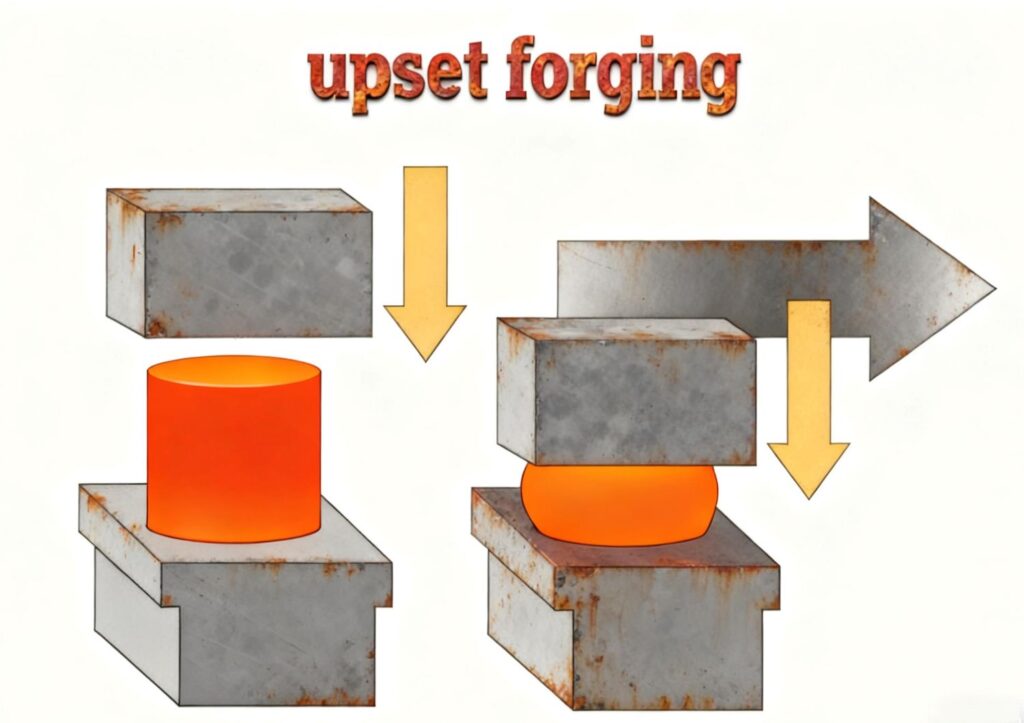
Upset forging, also called upsetting, is a forging process where a metal billet or bar is compressed along its axis to increase diameter while reducing length.
During the process, the workpiece is placed between dies and exposed to compressive force. The material flows outward, creating the required shape without removing excess metal.
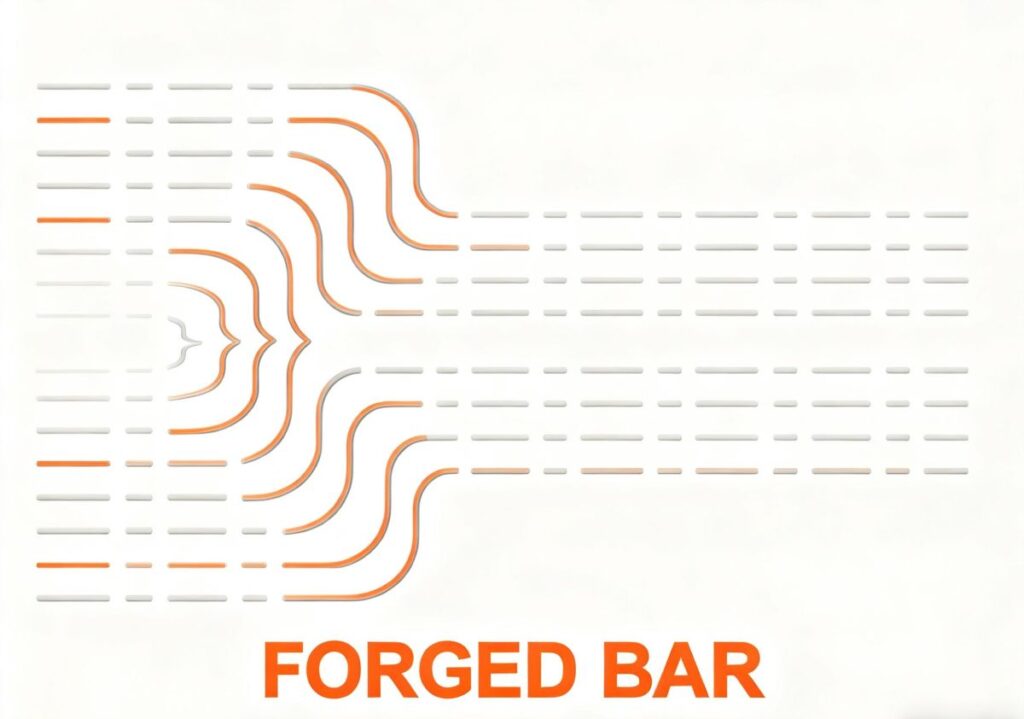
Compared with machining, upset forging helps maintain continuous grain flow, which can improve:
- Fatigue resistance
- Impact strength
- Load-bearing capability
- Component reliability
Because of these advantages, upset forging is commonly used for components exposed to high stress, vibration, and repeated loading.
Upset Forging Process
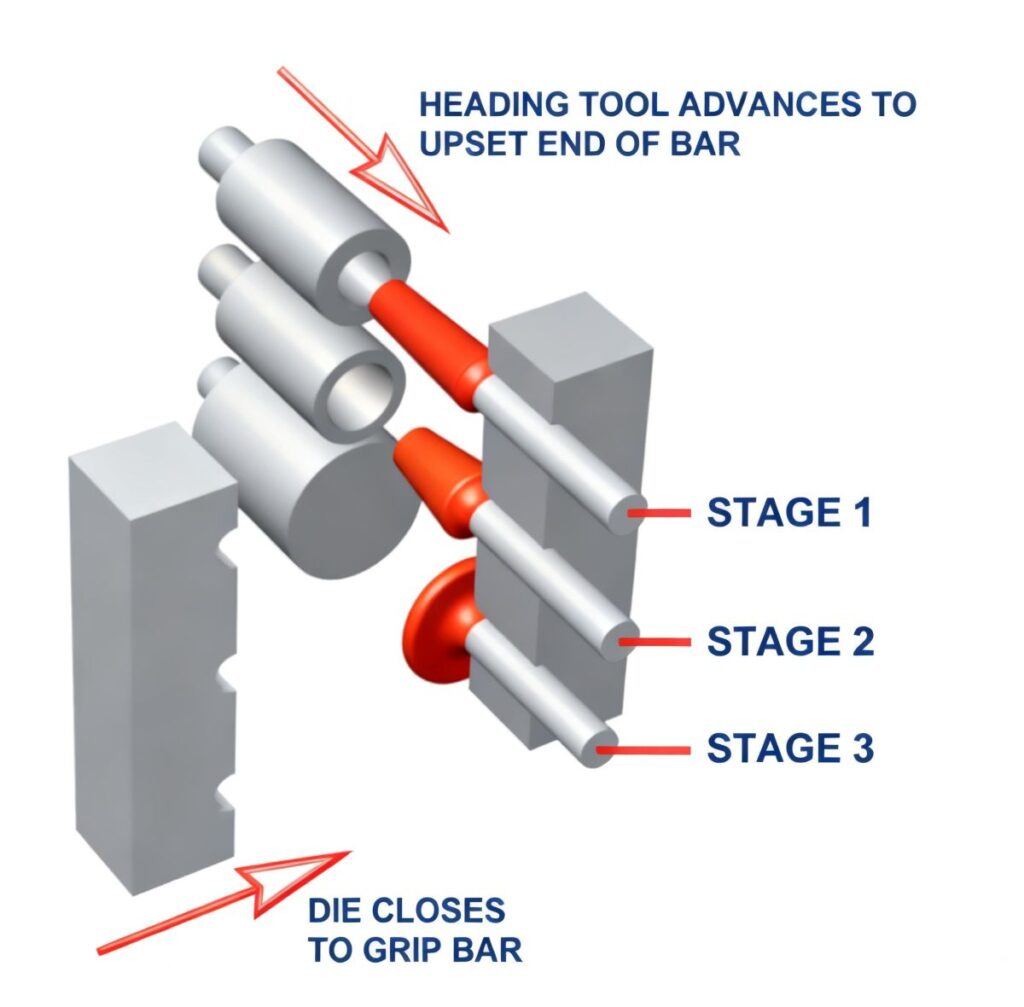
The upset forging process forms metal components by applying axial compression force to a heated billet, increasing its cross-sectional area while improving material strength.
The typical process includes:
- Material heating — Steel billets are heated to a suitable forging temperature to ensure proper material flow.
- Upsetting operation — The billet is compressed between dies, allowing the metal to expand and achieve the required shape.
- Heat treatment and machining — Additional processes such as heat treatment and CNC machining improve mechanical properties and dimensional accuracy.
- Inspection — Final components are checked through dimensional inspection and quality control processes.
This controlled forming process helps produce reliable forged components with improved strength and consistency for industrial applications.
Advantages of Upset Forging
Upset forging offers several key advantages for industrial manufacturing:
Improved grain flow alignment for higher strength
Enhanced fatigue and impact resistance
Better dimensional stability and repeatability
Reduced material waste through near-net-shape forming
Improved efficiency for medium- to high-volume production
Combined with controlled heat treatment and CNC machining, upset forged components achieve stable quality and long service life.
Suitable Materials for This Forming Process
The material selection for upset forging depends on the operating conditions and performance requirements of the final component.
Carbon Steel
Carbon steel is commonly used for general industrial applications requiring good strength and cost efficiency.
Alloy Steel
Alloy steels such as 42CrMo and 4140 are widely used for components requiring:
- High strength
- Wear resistance
- Fatigue performance
Stainless Steel
Stainless steel is selected when corrosion resistance is an important requirement.
Choosing the correct material is essential because it directly affects component performance, service life, and manufacturing reliability.
Applications of Upset Forging
Upset forging is widely used in industries that require high-strength and dimensionally stable components. Typical application fields include:
Automotive industry
Agricultural and construction machinery
Energy and power transmission systems
Heavy machinery and industrial equipment
Aerospace and engineering applications
These industries rely on upset forging to produce durable components with reliable mechanical performance and consistent quality.
Upset Forging vs Cold Heading
Although both processes use compressive deformation, upset forging and cold heading serve different manufacturing needs.
| Upset Forging | Cold Heading | |
|---|---|---|
| Temperature | Hot or warm forming | Usually cold forming |
| Size | Medium and larger parts | Small fasteners |
| Application | Industrial components | Bolts and screws |
Cold heading is commonly used for high-volume small fasteners, while upset forging provides more flexibility for larger components requiring higher mechanical performance.
For heavy-duty industrial applications, upset forging is often preferred because it provides better strength and design flexibility.
Upset Forging vs Other Forging Methods
Different forging methods are selected based on component size, geometry, production volume, and performance requirements.
The following comparison shows how upset forging differs from other common forging processes.
| Forging Process | Main Feature | Typical Applications |
|---|---|---|
| Open Die Forging | Flexible deformation for large and heavy components | Large shafts, rings, oversized parts |
| Closed Die Forging | Uses enclosed dies for complex shapes and repeatable production | Precision industrial components, automotive parts |
| Upset Forging | Axial compression increases diameter and improves material distribution | Shafts, bolts, pins, connection components |
Upset forging is especially suitable when components require improved strength, efficient material usage, and reliable performance under repeated loads.
Upset Forging Capability at Weforging
At Weforging, we provide custom upset forging solutions with integrated forging, machining, heat treatment, and inspection capabilities.
Our manufacturing support includes:
- Process optimization from drawing review to production
- Controlled forging and machining for consistent component quality
- Heat treatment and inspection including hardness testing, UT/MT, and CMM measurement
- Material traceability to support reliable OEM supply
By combining forging and machining in one process chain, we help customers reduce supplier coordination and improve production efficiency.
Conclusion
Upset forging is a reliable manufacturing process for producing strong and durable industrial components. By improving grain flow, reducing material waste, and enhancing mechanical performance, it remains an important solution for applications requiring high strength and long service life.
With integrated forging, machining, heat treatment, and inspection capabilities, Weforging helps OEM customers develop customized forged components with stable quality and controlled production processes.
If you have drawings or technical requirements for upset forged parts, our engineering team can provide manufacturing evaluation and process recommendations.