
Open Die Forging: Process, Benefits & Applications
Open die forging is widely used for producing high-strength components in industries where reliability, durability, and structural performance are critical. Compared with other manufacturing methods, forging helps create components with improved internal structure and mechanical properties for demanding applications.
This article covers the open die forging process, key benefits, common applications, and how this manufacturing method supports the production of large and customized industrial components such as shafts, rings, and heavy-duty parts.
What Is Open Die Forging?
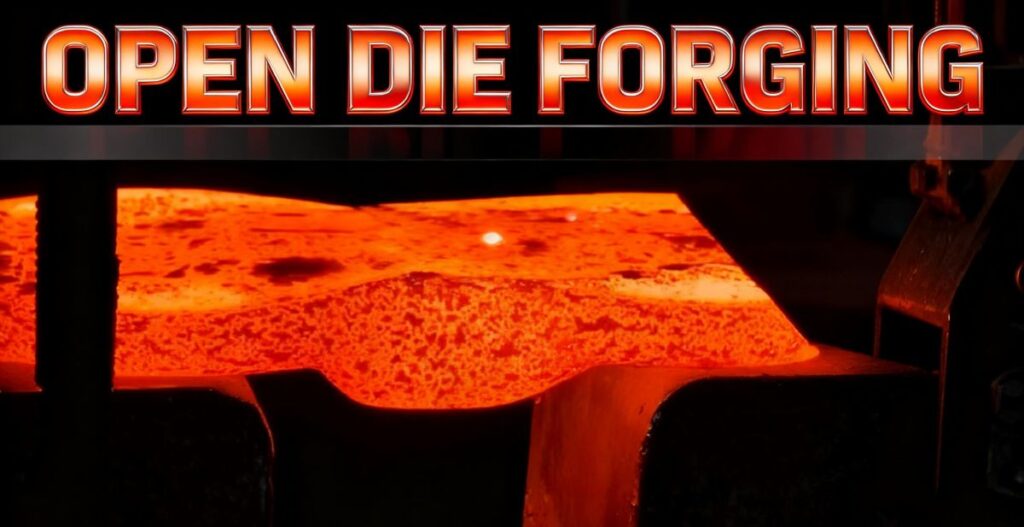
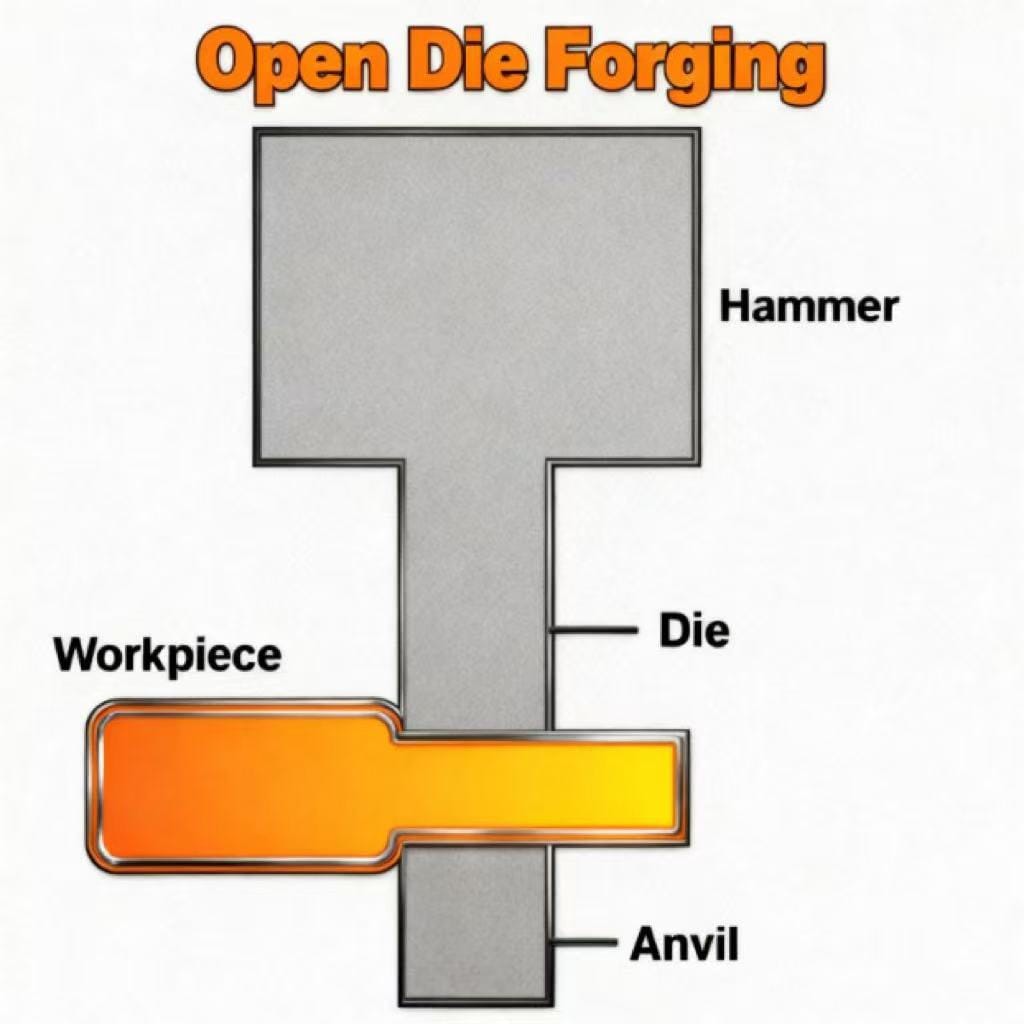
Open die forging is a metal forming process where heated metal is compressed between flat or simple-shaped dies without completely enclosing the material.
During the process, the workpiece is repeatedly pressed and repositioned to achieve the required shape and mechanical properties. This controlled deformation improves grain flow, strength, and fatigue resistance compared with many non-forged manufacturing methods.
Open die forging is commonly used for producing large and customized forged components, including shafts, rings, blocks, and heavy industrial parts. It is widely applied in industries that require high mechanical performance, durability, and reliable service life.
The Open Die Forging Process
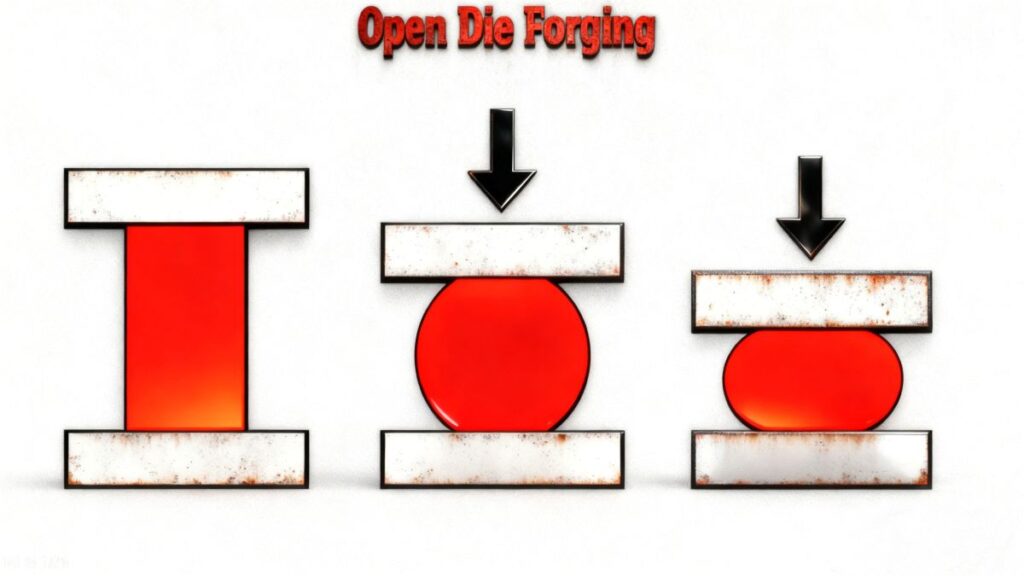
The open die forging process involves several key stages, from material heating to final inspection. Each stage is carefully controlled to achieve the required shape, strength, and dimensional accuracy.
1. Heating
The metal billet is heated to the proper forging temperature to improve plasticity and prepare the material for deformation.
2. Forging Deformation
The heated billet is compressed and shaped between open dies through repeated pressing. This controlled deformation improves grain flow and enhances mechanical properties.
3. Heat Treatment
After forging, processes such as quenching and tempering are applied to achieve the required hardness, strength, and durability.
4. Machining and Inspection
Open die forged components can undergo CNC machining, surface finishing, and dimensional inspection to meet final specifications.
Open Die Forging Materials
Material selection directly affects the strength, durability, and performance of open die forged components. Common open die forging materials include carbon steel, alloy steel, and stainless steel, selected according to application requirements and mechanical properties.
Carbon Steel
Carbon steel is commonly used for forged shafts and industrial components requiring good strength, machinability, and cost efficiency.
Alloy Steel
Alloy steel provides higher strength, toughness, and fatigue resistance for heavy-duty components exposed to high loads.
Stainless Steel
Stainless steel forgings offer corrosion resistance and long-term durability for demanding operating conditions.
The final material choice depends on component size, load requirements, and service environment.
Open Die Forging vs Closed Die Forging Comparison
Open die forging and closed die forging are two common forging methods used for different types of components. The main differences are in die design, component size, production volume, and part complexity.
| Open Die Forging | Closed Die Forging | |
|---|---|---|
| Component size | Large and heavy components | Small to medium-sized components |
| Die design | Simple dies with open deformation | Custom-shaped dies for specific geometries |
| Production volume | Low to medium production runs | Medium to high volume production |
| Part complexity | Suitable for simpler shapes and large structures | Suitable for complex shapes with tighter details |
| Typical applications | Shafts, rings, blocks, heavy industrial parts | Gears, brackets, connecting components |
| Main advantage | Large size capability and strong mechanical properties | Higher efficiency and near-net-shape production |
Open die forging is often preferred for large components that require strength, durability, and flexible production.
Closed die forging is typically used when complex geometries, repeatability, and higher production volumes are the priority.
Advantages of Open Die Forging
For procurement teams, open die forging provides a reliable and cost-effective solution for large and critical components.
- Higher Reliability – Improved grain flow reduces failure risk in demanding applications
- Large Part Capability – Suitable for oversized components that other processes cannot produce
- Lower Material Cost – Less waste compared to casting helps control overall costs
- Flexible for Custom Projects – Ideal for non-standard parts and low-volume production
Applications of Open Die Forged Components
Open die forged components are widely used in industries where strength, durability, and reliability are essential.
- Mining Equipment
Forged shafts and structural components withstand heavy loads and continuous operation. - Construction Machinery
Forged parts provide durability for equipment exposed to repeated stress. - Transmission Systems
Forged shafts and rings support high-load applications requiring stable performance. - Renewable Energy Equipment
Large forged components provide reliable performance for demanding operating conditions.
Cost Factors of Open Die Forging
The cost of open die forging can vary depending on project requirements. Unlike standard parts, pricing is influenced by multiple technical and production factors rather than a fixed unit price.
Key Cost Factors
- Material Type – Alloy steel, carbon steel, or stainless steel differ in raw material cost and processing requirements
- Part Size and Weight – Larger forgings require more material, higher forming force, and longer processing time
- Deformation and Complexity – More complex geometries or higher deformation ratios increase production difficulty
- Heat Treatment and Machining – Additional processes such as quenching, tempering, or CNC machining impact total cost
- Order Quantity – Small batch or custom production typically results in higher unit costs
How to Choose the Right Open Die Forging Company
When selecting an open die forging supplier, procurement teams should consider several key factors to ensure quality and long-term performance.
Material Quality: Using high-grade raw materials helps ensure durable, reliable forged parts. A trustworthy supplier maintains stable metallurgical performance throughout production.
Technical Capability: With strong engineering expertise, the right forging partner can produce large or complex components while maintaining precision and structural integrity.
Reliable Delivery: In addition, a consistent delivery record helps keep projects on schedule and reduces downtime across production lines.
Testing and Certification: More importantly, suppliers that perform ultrasonic testing, hardness checks, and metallographic analysis can ensure compliance with international safety and performance standards.
By evaluating these aspects, procurement teams can build a dependable partnership with a capable forging company that supports efficient operations and long-term project success.
Conclusion
Open die forging provides excellent strength, flexibility, and customization, making it ideal for large, high-performance components in industries like automotive, mining, and energy. Its high efficiency and low material waste ensure lasting value in modern manufacturing.
At Weforging, we combine advanced forging equipment, CNC precision, and strict testing to deliver reliable open die forging solutions. Whether standard or custom parts, we support your project with durable, high-quality components.
📩 Contact us to learn how our open die forging can support your needs.