
What Is Forging? Process, Benefits and Applications
Forging is one of the most widely used metal forming processes for producing components that require high strength, reliability, and long service life. By shaping heated metal under compressive force, the forging process improves internal grain flow and creates parts that perform better under heavy loads and repeated stress.
Today, forged parts are used across industries such as mining equipment, construction machinery, power transmission, energy systems, agriculture, and transportation. Components including shafts, gear blanks, bearing rings, flanges, and fasteners are commonly manufactured through forging before final machining.
This guide explains what forging is, how the forging manufacturing process works, the different types of forging methods, and how to choose the right forging solution for your project.
What Is Forging?
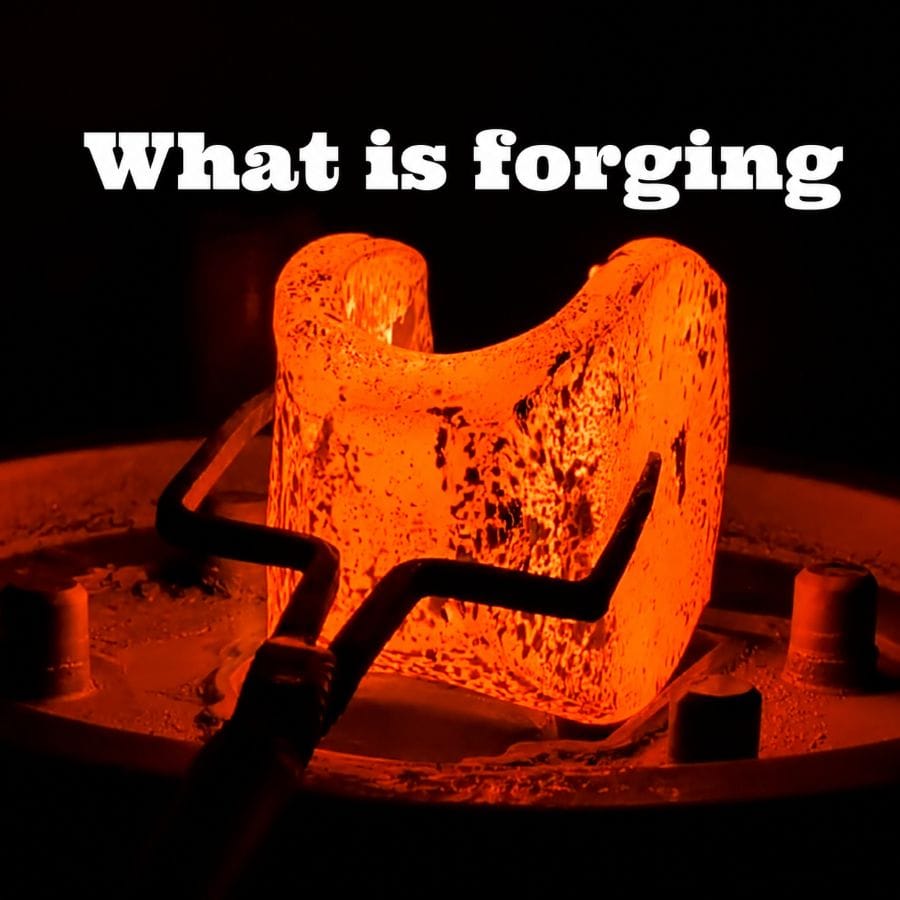
Forging is a manufacturing process in which solid metal is plastically deformed into a required shape under compressive force.
The starting material may be supplied as a billet, bar, ingot, or preformed blank. It is then shaped between dies or tooling using a press, hammer, upsetter, or rolling machine.
The basic principle is simple: sufficient force is applied to make the metal flow without breaking. However, producing reliable industrial forgings requires careful control of material quality, forming temperature, deformation, die design, cooling, and heat treatment.
During deformation, the internal grain structure follows the direction of material flow. When tooling and preform design are properly controlled, this grain flow can follow the contour of the finished part. This is one reason forged components are frequently selected for applications involving impact, torque, vibration, or repeated loading.
The Forging Manufacturing Process
The forging manufacturing process involves several stages, each contributing to the final quality of the component.
1. Material Selection
The process begins with selecting the appropriate material based on strength requirements, operating conditions, and machining needs.
2. Billet Cutting and Heating
Raw material is cut into billets and heated to the required forging temperature. Proper heating ensures sufficient plasticity while minimizing the risk of defects.
3. Forging
The heated billet is shaped using a forging press, hammer, or ring rolling machine. Depending on the application, the process may involve open die forging, closed die forging, or rolled ring forging.
4. Trimming and Preliminary Processing
Excess material is removed and the forged shape is prepared for downstream operations.
Processes such as normalizing, quenching and tempering, carburizing, or induction hardening may be applied to achieve required mechanical properties.
Critical dimensions, holes, gear teeth, and functional surfaces are machined to meet drawing specifications.
7. Inspection and Documentation
Dimensional inspection, material verification, and non-destructive testing help ensure product quality before shipment.
Benefits and Limitations of Forging
The main advantages of forging are high mechanical strength, improved fatigue performance, reliable internal structure, and efficient material distribution.
However, forging also involves tooling, geometric, tolerance, and process-control limitations.
Main Benefits
| Forging benefit | Practical value |
|---|---|
| Directional grain flow | Improved fatigue and load-bearing performance |
| Refined grain structure | Better strength and toughness |
| Reduced internal porosity | More reliable structural integrity |
| Efficient material distribution | Strength can be concentrated in critical areas |
| Near-net shaping | Less machining than producing complex parts from solid bar |
| Wide size range | Suitable for small fasteners through large shafts and rings |
| Repeatable production | Stable dimensions and properties for recurring orders |
Forging is particularly suitable for components exposed to impact, shock, torque, bending, vibration, or cyclic loading.
Main Limitations
- Closed die forging normally requires dedicated tooling.
- Complex internal cavities and undercuts may be difficult to produce.
- Forged surfaces usually require machining for final tolerances.
- Heating can create scale, oxidation, and dimensional variation.
- Process quality depends on temperature, material flow, die design, and cooling.
- Very small production quantities may result in higher unit costs.
Forging should therefore be selected according to the full project requirement rather than strength alone.
Main Types of Forging
The main types of forging include open die forging, closed die forging, rolled ring forging, upset forging, press forging, and hammer forging.
Each method is suitable for different component sizes, geometries, quantities, and performance requirements.
Open Die Forging
Open die forging shapes metal between dies that do not completely enclose the workpiece.
The billet is moved and rotated between repeated press strokes or hammer blows. This gradually changes its length, cross-section, or general geometry.
Open die forging is commonly used for:
- Large shafts
- Blocks
- Cylinders
- Discs
- Hubs
- Large rings
- Low-volume heavy components
Its main advantages are relatively low tooling cost, flexibility, and the ability to produce large custom forgings.
Its limitations include greater machining allowance, lower dimensional accuracy, and less capability for detailed shapes.
Open die forging is generally suitable for low-volume or large components that do not justify complex closed dies.
Closed Die Forging
Closed die forging, also called impression die forging, shapes metal inside one or more die cavities.
The billet is placed between shaped dies, and compressive force makes the material flow into the cavity. Excess material may form flash around the parting line and is removed after forging.
Typical closed die forged parts include:
- Gears and gear blanks
- Connecting rods
- Levers
- Brackets
- Clevises
- Fasteners
- Automotive components
- Industrial machinery parts
Closed die forging provides better dimensional consistency, repeatability, and material distribution than open die forging.
It is well suited to medium- and high-volume production, although tooling design, manufacture, and validation increase initial cost.
Rolled Ring Forging
Rolled ring forging produces seamless rings by reducing ring wall thickness while increasing the outside diameter.
A pierced ring blank is placed between a driven roll and an idler roll. As the wall becomes thinner, the diameter expands. Axial rolls may also control ring height.
Common products include:
- Bearing rings
- Gear rings
- Slewing rings
- Flanges
- Pressure vessel rings
- Wind power rings
- Heavy equipment rings
Rolled ring forging provides seamless construction, circumferential grain flow, efficient material use, and good mechanical performance under radial and cyclic loads.
Final rings may require heat treatment, turning, drilling, gear cutting, or grinding.
Upset Forging
Upset forging increases the cross-sectional area of a billet by compressing its length.
It is commonly used to produce:
- Bolt heads
- Pins
- Fasteners
- Valve components
- Shaft ends
- Flanged sections
The process is efficient for repeated production and can produce favorable grain flow around enlarged sections.
Press Forging
Press forging applies gradual, controlled pressure rather than repeated impact.
The force acts for a longer period and can penetrate more evenly through the workpiece. Hydraulic and mechanical presses are used for both open die and closed die production.
Press forging is suitable for large sections, controlled deformation, repeatable components, and parts requiring stable force application.
Hammer Forging
Hammer forging shapes metal using repeated impact blows.
It can be used for open die work and impression die forgings. The process provides rapid deformation but requires careful control of billet position, temperature, impact energy, and die filling.
Forging Processes by Temperature
Forging processes are commonly classified by forming temperature because temperature directly affects material flow, forming force, dimensional accuracy, tooling life, and production cost.
The three main temperature classifications are hot forging, warm forging, and cold forging. Each is suited to different materials, part geometries, and production requirements.
Hot Forging
Hot forging is performed above the material’s recrystallization temperature, allowing the metal to deform more easily under lower forming forces.
It is the preferred process for large components, complex shapes, and applications requiring high strength and continuous grain flow.
Typical applications
- Gear blanks
- Large shafts
- Bearing rings
- Flanges
- Mining equipment components
- Construction machinery parts
Advantages
- Excellent material formability
- Suitable for large and complex parts
- Lower forming force
- Improved grain flow
Limitations
- Oxidation and scale formation
- Additional machining is usually required
Warm Forging
Warm forging is performed between cold and hot forging temperatures.
It offers a balance between material formability and dimensional accuracy, making it suitable for medium-sized components that require tighter tolerances than conventional hot forging.
Advantages
- Better dimensional accuracy than hot forging
- Lower forming force than cold forging
- Reduced scale formation
Typical applications
- Automotive components
- Transmission parts
- Precision industrial components
Cold Forging
Cold forging is performed at or near room temperature.
It is commonly used for small precision components produced in high volumes, where dimensional accuracy and surface finish are critical.
Typical applications
- Fasteners
- Bushings
- Pins
- Small shafts
- Automotive fittings
Advantages
- High dimensional accuracy
- Excellent surface finish
- No oxidation during forming
Limitations
- Higher forming force
- Limited part size and deformation
Hot Forging vs. Cold Forging
| Factor | Hot Forging | Cold Forging |
|---|---|---|
| Forming Temperature | Above recrystallization temperature | Near room temperature |
| Best For | Medium to large components | Small precision parts |
| Material Formability | Excellent | Limited |
| Dimensional Accuracy | Moderate | High |
| Surface Finish | Requires machining | Better as forged |
| Production Volume | Flexible | High-volume production |
For heavy-duty industrial parts such as shafts, gear blanks, bearing rings, and flanges, hot forging remains the most widely used process because it allows greater material deformation and improved grain flow.
Cold forging is generally preferred for high-volume precision components where dimensional accuracy and surface finish are more important than large-scale deformation.
Typical Forging Temperature Ranges
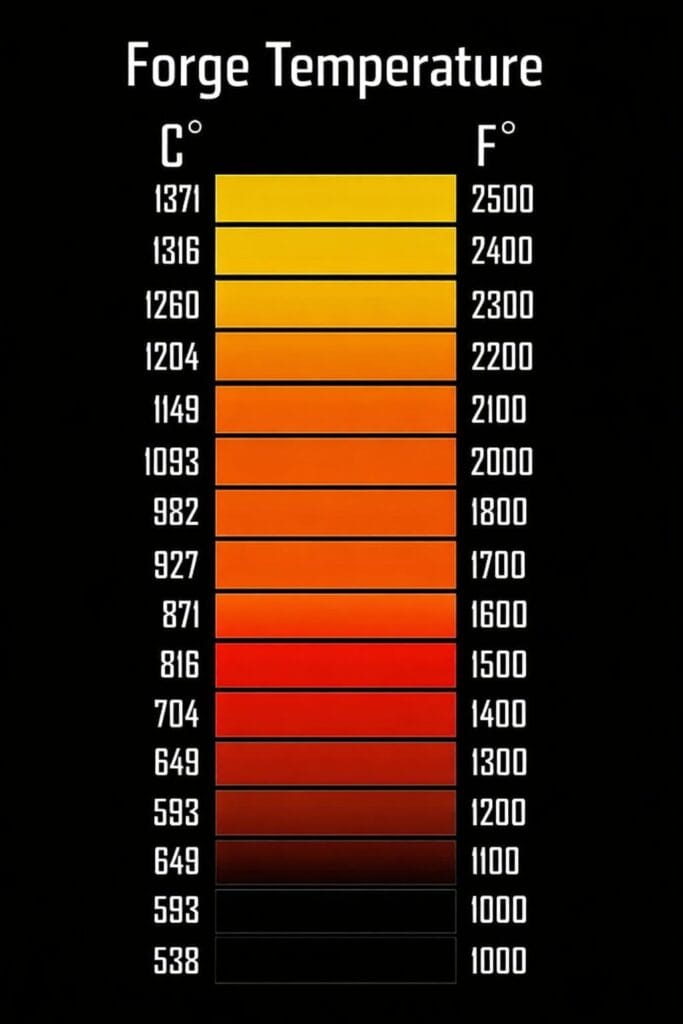
Forging temperature varies depending on material type and desired mechanical properties.
| Material | Typical Forging Temperature |
|---|---|
| Carbon Steel | 1100–1250°C |
| Alloy Steel | 1050–1200°C |
| Stainless Steel | 950–1150°C |
| Aluminum Alloys | 350–500°C |
Maintaining the correct temperature is critical. Excessive temperatures may lead to grain growth and reduced mechanical performance, while insufficient temperatures can increase forming resistance and the risk of cracking.
For OEM projects with strict quality requirements, stable temperature control is an important part of achieving consistent production results.
Forging vs. Casting vs. Machining
Forging, casting, and machining are suited to different component geometries, performance requirements, production volumes, and budgets.
| Factor | Forging | Casting | Machining from Bar |
|---|---|---|---|
| Mechanical performance | High strength and fatigue resistance | Depends on alloy and casting quality | Depends on stock material |
| Shape capability | Best for strong, load-bearing shapes | Best for complex cavities and housings | Best for precise, machinable geometry |
| Dimensional accuracy | Final machining usually required | Varies by casting method | High |
| Tooling cost | Moderate to high | Moderate to high | Low |
| Material efficiency | Good with near-net forging | Generally good | Lower because material is removed |
| Best suited for | High-load production parts | Complex shapes and housings | Prototypes and low-volume precision parts |
│ Forging vs. Casting
Forging is generally preferred for components that require high strength, fatigue resistance, impact performance, and structural reliability. Casting is more suitable for complex internal cavities, housings, and shapes that are difficult to forge.
│ Forging vs. Machining
Machining from bar is suitable for prototypes, low-volume orders, and parts requiring high dimensional accuracy. For repeat production, near-net forging can reduce material waste and machining time while providing favorable grain flow.
How to Choose the Right Forging Process
The correct forging process depends on geometry, dimensions, material, mechanical requirements, quantity, tolerance, tooling budget, and post-processing needs.
| Project requirement | Likely process direction |
|---|---|
| Large, simple, low-volume component | Open die forging |
| Repeatable complex geometry | Closed die forging |
| Seamless large-diameter ring | Rolled ring forging |
| Enlarged shaft end or fastener head | Upset forging |
| Small precision part at high volume | Cold forging |
| Large deformation or heavy component | Hot forging |
| Tight functional dimensions | Forging followed by CNC machining |
Conclusion
Forging is a key process in modern manufacturing, known for improving strength, reliability, and long-term performance. By shaping metal under controlled force, the forging process creates components that perform better in demanding applications.
At Weforging, we combine forging, CNC machining, heat treatment, and inspection into one integrated solution. This ensures consistent quality and simplifies your supply chain.
👉 If you have drawings or specifications, we can quickly review your project and recommend the most suitable solution.