
Hot Forging vs Cold Forging: Differences & Advantages
Hot forging and cold forging are two widely used metal forming processes, but they differ significantly in forming temperature, material behavior, dimensional accuracy, surface finish, forming force, production volume, and suitable part size.
Cold forging is generally preferred for high-volume precision components produced near room temperature, while hot forging offers greater material formability for larger, more complex, or high-strength components. Warm forging sits between the two and can provide a balance between forming force, accuracy, and material flow.
This guide compares hot forging vs cold forging in terms of temperature, mechanical properties, tolerances, cost, materials, applications, and process selection.
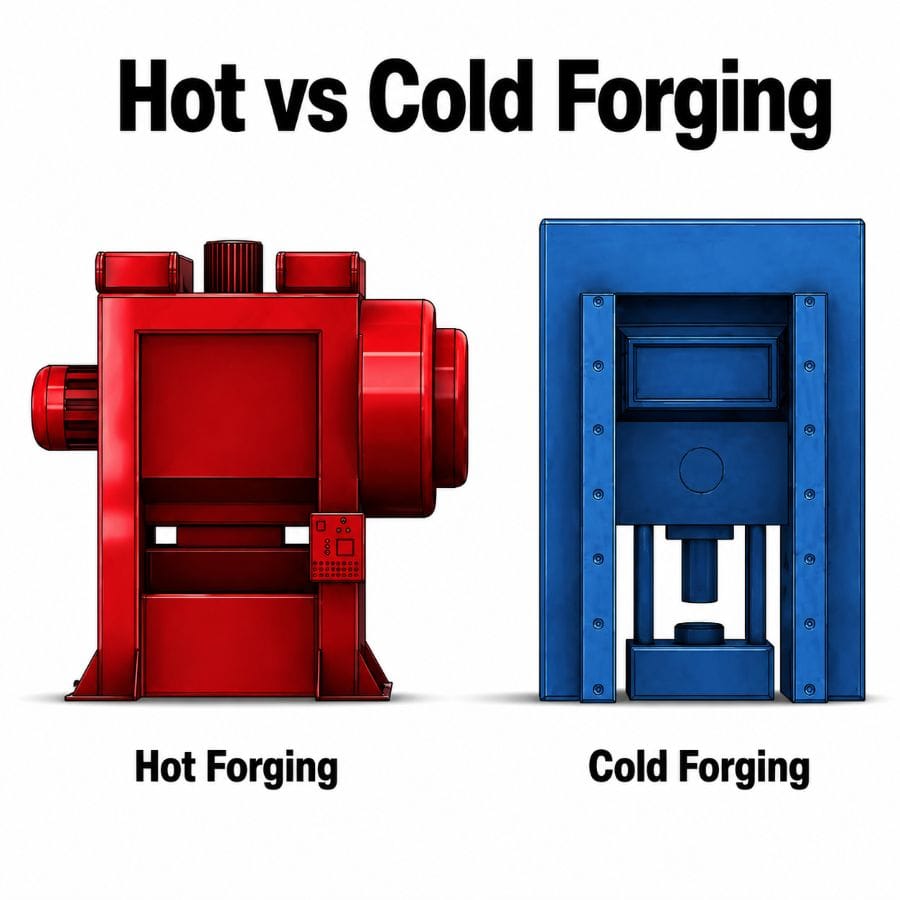
Hot Forging vs Cold Forging: Short Answer
Hot forging forms metal above its recrystallization temperature, reducing deformation resistance and making it easier to produce larger or more complex components. Cold forging shapes metal at or near room temperature, typically providing tighter dimensional control, smoother surface finish, and high production efficiency.
In general, cold forging is better suited to small, high-volume precision parts, while hot forging is more practical for larger components, complex geometries, and materials requiring greater formability.
Hot Forging vs Cold Forging: Quick Comparison
The table below summarizes the main differences between hot forging and cold forging.
| Factor | Cold Forging | Hot Forging |
|---|---|---|
| Temperature | At or near room temperature | Above recrystallization temperature |
| Forming Force | Higher | Lower |
| Accuracy | Higher | Moderate |
| Surface Finish | Smoother | Scale may occur |
| Work Hardening | Significant | Limited |
| Part Size | Small to medium | Medium to large |
| Shape Complexity | More limited | More flexible |
| Typical Use | Precision, high-volume parts | Larger, complex, heavy-duty parts |
Cold forging is generally better for precision and high-volume production, while hot forging is better suited to larger parts, complex shapes, and materials requiring greater formability.
What is cold forging?
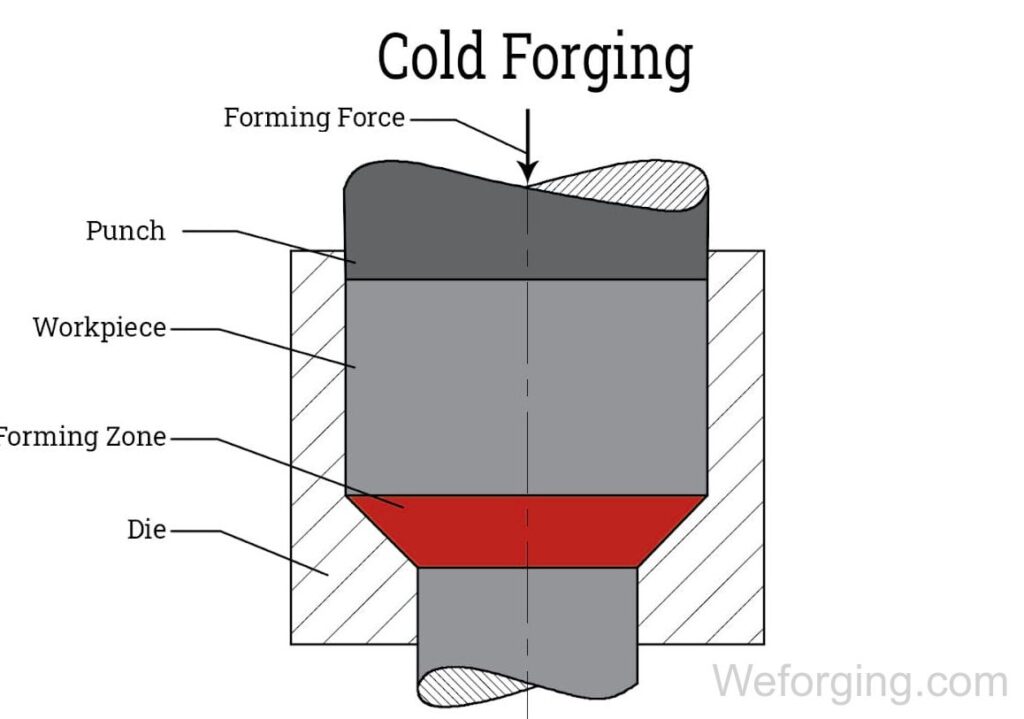
Cold forging, also called cold forming, shapes metal at or near room temperature using high compressive forces and precision dies. Because the material is not heated above its recrystallization temperature, deformation produces work hardening, which can increase hardness and strength.
Cold forging is commonly used for relatively small components where dimensional repeatability, surface quality, and production efficiency are important. Typical examples include fasteners, pins, connectors, small shafts, and other high-volume precision components.
Advantages of Cold Forging
Cold forging can provide:
- High dimensional accuracy and repeatability
- Smooth as-forged surface finish
- Minimal oxidation and scale
- Good material utilization
- Strength improvement through work hardening
- High productivity in large-volume manufacturing
- Reduced secondary machining for suitable geometries
However, cold forging requires high forming loads and becomes more difficult as part size, material strength, or geometric complexity increases.
What is hot forging?
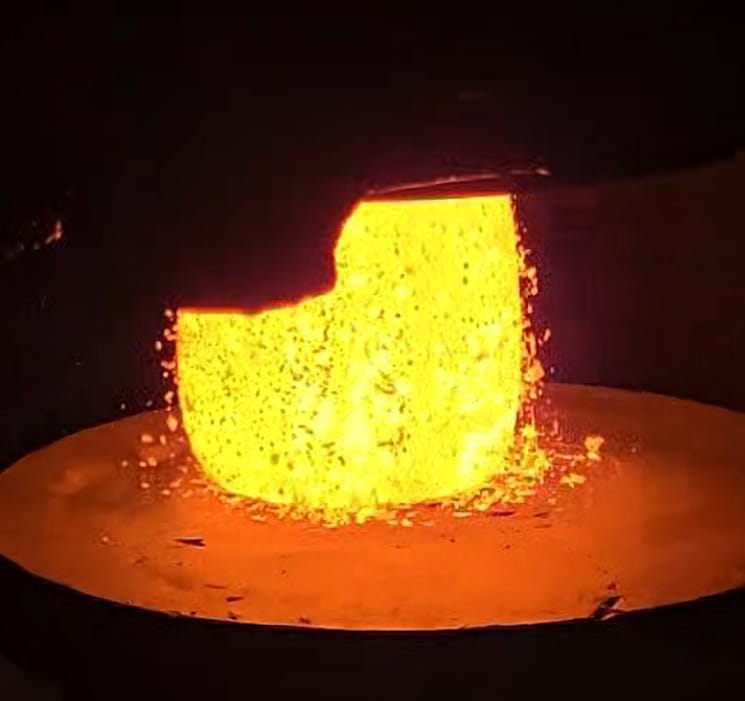
Hot forging shapes metal after heating it above its recrystallization temperature. At elevated temperatures, the metal has lower flow stress and greater ductility, allowing substantial deformation with lower forming forces than cold forging.
For steel components, hot forging is commonly used for gear blanks, shafts, flanges, rolled rings, structural components, and heavy-duty machinery parts where size, material flow, and mechanical performance are important.
Advantages of Hot Forging
Hot forging offers several manufacturing advantages:
- Greater material formability
- Lower forming resistance
- Ability to produce larger components
- Better suitability for complex geometries
- Favorable grain flow around the forged shape
- Broad compatibility with carbon and alloy steels
- Reduced risk of cracking during large deformation
- Good suitability for parts exposed to heavy loads and fatigue
Its main limitations include oxidation, scale formation, wider as-forged tolerances, heating energy, and the possible need for subsequent machining.
Hot Forging vs Cold Forging Temperature
Temperature is the most fundamental difference between hot forging vs cold forging.
| Process | Temperature Range |
|---|---|
| Cold Forging | Room temperature |
| Warm Forging | 600–900°C |
| Hot Forging | 900–1250°C |
In cold forging, the material remains at ambient temperature during deformation. This improves precision but requires very high forming forces.
In hot forging, the metal is heated above its recrystallization temperature. This reduces resistance to deformation and allows larger shapes to be formed.
However, heating the material can also lead to surface oxidation and scale formation, which may require additional finishing processes.
Hot Forging Process vs Cold Forging Process
Both processes use compressive force to deform metal, but heating requirements and downstream operations differ.
| Process Stage | Cold Forging | Hot Forging |
|---|---|---|
| Raw Material Preparation | Wire, bar, billet, or preform | Billet or cut stock |
| Heating | Normally not required | Furnace or induction heating required |
| Lubrication | Critical for reducing friction and die wear | High-temperature lubrication may be used |
| Forming | High-pressure die forming | Press or hammer deformation |
| Multi-Step Forming | Common for complex shapes | Preforming and multiple impressions may be used |
| Trimming | Depends on process | Common in closed-die forging |
| Heat Treatment | Application-dependent | Frequently used after forging |
| Machining | Often limited | Common where tighter final tolerances are required |
Cold forging relies more heavily on die precision and forming force, while hot forging relies on temperature control, material flow, and controlled cooling.
Mechanical Properties: Hot Forging vs Cold Forging
Mechanical performance is another important factor when comparing cold forging vs hot forging.
Cold forged parts often exhibit increased hardness and strength because of work hardening during deformation.
However, hot forging improves grain flow and internal structure, which enhances fatigue resistance and toughness.
In general:
Cold forging improves hardness and dimensional accuracy
Hot forging improves ductility and structural integrity
Both processes can produce strong components, but the final performance depends on material selection and heat treatment.
Advantages and Disadvantages of Hot vs Cold Forging
| Process | Main Advantages | Main Limitations |
|---|---|---|
| Cold Forging | High accuracy, smooth finish, high production efficiency, work hardening, low material waste | High forming force, restricted geometry, more demanding tooling |
| Warm Forging | Lower forming force than cold forging, good dimensional control, improved material flow | Requires temperature control and more complex process optimization |
| Hot Forging | High formability, suitable for large parts and strong alloys, favorable grain flow, complex shapes | Heating energy, oxidation, scale, wider as-forged tolerances |
The best option therefore depends on the entire manufacturing route rather than one isolated advantage.
Cost Comparison: Hot Forging vs Cold Forging
Cost considerations are important when choosing between hot forging and cold forging.
| Cost Factor | Cold Forging | Hot Forging |
|---|---|---|
| Energy consumption | Low | Higher due to heating |
| Tooling cost | Higher precision dies | Moderate |
| Material waste | Very low | Slightly higher |
| Production volume | Ideal for high volume | Flexible for large parts |
Cold forging can be more cost-effective when producing large quantities of small parts.
Hot forging may be more economical for large or complex components, where cold forming would require excessive force or multiple steps.
Different industries select cold or hot forging based on performance and production requirements:
Cold Forging Applications
Automotive fasteners and connectors
Bolts, nuts, and precision metal fittings
Small shafts and sleeves
High-volume precision components
Hot Forging Applications
Gear blanks and transmission parts
Large shafts and flanges
Ring forgings and heavy machinery components
Structural parts exposed to high loads
Cold forging is ideal where dimensional accuracy and production efficiency are critical, while hot forging is chosen when strength and load capacity are priorities.
Choose cold forging when:
Producing high-volume small parts
Tight tolerances and good surface finish are required
Parts such as fasteners and precision components are needed
Choose hot forging when:
Manufacturing large or high-strength components
Parts must withstand heavy loads or impacts
Products include gears, shafts, or ring forgings
In summary: Cold forging is ideal when precision and production efficiency are priorities, while hot forging is preferred for larger components requiring higher strength and durability in demanding industrial applications.
Conclusion
Choosing between hot, warm, and cold forging depends on more than part size alone. Material grade, geometry, production quantity, mechanical requirements, tolerances, and downstream machining should be evaluated together.
For custom forged components, providing the drawing, material specification, expected quantity, heat-treatment requirement, and critical tolerances allows the manufacturing route to be evaluated more accurately.