
Custom Underground Mining Support Parts: What OEM Buyers Should Consider
Underground mining support assemblies rely on a range of metal parts to anchor, fasten, connect, and transfer loads. Some are standard items, but others must match a specific support design, mating component, or OEM specification.
Anchor heads, bearing plates, heavy-duty nuts, sleeves, couplings, and drive components can differ in geometry, material, threads, mechanical properties, and inspection requirements. Within custom mining ground support components, these parts are often produced to match a specific assembly or OEM drawing rather than selected by nominal size alone.
This guide looks at underground mining support parts from an OEM sourcing perspective: when custom manufacturing is needed, which features deserve the most control, how manufacturing routes differ by part, and what should remain consistent from an approved sample to repeat production.
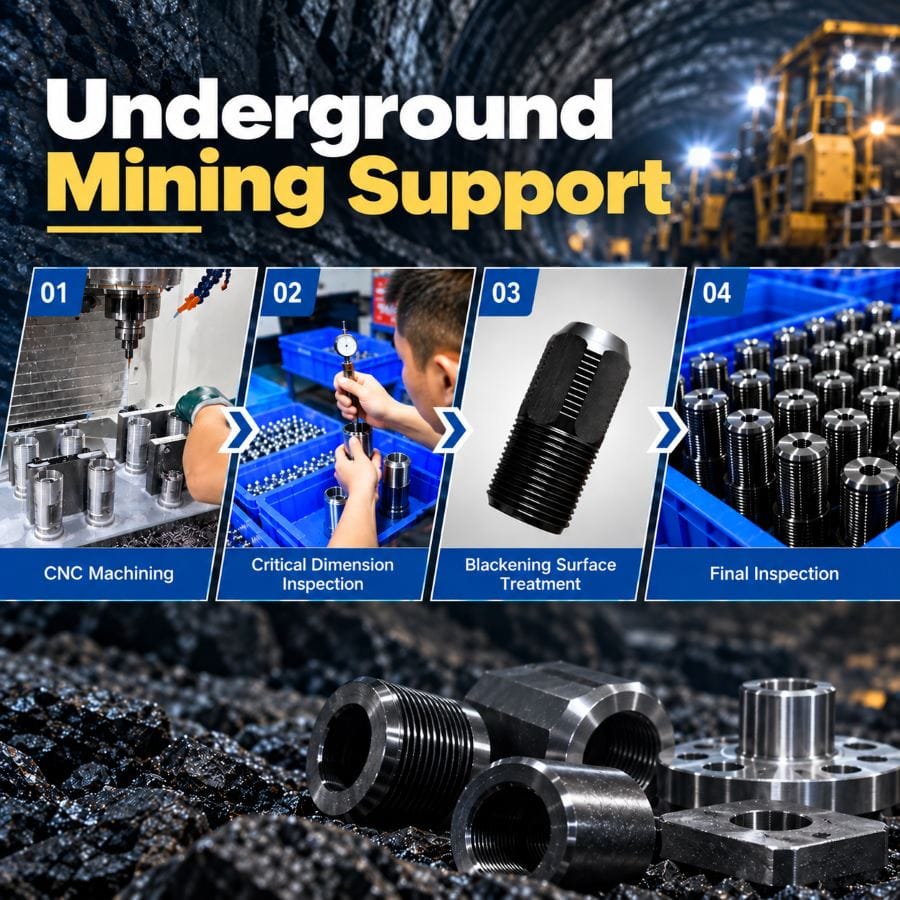
What Are Underground Mining Support Parts?
Underground mining support parts are the individual components used within roof, rock, cable, and related ground support assemblies. Their functions typically fall into four areas: anchoring, load transfer, fastening, and connection.
Function | Typical Parts |
Anchoring | Anchor heads, anchor components |
Load Transfer | Bearing plates, support plates |
Fastening | Heavy-duty nuts, washers |
Connection | Couplings, sleeves |
Drive / Assembly | Hex driver sockets, custom drive features |
These parts may look simple individually, but their interfaces matter. A thread must fit its mating part, a bearing surface must seat correctly, and an anchor or connecting feature must match the surrounding assembly.
Which Underground Mining Support Parts Need Custom Manufacturing?
A support part usually needs custom manufacturing when its function depends on more than a standard diameter, thread, or catalog dimension.
Typical reasons include a drawing-specific profile, non-standard thread, controlled bearing face, special bore or drive feature, defined material condition, heat treatment, mechanical properties, or inspection criteria. The interface with the mating component may also determine dimensions that cannot be replaced by an approximate standard size.
A custom mining anchor head, for example, may combine internal and external threads, machined profiles, holes, bearing features, and specified mechanical properties in one part.
For repeat OEM projects, the goal is not simply to reproduce the shape. The manufacturer needs a production route capable of repeating the critical characteristics defined by the approved drawing.
Does Every Underground Mining Support Part Need Forging?
No. Forging is suitable for many load-bearing parts, but it is not the default process for every underground mining component.
The manufacturing route should follow the finished geometry, material, mechanical requirements, production quantity, and the amount of secondary machining required.
Part | Possible Route |
Anchor Head | Forging or CNC machining |
Hex Driver Socket | Hot forging + machining / cold extrusion where suitable |
Bearing or Support Plate | Blanking, stamping and forming |
Heavy-Duty Nut | Hot forging + secondary machining |
Sleeve / Coupling | Forging or bar stock + CNC |
For suitable repeat-production parts, closed die forging can provide an efficient preform before heat treatment and final machining. Other parts may be better suited to cold extrusion, stamping, or direct machining.
A custom hex driver socket is a useful example: the process depends on its geometry, material, performance requirements, and quantity rather than on an assumption that every socket must be forged.
For a broader process comparison, see our guide to forged, cast or machined mining parts.
What Should OEM Buyers Define on the Drawing?
For custom support parts, the drawing should define the requirements that affect fit, function, manufacture, and acceptance. A material grade and overall dimensions alone may leave too much open to interpretation.
Important information can include:
- material grade and applicable standard;
- critical dimensions and tolerances;
- thread form, pitch, class, and standard;
- mating and bearing surfaces;
- bore, hole, or drive-feature requirements;
- required mechanical properties;
- heat treatment and hardness where applicable;
- surface treatment or corrosion protection;
- inspection and documentation requirements;
- current drawing revision.
The most useful drawings also identify critical-to-function features. A thread affects assembly, a bearing face affects load transfer, and a bore or hole position can affect alignment.
This distinction helps the manufacturer plan production and inspection around the characteristics that actually matter.
Which Features Need the Most Manufacturing Control?
Not every dimension on an underground mining support part carries the same functional risk. Manufacturing control should focus first on the features that affect assembly, alignment, load transfer, and interchangeability.
Feature | Why It Matters |
Threads | Fit and assembly with mating parts |
Bearing surfaces | Seating and load transfer |
Bores and holes | Position and alignment |
Drive features | Installation and tool engagement |
Mating diameters | Fit and interchangeability |
Unmachined formed surfaces | Must be controlled during forging or forming |
The last point is easy to overlook. If an internal hex, formed profile, or similar feature is not machined afterward, its geometry must be established and controlled during the forming process itself.
For the hex driver socket, Weforging uses a custom-made hex plug gauge to verify the formed internal hex, allowing this non-machined feature to be checked on every part. This provides a practical 100% inspection method for a feature that directly affects tool engagement and assembly.
Depending on the part and drawing requirements, inspection may also include thread gauges, dimensional inspection, CMM, hardness testing, material verification, and specified mechanical testing for forgings.
What Should Buyers Verify Before Repeat Production?
An approved sample establishes more than a dimensional reference. It can also establish the technical basis for repeat production.
Before a repeat order enters production, buyers and manufacturers should confirm that the key requirements remain unchanged:
Drawing Revision → Material Specification → Manufacturing Route → Heat Treatment → Critical Features → Inspection Requirements
If one of these changes, its effect on the approved part should be reviewed before the change is introduced into production.
Traceability can link material heat numbers, production batches, heat-treatment records, and inspection results according to project requirements. Where specified, a laser-marked identification code can also be applied directly to the finished part, linking the physical component to its corresponding batch and production records.
The purpose is not to create paperwork for its own sake, but to make it possible to identify which material, process, and inspection records belong to a specific production batch or marked component.
For long-running OEM programs, this traceability—together with the approved sample and controlled production requirements—provides a practical technical reference for subsequent batches.
How Should OEM Buyers Evaluate a Custom Mining Parts Manufacturer?
A supplier that can produce one acceptable sample is not necessarily ready for repeat production.
For build-to-drawing underground mining parts, supplier evaluation should focus on whether the manufacturer can understand the drawing, identify critical interfaces, select a suitable process, verify specified requirements, and repeat the approved production basis across batches.
Six questions are particularly useful:
- Can the supplier identify the features that affect fit and function?
- Can it select the manufacturing route around the finished part rather than one preferred process?
- Can material, heat treatment, and specified properties be verified?
- Can critical features be inspected with suitable equipment or gauges?
- Does the supplier have manufacturing experience with parts used in underground mining or related ground support applications?
- Can the approved requirements be maintained and traced during repeat production?
Previous experience with similar mining applications can also reduce the learning curve when reviewing drawings, identifying critical interfaces, and planning inspection for a new OEM part.
For OEM buyers, repeatability is often a better measure of manufacturing capability than a single successful sample.
Can You Request Samples for Custom Mining Support Parts?
Yes. For new build-to-drawing parts, samples can be produced before series production to verify whether the proposed manufacturing route meets the approved specification.
Sample approval should focus on the requirements that matter to the finished part: material, critical dimensions, threads, mating features, heat treatment, mechanical properties, and inspection results where specified.
For parts such as a custom mining anchor head, the approved sample can also serve as an important technical reference for subsequent batches. Once the sample and manufacturing basis are accepted, repeat production should follow the same controlled requirements unless an approved change is introduced.
Conclusion: Define the Part Before the Process
Custom underground mining support parts should be sourced from the requirements of the finished component backward.
The drawing defines geometry and interfaces. Material and mechanical requirements establish the performance basis. Manufacturing and inspection should then be selected around the features that must remain controlled in production.
Weforging manufactures build-to-drawing support parts using forging, cold forming, stamping, CNC machining, and related secondary processes according to the component specification. For projects involving integrated forging and CNC machining, the objective is to keep critical requirements under one controlled production route from the approved sample through repeat batches.