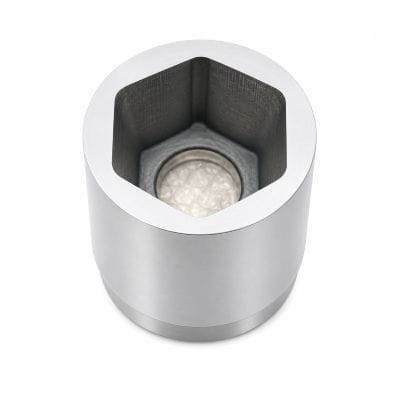
Custom Hex Driver Socket

Please enable JavaScript in your browser to complete this form.
Click or drag files to this area to upload.You can upload up to 10 files.

Table of Contents

Custom Hex Driver Socket for Mining

Weforging manufactures custom hex driver sockets for mining ground support and roof bolting applications, produced to OEM drawings rather than fixed catalog sizes. Internal hex dimensions, socket depth, outside geometry, material, heat treatment and drive features can be specified to match the mating component and operating requirements.

For suitable designs, Weforging combines forging, heat treatment and CNC machining within one manufacturing route. This helps maintain material traceability, control critical machining features and improve production consistency from raw material to finished socket.

Custom Hex Driver Sockets Made to OEM Drawings

A mining hex driver socket should be specified around the mating component and drive interface, not simply by its outside dimensions.

Weforging manufactures custom sockets from customer drawings, samples or defined mating requirements. The internal A/F dimension and depth determine how the socket engages with the mating feature, while the outside geometry and drive end need to match the installation equipment and available operating space.

For replacement or non-standard components, an existing mating part can also be used as a reference during technical review.

Specification

What Should Be Defined

Internal hex

A/F size, depth and tolerance

Drive interface

Hex, square or OEM-specific geometry

Outside geometry

OD, length, shoulders and related features

Mating component

Roof bolt nut or specified drive feature

Material

Steel grade or required properties

Heat treatment

Hardness or mechanical requirements

Surface finish

According to drawing and service conditions

How Does a Hex Driver Socket Work in Roof Bolting?

A hex driver socket transfers rotational torque from the bolting equipment to the mating nut or drive feature during roof bolt installation. The internal profile engages with the mating component, while the opposite drive interface connects to the installation equipment.

Correct engagement matters because torque needs to pass through the contact surfaces without excessive movement or unstable fit. The internal hex profile, A/F dimension, depth and drive alignment therefore need to match the intended application.

Bolting Equipment → Drive Interface → Hex Driver Socket → Mating Component → Torque Transfer

Why Socket Geometry and Fit Matter

For an OEM mining socket, fit is more important than the nominal socket size alone. Two sockets with similar basic dimensions may perform differently if the internal profile, depth, clearance or alignment does not correctly match the mating component.

For this reason, Weforging treats the internal drive geometry as a critical feature rather than a general machined cavity.

Internal Hex Fit

The internal A/F dimension, hex depth and profile determine the contact between the socket and mating component. Excessive clearance can reduce engagement stability, while insufficient clearance may prevent correct assembly.

For deep internal hex designs, critical dimensions should be controlled at the locations specified on the drawing rather than relying only on measurements taken at the opening.

Concentricity and Alignment

The relationship between the internal drive feature, outside diameter and relevant datums can affect alignment during rotation. Where tighter control is required, CNC finish machining can be used to establish the specified geometry and datum relationships.

Drive-End Compatibility

Not every mining installation system uses the same drive interface. Hex, square and other OEM-specific configurations may be required depending on the equipment and mating component.

Weforging can manufacture these drive features according to the customer drawing instead of limiting production to standard catalog configurations.

From Forged Blank to Finished Hex Driver Socket

For this hex driver socket, closed die forging and CNC machining perform different functions in the manufacturing route. The deep internal hex profile, including the across-corner geometry, is formed directly during forging and remains as-forged without subsequent machining. The outside diameter and end faces are then CNC machined to the dimensions and tolerances specified on the OEM drawing.

Because the internal hex is an as-forged functional feature, forging control is particularly important. Die geometry, material temperature, thermal expansion and contraction, and progressive die wear during batch production must all be considered to keep the internal profile within the specified tolerances.

A typical production route is:
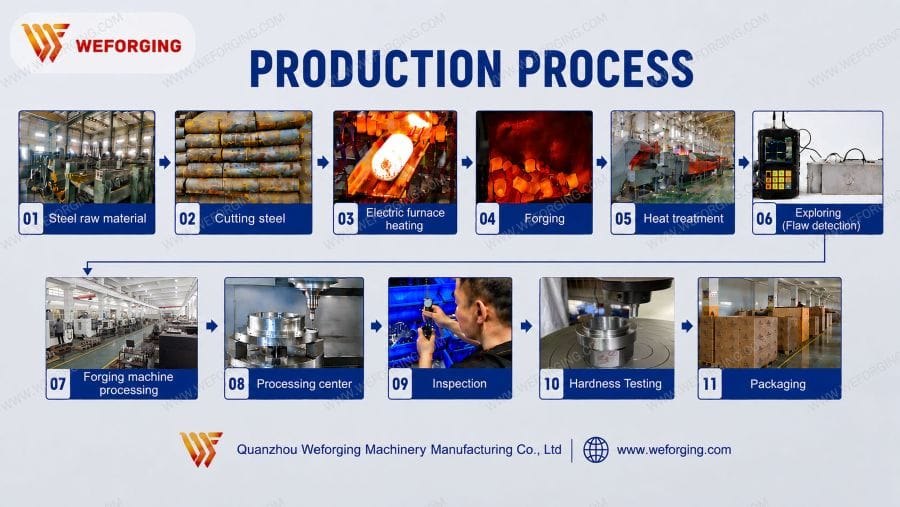
OEM forging and CNC machining production process from raw material to final inspection

Raw Material → Closed Die Forging → Pre-Machining → Heat Treatment → CNC Finish Machining → Critical Feature Inspection → Surface Treatment → Final Inspection

Not every hex driver socket requires a forged manufacturing route. Depending on the part geometry, material, mechanical requirements and production volume, the manufacturing process should be selected for the specific application. For suitable designs, cold extrusion can also be considered as an alternative forming process.

Keeping forging, heat treatment, machining and inspection within one coordinated manufacturing route helps maintain material traceability, dimensional control and batch consistency from the forged blank to the finished socket.

Materials, Heat Treatment and Traceability

Material selection for a mining hex driver socket should consider torque, repeated loading, wear at the drive surfaces and actual service conditions. The objective is not simply maximum hardness. Strength, toughness and wear resistance need to be balanced for the intended application.

Requirement

Why It Matters

Strength

Helps resist deformation under torque

Toughness

Supports impact and repeated loading

Hardness

Helps control wear at drive surfaces

Heat-treatment consistency

Supports repeatable batch properties

Weforging manufactures according to the material grade and heat-treatment requirements specified on the OEM drawing.

Where additional traceability is required, production records can connect the finished batch with the corresponding raw-material heat number, chemical analysis and mechanical test information, providing a traceable path from incoming material through forging, heat treatment and machining to the finished socket.
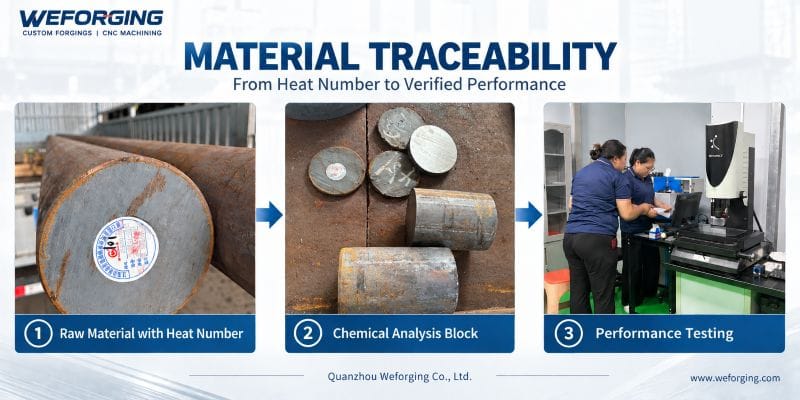
Weforging material traceability process showing heat-numbered raw material, chemical analysis samples, and performance testing for batch quality control. 

Inspection of Critical Socket Features

Inspection focuses on the features that affect mating fit, torque transfer and equipment compatibility, rather than checking only the outside dimensions.

For custom hex driver sockets, the inspection plan is based on the OEM drawing and specified acceptance requirements.

Inspection Item

Purpose

Internal hex A/F

Verify mating fit

Hex depth and profile

Confirm drive engagement

Concentricity / alignment

Check rotational relationship

OD and overall length

Verify equipment compatibility

Hardness

Confirm heat-treatment requirement

Surface condition

Verify drawing and finish requirements

Dimensional inspection, CMM measurement, hardness testing and other appropriate methods can be applied according to project requirements.

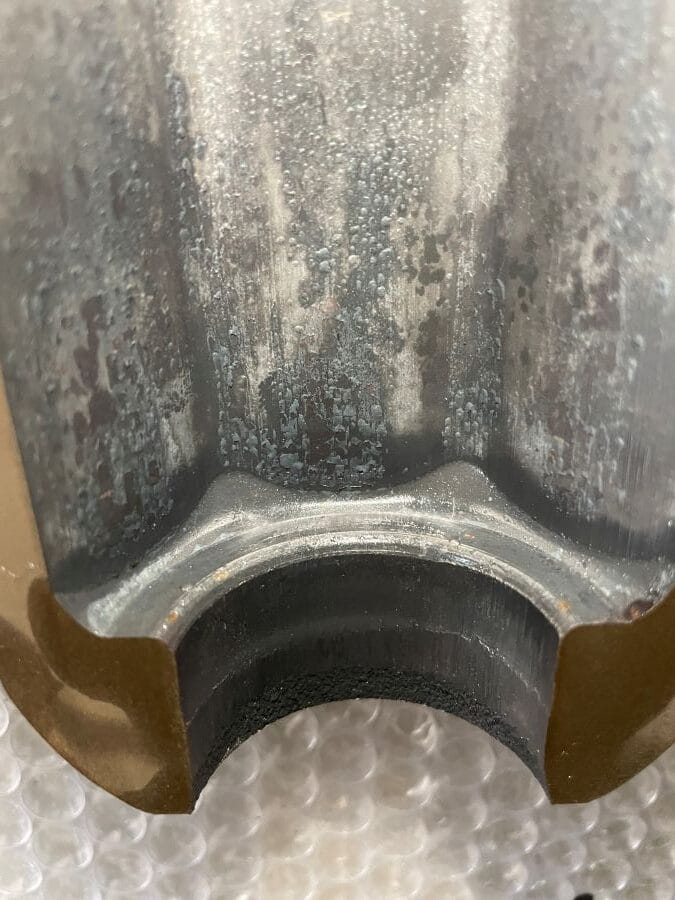
Sectioning Verification for As-Forged Internal Hex Features

For this hex driver socket, the internal hex profile and across-corner surfaces are formed during forging and are not subsequently machined. The outside diameter and end faces are machined, but the internal forged geometry must remain within the drawing tolerances to ensure correct assembly with the mating component.

This places tighter control on the forging process. In addition to the internal hex dimensions, the bottom corner radius must meet the drawing requirement—R4 maximum for this part—to avoid interference during assembly. Tooling design and process control must also account for thermal expansion and contraction of the die and workpiece, as well as progressive die wear during batch forging.

Because these deep as-forged features cannot be fully verified from the opening, Weforging uses sectioning inspection on selected samples. Cutting the sample exposes the internal profile for direct measurement of the hex geometry, across-corner dimensions and bottom radii. This provides physical verification that the forged internal features remain within the specified drawing requirements before and during series production.

Sectioned deep internal hex socket for machining and dimensional verification

From RFQ to Sample and Series Production

For a custom mining hex driver socket, the most useful RFQ information is the mating interface, internal hex dimensions, drive geometry, material, heat-treatment requirements and expected production quantity.

A typical OEM project follows:

Drawing / Mating Component → Technical Review → Material & Process Confirmation → Sample Production → Inspection & Fit Validation → Sample Approval → Series Production

For quotation and technical review, buyers should provide where available:

  • 2D drawing and/or 3D model
  • Internal hex A/F and depth
  • Mating component information
  • Drive-end geometry
  • Material or mechanical requirements
  • Heat treatment and hardness
  • Surface treatment
  • Required quantity

Samples can be produced before series production to verify critical dimensions, mating fit, material and hardness requirements. Once approved, the confirmed sample and manufacturing parameters can be retained as technical references for subsequent production batches.

What Is the Difference Between a Hex Socket and a Hex Driver Socket?

A hex socket generally describes the internal hexagonal form, while hex driver socket more clearly describes a component designed to transmit torque through a drive interface. In mining applications, terminology may vary according to the bolting equipment and mating component.

Can You Manufacture a Socket to Match an Existing Roof Bolt or Nut?

Yes. A custom socket can be manufactured from an OEM drawing or defined mating dimensions. Where appropriate, an existing mating component can also be used as a reference to confirm the internal profile and fit requirements.

Can the Internal Hex and Drive End Both Be Customized?

Yes. Internal A/F, depth, outside geometry and drive-end configuration can be manufactured to the customer drawing. Hex, square or other OEM-specific interfaces can be reviewed according to the application.

Are Mining Hex Driver Sockets Forged or Machined?

They can involve both processes. For suitable geometry and production volume, a forged blank can be followed by heat treatment and CNC finish machining. Other designs may be machined from suitable steel stock. The route depends on geometry, material, performance requirements and quantity.

What Information Is Needed for a Custom Hex Driver Socket RFQ?

The most useful information includes the drawing or 3D model, internal hex dimensions, mating component, drive geometry, material, heat treatment, surface finish and required quantity. These details allow the manufacturing route and inspection requirements to be reviewed before quotation.

Can Samples Be Supplied Before Series Production?

Yes. Samples can be produced for dimensional inspection, mating-fit verification and specified material or hardness checks. Once approved, the confirmed sample and process requirements can be retained as references for subsequent batch production.
Scroll to Top