Custom Mining Equipment Parts: Forged, Cast or Machined?
For custom mining equipment parts, the manufacturing route is rarely a simple choice between forging, casting and machining. Forging and casting usually determine how the starting blank is formed, while CNC machining brings bores, threads, fits and mounting surfaces to final dimensions.
A shaft, gear blank, crusher component and bearing housing may all work in the same mining system, but their loads, geometry and production requirements are different. Some parts are better suited to forged blanks, others to castings, while low-volume or simpler components may be machined directly from bar or plate.
The right route depends on service load, geometry, material, production volume and inspection requirements. Choosing it early can reduce unnecessary machining, tooling cost and production risk.
Forged, Cast or Machined: What Actually Changes?
The first question should not be “Which process is best?” It should be “What does this part need to do?”
A high-torque shaft and a large housing may work in the same machine, but their geometry, loading and failure risks are very different. Manufacturing should reflect those differences.
Manufacturing Route | Best Fit | Main Advantage | Key Limitation |
Forging + CNC | Shafts, pins, gear blanks, hubs and high-load parts | Good strength and fatigue performance | Tooling and geometry must be considered |
Casting + CNC | Large housings and complex shapes | Greater geometric flexibility | Internal defect control is important |
Bar Stock + CNC | Simple parts, prototypes and lower volumes | No forming tooling required | More material removal |
Fabrication + Machining | Large structural parts | Flexible for large assemblies | Weld quality and distortion require control |
For many mining equipment parts, machining is not an alternative to forging or casting. It is the next step. A forged shaft may still require turning, milling, drilling, spline machining or grinding before assembly.
This distinction matters when comparing quotations. Two suppliers may offer the same finished dimensions while using very different starting materials and manufacturing routes.
When Does Forging Make Sense for Mining Equipment Parts?
Forging is particularly suitable when a component carries repeated, directional or impact loading. The material is plastically worked into shape rather than solidified in a mold. With suitable process control, forging can support favorable grain flow and consistent mechanical properties in critical sections.
Typical candidates include:
- drive and transmission shafts;
- pinion shafts and gear blanks;
- heavy-duty pins;
- hubs and couplings;
- forged rings and flanges;
- selected crusher and transmission components.
The drawing and service conditions still determine the final route. High torque or repeated cyclic loading may favor a forged blank, while oversized or highly complex geometry may point toward another process.
Production volume also matters. Closed-die forging requires tooling, so it becomes more economical when the expected production program can justify the initial tooling investment.
For application-specific examples, see Weforging’s mining equipment forgings capabilities.
When Are Casting or Bar-Stock Machining Better Choices?
Not every mining component benefits from a forged blank.
Casting can be practical for large parts with complex external or internal geometry, especially where forging would require excessive tooling or machining. Housings and certain large structural shapes are typical examples.
Direct machining from bar stock can make more sense for prototypes, repair parts and low-volume components with relatively simple geometry. Eliminating forming tooling can shorten development time and reduce upfront cost.
The trade-off is material efficiency. As production volume increases, bar-stock machining may require substantially more material removal and longer machine time.
The best process is the one that meets the drawing, service load and production volume without adding manufacturing steps that do not improve the finished part.
How Part Design and Service Conditions Drive the Choice
Mining service is not one operating condition. Crusher, conveyor, drilling and drive components experience different combinations of torque, shock, fatigue, wear and alignment requirements.
That is why process selection should be based on the part itself rather than the industry name alone.
Part Requirement | Manufacturing Consideration |
High impact load | Forging may offer an advantage for suitable geometries |
Repeated cyclic load | Fatigue behavior and heat treatment become important |
Complex hollow geometry | Casting may be more practical |
Tight bores, threads or fits | CNC machining is normally required |
Prototype or very low volume | Bar-stock machining may avoid tooling cost |
Stable series production | Forging can become more economical |
Critical internal integrity | Material control and NDT should be defined |
High torque transmission | Material, grain flow and heat treatment require close review |
Geometry can change the answer even when loading is similar. A stepped shaft with a machined spline is very different from a large gearbox housing. Production quantity can also change the most economical route without changing the engineering requirements of the finished component.
For this reason, process selection is best completed during drawing review, before tooling or raw material is ordered.
Why the Finished Part Usually Needs More Than One Process
A heavy-duty mining component rarely reaches its finished condition in one operation. Each process serves a different purpose.
For a forged part, the route may include:
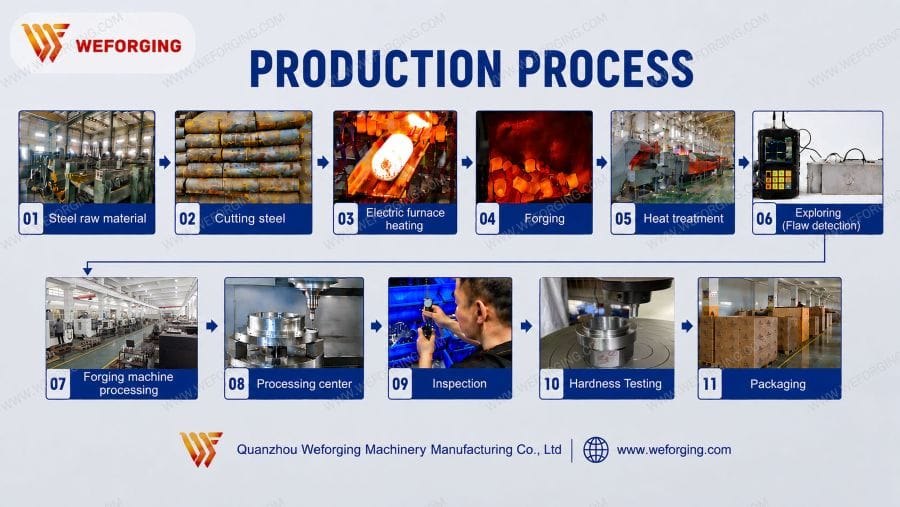
Steel → Forging → Heat Treatment → CNC Machining → Inspection → Finished Part
Forging creates the basic geometry and supports the required material flow in load-bearing sections. Heat treatment develops the specified strength, hardness or toughness. CNC machining then produces features that cannot normally be held to final tolerance during forging, such as bearing seats, precision bores, threads, splines and assembly interfaces.
These processes must also be planned together. Forging geometry affects machining allowance, while heat-treatment distortion can influence the final machining sequence.
For many high-load mining equipment parts, the practical manufacturing route is therefore not forging or machining, but forging followed by controlled heat treatment and CNC machining.
What Should Be Verified Before a Mining Part Enters Production?
A good manufacturing route still depends on a complete specification.
Before production, the drawing and purchasing requirements should define:
- drawing number and revision;
- material grade and standard;
- mechanical properties;
- heat treatment and hardness;
- critical dimensions and tolerances;
- machining allowance where required;
- surface finish or coating;
- UT, MT or other NDT requirements;
- inspection and certification documents;
- prototype and production quantities.
Material grade alone does not define finished-part performance. Heat treatment, section size, forging conditions and hardness requirements can be equally important.
Grades such as 42CrMo4 or AISI 4140 are common in heavy-duty components, but the required material condition and mechanical properties should still be stated clearly.
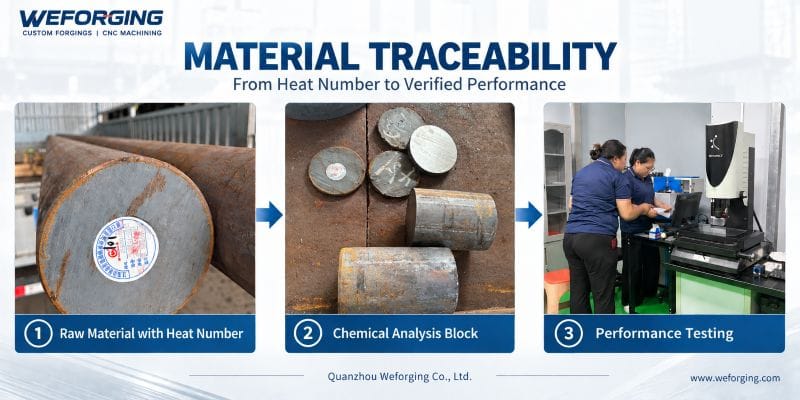
Weforging in-house laboratory provides tensile, yield strength, impact, spectrometric, metallographic, and CMM inspection for forging components, supporting material verification, mechanical-property control, and dimensional inspection throughout production.
From Drawing to a Production-Ready Mining Component
Moving from an approved drawing to repeatable production requires more than selecting the right forming process. The critical requirements must remain controlled as the part moves through each production stage.
Before tooling or batch production begins, the drawing review should confirm material grade, heat-treatment condition, machining allowance, critical tolerances, inspection points and required documentation. Drawing revisions also need to be controlled so that machining and inspection work from the same specification.
For series production, traceability becomes equally important. Material certificates and heat numbers should remain linked to the production batch, while hardness, dimensional inspection and specified NDT provide evidence that critical requirements have been met.
At Weforging, a chemical analysis sample is tested first to independently verify the material composition. The results are then matched with the heat-number identification of the incoming raw material. This links material verification to the same production batch, maintaining traceability from raw material to finished parts and consistent processing across batch production, rather than treating each manufacturing step as an isolated supply stage.
Choose the Manufacturing Route Around the Part
There is no single manufacturing route for every mining component. High-load and fatigue-critical parts may benefit from forging; large complex geometries may be better suited to casting; simple or low-volume components may justify direct machining from stock.
CNC machining remains part of many routes because critical fits and interfaces still require controlled final dimensions. Forming, heat treatment, machining and inspection should therefore be considered as connected decisions rather than separate purchasing steps.
For custom mining parts suited to forging, Weforging can support production from forged blank through heat treatment, CNC machining and final inspection. Send your drawing or technical specification for a manufacturing review.
