Mining Drive Nut
Table of Contents
Custom Drive Nut for Mining Ground Support
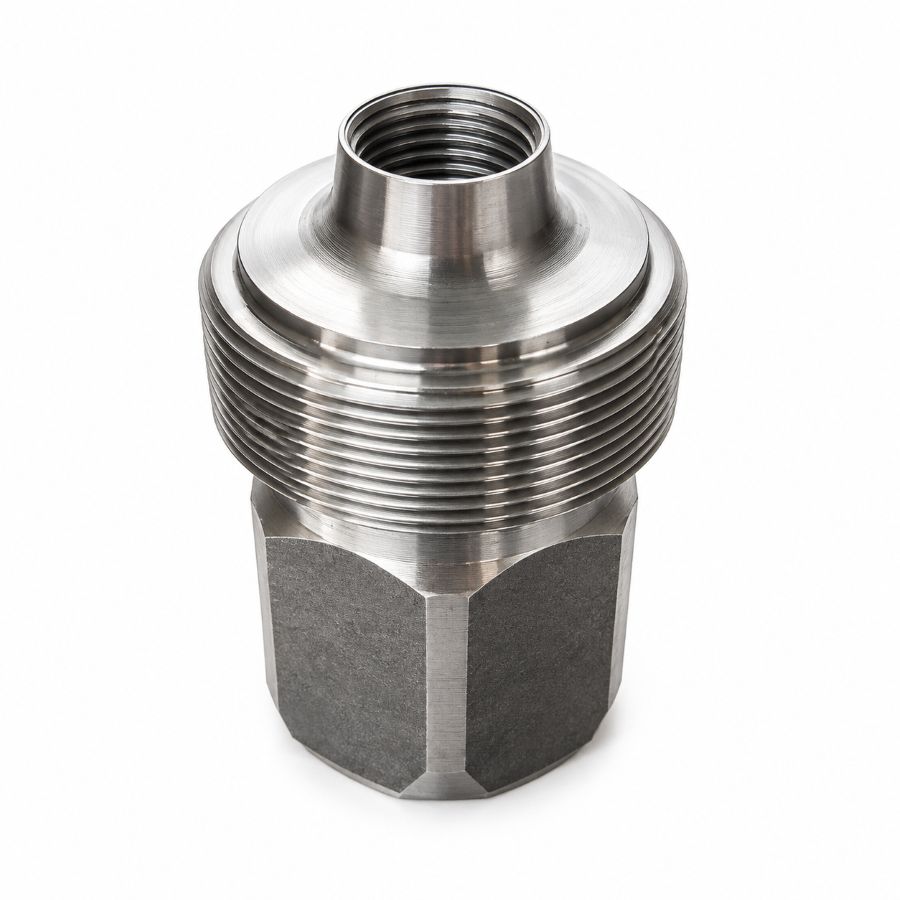
Weforging manufactures custom Drive Nuts for mining ground support systems and rock bolting applications based on OEM drawings. Instead of supplying fixed catalog sizes, we produce non-standard components around the required thread, drive geometry, material, heat treatment, dimensions and inspection requirements.
Depending on part geometry and production volume, manufacturing can combine forging or metal forming with CNC turning, thread machining and final inspection. This integrated approach allows critical features to be controlled from the initial blank through to the finished Drive Nut.
For OEM projects, samples can be produced for dimensional and functional verification before series production.
Custom & Non-Standard Drive Nuts to OEM Drawings
A custom Drive Nut should be defined by more than its overall dimensions. For mining applications, the thread must match the mating bolt, while the drive geometry must work correctly with the specified installation tooling. Material, heat treatment and surface requirements may also vary between ground support systems.
Weforging manufactures non-standard Drive Nuts from customer drawings rather than limiting production to standard nut specifications. Before production, the following requirements should be confirmed:
Drawing Requirement | What Should Be Defined |
Material | Steel grade or required mechanical properties |
Internal Thread | Diameter, pitch, tolerance/class and direction |
Drive Geometry | Hex, square or project-specific profile |
External Geometry | Diameter, shoulder, external thread or formed profile |
Heat Treatment | Hardness or specified mechanical properties |
Surface Finish | Black oxide, plating or customer-specified treatment |
Inspection | Thread gauges, critical dimensions, hardness and material verification |
Identification | Part number, batch identification or laser marking where required |
For an OEM buyer, defining these requirements before tooling or machining begins reduces uncertainty during sample approval and later series production.
How Does a Drive Nut Work in a Mining Ground Support System?
A Drive Nut is a threaded component used as part of a rock bolting or mining ground support assembly. Its exact function depends on the bolt system, but the nut typically needs to interface correctly with both the mating thread and the installation tooling.
This makes thread specification and drive geometry functionally important. A component that meets its basic outside dimensions may still be unsuitable if the thread, engagement or drive feature does not match the intended bolt and installation method.
For custom projects, Weforging therefore manufactures the Drive Nut according to the specific OEM system rather than assuming one standard design fits different rock bolting applications.
Forged, Formed or Machined: Which Process Fits the Drive Nut?
Not every custom Drive Nut should follow the same manufacturing route. The appropriate process depends on part geometry, material, mechanical requirements, production quantity and the amount of machining required after the blank is produced.
Manufacturing Route | Suitable Applications | Main Consideration |
Higher-volume or mechanically demanding parts | Near-net geometry, material utilization and repeatability | |
Cold Forming / Extrusion | Suitable geometries and production volumes | Forming efficiency and reduced material removal |
Bar Stock + CNC Machining | Samples, lower volumes or machining-suitable designs | Lower tooling commitment and greater geometry flexibility |
For parts suited to forging, Weforging can combine Closed Die Forging with subsequent machining rather than treating the forged blank and finished component as separate sourcing stages.
The process should ultimately be selected from the drawing and functional requirements—not simply because one manufacturing method is preferred.
From Forged or Formed Blank to Finished Drive Nut
For a forged or formed Drive Nut, producing the blank is only the first stage. Machining allowance must be considered before forming so that the finished component has sufficient material for turning, threading and other critical features without unnecessary stock removal.
A typical route may include:
Raw Material → Forging/Forming → Heat Treatment → CNC Turning → Thread Machining → Drive Feature Machining → Dimensional Inspection → Surface Treatment → Final Inspection
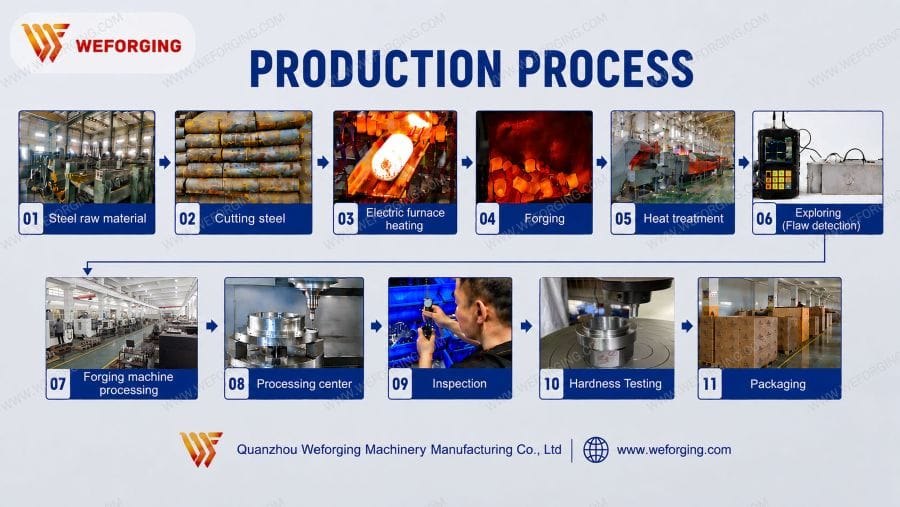
During CNC machining, the internal thread, external profile, shoulders and other specified interfaces are produced according to the OEM drawing. Where several machined features share a common axis, process planning and setup control are important to maintain their positional relationship.
Combining forming with CNC Machining also allows machining feedback to be used when adjusting the blank and subsequent production process.
Why Thread and Drive Geometry Matter
For a custom Drive Nut, thread size alone is not enough to define functional compatibility. Thread form, pitch, direction, tolerance and engagement length should be considered together with the mating bolt.
The drive feature requires the same attention. Its geometry must correspond to the installation socket or other tooling specified for the system. This is particularly important for non-standard OEM parts where catalog dimensions cannot be assumed.
Before production, Weforging recommends confirming:
- Thread diameter and pitch
- Thread form and tolerance
- Left-hand or right-hand thread
- Required engagement length
- Drive profile and critical dimensions
- Compatibility with the mating bolt and installation tooling
A Drive Nut should therefore be evaluated as part of the complete assembly, not only as an individual machined component.
How We Verify Custom Drive Nuts Before Production
For a non-standard Drive Nut, inspection should verify more than finished dimensions. Thread fit, internal machining, material properties and heat-treatment condition can all affect whether the part performs as intended in the specified mining ground support system.
At Weforging, verification can combine thread and dimensional inspection, sectioning of selected parts, and mechanical-property testing according to the OEM drawing and project requirements. The objective is to confirm both the finished component and the manufacturing process before series production.
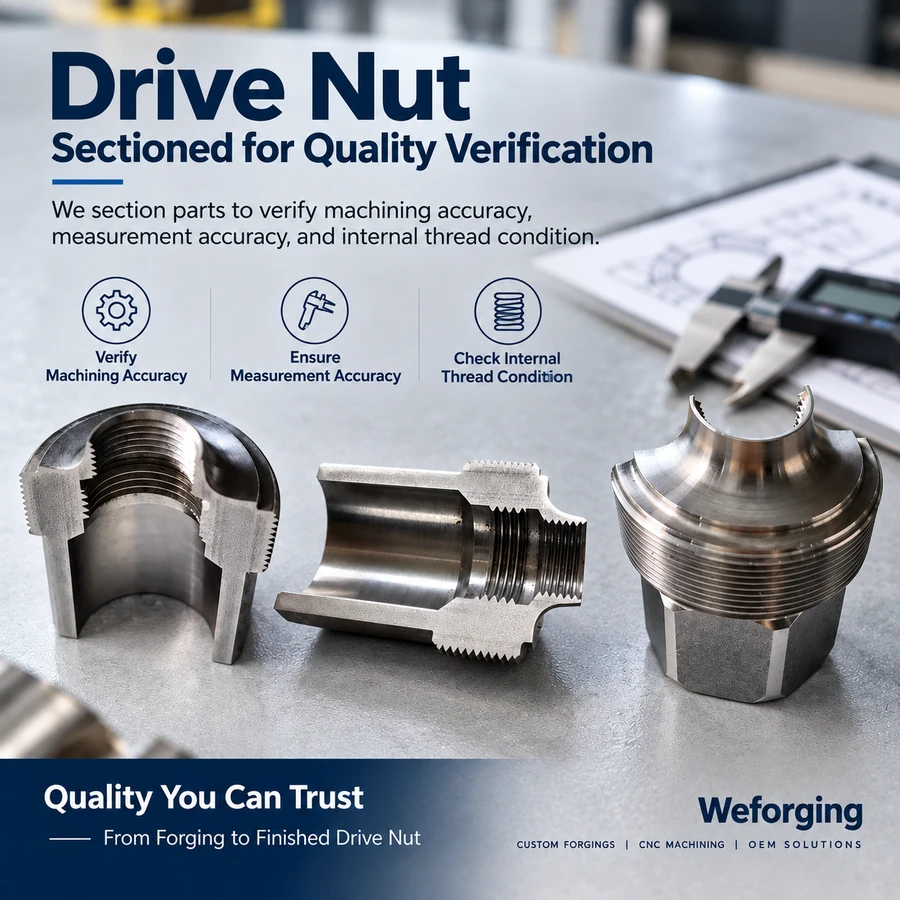
Sectioning Verification for Internal Threads and Machined Features
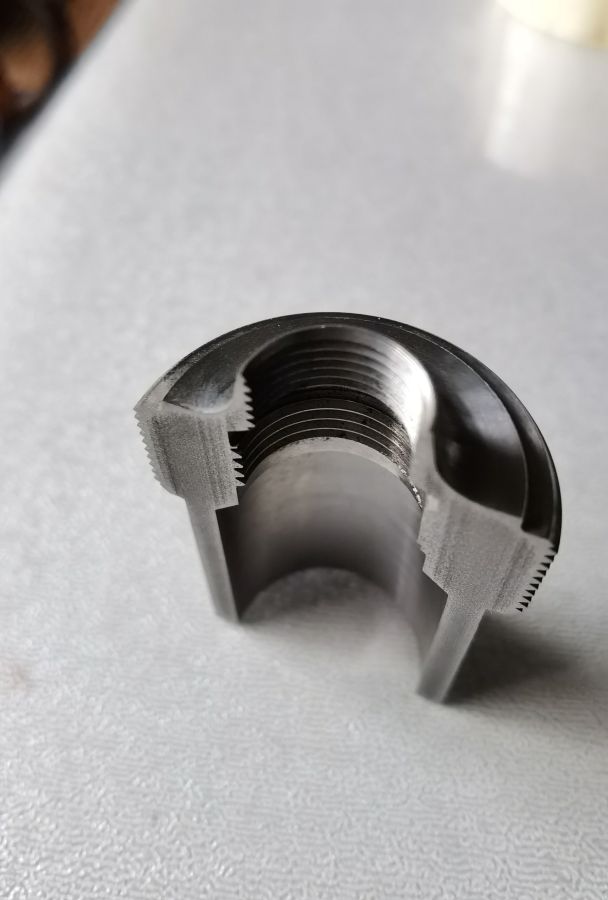
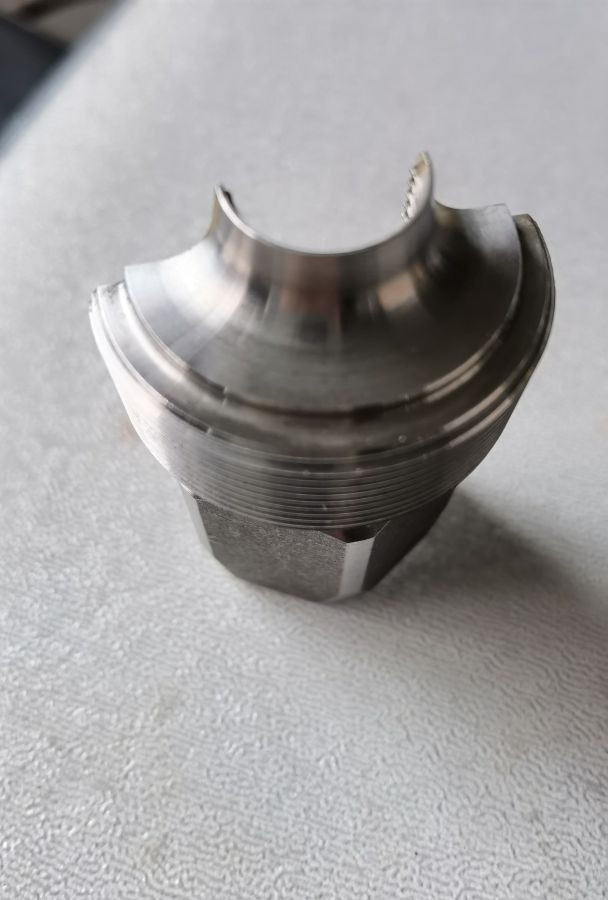
Sectioning is one of Weforging’s internal quality verification methods for selected custom parts. For this Drive Nut, a finished component was cut open during process validation to inspect internal features that cannot be fully evaluated from the outside.
The section allows our engineers and inspectors to directly examine the internal thread profile, machining depth, wall thickness and internal transitions against the drawing. It also provides a cross-check of conventional dimensional measurements and helps verify that the CNC machining program correctly produces the intended internal geometry and machining sequence.
If an abnormal thread profile, incorrect machining depth or other internal deviation is identified, the machining process can be reviewed and corrected before series production. Sectioning is not required for every production part; it is an additional internal verification method used when deeper process confirmation is needed.
Mechanical Properties, Impact and Hardness Verification
Material and heat-treatment requirements are verified according to the OEM drawing and intended service conditions. Where specified, Weforging can perform tensile strength, yield strength and hardness testing to confirm that the material and heat-treatment condition meet the required mechanical properties.
For projects intended for low-temperature mining environments, Charpy impact testing at −20°C can also be carried out when required by the drawing, customer specification or applicable test standard. This verifies material toughness at the specified temperature rather than relying only on room-temperature properties.
Test results can be linked to the relevant material heat number, heat-treatment batch and production records for traceability. For more information on mechanical-property verification, see our Mechanical Testing for Forgings and Tensile Testing for Forgings resources.
Thread and Dimensional Inspection
Internal threads are checked using the specified GO/NO-GO thread gauges, while critical diameters, shoulders, drive geometry and other machined features are inspected against the drawing. CMM or other measuring equipment can be used where tighter geometric control is required.
For a custom Drive Nut, these checks are also used to confirm compatibility with the specified bolt and installation tooling. Where necessary, customer-supplied mating parts or approved gauges can be included in the verification process.
Lorem ipsum dolor sit amet, consectetur adipiscing elit. Ut elit tellus, luctus nec ullamcorper mattis, pulvinar dapibus leo.
Traceability for OEM Mining Projects
For OEM mining projects, traceability can be established according to the level required by the customer. Material heat numbers, production batches, heat-treatment records and inspection results can be linked so that finished parts can be traced back to relevant manufacturing records.
Part numbers, batch information or other identification can also be laser marked on the component where required by the drawing or project.
The purpose is practical: if a specific production batch needs to be reviewed later, the corresponding material, process and inspection information can be identified without relying on disconnected records.
How Are Drive Nuts Protected During Production and Overseas Delivery?
For machined Drive Nuts, product protection does not begin only at final packaging. Threads, machined surfaces and critical edges can be damaged by part-to-part contact during production handling, as well as by moisture, corrosion or impact during storage and overseas transportation.
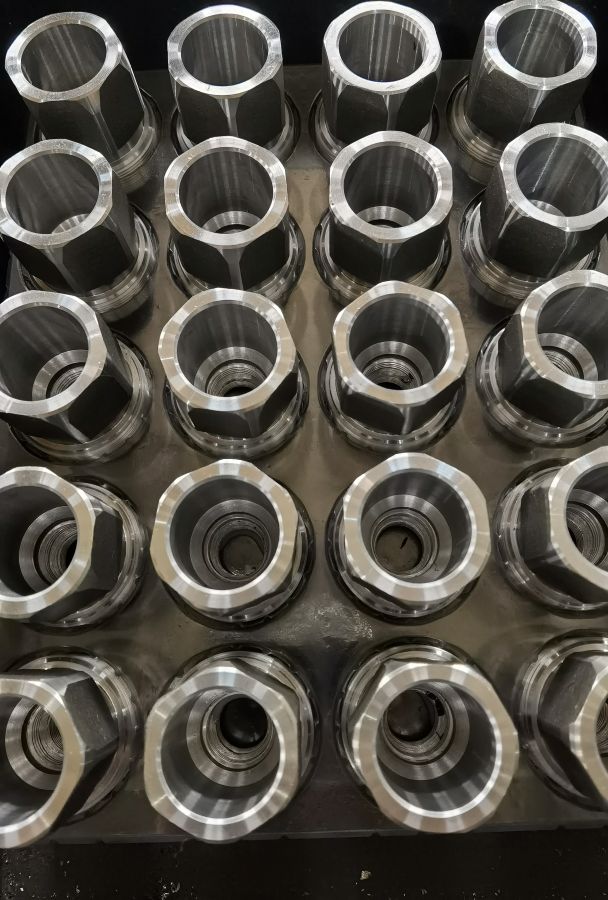
At Weforging, blister trays are used for part transfer between manufacturing operations, helping keep individual Drive Nuts separated as they move from one process to the next. This reduces direct metal-to-metal contact and helps protect machined surfaces, threads and critical features before the part reaches final inspection.
Before shipment, finished parts are ultrasonically cleaned to remove machining residues and contaminants. Protective oil is then applied to exposed metal surfaces to provide temporary corrosion protection during storage and sea freight.
After cleaning and rust protection, the Drive Nuts are packed with protective soft packaging and outer cartons. The packaging is designed to reduce movement and part-to-part contact while protecting threads, machined edges and critical surfaces from impact or abrasion during handling and transportation.
For OEM mining components, protection therefore extends throughout the production and delivery process—from in-process handling and inspection to cleaning, corrosion protection, packaging and overseas shipment. The objective is to maintain the condition of the finished component from the manufacturing line through to customer receiving inspection.
Why Source Custom Drive Nuts from an Integrated Manufacturer?
A custom Drive Nut brings several manufacturing stages together. Blank geometry affects machining allowance; heat treatment can influence subsequent machining and dimensional stability; CNC operations determine the final thread and interface geometry; inspection must then confirm that these features meet the same OEM drawing.
Managing these stages within one manufacturing route makes it easier to use machining and inspection feedback to control subsequent production rather than treating each process as an isolated operation.
Weforging integrates forging/forming, heat treatment, CNC Machining, inspection and traceability for custom OEM components. This is particularly useful for non-standard mining parts where the finished component must meet both drawing dimensions and specific mating requirements.
For a manufacturing review, provide the Drive Nut drawing, material specification, thread requirements, expected quantity and any required inspection or mating-component information.
Send us your drawing and technical requirements. Our engineering team can review the material, manufacturing route, machining features, thread requirements and inspection plan before sample production.
Can Weforging manufacture non-standard Drive Nuts to OEM drawings?
Are all mining Drive Nuts forged?
What information is needed for a custom Drive Nut RFQ?
Can you manufacture left-hand and right-hand threads?
Can samples be supplied before mass production?
Related products
- CNC Machining Parts
Custom Rock Bolt Bearing Plate
- CNC Machining Parts
Forged Splined Hubs
- CNC Machining Parts
Forged Sleeves
- CNC Machining Parts
Forged Clevis Components