
CNC Turning Guide: Process, Types, Materials & Applications
CNC turning is a precision machining process used to produce cylindrical components by rotating the workpiece while a cutting tool removes material. It is widely used for manufacturing shafts, flanges, rings, bushings, and other rotational components requiring high concentricity and dimensional stability.
Unlike general machining processes, CNC turning is optimized for symmetrical geometries and high-volume repeatable production.
At Weforging, CNC turning is combined with forging and heat treatment to improve mechanical strength and ensure stable performance in heavy-duty applications.
Understanding CNC Turning
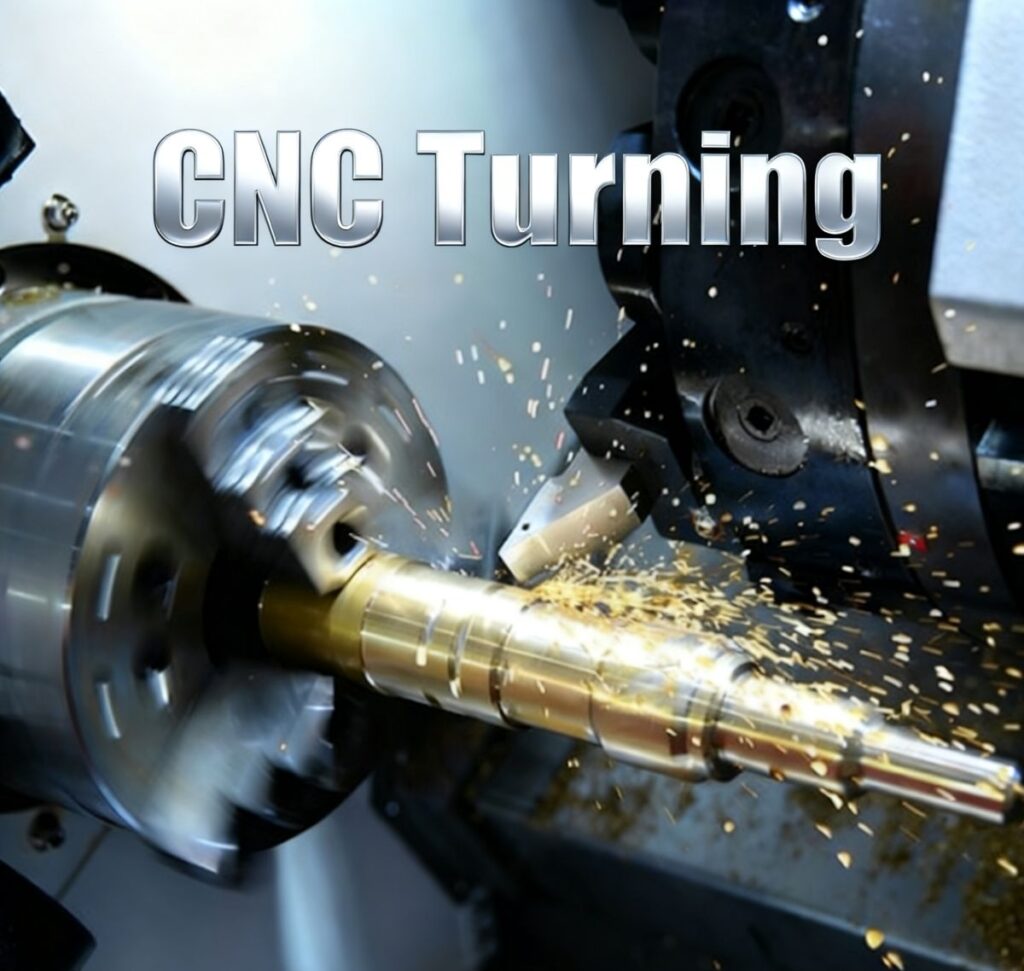
CNC turning is a precision machining process in which a rotating workpiece is shaped by controlled cutting tools. Guided by computer programs, the machine removes material gradually to produce accurate diameters, threads, and surfaces. This process is ideal for manufacturing cylindrical and conical parts with tight tolerances and smooth finishes. It is widely applied to steels, aluminum, and other engineering metals. Furthermore, it ensures tight tolerances and dimensional stability. As a result, it provides repeatable quality and reliable performance in modern manufacturing.
How CNC Turning Works
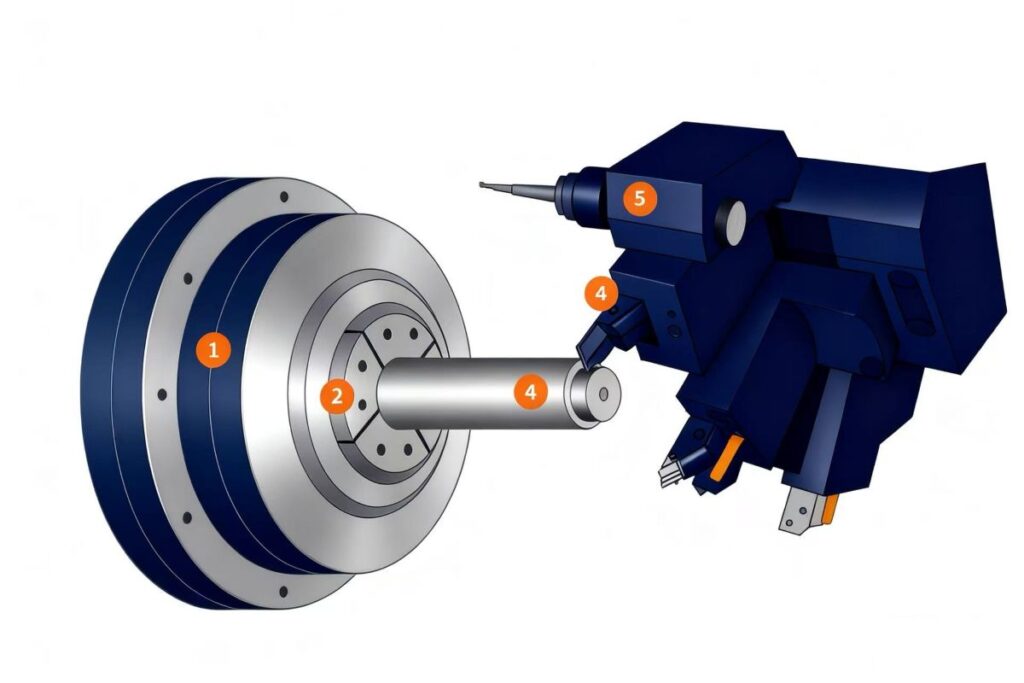
CNC turning starts with a forged or raw metal blank that is securely clamped onto a CNC lathe. The workpiece rotates at high speed while cutting tools move along controlled paths to remove material layer by layer.
The process typically includes:
- Rough turning to achieve basic geometry
- Finish turning for dimensional accuracy
- Threading, grooving, or contour machining when required
- Surface finishing for improved quality
- Final inspection before delivery
Compared with manual machining, CNC turning ensures higher repeatability, tighter tolerances, and stable batch consistency.
Types of CNC Turning Operations
CNC turning consists of several fundamental machining operations, each designed to produce specific geometries and functional features in precision components.
Straight Turning
Straight turning is the primary CNC turning operation used to reduce the outer diameter of a rotating workpiece. The cutting tool moves parallel to the axis of rotation, gradually removing material to achieve the required size and surface finish. It is commonly applied to shafts, rollers, and cylindrical forged components where concentricity and dimensional stability are critical in industrial use.
Taper Turning
Taper turning is used to produce a gradual change in diameter along the length of a workpiece, forming a conical shape. The tool is fed at an angle relative to the workpiece axis to achieve controlled geometry transitions. This operation is widely used in mechanical fittings, alignment components, and hydraulic or machine tool assemblies that require precise mating surfaces.
Grooving
Grooving involves cutting narrow recesses or slots into a cylindrical surface. These features are used for sealing elements, snap rings, or functional positioning in mechanical assemblies. In industrial manufacturing, grooving is often combined with turning operations to integrate functional features directly into shafts, housings, or hydraulic components.
Facing
Facing is the process of machining a flat surface at the end of a rotating workpiece. The tool moves across the face of the part to create a smooth and perpendicular reference surface. This operation is commonly used in flanges, gear blanks, and structural components to ensure accurate assembly alignment and stable dimensional referencing.
Thread Turning
Thread turning is used to produce internal or external threads with high precision using CNC-controlled cutting tools. It supports standard thread forms such as metric, UNC, and UNF, as well as custom specifications. This process is widely applied in fasteners, connectors, and hydraulic systems where secure engagement and load-bearing performance are required.
Advantages of CNC Turning
1. Micron-Level Precision
CNC turning delivers highly accurate dimensions with digital control, ensuring stable tolerances and consistent geometry across all parts.
2. High Productivity and Process Stability
Automated operation reduces manual intervention, increases machining efficiency, and keeps cycle times stable for both small and large batches.
3. Wide Material Compatibility
The process supports stainless steel, carbon steel, alloy steels, and forged materials while maintaining consistent machining quality.
4. Seamless Integration With Forging and Heat Treatment
CNC turning works effectively with pre-forged blanks and heat-treated components, producing durable, high-strength parts for demanding applications.
5. Reliable Performance Under Harsh Conditions
The precise control of surface finish, concentricity, and dimensional accuracy ensures long-term reliability even under heavy loads and continuous operation.
6. Reduced Setup Time and Improved Flexibility
Multi-axis capability and efficient tooling reduce setup time, supporting both prototype runs and high-volume OEM production.
Industrial Applications of CNC Turned Parts
CNC turned components are widely used across multiple industries:
- Automotive industry: shafts, drivetrain parts
- Mining equipment: couplings, gear components
- Energy sector: flanges, turbine-related parts
- Heavy machinery: rings, bushings, structural parts
- Agricultural machinery: transmission components
These industries require high reliability, wear resistance, and stable mechanical performance.
CNC Turning vs CNC Milling
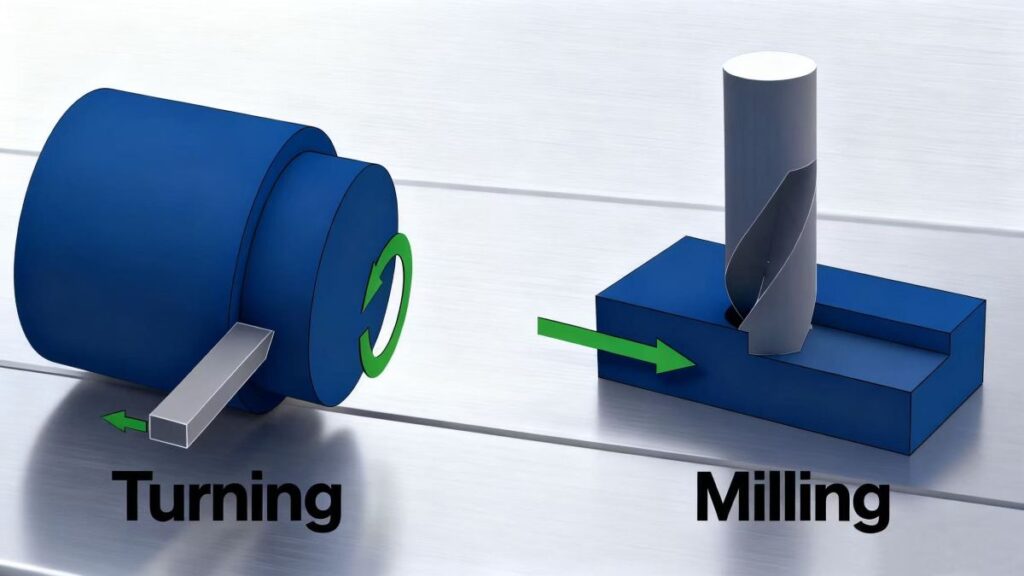
Although both CNC turning and CNC milling are machining processes, they differ in how material is removed.
| Feature | CNC Turning | CNC Milling |
|---|---|---|
| Workpiece Movement | Rotates | Fixed |
| Tool Movement | Stationary cutting tool | Rotating cutter |
| Suitable Shapes | Cylindrical parts | Complex 3D shapes |
| Typical Products | Shafts, rings, flanges | Housings, blocks |
| Efficiency | High for round parts | Higher for complex parts |
CNC turning is ideal for components with symmetrical geometry, while CNC milling is better for irregular shapes.
Why Choose Weforging CNC Turning Services
Weforging provides an integrated manufacturing system that combines forging, heat treatment, CNC machining, and inspection under one production chain.
This allows us to offer:
- Stable material quality from forging stage
- Reduced supply chain risk
- Faster production lead times
- Better consistency across batches
- Stronger mechanical performance of final parts
We support OEM customers who require reliable CNC machined components for critical applications.
Conclusion
CNC turning stands as the foundation of modern precision CNC machining. At Weforging, we merge forging strength with CNC accuracy to deliver high-quality metal components for global industries. Our integrated approach ensures superior strength, exact tolerances, and dependable performance. Whether for marine systems, automotive drives, or hydraulic assemblies, every product reflects Weforging’s commitment to precision and reliability.
For technical consultation or quotation, please contact Weforging’s engineering team.
F.A.Q.
CNC turning is used to manufacture cylindrical and rotational components such as shafts, flanges, rings, bushings, and threaded parts for industrial applications.
CNC turning can process carbon steel, alloy steel, stainless steel, and forged steel as well as non-ferrous metals like aluminum, brass, and copper.
CNC turning rotates the workpiece while the cutting tool remains fixed, making it suitable for cylindrical parts. CNC milling rotates the tool and is used for complex 3D shapes.