
Machining Allowance for Forgings: How Much Is Needed?
Introduction
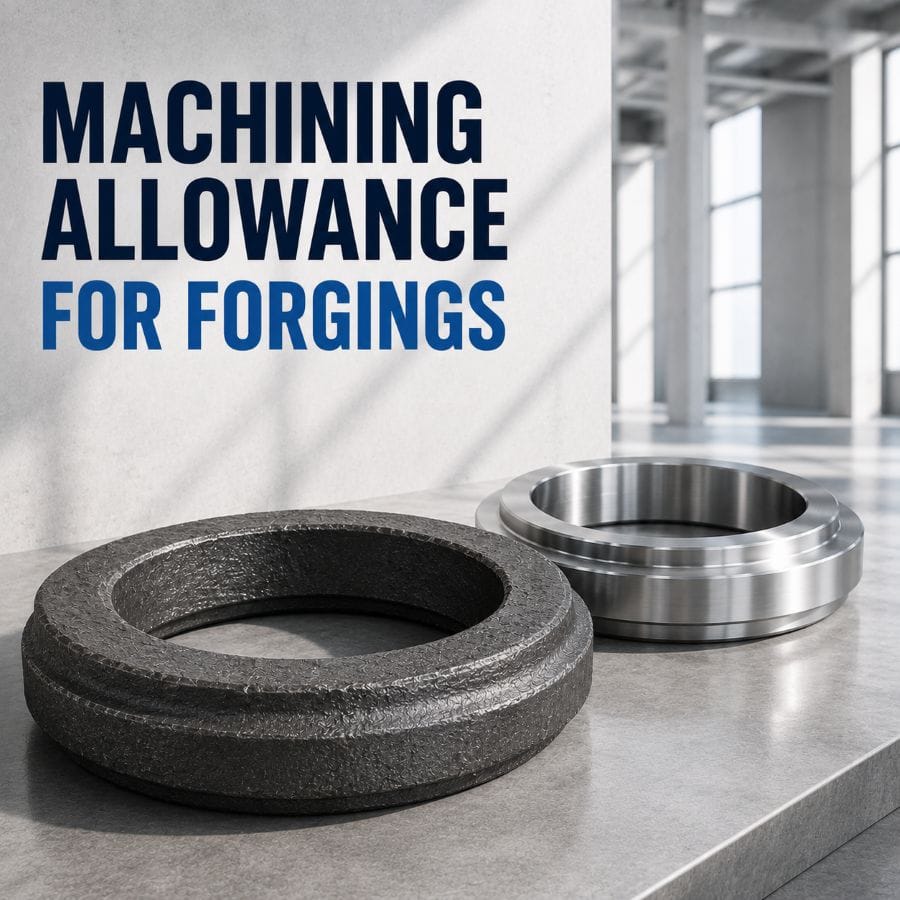
Machining allowance for forgings is the extra material intentionally left on a forged part for later turning, milling, boring, or grinding. It ensures that the final dimensions, tolerances, and surface requirements can be achieved during machining.
So, how much machining allowance does a forging need?
There is no universal value. The required allowance depends mainly on the forging process, part size and geometry, forging tolerance, heat treatment, and final machining requirements.
The goal is to leave enough machining stock for reliable finishing without adding unnecessary material, machining time, or cost. This guide explains how machining allowance is determined and what engineers should consider when specifying a forged blank.
What Is Machining Allowance in Forging?
Machining allowance is the extra material intentionally left on a forged surface for later machining.
For example, a forged shaft is usually made slightly larger than its final diameter so the surface can be turned to the required size and finish.
In simple terms:
Finished dimension → machining allowance → as-forged dimension
Machining allowance is different from forging tolerance. Allowance is material added for machining, while tolerance is the permitted dimensional variation of the forging.
Machining allowance is only one part of the finished-component strategy. For machined forgings, datum selection, heat-treatment distortion, locating surfaces, and final inspection also need to be considered together. Our guide to machined forgings explains how these decisions affect the full manufacturing route.
How Much Machining Allowance Is Needed for Forgings?
There is no fixed machining allowance for forgings. The required stock changes with the forging process, part size, geometry, tolerance, heat treatment, and the surfaces that must be finished.
As a general rule, parts with better as-forged dimensional control can be produced closer to the finished shape. Large open-die forgings, long shafts, and rolled rings often need more stock to cover dimensional variation, scale, straightness, or distortion.
Forging Type | Machining Allowance Approach |
Closed-die forging | Often lower when dimensions are well controlled |
Open-die forging | Usually higher, especially for large parts |
Rolled ring forging | Set separately for OD, ID, and end faces as required |
Long forged shaft | Allow for straightness and possible distortion |
Near-net-shape forging | Can reduce the amount of material removed |
The final allowance should be set from the finished drawing and actual manufacturing route, not from a single rule of thumb. In practice, machining stock should be defined for the surfaces that require finishing rather than applying one fixed value to the entire forging.
What Determines Machining Allowance for a Forged Part?
The machining allowance for a forged part is mainly determined by the forging process, part size and geometry, forging tolerance, heat treatment, and final machining requirements. These factors affect how much extra material is needed to reliably reach the finished dimensions.
- Forging Process
Closed-die forging generally provides better dimensional control and may require less machining stock. Open-die forging often needs more allowance, especially for large shafts, rings, and cylinders. - Part Size and Geometry
Large or complex forgings usually require more consideration for dimensional variation, straightness, and local deformation. - Forging Tolerance
The allowance must cover dimensional variation within the specified forging tolerance so that all required surfaces can be fully machined. - Heat Treatment
Quenching and tempering may cause scale, distortion, or dimensional changes, which can affect the required machining stock. - Final Machining Requirements
Precision surfaces, tight tolerances, and operations such as grinding may require a different allowance from general turned or milled surfaces.
In practice, machining allowance should be determined from the complete forging and machining route, rather than from part size alone.
Machining Allowance for Open-Die vs Closed-Die Forgings
Open-die forgings generally require more machining allowance than closed-die forgings because they typically have wider dimensional variation and lower near-net-shape capability. Closed-die forging provides better control of the forged shape, allowing less machining stock for suitable parts.
Factor | Open-Die Forging | Closed-Die Forging |
Dimensional control | Generally lower | Generally higher |
Shape repeatability | Lower | Higher |
Near-net-shape capability | Limited | Better for suitable parts |
Machining allowance | Usually higher | Can often be lower |
However, the required allowance should not be determined by the forging process alone. Part size, geometry, forging tolerance, surface condition, and heat treatment must also be considered when defining the final machining stock.
Forging Tolerance vs Machining Allowance
Machining allowance and forging tolerance are related, but they serve different purposes.
Machining allowance is the extra material intentionally left for later material removal. Forging tolerance defines how much the actual forged dimension may vary from the specified dimension.
A simplified relationship is:
Finished dimension → add machining allowance → nominal forging dimension → apply forging tolerance
Both must be considered when creating the forging drawing. Even at the minimum-material condition within the permitted tolerance, enough stock should remain for final machining.
What Happens If Machining Allowance Is Too Small?
Too little machining allowance can prevent a forging from being fully machined to its required dimensions and surface condition.
Insufficient stock may not compensate for dimensional variation, surface scale, straightness errors, or heat-treatment distortion. As a result, manufacturers may face:
- incomplete machining or remaining surface defects;
- failure to achieve the required finished dimensions;
- additional rework or corrective machining;
- rejection or scrap of the forged part.
Reducing machining stock can save material and machining time, but only when the forging process can reliably maintain the required dimensions.
What Happens If Machining Allowance Is Too Large?
Excessive machining allowance increases material use and machining cost without necessarily improving part quality.
More stock means a heavier forging and more material to remove during CNC machining. This can lead to:
- higher material consumption and forging weight;
- longer machining cycles and more cutting passes;
- increased tool wear and chip volume;
- higher overall manufacturing cost.
The impact can be significant for large steel forgings, where a few unnecessary millimeters may add considerable material.
The goal is therefore sufficient machining allowance, not maximum allowance.
How to Determine the Right Machining Allowance
The right machining allowance for a forging should be determined from the finished part backward, considering both the forging process and final machining requirements.
- Setp 1: Review the Finished Drawing
Identify the final dimensions, tolerances, surface finish, datums, and critical features. - Step 2: Identify the Machined Surfaces
Determine which surfaces require turning, milling, boring, or grinding and which can remain as-forged. - Step 3: Consider the Forging Process and Tolerances
Evaluate whether the part is open-die forged, closed-die forged, or ring rolled, and account for the dimensional variation of that process. - Step 4: Account for Heat Treatment
Consider scale, decarburization, distortion, and dimensional changes that may occur before final machining. - Step 5: Set and Verify the Machining Stock
Define the required stock for each machined surface based on its geometry and final requirements. Verify that enough material remains under the expected forging and heat-treatment conditions.
The best machining allowance is enough to ensure complete machining without adding unnecessary material or machining time.
How Machining Allowance Affects Forging Cost
Machining allowance affects forging cost by changing material usage, forged weight, and the amount of material removed during final machining. More allowance can increase both forging and CNC machining costs.
The cost impact works in two directions:
- Excessive allowance → more material → heavier forging → longer machining time → higher cost
- Insufficient allowance → machining risk → rework or scrap → higher cost
For large or fully machined forgings, even a small reduction in unnecessary stock can improve material utilization and reduce machining time.
The goal is therefore not to minimize machining allowance, but to optimize it for the complete manufacturing route. For OEM forged parts, forging, heat treatment, and final machining should be considered together when evaluating total manufacturing cost.
Conclusion
The right machining allowance for forgings should provide enough stock to achieve the finished dimensions without creating unnecessary material removal.
Rather than applying one fixed value, the allowance should be defined around the forged blank, heat-treatment route, and final machining plan. Reviewing these stages together helps reduce machining risk, control material use, and improve the total manufacturing cost of the finished component.