
How Much Does Forging Cost? OEM Price Guide 2026
Understanding forging cost is essential for OEM buyers sourcing custom metal components. Forging cost is not fixed. It varies based on material grade, part complexity, tooling, machining, and production volume. Typical forging cost per kg can vary widely depending on the application.
Focusing only on unit price can be misleading. The real cost includes durability, fatigue resistance, and lifecycle performance. Comparing forging vs casting cost is also important when evaluating long-term value.
This guide explains forging cost breakdown, key cost factors, and how to reduce custom forging cost while maintaining quality.
How Much Does Forging Cost in 2026?
In 2026, typical forging cost ranges are:
- $1.5–$5 per kg→ simple carbon steel parts
- $5–$15 per kg→ complex alloy steel or precision OEM components
These are general benchmarks. Actual forging cost depends on:
- Production volume
- Part complexity
- Tolerance requirements (e.g., IT6–IT8)
- Heat treatment and machining processes
Key factors that drive cost differences include:
- Small batch → higher unit cost
- High precision → higher cost
More importantly, forging cost should not be judged by price per kg alone. High-quality forged parts reduce failure, maintenance, and downtime, resulting in lower total cost of ownership (TCO).
Typical Forging Cost by Material and Process
Many buyers ask for a forging cost per kg, but the answer depends on material, part geometry, production volume, and secondary operations.
The table below provides general reference ranges for OEM projects.
| Material / Process | Typical Cost Range |
|---|---|
| Carbon Steel Forging | $1.5–$5/kg |
| Alloy Steel Forging | $3–$8/kg |
| Stainless Steel Forging | $5–$15/kg |
| Closed Die Forging | Higher tooling cost, lower unit cost |
| Open Die Forging | Lower tooling cost, higher machining allowance |
| Precision Forging | $8–$20+/kg |
Note: These figures are reference values only. Final forging cost depends on drawing requirements, tolerances, machining scope, heat treatment, inspection requirements, and annual volume.
Forging Cost Per Kg or Ton: What to Expect
While forging cost is commonly quoted per kg or per ton, the actual price is determined by how the part is designed and manufactured rather than weight alone.
Several key factors drive cost differences:
- Material type
Carbon steel is generally more cost-effective than alloy or stainless steel - Production volume
Higher volumes reduce unit cost through economies of scale - Heat treatment
Processes such as quenching and tempering increase total cost - Machining requirements
Tight tolerances require more CNC machining time and precision
Key Insight
- Cost per kg reflects part complexity and precision requirements
- Cost per ton reflects production scale and manufacturing efficiency
Understanding this difference helps OEM buyers make more accurate cost evaluations instead of relying solely on weight-based pricing.
What Factors Affect Forging Cost?
Key factors affecting forging cost include:
- Material selection (e.g., 42CrMo vs carbon steel)
- Part geometry and complexity
- Tolerance requirements (IT6–IT8)
- Forging method (closed die forging or open dieforging)
- Heat treatment and finishing
More complex components require additional machining and precision control.
Forging Cost Breakdown: Materials, Tooling, and Processing
The chart below shows a typical forging cost breakdown by percentage.
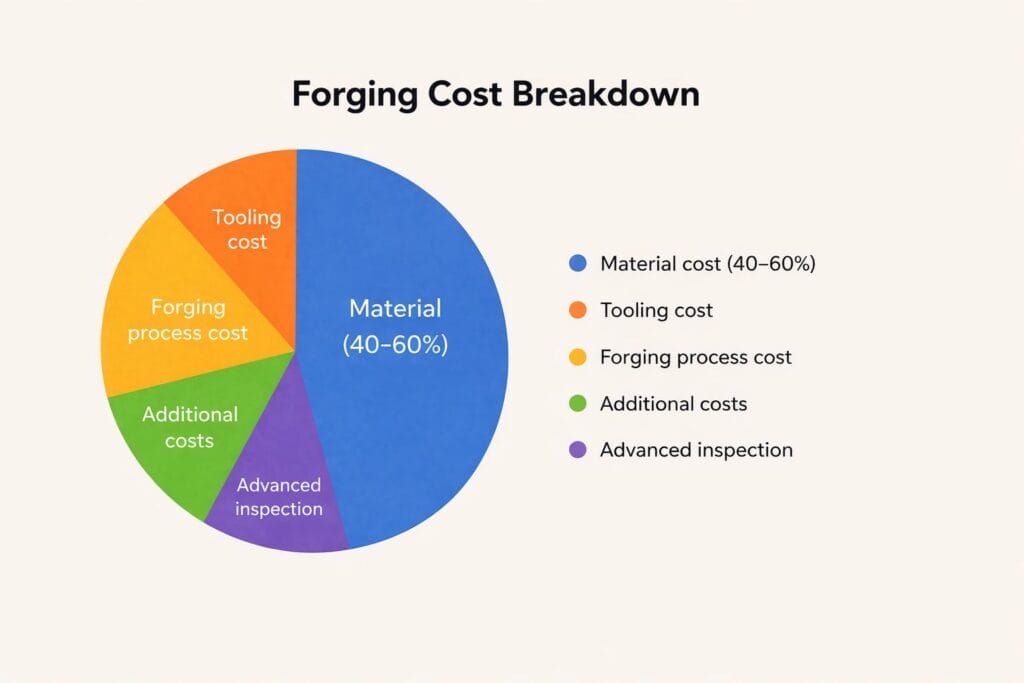
A typical forging cost breakdown focuses on the core forging process. It includes the following key components:
- Material cost (40–60%)
The largest portion of total forging cost, depending on material grade and weight - Tooling cost
Die design and manufacturing, usually amortized over production volume - Forging process cost
Heating, forming, trimming, and basic surface preparation - Inspection (basic)
Visual inspection and standard dimensional checks during forging
Key Insight
- Tooling cost decreases significantly with higher production volume
- Material selection has the greatest impact on overall forging cost
Additional Costs Beyond Forging
In most OEM projects, forging is only part of the total manufacturing cost. Additional processes may include:
- CNC machining – achieving final dimensions and tight tolerances
- Heat treatment – improving hardness, strength, and durability
- Advanced inspection – UT, CMM, hardness testing, etc.
These processes are typically quoted separately depending on technical requirements.
Forging vs Casting Cost: Which Is More Economical?
Casting is often perceived as a lower-cost alternative to forging. While this may be true for initial production, the long-term performance of forged components often delivers better value.
- Casting: Lower upfront cost, but higher risk of defects such as porosity
- Forging: Higher initial cost, but superior mechanical properties
Forged parts offer improved grain flow, higher fatigue strength, and better reliability. As a result, they reduce maintenance frequency and downtime, leading to a lower total cost of ownership (TCO).
For a more detailed comparison, see our guide on forging vs casting.
Closed Die vs Open Die Forging Cost Comparison
Choosing the right forging method has a direct impact on cost, precision, and production efficiency. While both closed die forging and open die forging are widely used in industrial manufacturing, they differ significantly in terms of tooling investment, unit cost, and application scenarios.
The following comparison highlights the key differences:
Comparison Table
Factor | Closed Die Forging | Open Die Forging |
Precision | High (IT6–IT8) | Lower |
Tooling Cost | High (die required) | Low |
Unit Cost (High Volume) | Lower | Higher |
Unit Cost (Low Volume) | Higher | Lower |
Part Complexity | Suitable for complex shapes | Suitable for simple shapes |
Production Volume | Mass production | Small batch |
Typical Applications | Gears, shafts, automotive parts | Large rings, shafts, blocks |
Key Takeaway
- Closed die forging is more cost-effective for high-volume OEM production
- Higher tooling cost is offset by lower unit cost and better consistency
Why Forging Quotes Vary So Much Between Suppliers
Forging quotations can vary significantly between suppliers, even for similar parts. In many cases, the difference is not simply profit margin, but differences in manufacturing standards and process scope.
Key factors that affect forging cost include:
- Material grade and certification standards
- Closed die forging vs open die forging
- Heat treatment requirements
- UT/MT inspection and quality control scope
- CNC machining allowance and tolerance requirements
- Whether full OEM production standards are followed
Some lower quotations may exclude heat treatment, advanced inspection, or precision machining. While this reduces initial cost, it can increase later risks related to dimensional consistency, fatigue performance, and reliability.
For OEM buyers, evaluating forging capability and process control is often more important than comparing price per kg alone.
China vs Europe/US Forging Cost Comparison
Forging costs can vary significantly by region due to differences in labor, energy, tooling, and manufacturing structure. For many OEM buyers, China forging suppliers are often considered for better cost efficiency in medium- to high-volume production projects.
| Region | Typical Cost Factors |
|---|---|
| China | Lower labor and tooling cost, integrated manufacturing |
| Europe | Higher energy and labor cost, strong local compliance |
| US | Higher machining and operating cost, shorter local lead time |
However, forging cost should not be evaluated by price alone. Factors such as process control, material certification, machining capability, and inspection standards also directly affect total manufacturing cost and long-term reliability.
For OEM projects, many buyers focus on overall cost efficiency, stable batch production, and supplier process capability rather than simply choosing the lowest quotation.
Why the Lowest Forging Quote Is Not Always the Lowest Cost
When comparing forging quotations, the lowest price is not always the best value.
Two suppliers may quote very different prices for what appears to be the same part. In many cases, the difference is not the forging itself, but what is included in the scope of supply.
A lower quotation may leave out items such as:
- Heat treatment
- CNC machining
- Material certification (MTC)
- UT or MT inspection
- Dimensional reports
- Full batch traceability
At first glance, the lower quote looks attractive. However, additional costs often appear later when extra processing, testing, or documentation is required.
What OEM Buyers Usually Check
✔ Material certification
✔ Inspection reports
✔ Process capability
✔ Delivery performance
✔ Batch consistency
Key Takeaway
A lower unit price can quickly lose its advantage if additional processing, rework, delays, or quality issues occur later in production.
For OEM projects, total cost of ownership (TCO) is often more important than the initial purchase price.
How to Reduce Custom Forging Cost
Reducing forging cost does not mean lowering quality.
It means optimizing the full manufacturing process.
Key ways include:
- DFM (Design for Manufacturability)
Simplify geometry to reduce material use and machining - Material selection
Choose cost-effective materials without over-specifying - Batch production
Higher volume lowers tooling cost per part - Integrated manufacturing
Forging + CNC machining reduces time and cost - Process control
Minimize machining allowance and avoid extra steps
Working with an experienced supplier ensures better cost control and stable quality.
Why Forging Can Save Cost in the Long Run
Although forging may have a higher initial cost, it often delivers significant cost savings over the full lifecycle of a component.
Forged components provide:
- Better grain structure→ improves mechanical strength and fatigue resistance
- Higher durability→ extends service life under heavy loads
- Reduced maintenance frequency→ lowers repair and replacement costs
- Lower failure rates→ minimizes downtime and operational risk
From a procurement perspective, the key is not the unit price, but the total cost of ownership (TCO).
Get Accurate Forging Cost for Your Project
Every forging project is unique. The most accurate way to estimate forging cost is based on your drawings and technical requirements.
To get a precise quotation, we typically review:
- Material specification
- Part geometry and tolerances
- Production volume
- Required machining and heat treatment
Upload your drawing to receive a fast and accurate cost evaluation tailored to your project.