
Forging Allowance Explained: Why Extra Material Is Added
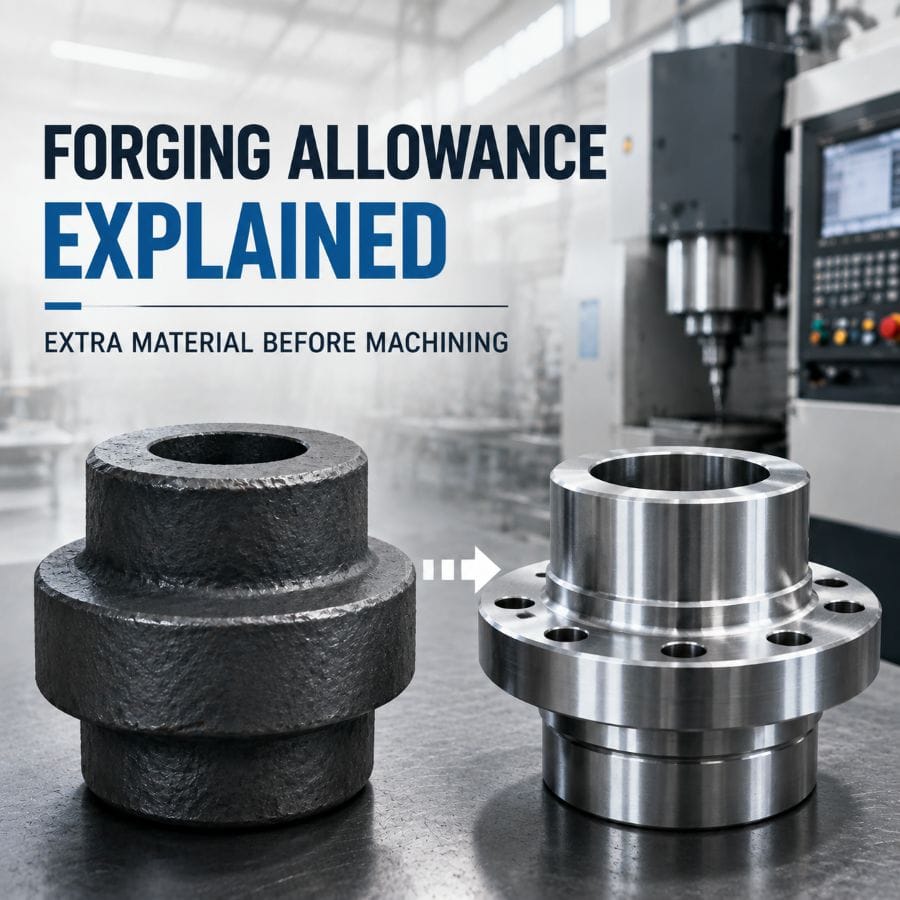
Forging allowance is the extra material added to forged components before machining to achieve the required dimensions, surface quality, and tolerances. Since forged blanks are typically produced slightly larger than the final part, the additional stock allows CNC machining to remove surface variations and achieve precise specifications.
The required allowance depends on factors such as material, forging process, component design, and machining requirements. Proper forging allowance design helps reduce unnecessary machining, control production costs, and ensure reliable component performance.
For OEM applications, effective allowance planning is essential for producing high-quality forged parts used in industries such as construction equipment, mining machinery, and power transmission.
What Is Forging Allowance?
Forging allowance is the extra material intentionally added to forged components before machining to achieve the required dimensions, surface quality, and tolerances. This additional stock allows manufacturers to remove surface variations and complete CNC machining operations without affecting the final part requirements.
Although modern forging processes can produce near-net-shape components, most forged parts still require machining to achieve precise dimensions and surface finishes. The required allowance is determined based on factors such as material, forging process, component design, and machining requirements.
In simple terms:
Forging allowance = Extra material added during forging to ensure accurate machining and final part quality.
Why Do Forged Parts Need Extra Material?
There are several reasons why forged parts require additional material before machining.
Surface Condition After Forging
During hot forging, steel is heated to high temperatures and formed under pressure. The forging surface may contain oxide scale, minor irregularities, or uneven deformation.
The machining allowance provides enough stock to remove these surface conditions and expose clean material.
This is especially important for components requiring:
- precise dimensions
- smooth surfaces
- fatigue resistance
- reliable assembly performance
Dimensional Accuracy Requirements
The forging process creates the basic shape of a component, but achieving final precision usually requires CNC machining.
Factors including:
- forging temperature
- material flow
- die condition
- cooling process
can influence final forged dimensions.
Therefore, machining allowance for forged parts ensures that manufacturers have enough material to achieve required tolerances.
Forging Allowance vs Machining Allowance: What Is the Difference?
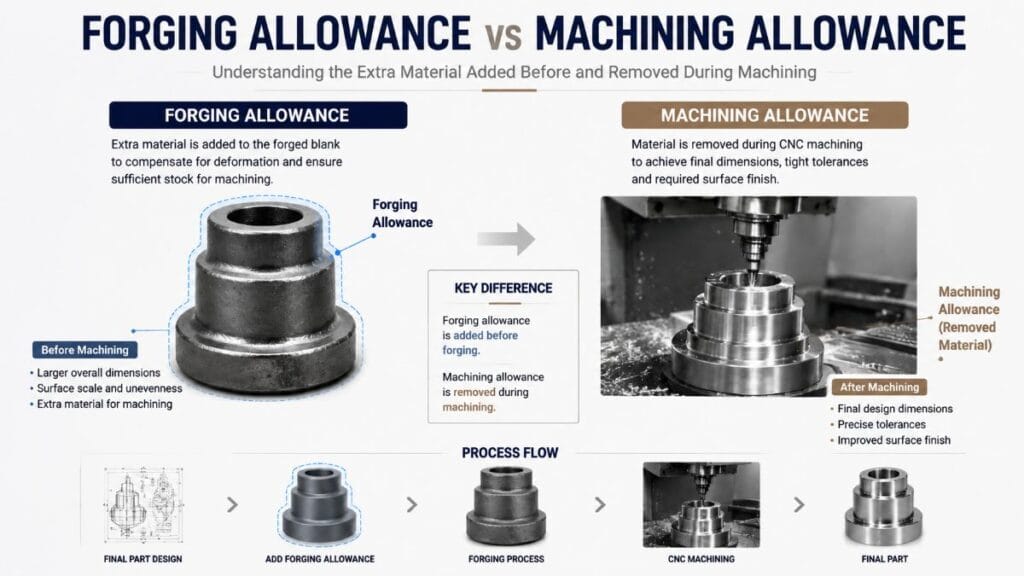
Although forging allowance and machining allowance are closely related, they describe different stages of manufacturing.
Forging Allowance
Forging allowance refers to the extra material designed into the forged blank before machining.
Its purpose is to compensate for:
- forging process limitations
- surface removal requirements
- dimensional adjustments
Machining Allowance
Machining allowance refers to the amount of material removed during machining operations.
It supports processes such as:
- turning
- milling
- drilling
- grinding
In simple terms:
Forging allowance adds extra material before machining, while machining allowance defines how much material is removed during finishing operations.
A properly designed allowance system helps manufacturers optimize material usage, reduce machining workload, and maintain consistent component quality.
How Is Forging Allowance Determined?
Forging allowance is determined based on the component design, forging process, material characteristics, and machining requirements. It refers to the extra stock reserved on a forged blank before machining to achieve the required dimensions, tolerances, and surface finish.
The required allowance is not a fixed value. During the engineering design stage, engineers evaluate factors such as part geometry, material behavior, forging process, and forging tolerance requirements to determine the appropriate amount of material needed before final machining.
Key Factors Considered in Forging Allowance Design
- Component Geometry
Part size, shape complexity, and critical machining areas influence the required forging allowance. Components with complex features or tight dimensional requirements may need additional stock to achieve the final specifications.
- Forging Process and Material
Different forging methods and materials can affect dimensional variation, surface conditions, and machining requirements. For example, closed die forging usually provides better dimensional control, while larger or more complex forgings may require additional machining stock.
- Machining Requirements
Final tolerances, surface finish, and CNC machining capability determine how much material needs to be removed after forging. The allowance should provide enough stock for machining without creating unnecessary processing work.
How Forging Allowance Affects Machining Cost
Forging allowance directly affects the machining cost, material utilization, and production efficiency of forged components. Proper allowance provides enough stock for removing surface imperfections and achieving final dimensions, while excessive allowance can increase unnecessary machining work.
Too much forging allowance may result in:
- higher material consumption
- longer CNC machining time
- increased tool wear
Insufficient allowance may cause:
- difficulty removing surface defects
- challenges in achieving final tolerances
- additional rework
For OEM components, the goal is to optimize forging allowance based on part design, material, forging process, and machining requirements. By combining forging and CNC machining capabilities, manufacturers can produce optimized forged blanks that reduce machining workload while maintaining quality.
Why Proper Forging Allowance Matters for OEM Components
For OEM components, forging allowance directly affects machining efficiency, production cost, and final part quality. Proper allowance ensures enough material for CNC machining while avoiding unnecessary material waste and additional processing.
A well-designed forging allowance helps to:
- improve material utilization
- reduce machining workload
- maintain dimensional accuracy
- ensure consistent component quality
This is especially important for applications such as construction equipment, mining machinery, and power transmission, where forged components must withstand high loads and long service cycles.
Conclusion
Optimizing forging allowance requires a balance between forging process, machining requirements, and final part performance. The right allowance design helps control material usage, machining efficiency, and dimensional consistency during production.
At Weforging, forging allowance is evaluated together with part design, forging process, CNC machining, and inspection requirements. With integrated capabilities in forging, machining, heat treatment, and quality control, we support OEM customers in developing reliable forged components with stable production processes.
Working with an experienced forging supplier during the early engineering stage helps reduce unnecessary machining and improve long-term manufacturing efficiency.