Why Mining Forgings Are Critical for Heavy Equipment
Mining forgings are critical for heavy equipment because they provide superior strength, fatigue resistance, and long-term reliability in extreme mining environments. Heavy machinery operating in mining applications must withstand continuous shock loads, abrasive materials, and long operating cycles under high stress. In these conditions, component failure can lead to costly downtime and serious safety risks.
Compared with cast or purely machined parts, forged components offer improved grain flow and structural integrity, making them better suited for demanding mining operations. For OEM manufacturers and procurement teams, understanding the value of mining forgings is essential for improving equipment reliability, extending service life, and reducing lifecycle costs.
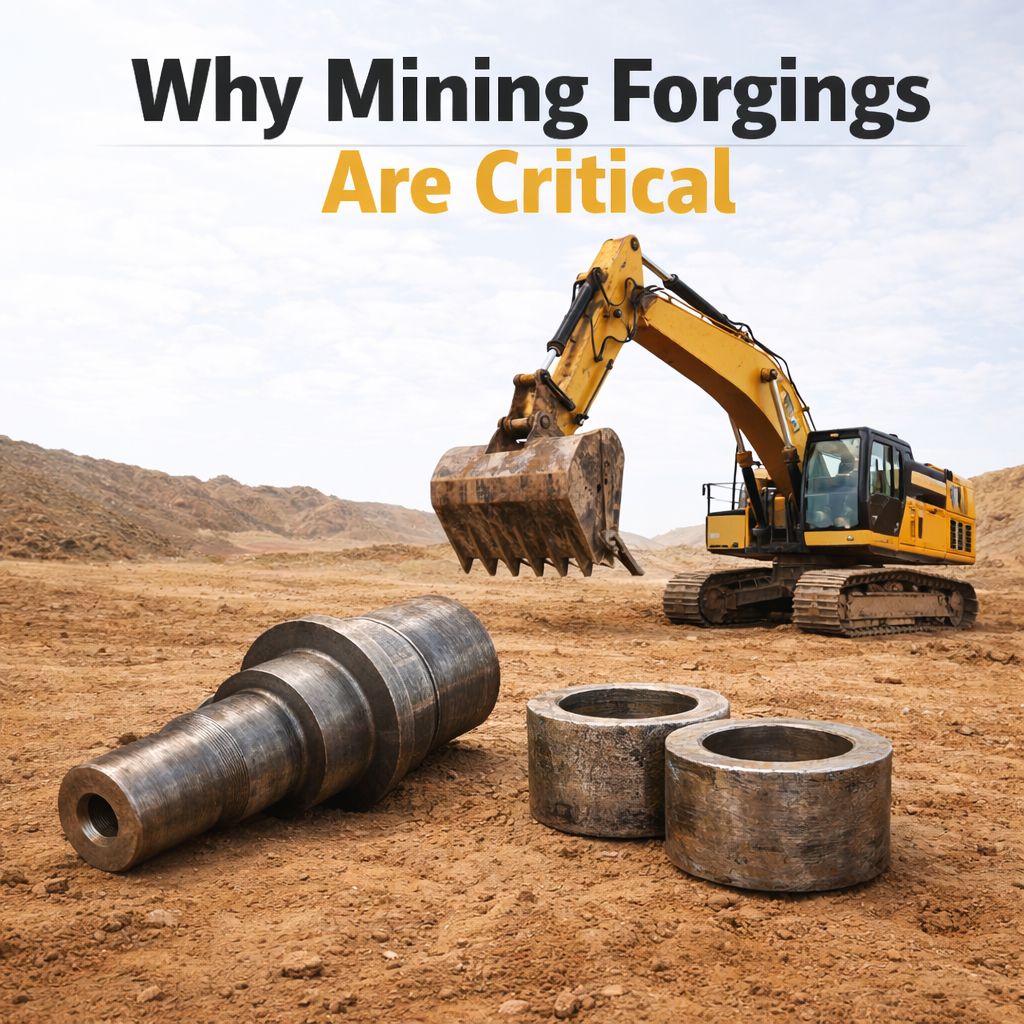
What Are Mining Forgings?
Mining forgings refer to forged metal components specifically designed for mining equipment and harsh operating environments. Through controlled deformation under high temperature and pressure, forging aligns the internal grain flow of the metal, resulting in improved mechanical properties.
Common forged mining parts include gears, shafts, bushings, and structural rings used in crushers, excavators, and drilling machinery. Unlike casting, which may contain internal defects, forging produces dense material structures that perform better under dynamic loads.
Why Heavy Equipment Relies on Forged Components
Heavy equipment used in mining faces extreme vibration, impact loads, and continuous fatigue stress. Components that fail under these conditions can cause production shutdowns and expensive repairs.
Forged components for mining equipment provide higher impact resistance and better fatigue performance because the grain flow follows the geometry of the part. This structural advantage allows forged parts for heavy equipment to maintain stability even under repeated stress cycles.
For engineers and procurement managers, choosing forged solutions means improved safety margins and reduced risk of unexpected failure.
Common Mining Equipment Forgings Used in the Industry
Mining equipment forgings are widely used across critical mechanical systems. Typical examples include:
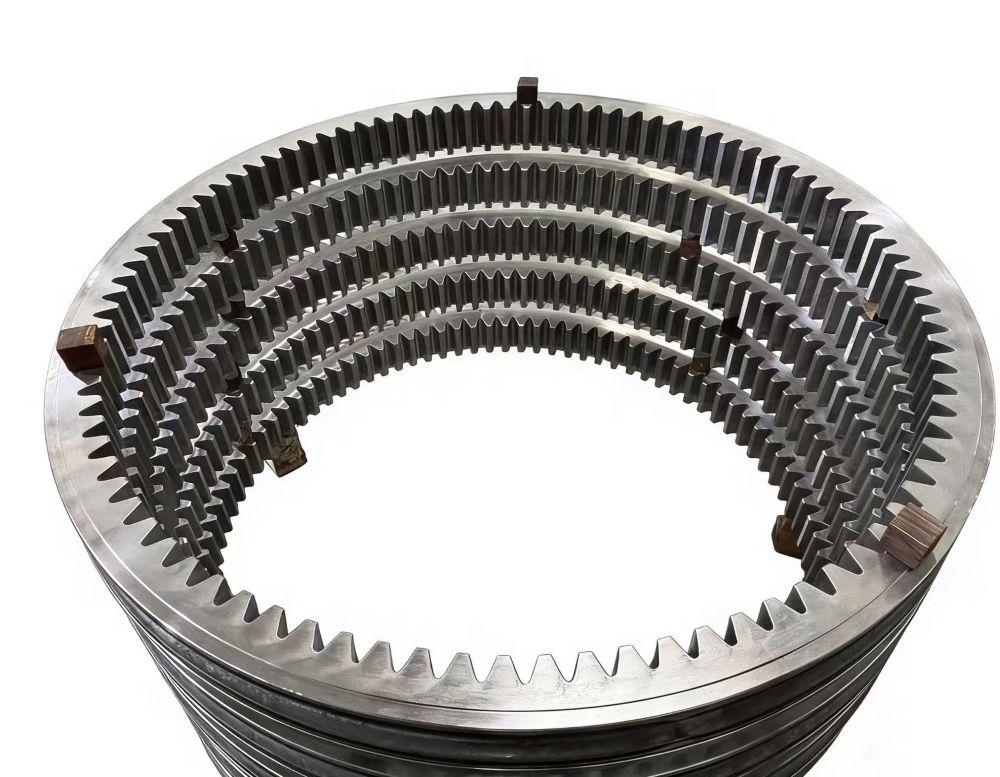
- Forged ring gears for transmission systems
- Heavy-duty shafts for crushers and conveyors
- Forged bushings and sleeves for rotating joints
- Flanges and couplings for hydraulic systems
These forged mining parts are designed to withstand high torque and continuous wear. Their reliability directly affects machine uptime and operational efficiency.
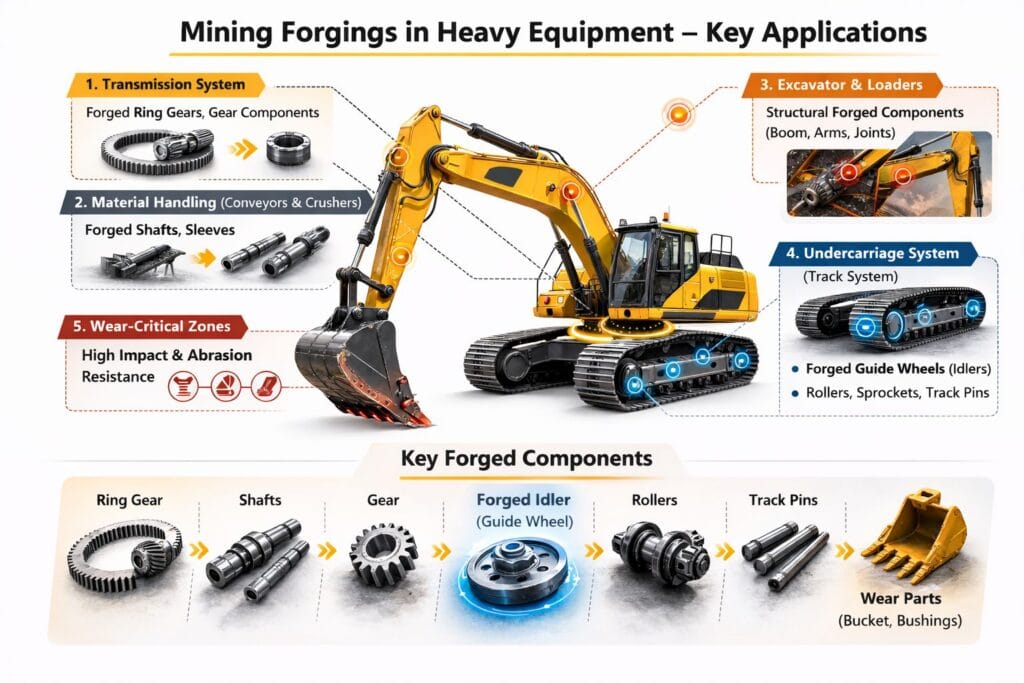
Typical Applications of Mining Forgings in Heavy Equipment
Mining forgings are widely used in heavy equipment that operates under high impact, vibration, and abrasive conditions. Typical applications include:
- Transmission systems: forged ring gears and large gear components for torque transfer
- Material handling equipment: forged shafts and sleeves used in conveyors and crushers
- Excavators and loaders: structural forged components supporting high cyclic loads
- Undercarriage systems: forged guide wheels (idlers) used to stabilize tracks, reduce wear, and improve service life in crawler equipment
- Wear-critical zones: forged wear-resistant parts exposed to continuous impact and abrasion
Using forged components in these applications helps extend equipment lifespan, reduce downtime, and maintain long-term performance stability.
Heavy Duty Mining Forgings vs Cast Components
Heavy duty mining forgings are stronger and more reliable than cast components because forging creates continuous grain flow, improving fatigue resistance, durability, and long-term performance in harsh mining environments.
Feature | Heavy Duty Mining Forgings | Cast Components |
Material Structure | Continuous grain flow aligned with part geometry | Random grain structure |
Mechanical Strength | High impact strength | Moderate strength |
Fatigue Resistance | Excellent under cyclic loads | Lower fatigue performance |
Internal Defects | Dense structure with minimal porosity | Possible porosity or shrinkage |
Wear Performance | Better in abrasive environments | Faster wear |
Service Life | Longer lifespan in mining applications | Shorter under heavy-duty conditions |
Reliability | High reliability for critical equipment | Suitable for less demanding applications |
Lifecycle Cost | Lower long-term operating cost | Lower initial cost |
Wear Resistance and Service Life in Mining Applications
Mining forgings improve wear resistance and extend service life in heavy equipment used for mining. Compared with cast parts, forged components provide stronger structure and better durability under abrasive conditions. Key benefits include:
- Higher wear resistance for harsh mining environments
- Longer service life with fewer failures
- Reduced maintenance frequency and lower replacement costs
- Improved equipment reliability with less downtime
With proper heat treatment and machining, mining forgings help maintain stable performance, increase equipment availability, and reduce long-term operating costs.
Custom Mining Forgings for OEM Requirements
Modern OEM manufacturers often require custom mining forgings based on engineering drawings and specific performance standards.
By combining forging with CNC machining and controlled heat treatment, suppliers can deliver components that meet strict dimensional tolerances and mechanical requirements. This integrated approach ensures batch consistency, traceability, and reliable performance in heavy-duty applications.
For mining equipment manufacturers, custom forged solutions allow better design flexibility while maintaining structural strength.
How Mining Forgings Improve Reliability and Cost Efficiency
Mining forgings improve equipment performance by reducing failures, extending service life, and lowering long-term operating costs. Key benefits include:
✔ Reduced Unplanned Failures
Forged components provide higher structural integrity and fatigue resistance, helping reduce unexpected breakdowns in demanding mining environments.
✔ Longer Equipment Lifespan
Continuous grain flow improves durability, allowing mining forgings to withstand heavy loads and abrasive conditions for longer periods.
✔ Lower Maintenance Costs
Improved wear resistance means fewer repairs and replacement cycles compared with cast components.
✔ Better Lifecycle Cost Efficiency
Although initial production costs may be higher, forged parts often deliver lower total lifecycle costs through improved reliability and reduced downtime.
✔ Higher Return on Investment for Procurement Teams
Investing in forged parts for heavy equipment leads to fewer replacements, improved machine uptime, and stronger long-term ROI.
Conclusion
Mining environments require components that can maintain strength, reliability, and safety under extreme conditions. Mining forgings provide the durability and performance needed for modern heavy equipment, helping reduce failures and improve long-term operational stability.
As equipment demands continue to increase, forged solutions remain a reliable choice for critical mining applications.
If you are evaluating forged components for mining equipment, feel free to share your project requirements with our team. We are glad to discuss practical solutions for your application.