
Fatigue Resistance in Forgings: Why Forged Parts Last Longer
Fatigue resistance in forgings is a critical factor in determining the service life of industrial components. In many applications, component failure is not caused by insufficient strength, but by fatigue under repeated loading.
This issue is especially common in gears, shafts, flanges, and mining equipment, where cyclic loads are unavoidable. Fatigue failure can occur unexpectedly and often leads to costly downtime, safety risks, and reduced equipment reliability.
One key factor influencing fatigue resistance is the manufacturing process. Forging improves fatigue resistance by enhancing grain flow and reducing internal defects, making forged parts more reliable under cyclic loading conditions.
Quick Answer: What Improves Fatigue Resistance?
Forging improves fatigue resistance by creating continuous grain flow, reducing internal defects, and enhancing load distribution. Compared with casting or machining from bar stock, forged parts typically offer longer fatigue life and higher reliability under cyclic loading.
What Is Fatigue Resistance in Steel Components?
Fatigue resistance is a material’s ability to withstand repeated (cyclic) loading over time without failure.
Unlike static strength, which measures performance under a single load, fatigue resistance focuses on how a component behaves over long-term use.
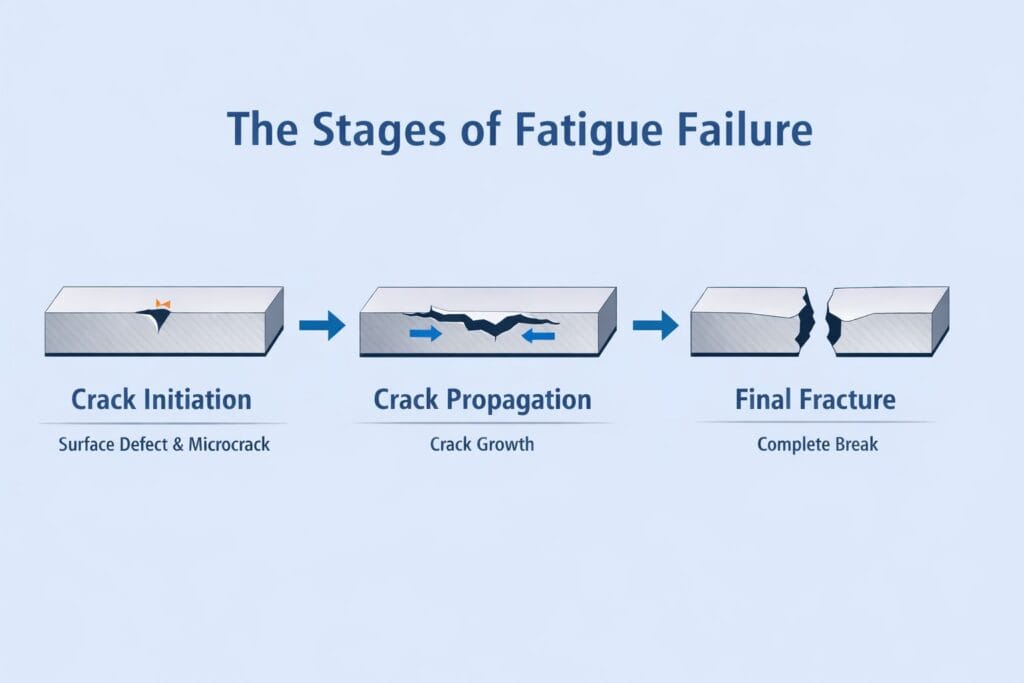
Fatigue failure typically occurs in three stages:
- Crack initiation – small defects or surface imperfections act as starting points
- Crack propagation – cracks grow gradually under repeated stress cycles
- Final fracture – the component eventually breaks
Key insight:
Even very small defects can lead to failure when loads are repeated over time.
For steel components used in demanding environments, fatigue resistance is often more critical than ultimate tensile strength.
What Causes Fatigue Failure in Industrial Parts?
Fatigue failure in industrial components is usually caused by a combination of material, design, and manufacturing factors:
- Internal defects
Porosity or inclusions weaken the material and create potential crack initiation points - Stress concentration
Sharp corners, notches, or poor design increase localized stress - Poor surface condition
Rough surfaces from inadequate machining accelerate crack formation - Improper heat treatment
Inconsistent hardness or excessive brittleness reduces fatigue performance - Non-uniform microstructure
Irregular grain structure leads to unstable material behavior under cyclic loads
Most fatigue-related issues are closely linked to how the component is manufactured. Choosing the right process plays a critical role in improving fatigue resistance.
Example: Gear Failure Due to Poor Fatigue Resistance
A gear used in heavy machinery developed cracks after a short service period, even within its designed load range.
Failure analysis showed:
- Cracks initiated at surface defects
- Non-uniform internal structure, often due to insufficient heat treatment control or unmet hardness requirements
- Machined from bar stock with no optimized grain flow
Insight:
Under cyclic loading, such conditions can significantly shorten fatigue life. In practice, forged components are generally observed to provide more stable performance and longer service life due to improved grain flow and reduced defects.
Why Forging Improves Fatigue Resistance in Steel Parts
Forging offers several structural advantages that directly enhance fatigue resistance:
- Continuous grain flow improves resistance to crack initiation
- Reduced internal defects due to higher material density
- Better load distribution lowers stress concentration
- Optimized microstructure when combined with heat treatment
These advantages make forged parts significantly more reliable under cyclic loading conditions.
If you are comparing manufacturing options for fatigue-critical components, forging is often the most reliable starting point.
How Grain Flow Improves Fatigue Resistance in Forging
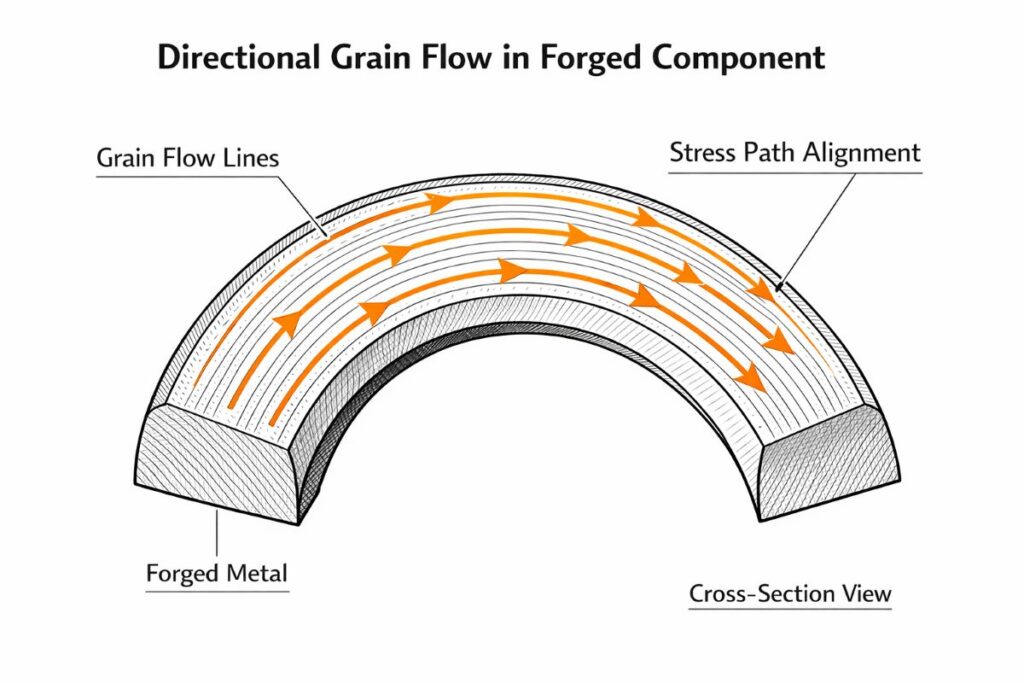
One of the key reasons forging improves fatigue resistance is the formation of continuous grain flow within the material.
During the forging process, metal is plastically deformed so that its internal grain structure follows the shape of the part. This structural alignment plays a critical role in fatigue performance.
How grain flow enhances fatigue resistance:
- Grain follows load direction
The aligned grain structure supports the primary stress path, reducing weak points - Crack propagation is slowed
Continuous grain flow makes it more difficult for cracks to grow under cyclic loading - Internal structure becomes stronger
The material behaves as an integrated structure, improving overall durability
Engineering insight:
Compared with casting or machining from bar stock, forging creates a grain structure that is better adapted to real working conditions, resulting in improved fatigue life and reliability.
Fatigue Strength vs Fatigue Resistance: What’s the Difference?
These two terms are often confused: fatigue strength and fatigue resistance.
However, they describe different aspects of performance under cyclic loading.
- Fatigue strength
The maximum stress a material can withstand for a given number of cycles - Fatigue resistance
The overall ability of a component to perform reliably over time under repeated loading
Key difference:
Fatigue strength focuses on a test value, while fatigue resistance reflects real-world performance.
In practical applications, fatigue resistance is usually more important. It depends not only on material, but also on factors such as surface condition and manufacturing process.
Forging vs Casting: Which Has Better Fatigue Strength?
When comparing manufacturing processes, forging consistently delivers superior fatigue resistance, especially in cyclic loading conditions.
Comparison of Fatigue Performance
Factor | Forging | Casting | Machining (Bar Stock) |
Grain Structure | Continuous grain flow | Random grain structure | Interrupted grain flow |
Internal Defects | Minimal | Porosity & shrinkage common | Minimal |
Stress Distribution | Uniform | Uneven | Moderate |
Crack Initiation Risk | Low | High | Medium |
Fatigue Resistance | High | Low–Medium | Medium |
Conclusion:
For components subjected to repeated or cyclic loads, forging provides the most reliable fatigue resistance and longest service life.
Where Is Fatigue Resistance Critical in Industrial Applications?
Fatigue resistance is essential in many industries where components are exposed to cyclic loads:
- Mining equipment: subject to impact and repeated stress
- Gear systems: continuous engagement under load
- Shafts: torsional and bending fatigue
- Flanges and pressure components: fluctuating pressure cycles
In these applications, forged components provide higher reliability and longer service life.
How to Improve Fatigue Life in Forged Components
Several factors can further enhance fatigue life in forged components:
- Controlled forging process to ensure uniform grain flow
- Proper heat treatment, such as quenching and tempering
- Precision CNC machining to reduce stress concentration
- Surface finishing to achieve low roughness
- Inspection methods like ultrasonic testing (UT) and magnetic particle inspection (MPI)
These processes together ensure consistent quality and improved fatigue performance.
How to Choose the Right Process for Fatigue-Critical Parts
When selecting a manufacturing method, engineers and buyers should consider:
- High cyclic loads → forging is recommended
- Safety-critical applications → forging preferred
- Complex shapes with lower stress → casting may be acceptable
- Cost considerations → evaluate total lifecycle cost
Choosing the right process can significantly reduce failure risk and maintenance costs.
Buyer Checklist: When to Choose Forging
Choose forging if:
- Parts face repeated loading
- Failure is not acceptable
- You need long service life
- Working conditions are harsh
- Material defects must be minimized
In short:
High stress + high reliability → choose forging
Conclusion
Fatigue failure is a common issue in industrial components, especially under cyclic loading. As shown in this article, fatigue performance depends not only on material, but also on the manufacturing process.
Forging improves fatigue resistance by optimizing grain flow and reducing internal defects. Compared with casting or machining, forged parts typically offer more stable performance and longer service life.
If you are evaluating components for high fatigue applications, feel free to share your drawings or requirements —we’re happy to help review and suggest a suitable solution.