
Forged Ring Benefits: Why Engineers Choose Forging
In industrial applications, the choice of manufacturing process has a direct impact on component performance, reliability, and long-term cost. This is especially critical for parts such as bearing rings and gear rings, which must withstand heavy loads and cyclic stress.
Among these options, forged rings benefits are often a key factor when engineers compare forging with casting or machining. The selected process directly affects material structure, strength, and service life, and a poor decision can lead to premature failure, increased maintenance, and unexpected downtime.
Understanding how forging improves performance helps support more reliable engineering decisions in demanding applications.
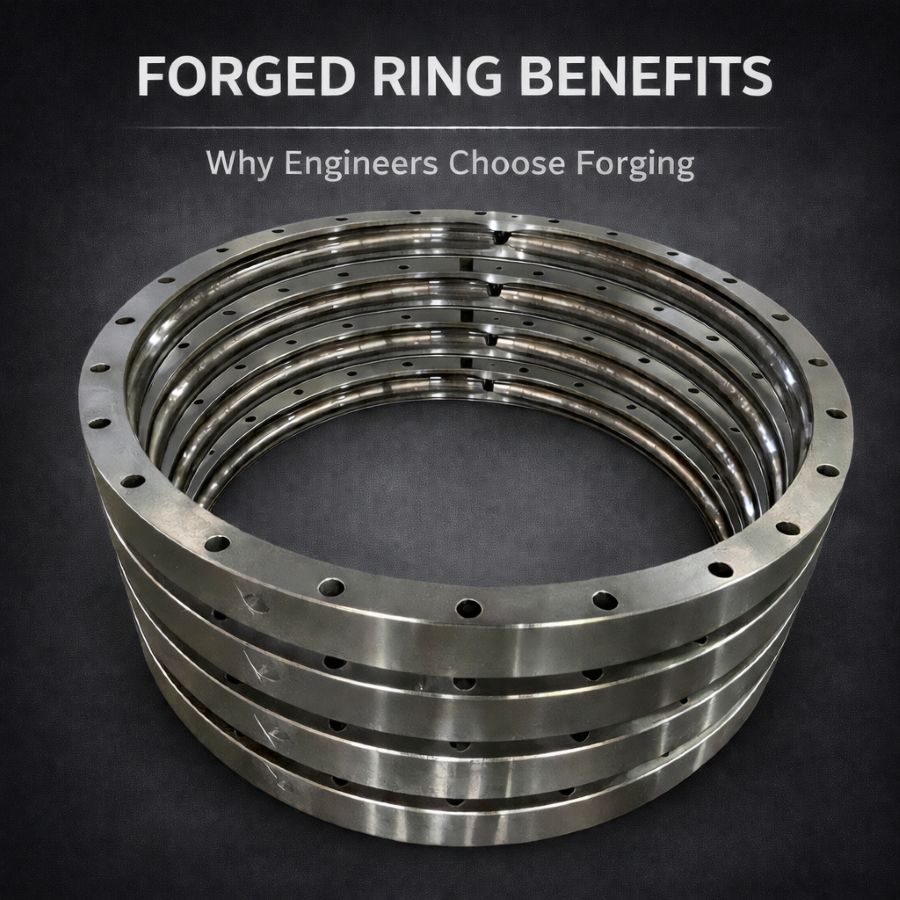
Forged Ring Benefits vs Other Manufacturing Methods
Forged rings are produced through controlled plastic deformation under high pressure. This process reshapes the internal grain structure of the material, improving strength and consistency.
To better understand forged rings benefits, it is helpful to compare forging with other common manufacturing methods:
- Casting – molten metal is poured into molds, which may introduce internal defects such as porosity and shrinkage
- Machining – material is cut from solid bars, which interrupts the natural grain flow
- Forging – material is deformed and refined, preserving and enhancing grain structure
Forging not only improves mechanical performance but also ensures more reliable and consistent results in demanding applications.
How Forged Rings Are Made: Key Steps in the Forging Process
Forged rings are typically produced through a controlled process known as ring rolling forging. This method is widely used to achieve high strength and consistent material properties.
The main steps include:
- Material preparation– cutting and heating the billet to the required temperature
- Piercing and pre-forming– creating an initial ring shape
- Ring rolling – expanding the ring while maintaining continuous grain flow
- Heat treatment– improving strength, hardness, and toughness
- CNC machining– achieving final dimensions and tight tolerances
Key advantage:
This process ensures continuous grain flow, high material utilization, and stable mechanical performance across batches.
Continuous Grain Flow: A Core Forged Ring Benefit
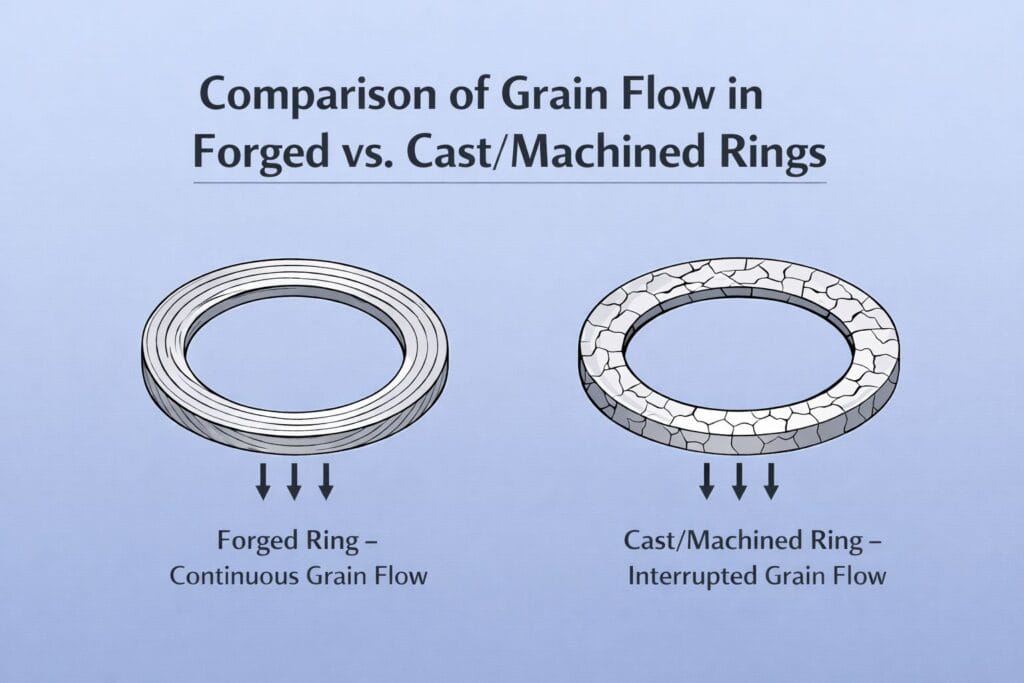
One of the most critical advantages of forged rings is continuous grain flow. During forging, the metal’s grain structure follows the shape of the ring, forming a continuous circumferential pattern.
This brings several key benefits:
- Uniform stress distribution across the component
- Reduced weak points caused by interrupted grain structure
- Improved structural integrity under dynamic loads
- Better resistance to cracking and failure
Compared with other methods:
- Cast rings have random grain structure and may contain defects such as porosity
- Machined rings are cut from bar or plate, resulting in interrupted grain flow and stress concentration
This is why forged rings are widely used in bearings and rotating equipment, where reliability and long service life are essential.
Higher Strength and Load Capacity in Forged Rings
Forged rings are widely recognized for their superior mechanical properties. Compared with cast or machined components, they provide:
- Higher tensile strength – better resistance to deformation
- Improved impact resistance – performs reliably under shock loads
- Enhanced load capacity – suitable for heavy-duty applications
- Consistent mechanical performance – uniform properties throughout
These advantages make forged rings ideal for:
- Gear rings
- Slewing bearings
- Rotating industrial equipment
How to Choose the Right Forged Ring Material
Material selection is one of the most critical factors in forged ring performance. Different materials offer different balances of strength, toughness, corrosion resistance, and cost.
Engineers typically choose materials based on application requirements:
- Alloy steel (e.g., 42CrMo / 4140)
Ideal for high-load applications requiring strength and toughness - Carbon steel
Cost-effective option for general industrial use - Stainless steel
Suitable for corrosive environments or hygiene-sensitive industries - Special alloys
Used for high-temperature or extreme conditions
Key consideration:
Choosing the wrong material can significantly reduce service life, even if the forging process is correct.
Forged Rings vs Cast Rings: Key Performance Differences
When comparing forged rings vs cast rings, the key differences lie in material structure, strength, and long-term performance. While both methods are used in industrial applications, their mechanical properties and reliability can vary significantly.
The following comparison highlights the main differences:
Feature | Forged Rings | Cast Rings |
Internal Structure | Dense and uniform, minimal defects | May contain porosity and shrinkage |
Grain Flow | Continuous, follows ring shape | Random and discontinuous |
Strength | High strength, suitable for heavy loads | Moderate strength |
Fatigue Resistance | Excellent under cyclic loading | Lower, prone to crack initiation |
Service Life | Longer lifespan under demanding conditions | Shorter service life |
Reliability | High consistency across batches | Less consistent quality |
Key takeaway:
Forged rings offer clear advantages in strength, fatigue resistance, and durability. This makes them a more reliable choice for critical applications such as bearings, gear rings, and heavy-duty equipment.
Common Failure Modes in Rings (and How Forging Prevents Them)
Understanding failure modes helps engineers select the right manufacturing process.
Common ring failures include:
- Cracking
Often caused by internal defects or stress concentration - Deformation
Due to insufficient strength or improper material - Wear and surface damage
From poor hardness or inadequate heat treatment - Design-related issues
Caused by improper geometry, uneven load distribution, or insufficient safety factors
Forging helps prevent these issues by:
- Eliminating internal defects
- Improving grain flow
- Enhancing overall strength and fatigue resistance
How Forging Reduces Defects and Improves Material Integrity
Forging significantly improves material integrity by reducing internal defects:
- Eliminates voids and shrinkage
- Increases material density
- Improves batch consistency
- Supports reliable non-destructive testing (UT / MT)
This makes forged rings highly suitable for OEM applications requiring strict quality control.
Better Fatigue Resistance and Longer Service Life
Forged rings perform exceptionally well under cyclic loading conditions:
- Resist crack initiation
- Slow down crack propagation
- Maintain performance over long cycles
This leads to longer service life and reduced maintenance costs.
Cost Efficiency: Why Forged Rings Reduce Long-Term Costs
Although initial costs may be higher, forged rings offer long-term savings:
- Lower maintenance requirements
- Reduced downtime
- Longer replacement intervals
- Better lifecycle cost performance
Key insight: Forged rings deliver better value over time.
Lead Time and Production Process for Forged Rings
Understanding the production timeline is essential for procurement planning. A typical forged ring production process includes:
- RFQ & drawing review: 1–2 days
- DFM and technical confirmation: 2–3 days
- Tooling design and manufacturing: 10–20 days
- Sample production and validation: 5–7 days
- Mass production: 20–30 days
Typical total lead time:
40–60 days, depending on part complexity and order quantity.
Tip:
Early technical communication can significantly reduce lead time.
Typical Industrial Applications of Forged Rings
Forged rings are widely used in industries where strength, reliability, and long service life are critical. Typical applications include:
- Wind power – bearing rings and large structural components
- Mining equipment – heavy-duty rotating parts under high load
- Construction machinery – gear rings and connection components
- Bearing systems – precision rings for high-performance operation
- Energy sector – components exposed to extreme conditions
In these applications, forged rings provide superior fatigue resistance and consistent performance, making them a preferred choice for demanding industrial environments.
-2.jpg)
Why Choose an Integrated Forging + CNC Machining Solution
Combining forging with CNC machining ensures both structural strength and dimensional accuracy, while reducing risks associated with multi-supplier production. This integrated approach is widely used for forged rings in demanding industrial applications.
At Weforging, forging, machining, heat treatment, and inspection are managed in-house to maintain consistent quality. Key capabilities include:
- Compliance with ASTM, EN, and ISO standards
- Full traceability for each component
- Stable process control across production batches
This approach supports reliable performance in industries such as construction, mining, and energy.
Conclusion
Forged rings offer clear advantages in strength, structural integrity, and long-term reliability, making them a practical choice for demanding industrial applications. In real projects, performance also depends on material selection, engineering requirements, and quality control.
If you are evaluating forged rings, feel free to share your drawings or requirements. We’re happy to provide a free quotation and respond within 24 hours, along with practical input based on similar applications.