
1045 Steel vs 4140 Steel Forging: Which to Choose?
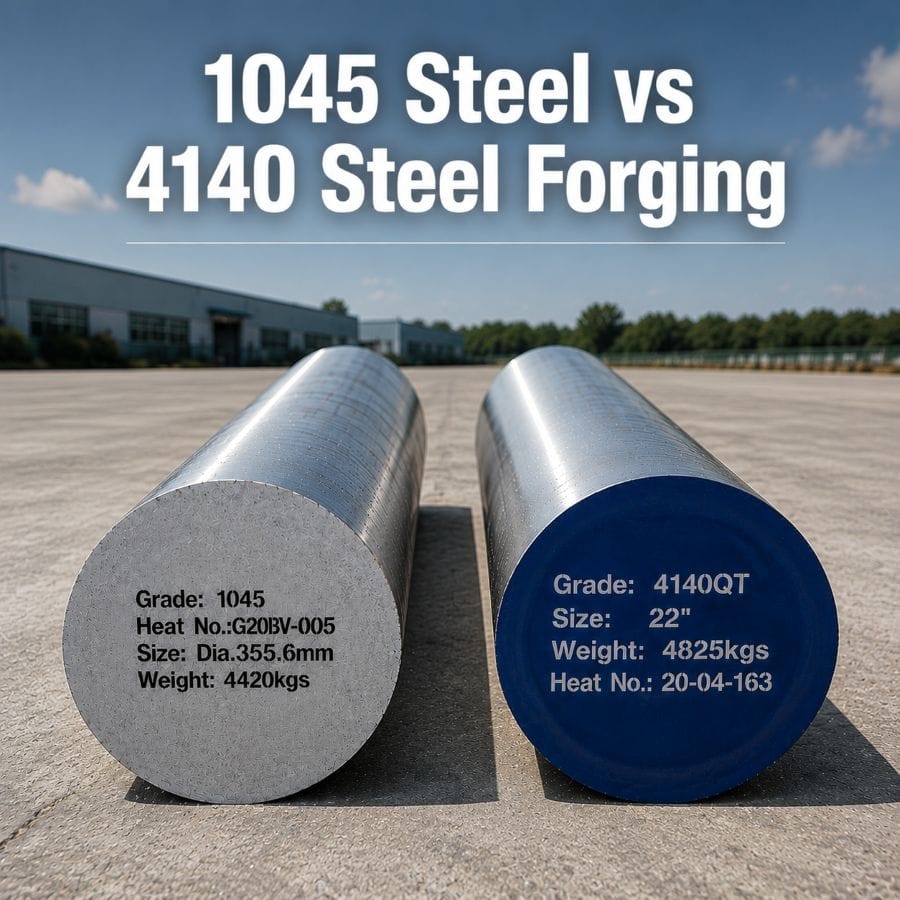
1045 steel vs 4140 steel is a common comparison when selecting materials for forged components, especially for parts that require a balance of strength, durability and machinability. Although both materials are widely used in industrial steel forging, they have different performance characteristics and are suitable for different applications.
1045 steel is a medium carbon steel known for its good machinability and cost efficiency. In comparison, 4140 steel is a chromium-molybdenum alloy steel that offers higher strength, better toughness and improved fatigue resistance, making it suitable for more demanding working conditions.
This article compares 1045 steel and 4140 steel from the perspective of forging applications, including their material properties, strength differences, heat treatment performance and typical uses in industrial components.
What Is 1045 Steel Forging?
1045 steel is a medium carbon steel commonly used for general industrial forged components. It is also known as SAE 1045 or AISI 1045.
1045 steel forging offers a good balance of strength, machinability and cost. Compared with cast materials, the forging process improves grain structure and provides more reliable mechanical performance.
Due to its excellent machinability, 1045 steel is often selected for shafts, pins, rollers and general mechanical parts. However, its hardenability is lower than alloy steels, making it less suitable for components requiring high strength or fatigue resistance.
What Is 4140 Steel Forging?
4140 steel is a chromium-molybdenum alloy steel commonly used for industrial forged components that require higher strength and durability.
Compared with carbon steels such as 1045, 4140 steel forging provides better hardenability, toughness and fatigue resistance. Through heat treatment processes such as quenching and tempering, 4140 steel can achieve higher strength while maintaining good mechanical performance.
Due to its excellent strength-to-toughness balance, 4140 steel is often selected for demanding applications such as forged shafts, gear components, mining parts and heavy-duty machinery components.
1045 vs 4140 Steel: Key Differences
The main difference between 1045 steel and 4140 steel for forged components is their alloy composition and resulting mechanical performance.
Property | 1045 Steel | 4140 Steel |
Material Type | Medium Carbon Steel | Chromium-Molybdenum Alloy Steel |
Strength | Moderate | High |
Fatigue Resistance | Good | Excellent |
Machinability | Excellent | Good |
Heat Treatment Response | Limited | Excellent |
Cost | Lower | Higher |
1045 steel is suitable for applications where machining efficiency and cost control are important. In comparison, 4140 steel forging is preferred for components requiring higher strength, better fatigue resistance and longer service life.
The right material choice depends on component requirements, including load conditions, heat treatment needs and operating environment.
Strength and Heat Treatment Comparison
When selecting materials for forged components, strength and heat treatment performance are key differences between 1045 steel vs 4140 steel. Although both materials can be heat treated, their performance varies due to different alloy compositions.
Property | 1045 Steel | 4140 Steel |
Material Type | Medium Carbon Steel | Chromium-Molybdenum Alloy Steel |
Strength | Moderate | Higher |
Hardenability | Limited | Excellent |
Fatigue Resistance | Good | Excellent |
Machinability | Excellent | Good |
1045 steel forging is suitable for moderate-load parts where cost efficiency and machining performance are important. 4140 steel forging provides higher strength and fatigue resistance, making it a better choice for forged shafts, gear components and heavy-duty applications.
Applications of 1045 and 4140 Forged Components
The choice between 1045 and 4140 steel depends largely on the working conditions of the final component.
1045 Steel Forging Applications
1045 steel is commonly used for general mechanical parts where moderate strength and good machinability are required, including:
- Shafts and rollers
- Pins and bushings
- Machine components
4140 Steel Forging Applications
4140 steel is more suitable for high-load applications that require improved strength and fatigue resistance, such as:
- Forged shafts
- Gear components
- Mining equipment parts
- Hydraulic components
In industries such as construction machinery, mining and heavy equipment, forged components often face impact loads and repeated stress. In these cases, 4140 steel can provide better durability and longer service life.
.jpg)
Can 1045 Steel Replace 4140 Steel?
There is no direct one-to-one replacement between 1045 steel and 4140 steel, as they are selected for different performance requirements.
4140 steel forging is generally preferred for components requiring higher strength, fatigue resistance and longer service life, especially in demanding applications such as forged shafts, gear components and mining equipment parts.
1045 steel forging may be considered when:
- The application has lower load requirements
- The required performance level can be achieved with lower material strength
- Cost efficiency and machining performance are important factors
For components originally designed for 4140 steel, replacing it with 1045 steel requires careful evaluation of load conditions, safety requirements and expected service life. The final material choice should balance performance requirements and manufacturing costs.
1045 vs 4140 Steel: Which One Should You Choose?
There is no single answer when choosing between 1045 steel vs 4140 steel. The right material depends on the balance between performance requirements and manufacturing cost.
Choose 1045 steel forging when:
- The component works under moderate loads
- Machining efficiency is important
- Cost optimization is a priority
Choose 4140 steel forging when:
- Higher strength is required
- Fatigue resistance is critical
- The component operates under heavy-duty conditions
For OEM manufacturers, selecting the correct material at the design stage can improve component reliability and reduce long-term maintenance costs.
Custom 1045 and 4140 Steel Forging Solutions
Selecting the right material is essential for forged component performance. However, consistent quality also depends on proper forging processes, machining accuracy and quality control.
At Weforging, we provide custom 1045 and 4140 steel forging solutions, integrating:
With experience in forged shafts, gear components, hydraulic parts and heavy equipment components, we support OEM customers with reliable manufacturing and stable quality.
For 1045 carbon steel, 4140 alloy steel and equivalent materials such as C45 and 42CrMo4, our engineering team helps optimize material selection and production processes based on application requirements.
Conclusion
Selecting between 1045 steel and 4140 steel depends on the actual requirements of the forged component, including load conditions, service environment, heat treatment needs and expected service life.
With experience in steel forging, CNC machining and heat treatment, Weforging works with OEM customers to evaluate suitable materials for shafts, gears, hydraulic components and other industrial parts.
Whether the project requires the cost efficiency of 1045 steel or the higher strength of 4140 steel, the right material choice helps achieve reliable performance and consistent production quality.