
Custom Forging Blanks: What OEM Buyers Should Specify
For OEM projects, a forging blank is more than an unfinished piece of metal. Its material, forged geometry, machining allowance, heat treatment, and inspection requirements can directly affect downstream machining cost, dimensional stability, and production consistency.
A well-designed forged blank provides enough stock for reliable machining without leaving unnecessary material to remove. Its geometry should therefore be considered together with the finished dimensions, critical surfaces, and subsequent CNC operations.
For this reason, sourcing custom forging blanks should begin with the finished component. This article explains what OEM buyers and engineers should specify before production, from material and machining allowance to heat treatment, inspection, and traceability.
What Is a Forging Blank?
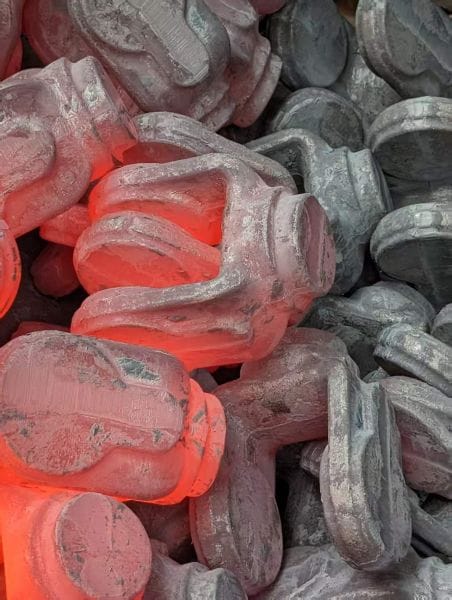
A forging blank, also called a forged blank, is a semi-finished component produced by forging for subsequent machining or other manufacturing operations. Depending on the part, these may include turning, milling, drilling, boring, gear cutting, heat treatment, or grinding.
Compared with machining the entire shape from oversized bar or plate, a forged blank can place material closer to the final geometry. This is particularly useful for components with stepped sections, flanges, hubs, shoulders, or significant changes in cross-section.
Typical examples include forged gear blanks, shaft blanks, ring blanks, flange blanks, hub blanks, and custom-shaped blanks.
When Should OEMs Buy Forging Blanks Instead of Finished Parts?
Buying forging blanks makes sense when the OEM or its designated machine shop already controls downstream manufacturing. This may include established CNC programs, dedicated fixtures, gear-cutting processes, final heat treatment, or proprietary finishing operations.
A common blank can also support several finished part numbers when the basic forged geometry is similar but the final machining differs.
However, buying blanks transfers more responsibility for machining to the customer. Blank tolerances, machining allowance, locating surfaces, and heat-treatment distortion must all work with the downstream process.
Where this interface is difficult to manage, sourcing the forging and CNC machining from one supplier can reduce handoffs and clarify responsibility.
What Should Be Specified When Ordering Custom Forging Blanks?
A useful RFQ should define more than the outside dimensions of the blank. The supplier also needs to understand what the blank will become after machining.
For most custom forging blank projects, the following information should be reviewed:
Requirement | What Should Be Defined? | Why It Matters |
Finished drawing | Dimensions, tolerances, critical features | Defines the final manufacturing target |
Material | Grade and applicable specification | Affects forging, heat treatment and properties |
Blank geometry | Forged profile or reference dimensions | Defines the starting condition for machining |
Machining allowance | Stock on machined surfaces | Affects machining reliability and material use |
Heat treatment | As-forged, normalized, annealed, Q&T, etc. | Affects properties and machinability |
Mechanical properties | Tensile, yield, elongation, impact, hardness | Defines performance requirements |
Inspection | Dimensional inspection, UT, MT or specified tests | Defines acceptance requirements |
Traceability | Heat number, batch and MTC requirements | Maintains material and production records |
Quantity | Prototype, batch and annual demand | Influences tooling and process selection |
If a dedicated forging drawing is not available, the finished-part drawing can be used as the starting point for engineering review.
How Much Machining Allowance Should a Forging Blank Have?
There is no single machining allowance that is suitable for every forged blank.
The required stock depends on the forging process, part size, geometry, material, heat treatment, dimensional capability, and surfaces to be machined. Scale, decarburization, forging tolerances, and possible distortion may also need to be considered.
Too little allowance can leave insufficient stock to achieve the finished dimension. Excessive allowance increases material consumption, CNC machining time, and tool wear.
The practical target is therefore enough controlled stock for reliable machining without unnecessary material removal. For custom parts, the allowance should be reviewed against the finished drawing and manufacturing route rather than selected as a generic value.
Common Types of Forging Blanks for OEM Components
The blank geometry should reflect the finished component rather than simply reproduce an oversized version of it.
Forged gear blanks provide a starting form for spur gears, helical gears, ring gears and other transmission components. Subsequent operations may include turning, boring, hobbing, shaping, spline machining and grinding.
Forged shaft blanks can incorporate stepped diameters, shoulders, flanges or enlarged sections for transmission shafts, pinion shafts and heavy-equipment components.
Ring and flange blanks provide material around the required OD, ID and connection areas before turning, facing or drilling.
For components with hubs, bosses or large section changes, a custom-shaped forged blank can place material closer to where it is required in the finished part.
What Quality Requirements Should Be Defined for Forging Blanks?
Inspection requirements should match the function and risk level of the finished component. Not every forging blank requires the same test plan.
Depending on the drawing and application, requirements may include:
- chemical composition verification
- tensile and yield strength
- elongation
- impact testing
- hardness testing
- ultrasonic testing (UT)
- magnetic particle testing (MT)
- metallographic examination
- dimensional inspection
- material and batch traceability
Where possible, the drawing or purchase specification should state both the required test and its acceptance criteria. Inspection is most useful when it answers a defined engineering requirement rather than simply adding more tests.
Our in-house laboratory provides tensile, yield strength, impact, spectrometric, metallographic, and CMM inspection for components, supporting material verification, mechanical-property control, and dimensional inspection throughout production.
Why Does Machining Capability Matter When Buying Forging Blanks?
A forging blank is designed for what happens next. This makes machining knowledge relevant even when the purchase order covers blanks only.
A supplier familiar with both forging and CNC machining can review machining datums, clamping areas, critical surfaces, stock distribution, tool access, and possible heat-treatment distortion before the blank design is finalized.
Removing material from the wrong area may reduce forging weight but make locating or machining more difficult. Leaving excessive stock creates the opposite problem: more material must be purchased and then removed.
The blank and finished component should therefore be treated as two stages of the same manufacturing process, not as unrelated parts of the supply chain.
From Forging Blank to Finished Component
A typical OEM manufacturing route may include:
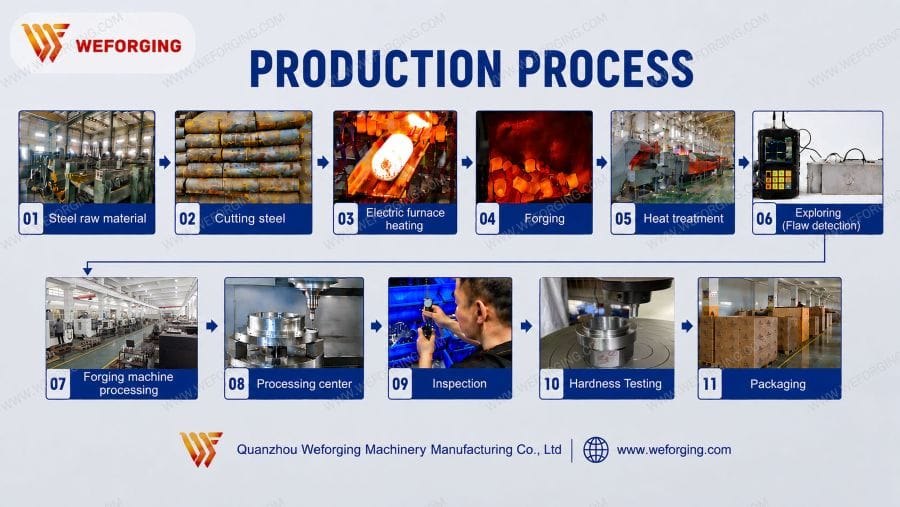
Raw Material → Cutting → Heating → Forging → Heat Treatment → Cleaning → Blank Inspection → CNC Machining → Final Inspection
The exact sequence depends on the component and drawing requirements.
At Weforging, projects can be reviewed from both the forging and machining sides. Customers may purchase custom forged blanks for their own machining, or continue through CNC machining and final inspection when finished components are required.
This allows the supply boundary to match the customer’s manufacturing strategy while keeping the blank geometry connected to the final part requirements.
Why Is Traceability Important for Forging Blanks?
Traceability becomes particularly important when forging and machining are performed at different facilities.
After a blank moves into the next production stage, its material identity should remain linked to the original heat and production batch. This makes it easier to investigate material, heat-treatment or mechanical-property issues if they arise later.
Depending on the project, records may include:
- raw material heat number
- material certificate / MTC
- forging batch
- heat-treatment batch
- inspection and test results
- part or production identification
For repeat OEM orders, consistent records also support batch comparison and process control.
How Should OEM Buyers Evaluate a Forging Blank Manufacturer?
Price per kilogram is useful, but it does not show the full cost of a forging blank. Excessive machining stock, inconsistent dimensions, or weak process control can create additional cost after the blank reaches the machine shop.
OEM buyers should evaluate whether the supplier can:
- produce the required geometry and production volume
- review the finished drawing and blank manufacturability
- control material and heat-treatment requirements
- define practical machining allowance
- understand downstream CNC machining
- perform the required inspection and testing
- maintain material and batch traceability
- reproduce the approved process across repeat orders
The objective is not simply to purchase a forged shape. It is to obtain a controlled starting component that can move reliably into the next manufacturing stage.
What Information Should Be Included in a Forging Blank RFQ?
A clear RFQ reduces technical clarification and makes quotations easier to compare. Whenever possible, provide:
- Finished component drawing or 3D model
- Forging blank drawing, if available
- Material grade and specification
- Required heat-treatment condition
- Machining allowance or surfaces to be machined
- Mechanical-property requirements
- Inspection and NDT requirements
- Material certification and traceability requirements
- Prototype and production quantities
- Required delivery condition
If some details have not yet been defined, the finished drawing and application information provide a practical starting point for engineering review.
Conclusion: Start with the Finished Part, Not Just the Forging Blank
For OEM sourcing, the finished component should define the forging blank—not the other way around. Material, blank geometry, machining allowance, heat treatment, inspection, and traceability should be specified with the downstream manufacturing process in mind.
Even when an OEM purchases forging blanks only, the finished drawing should remain the basis for technical review. This helps align the forged geometry and machining stock with the dimensions, critical surfaces, and quality requirements of the final part.
Weforging can supply custom forging blanks or finished CNC machined components, allowing OEM buyers to define the manufacturing scope according to their drawings, production requirements, and existing supply chain.