
Why Forged Piston Rods Outlast Welded Designs
In heavy-duty hydraulic systems, forged piston rods are increasingly used to improve structural reliability and reduce long-term fatigue failure. Under cyclic loading and impact conditions, weld interfaces, threaded areas, and stress concentration zones may gradually develop cracks and reduce hydraulic cylinder service life.
Today, common piston rod structures include forged, friction welded, and threaded designs. Among them, forged piston rods are widely preferred in mining equipment and construction machinery because they provide better structural continuity and fatigue resistance under heavy loads.
This article compares different piston rod structures, common failure areas, inspection methods, and the advantages of forged piston rods in heavy-duty hydraulic cylinders.
Why Piston Rod Design Matters in Hydraulic Systems
In heavy-duty hydraulic cylinders, piston rod failure is often linked to structural design rather than material strength alone. Under cyclic loading and vibration, weak transition areas may gradually develop fatigue cracks.
During operation, piston rods are exposed to:
- Tensile stress
- Bending force
- Vibration and shock loads
The structure of the piston rod directly affects:
- Fatigue resistance
- Stress distribution
- Hydraulic cylinder reliability
- Overall service life
In welded and threaded structures, weld seams and thread roots are more likely to become stress concentration areas under repeated loading conditions. For mining equipment, construction machinery, and lifting systems, piston rod structure plays an important role in long-term equipment durability.
Common Piston Rod Structures Used Today
Several piston rod manufacturing methods are commonly used across hydraulic applications.
One-Piece Forged Piston Rods
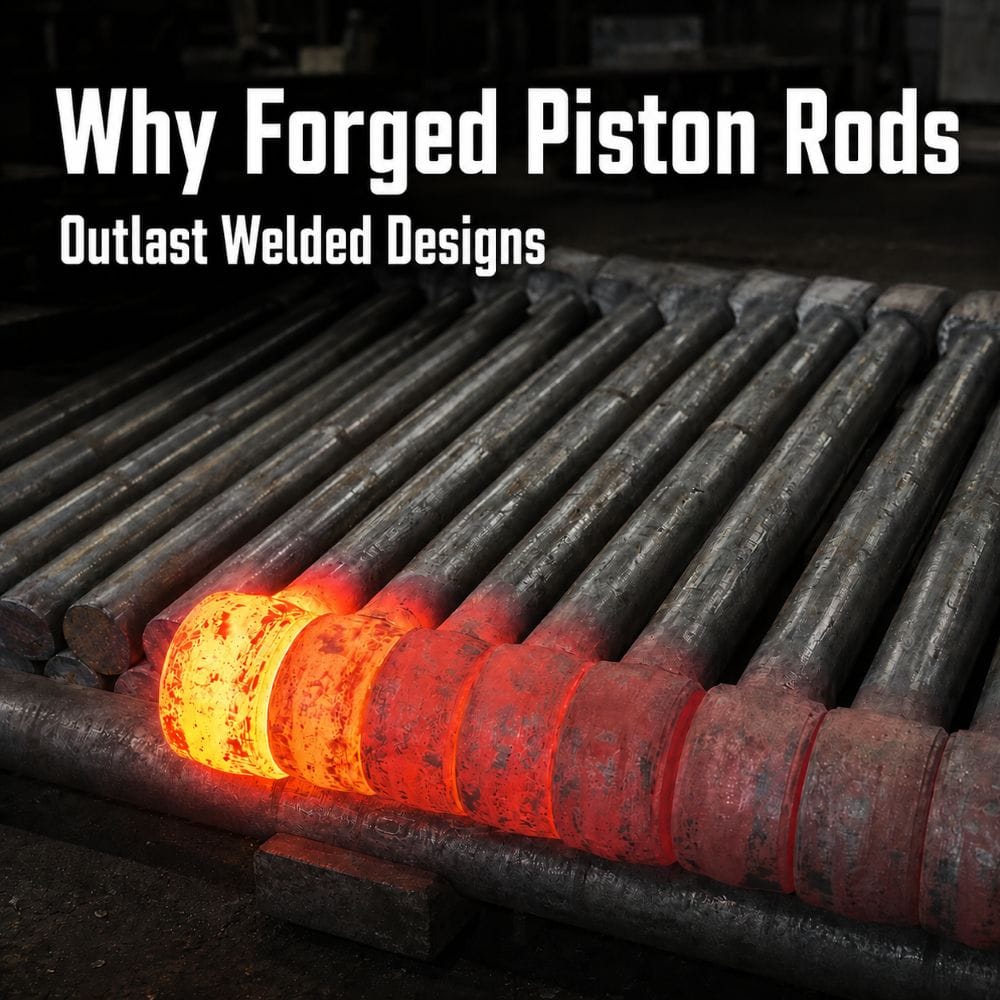
A forged piston rod is produced from a single forged steel blank. The forging process improves internal grain flow and creates a more continuous material structure.
Key advantages include:
- Better fatigue resistance
- Improved structural continuity
- Lower crack initiation risk
- Higher impact strength
This structure is widely used in heavy-duty hydraulic cylinders.
Friction Welded Piston Rods
Friction welded piston rods combine separate components through rotational welding.
Advantages include:
- Lower material consumption
- Reduced machining cost
- Flexible component combinations
These designs are commonly used in medium-duty hydraulic systems.
Threaded Piston Rods
Threaded piston rods use mechanical threads to connect rod sections or rod ends.
This design offers:
- Easier maintenance
- Convenient replacement
- Lower repair cost
However, threaded areas may create local stress concentration under heavy loads.
Forged vs Welded vs Threaded Piston Rod Comparison
Different piston rod structures are designed for different hydraulic applications. In heavy-duty hydraulic cylinders, structural continuity and fatigue resistance are often critical for long-term reliability.
Structure | Fatigue Resistance | Structural Continuity | Maintenance | Heavy-Load Suitability |
One-Piece Forged | High | Excellent | Medium | Excellent |
Friction Welded | Medium | Moderate | Medium | Moderate |
Threaded Design | Lower | Lower | Excellent | Limited |
Compared with welded and threaded structures, forged piston rods generally provide smoother stress transfer and lower fatigue crack risk under cyclic loading conditions. This is one reason why forged piston rods are widely used in mining equipment, construction machinery, and high-pressure hydraulic systems.
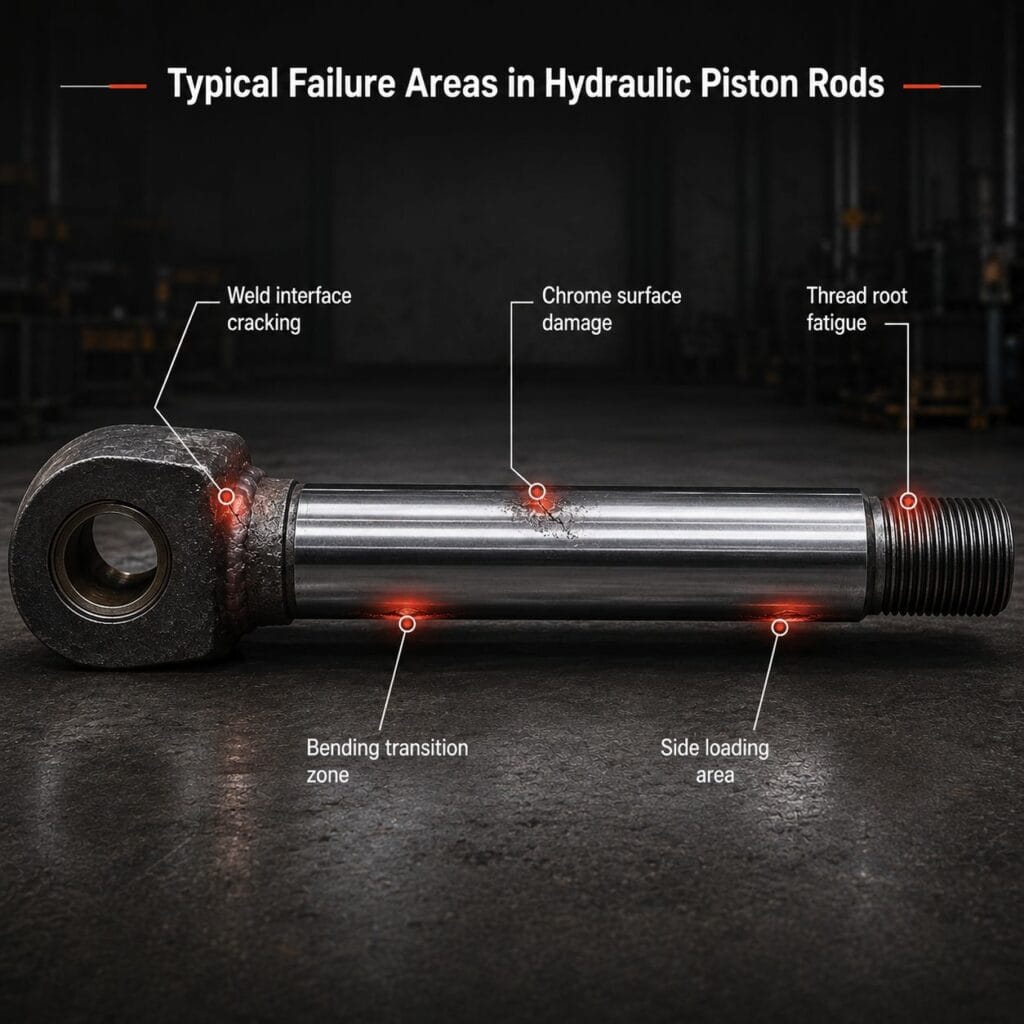
Typical Failure Areas in Hydraulic Piston Rods
In heavy-duty hydraulic cylinders, most piston rod failures begin in localized high-stress areas under cyclic loading conditions.
Common failure areas include:
- Weld interface cracking
- Thread root fatigue
- Bending transition zones
- Chrome surface damage
- Side loading areas
Welded structures are more likely to develop fatigue cracks near heat affected zones, while threaded designs may experience stress concentration around thread roots. Poor transition geometry and uneven side loading can also accelerate bending fatigue.
Compared with welded structures, forged piston rods generally provide smoother stress transfer and better structural continuity under heavy loads.
How Forged Piston Rods Improve Fatigue Resistance
One of the biggest advantages of forged piston rods is better fatigue resistance under heavy loading conditions.
During forging, metal grain flow follows the shape of the component, helping create a more continuous internal structure. Compared with welded designs, forged piston rods usually provide:
→ Better stress transfer
→ Lower fatigue crack risk
→ Improved structural stability
In heavy-duty hydraulic cylinders, repeated vibration and cyclic loading often weaken weld interfaces and stress concentration areas over time. A one-piece forged piston rod helps reduce these weak zones and improves long-term reliability.
For mining equipment, construction machinery, and high-pressure hydraulic systems, forged piston rods are widely used where durability and stable hydraulic performance are critical.
Limitations of Friction Welded Piston Rods
Friction welding offers several manufacturing advantages and is widely used in many hydraulic applications.
Compared with fully forged designs, friction welded piston rods may provide:
- Lower manufacturing cost
- Reduced material waste
- Faster production efficiency
For medium-duty hydraulic systems, this can be a practical solution.
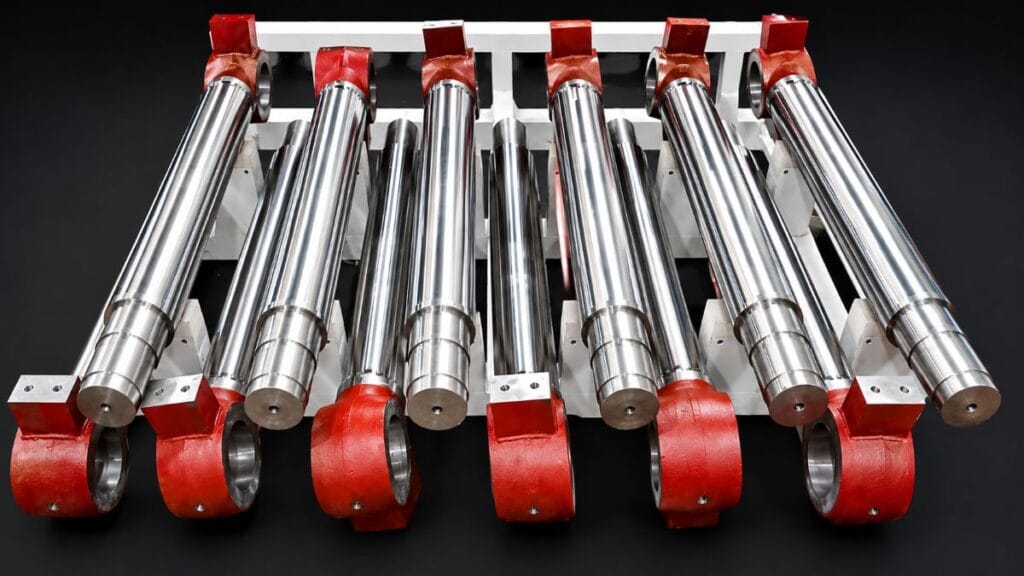
However, friction welded piston rods also introduce a weld interface into the structure. Under cyclic loading conditions, the welded area may experience:
- Heat affected zone softening
- Residual stress concentration
- Fatigue-sensitive transition areas
Although modern friction welding technology is highly advanced, the weld interface still remains a potential structural discontinuity compared with a one-piece forged design.
Stress Concentration Risks in Threaded Piston Rods
Threaded piston rods are commonly used in hydraulic systems requiring easier maintenance or replaceable rod-end assemblies. This design allows damaged accessories or threaded ends to be replaced without changing the entire component.
However, threaded areas naturally create stress concentration at the thread root. Under cyclic loading and vibration conditions, these locations may gradually become fatigue crack initiation points.
Common risks may include:
- Thread root fatigue
- Uneven stress distribution
- Connection loosening under vibration
- Reduced long-term fatigue life
For light-duty hydraulic systems, threaded piston rods can be a practical solution. However, in heavy-duty hydraulic cylinders operating under continuous impact and vibration loading, forged piston rods generally provide better structural continuity and long-term reliability.
Manufacturing Factors That Affect Piston Rod Reliability
Piston rod reliability depends not only on forging structure, but also on manufacturing consistency in heavy-duty hydraulic cylinders.
Key manufacturing factors include:
- Heat treatment consistency
- Rod straightness control
- Surface hardness stability
- Chrome plating quality
- Machining accuracy
Small manufacturing deviations may gradually increase stress concentration and fatigue risk under cyclic loading conditions.
Stable manufacturing control helps forged piston rods achieve better fatigue resistance and long-term hydraulic reliability.
Inspection Methods for Forged Piston Rods
Inspection plays an important role in maintaining the reliability of forged piston rods used in heavy-duty hydraulic cylinders.
Common inspection methods include:
- Ultrasonic testing (UT)
- Magnetic particle inspection (MT)
- Dimensional inspection
- Heat treatment verification
- Surface quality inspection
UT inspection helps detect internal discontinuities inside forged piston rods, while MT inspection is commonly used to identify surface cracks near stress concentration areas.
Consistent inspection and process traceability help improve fatigue resistance, structural stability, and long-term performance under cyclic loading conditions.
Conclusion
As hydraulic systems continue moving toward heavier operating conditions, piston rod reliability becomes increasingly important for long-term equipment performance.
Compared with welded and threaded structures, forged piston rods generally provide better structural continuity, improved fatigue resistance, and lower long-term failure risk under cyclic loading conditions. For heavy-duty hydraulic cylinders, this also helps reduce unexpected downtime, cylinder disassembly, and long-term maintenance cost.
If you are reviewing forged piston rod solutions or optimizing hydraulic cylinder designs, feel free to contact our team for technical support. We will respond within 24 hours.