
Why Is Forged Steel Stronger Than Cast Steel?
In modern industrial manufacturing, forged steel is widely used in applications where strength, durability, and reliability are critical. However, not all steel components perform the same. Engineers and procurement teams often ask: Why is forged steel stronger than cast or machined steel?
The answer lies in how the metal is formed and how its internal structure responds to load. This article explains why forged steel is stronger by examining the forging process, grain flow behavior, defect reduction, mechanical properties, and typical industrial applications.
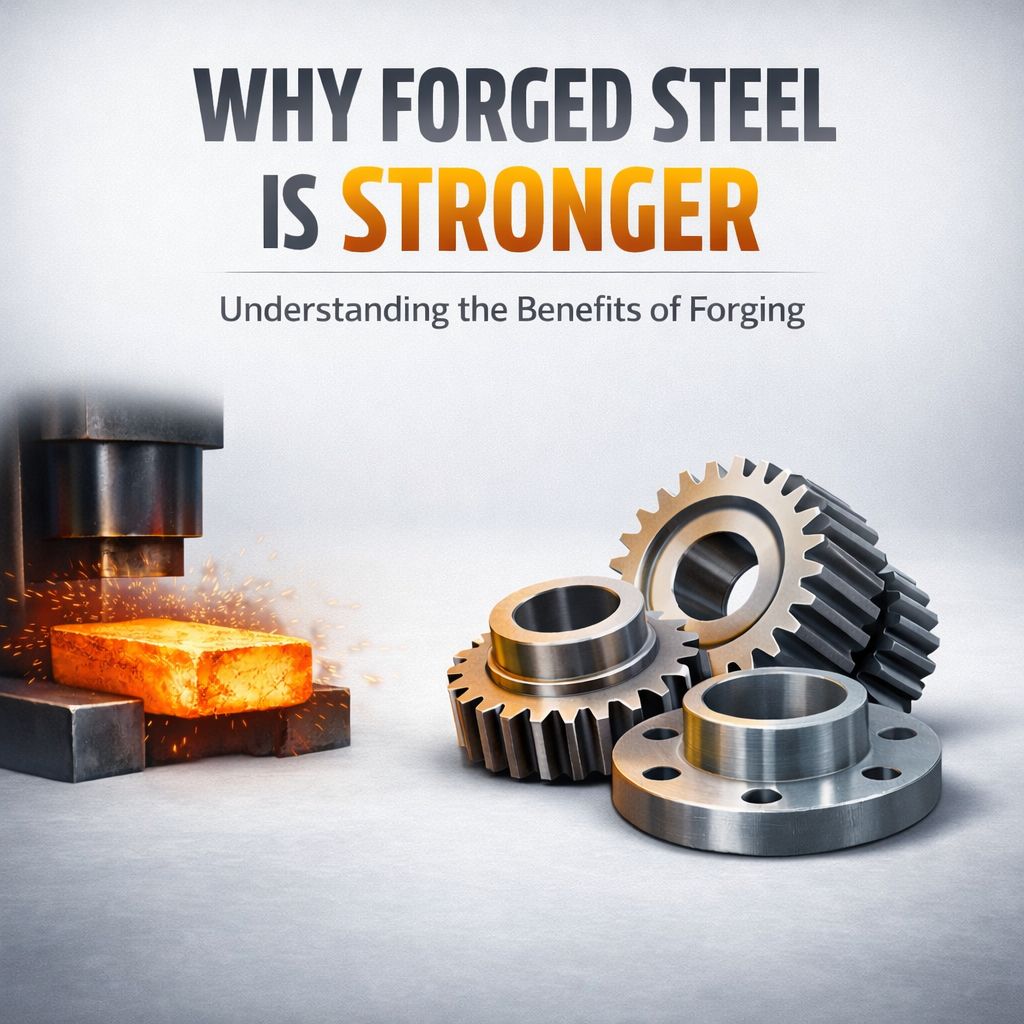
What Makes Forged Steel Stronger?
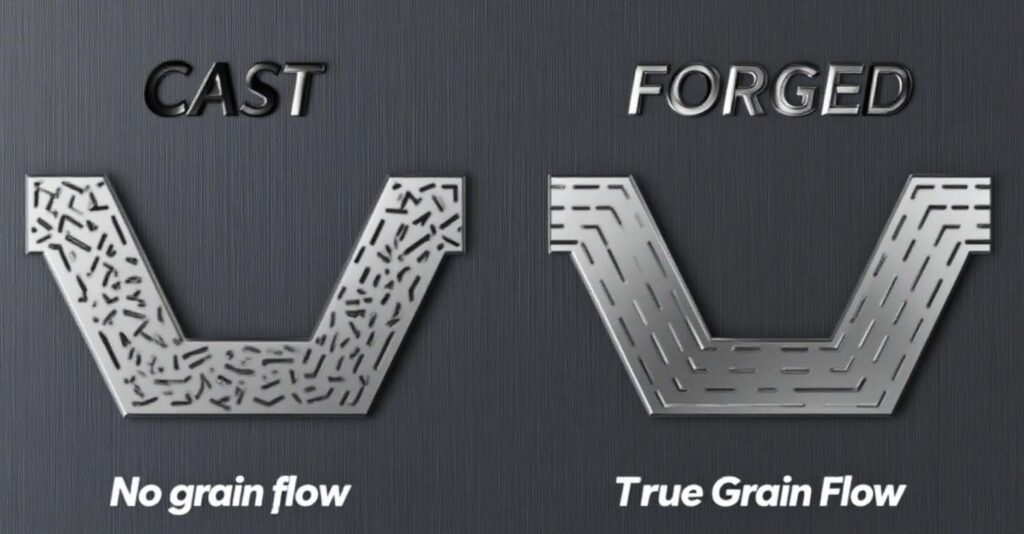
Forging improves steel by changing its internal structure through controlled deformation. The process can refine grains, align grain flow with the part geometry, and reduce internal discontinuities that may become stress concentration points.
The main factors include:
- Directional grain flow
- Refined grain structure
- Reduced porosity and internal defects
- Better fatigue and impact resistance
These advantages are especially important for components exposed to cyclic, impact, or high mechanical loads.
What is Steel Forging?
Steel forging is a manufacturing process that shapes steel using compressive force from presses, hammers, or ring rolling equipment. Common methods include open-die forging, closed-die forging, and ring rolling.
Unlike casting, which forms a component by solidifying molten metal in a mold, forging deforms solid steel. This controlled deformation changes both the external shape and internal grain structure of the material.
How Forging Changes the Grain Structure of Steel
During forging, plastic deformation causes the grain flow to follow the movement and shape of the metal. Properly controlled grain flow can follow the contour and primary loading direction of a component.
Forging can also refine coarse grains into a finer, more uniform structure. This combination of directional grain flow and grain refinement contributes to better fatigue resistance, toughness, and structural consistency.
Reduced Defects and Porosity
Forging significantly reduces internal defects such as porosity and shrinkage cavities. The compressive deformation closes internal voids and increases material density, resulting in superior structural integrity.
This defect reduction is especially important for components used in high-load or safety-critical applications, where internal flaws can lead to premature failure.
Superior Mechanical Properties
Forged steel typically exhibits higher strength-to-weight ratio, better fatigue resistance, and improved toughness. Heat treatment after forging further enhances hardness and performance consistency.
These mechanical advantages make forged steel ideal for components that must withstand repeated loading, vibration, or impact during long-term operation.
Forged Steel vs Cast Steel: Strength and Performance
The main difference between forged and cast steel lies in how their internal structures are formed. Forging uses controlled deformation to influence grain flow and reduce internal discontinuities, while casting forms its structure during solidification.
| Property | Forged Steel | Cast Steel |
|---|---|---|
| Grain Flow | Directional | Primarily solidification-dependent |
| Grain Structure | Can be refined by deformation | Depends on solidification and heat treatment |
| Porosity Risk | Generally lower | Higher risk during solidification |
| Fatigue Resistance | Often higher | Quality dependent |
| Impact Performance | Well suited to demanding loads | Material and quality dependent |
| Shape Complexity | Moderate to high | Excellent |
| Typical Use | High-load components | Complex-shaped components |
Forging is therefore often preferred for fatigue- or load-critical parts, while casting remains valuable for complex geometries and applications where its manufacturing advantages are more important.
Is Forged Steel Stronger Than Machined Steel?
Forging and machining are not directly comparable. Forging forms material, while machining removes material. A finished component can therefore be both forged and machined.
For example, a forged shaft may undergo heat treatment followed by CNC machining to achieve its final dimensions. This manufacturing route combines the structural advantages of forging with the dimensional accuracy of machining:
Forging → Heat Treatment → CNC Machining → Inspection
When Should You Choose Forged Steel Instead of Cast Steel?
Forged steel is often preferred when a component must withstand high loads, repeated stress, torque, fatigue, or impact.
Typical applications include:
- Shafts: torque, bending, and cyclic loading
- Gear blanks: repeated contact and fatigue loads
- Rolled rings: radial and axial loads
- Flanges: pressure and structural loads
- Heavy-duty components: impact and repeated mechanical stress
The final process choice should still consider geometry, material, production volume, mechanical requirements, and manufacturing cost.
Conclusion
Forged steel is stronger because controlled deformation refines grain flow and reduces internal defects, resulting in higher strength, better fatigue resistance, and more reliable long-term performance than cast or machined steel.
For industrial components operating under heavy loads or cyclic stress, forged steel offers a more predictable and durable solution. If you are comparing material options for a specific application, reviewing performance requirements early in the design stage can help reduce long-term risk. Drawings or technical details can be shared for an initial discussion if needed.