
Hot Forging Production Lines: A Buyer’s Guide
A hot forging production line is a manufacturing system used to produce high-strength steel components through heating, forging, and forming processes. By controlling the deformation of heated steel, hot forging improves grain structure, mechanical strength, and fatigue resistance.
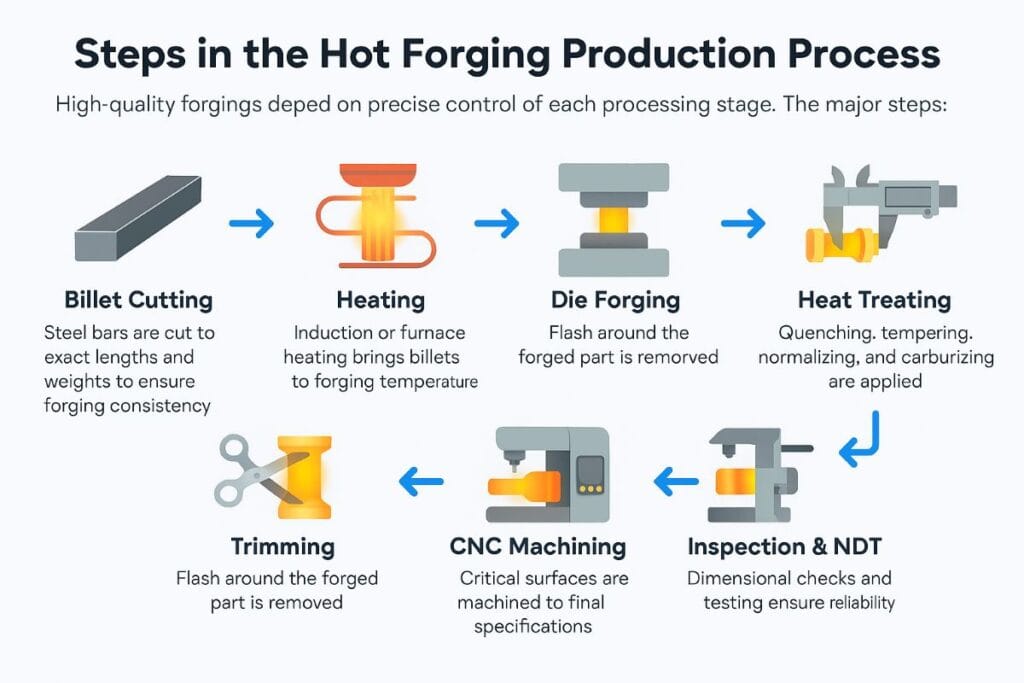
A complete hot forging production line typically includes material preparation, billet heating, forging, trimming, heat treatment, CNC machining, and inspection to achieve consistent quality and dimensional accuracy.
Hot forging is widely used to manufacture forged steel components such as shafts, gears, flanges, hydraulic parts, and structural components for mining equipment, construction machinery, transmission systems, and industrial applications.
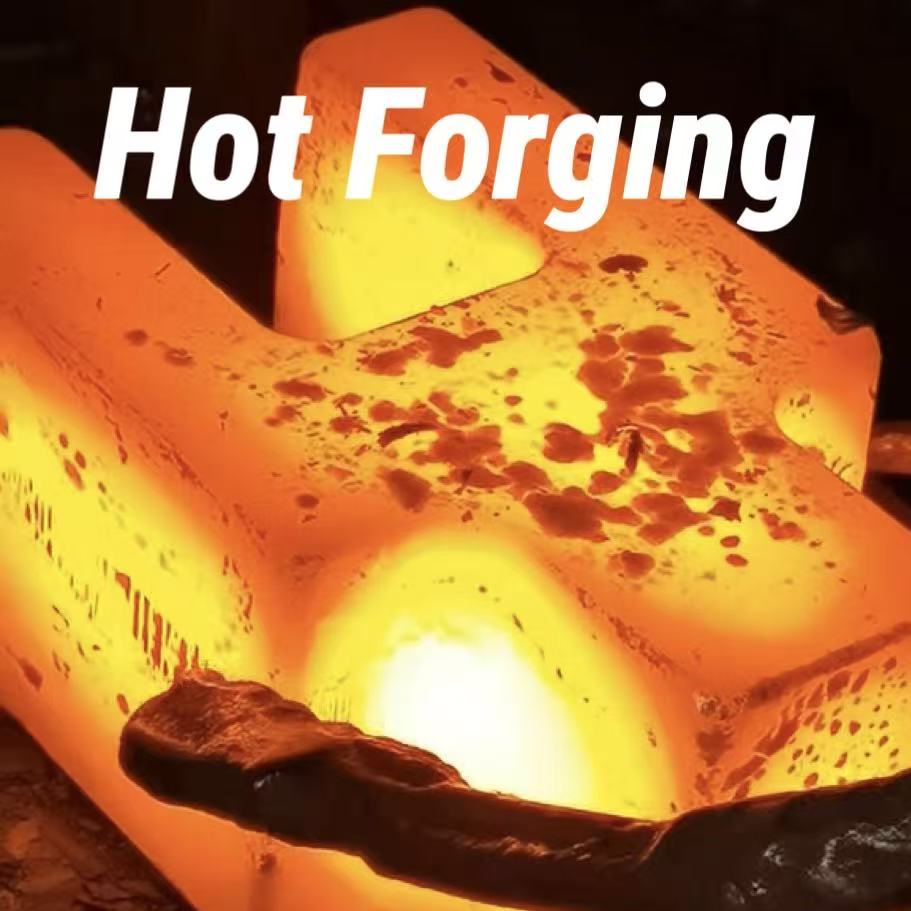
What Is a Hot Forging Production Line?
A hot forging production line is a complete manufacturing system used to transform heated steel billets into high-strength forged components through controlled deformation.
Unlike machining processes that remove material, hot forging improves the internal grain structure of steel by shaping the material under high temperature and pressure. This results in:
- Higher mechanical strength
- Improved fatigue resistance
- Better impact performance
- Reduced material waste
- Longer component service life
A typical hot forging production line includes multiple manufacturing stages:
- Raw material preparation
- Steel billet heating
- Pre-forging and forming
- Die forging or press forging
- Trimming and finishing
- Heat treatment
- CNC machining
- Dimensional inspection and final quality control
Hot Forging Production Workflow
Our typical OEM forging workflow:
Step 1: Drawing Review
Customers provide drawings, specifications, or samples.
Our engineers review:
- Material requirements
- Forging feasibility
- Machining allowance
- Quality standards
Step 2: Process Design and Tooling
Based on component requirements, we develop:
- Forging process
- Die design
- Manufacturing plan
Step 3: Prototype Production
Sample parts are produced and inspected before mass production.
Typical timeline:
- RFQ evaluation: 1–2 days
- DFM review: 2–3 days
- Tooling preparation: 10–20 days
- Sample production: 5–7 days
Step 4: Mass Production and Delivery
After approval, production begins with continuous quality monitoring and delivery control.
Typical production lead time:
20–30 days depending on part complexity and quantity.
Hot Forging vs Other Manufacturing Methods
| Process | Advantages | Limitations |
|---|---|---|
| Hot Forging | High strength, excellent fatigue resistance, efficient material usage | Requires tooling investment |
| Casting | Suitable for complex shapes | Lower mechanical strength |
| Machining from Bar | High accuracy | More material waste and longer cycle time |
| Fabrication/Welding | Flexible for large structures | Lower fatigue performance |
For safety-critical and heavy-load components, hot forging often provides better long-term performance.
Hot Forging Capabilities for Industrial Applications
Our hot forging manufacturing solutions serve industries that require strong, reliable, and fatigue-resistant components.
Mining Equipment
Forged components used in mining applications require excellent impact resistance and durability.
Typical parts:
- Gear blanks
- Shafts
- Pins
- Structural components
Construction Machinery
Heavy equipment manufacturers rely on forged parts for demanding operating conditions.
Applications include:
- Hydraulic cylinder components
- Linkage parts
- Bushings
- Connection components
Transmission Systems
Forged transmission components provide high strength and dimensional stability.
Products include:
- Forged gears
- Gear rings
- Drive shafts
- Transmission components
Renewable Energy and Industrial Equipment
Hot forged steel components are widely used where reliability and long service life are required.
Applications include:
- Structural rings
- Flanges
- Mechanical components
How Buyers Should Evaluate a Forging Supplier
1. Complete Process Chain
A reliable forging supplier integrates forging, heat treating, and machining within one facility. This unified workflow enhances coordination throughout production and helps maintain stable, repeatable quality.
2. Material Capability
The supplier should demonstrate strong expertise in processing materials such as 42CrMo, 4140, 20CrMnTi, SCM440, stainless steel, and various alloy steels. In addition, consistent batch performance reflects solid process control and material understanding.
3. Automation Level
Higher automation contributes to greater product uniformity and improved production efficiency. Furthermore, it supports predictable delivery performance—an important advantage for OEM procurement planning.
4. Heat Treatment Expertise
In-house quenching, tempering, normalizing, and carburizing allow components to achieve the required mechanical properties with high repeatability. As a result, forged parts can meet performance expectations across diverse applications.
5. Quality Control & Certification
Reliable suppliers typically maintain ISO 9001 and perform UT/MPI testing, hardness inspections, and CMM dimensional checks. These measures establish well-documented, consistent quality throughout production.
6. Delivery Capability
A capable forging supplier can support prototyping, small-batch production, and large-scale manufacturing. This level of flexibility helps customers plan their supply chain with confidence and maintain stable long-term operations.
Why Choose Our Hot Forging Manufacturing Solution?
1. Complete Forging-to-Finished-Part Capability
We provide an integrated manufacturing route:
Forging → Heat Treatment → CNC Machining → Inspection → Delivery
This reduces supply chain complexity and improves production consistency.
2. Engineering Support From Drawing to Production
Our team supports customers throughout the development process:
- Drawing review
- Forging feasibility analysis
- DFM optimization
- Tooling design
- Prototype production
- Mass production
For new projects, we can help optimize part design to improve manufacturability and control production costs.
3. Flexible Production for Different Requirements
Our hot forging production line supports:
- Prototype orders
- Small batch production
- Medium-volume manufacturing
- Long-term OEM supply
This flexibility allows customers to develop new components without committing to unnecessary production risks.
4. Consistent Quality and Traceability
For industrial applications, quality consistency is critical.
Our production management system ensures:
- Stable forging processes
- Batch traceability
- Inspection records
- Process control
Conclusion
A well-controlled hot forging production line is the foundation for producing reliable steel components with excellent strength, durability, and dimensional consistency.
With integrated forging, machining, heat treatment, and inspection capabilities, Weforging provides OEM customers with a complete manufacturing solution from raw steel material to finished forged components.
Whether you need a prototype part or a long-term production partner, our team can support your next forging project with engineering expertise and reliable manufacturing capability.