
Hydraulic Cylinder Components: Parts, Functions & Materials
What makes hydraulic cylinders reliable in demanding applications such as construction equipment, mining machinery, and industrial systems? The answer often lies in the quality of the hydraulic cylinder components inside the assembly.
From piston rods and rod ends to cylinder heads and seals, each component plays a critical role in force transmission, pressure containment, and long-term durability. For engineers, selecting the right materials and manufacturing methods can improve performance and service life. For buyers, understanding component quality and supplier capabilities can help reduce maintenance costs and supply chain risks.
This guide explains the main hydraulic cylinder components, their functions, materials, manufacturing processes, and sourcing considerations.
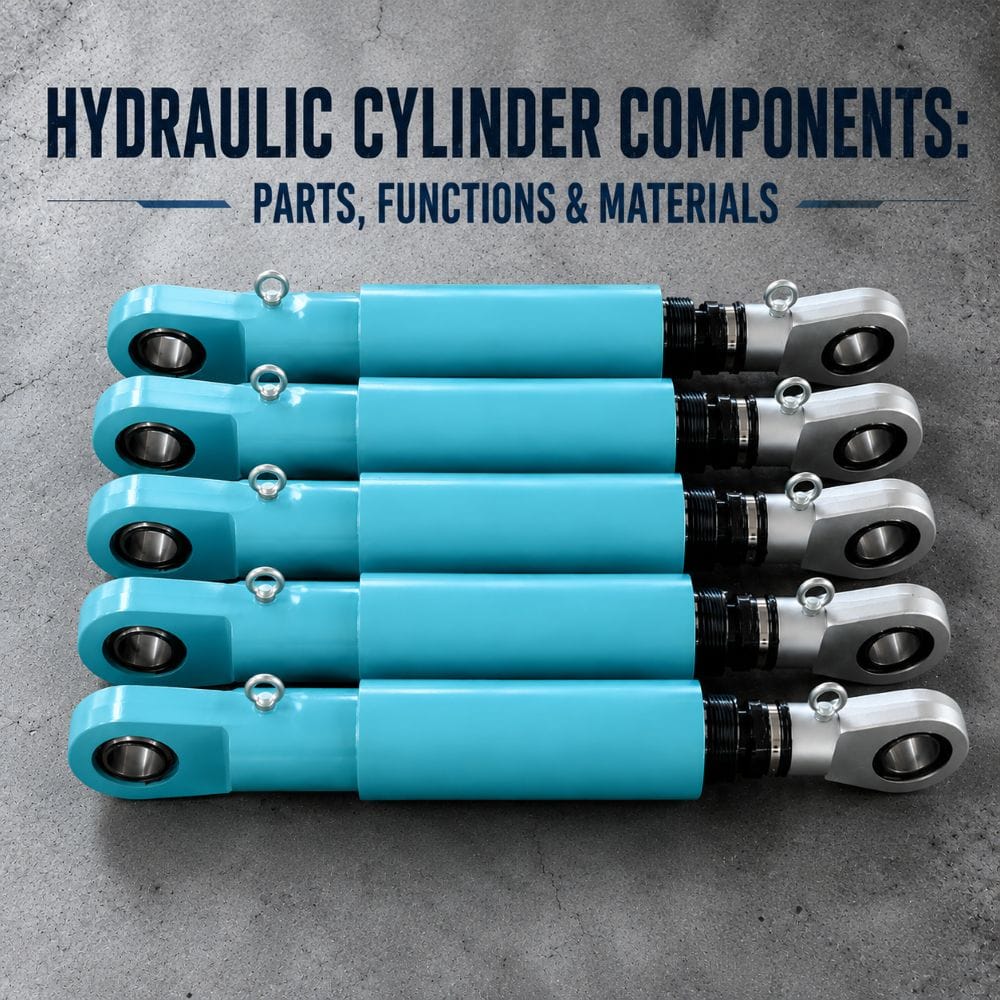
Main Hydraulic Cylinder Components
A hydraulic cylinder consists of several critical components, each responsible for a specific function. Together, they convert hydraulic pressure into controlled linear force and motion.
Component | Primary Function |
Cylinder Barrel | Contains hydraulic pressure |
Piston | Converts pressure into force |
Piston Rod | Transfers force to external equipment |
Gland | Supports and seals the rod |
End Cap | Closes and protects the cylinder |
Seals | Prevent fluid leakage |
Rod End / Clevis | Connects the cylinder to machinery |
While these parts may appear simple individually, their interaction determines the overall performance of the hydraulic system. A failure in one component can affect the efficiency and reliability of the entire cylinder assembly.
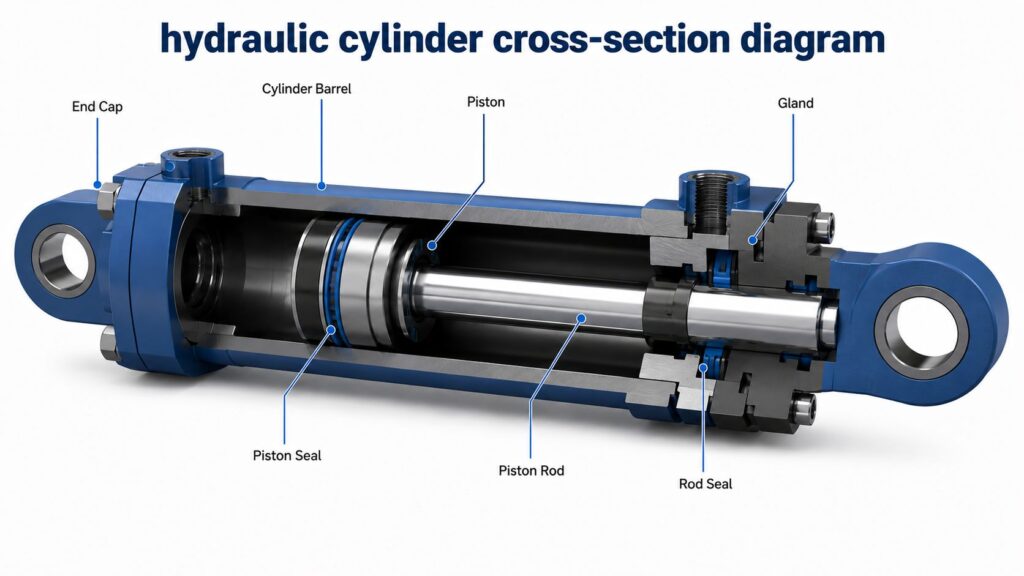
How Hydraulic Cylinder Components Work Together
Hydraulic cylinder components are designed to function as an integrated system rather than as independent parts.
When hydraulic fluid enters the cylinder barrel, pressure acts on the piston surface and generates force. The piston moves within the barrel and pushes the piston rod outward. Through a rod end or clevis, this force is transferred to the connected equipment.
At the same time:
- The barrel contains internal pressure.
- The gland maintains rod alignment.
- Seals prevent hydraulic fluid leakage.
- The end cap helps maintain structural integrity.
This is why dimensional accuracy and assembly quality are so important. Even a small issue such as poor rod alignment or inadequate sealing can reduce cylinder performance and shorten service life.
Common Materials Used
Material selection depends on load, pressure, and operating conditions. Different hydraulic cylinder components often require different materials to balance strength, durability, and cost.
Component | Common Materials | Typical Purpose |
Piston Rod | C45, SAE 1045, 4140, 42CrMo4 | Strength and fatigue resistance |
Rod End | Forged Alloy Steel | Heavy-load applications |
Clevis | Forged Carbon or Alloy Steel | Impact and cyclic loading |
Cylinder Head | Carbon Steel, Alloy Steel | Pressure support |
End Cap | Carbon Steel | Structural strength |
Barrel | Seamless Steel Tube | Pressure containment |
For demanding applications, heat-treated alloy steels are often preferred due to their improved fatigue performance and service life. The best material is not necessarily the strongest, but the one that best fits the application.
What Affects the Service Life of Hydraulic Cylinder Components?
Even components with similar dimensions can perform very differently in service. In many cases, service life depends on more than material strength alone.
Key factors include:
- Load Conditions – Repeated shock loads and vibration can accelerate fatigue failure.
- Working Pressure – Higher pressure requires appropriate materials and manufacturing quality.
- Wear-Prone Areas – Rod ends, clevises, and pin holes are often exposed to the highest stress.
- Operating Environment – Dust, moisture, and corrosion can shorten component life.
- Manufacturing Consistency – Stable dimensions and proper heat treatment help ensure long-term reliability.
A longer-lasting component is often the result of better process control rather than simply stronger materials.
Why Are Forged Hydraulic Cylinder Components Used?
Not all hydraulic cylinder components need to be forged. However, for heavy-duty equipment operating under high loads, vibration, and repeated stress, forging is often preferred.
Compared with parts machined directly from bar stock, forged hydraulic cylinder components can provide:
- Better Grain Flow → Improved fatigue resistance
- Higher Strength → Better load-bearing capacity
- Better Toughness → Improved impact resistance
- Longer Service Life → Reduced maintenance frequency
- More Consistent Quality → More reliable long-term performance
For construction equipment, mining machinery, and other demanding applications, forged components are often selected to improve reliability and extend service life.
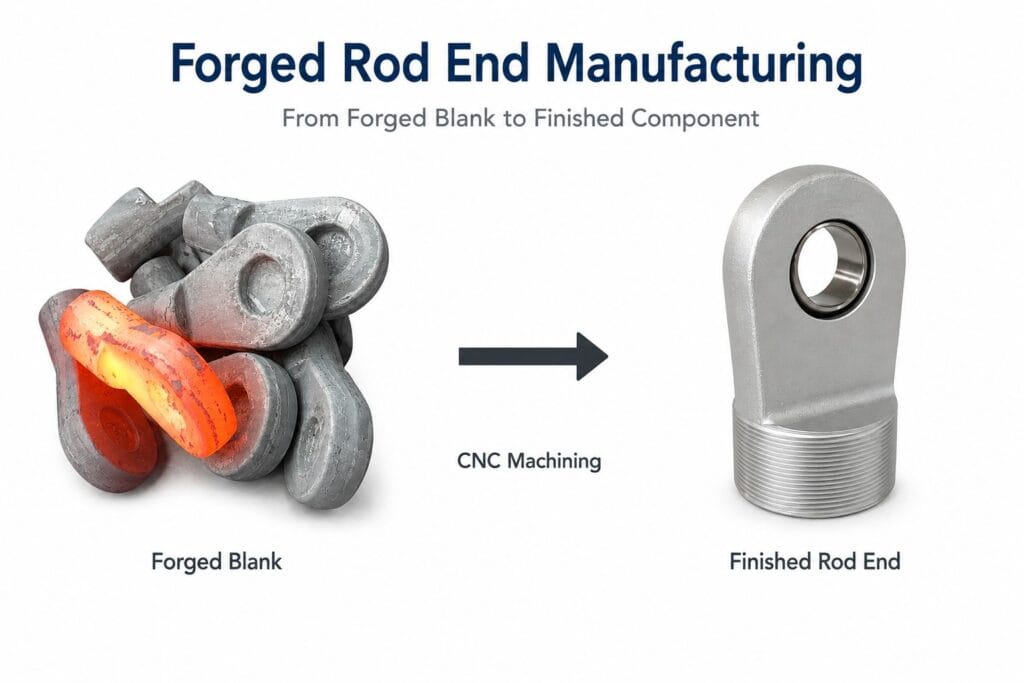
Manufacturing Process of Hydraulic Cylinder Components
The reliability of hydraulic cylinder components depends not only on design and materials, but also on how they are manufactured. For critical parts such as rod ends, clevises, cylinder heads, and mounting lugs, a controlled process helps ensure consistent quality and long service life.
- Material Selection – Choose suitable steel grades based on load, pressure, and operating conditions while ensuring full material traceability.
- Forging or Forming – Improve grain flow and structural integrity, especially for components subjected to repeated stress and impact loads.
- Heat Treatment – Achieve the required balance of hardness, strength, and toughness to improve durability and fatigue resistance.
- CNC Machining – Produce precise dimensions, tolerances, and sealing surfaces to ensure proper fit and performance.
- Inspection & Traceability – Verify quality through dimensional inspection, CMM measurement, and material certification before shipment.
For OEM and custom hydraulic cylinder components, a stable and traceable manufacturing process is often as important as the component design itself.
Hydraulic Cylinder Components by Application
Hydraulic cylinder components are used in a wide range of hydraulic systems, from mobile equipment to industrial machinery. Depending on the application, performance requirements may vary significantly.
- Heavy-Duty Equipment – Excavators, loaders, mining trucks, and other machines require components with high strength and fatigue resistance.
- Replacement and Repair Parts – Rod ends, clevises, and cylinder heads are among the most commonly replaced hydraulic cylinder parts due to wear and long-term service.
- OEM Hydraulic Systems – Equipment manufacturers often require custom hydraulic cylinder components designed to match specific performance and installation requirements.
- High-Cycle Applications – Components used in continuous-operation equipment must provide consistent performance and extended service life.
Choosing components based on actual operating conditions helps improve reliability and reduce maintenance costs.
Common Causes of Component Failure
Even a well-designed hydraulic cylinder can fail prematurely if components are improperly selected, installed, or maintained. Some of the most common failure modes include:
Failure Type | Typical Cause |
Seal Leakage | Worn seals or damaged sealing surfaces |
Rod Bending | Overloading or misalignment |
Fatigue Cracking | Repeated cyclic loading |
Excessive Wear | Contamination or poor lubrication |
Corrosion Damage | Harsh operating environments |
Many failures develop gradually. For example, minor misalignment can increase seal wear and eventually lead to leakage or rod damage. Identifying the root cause early can help reduce maintenance costs and extend service life.
Custom Hydraulic Cylinder Components
Standard components work well for many applications, but they are not always suitable for OEM equipment, heavy-duty machinery, or replacement projects.
Custom hydraulic cylinder components are commonly used when:
- Existing parts are discontinued or difficult to source
- Standard dimensions do not match the installation requirements
- Equipment operates under higher loads or harsher conditions
- OEM projects require improved durability, weight reduction, or longer service life
- Specific material, heat treatment, or inspection standards must be met
In practice, many custom projects start with a simple challenge: a replacement part is no longer available, a standard component fails too quickly, or a new machine requires a non-standard design.
For these applications, custom hydraulic cylinder components can help improve fit, performance, and long-term reliability while meeting the specific requirements of the equipment.
Choosing a Reliable Supplier
Price is often one of the first factors buyers compare, but long-term quality, consistency, and delivery performance are equally important.
When evaluating a hydraulic cylinder parts supplier, consider the following:
- Manufacturing Capability – Forging, machining, heat treatment, and inspection capabilities under a controlled production process.
- Material Traceability – Material certificates and heat number tracking available for each production batch.
- Quality Assurance – CMM inspection and documented quality control procedures for critical dimensions.
- Engineering Support – Assistance with manufacturability reviews and cost-optimization opportunities.
- Delivery Reliability – Stable production planning and a proven record of on-time delivery.
A reliable supplier focuses on preventing quality issues throughout production, not simply identifying defects during final inspection.
Conclusion
Hydraulic cylinder components directly affect the performance, reliability, and service life of hydraulic systems. Beyond component design, material quality, manufacturing processes, and inspection standards all play a key role in long-term performance.
Whether you are sourcing replacement parts, developing a new OEM project, or looking for a reliable manufacturing partner, choosing a supplier with strong production capability, quality control, and traceability can help reduce risk and improve consistency.
Need custom hydraulic cylinder components? Send us your drawings or specifications, and our engineering team will review your project and provide a manufacturing solution.