Forged Ring Gear Manufacturing Process
Forged ring gear is a critical component in planetary gearboxes, slewing drives, mining machinery, and heavy industrial equipment. Compared with cast or welded ring gears, forged versions offer superior strength, longer fatigue life, and greater dimensional stability under shock loads.
This guide explains how forged ring gears are produced according to AGMA standards, covering material selection, closed-die forging, CNC machining, heat treatment, and full gear inspection. It also outlines why many US and EU OEMs now prefer custom-forged ring gears for high-duty applications.
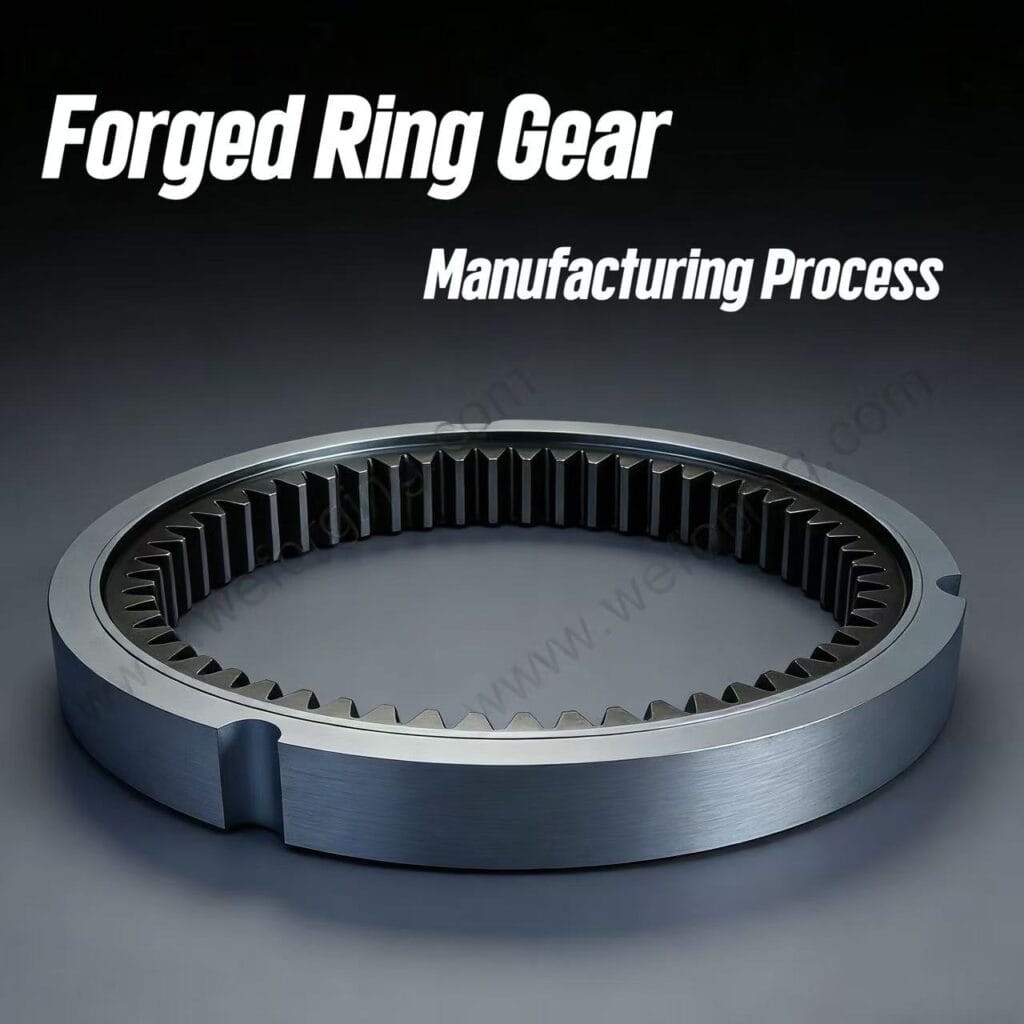
What Is a Forged Ring Gear?
A forged ring gear is a precision-engineered internal or external gear manufactured through hot forging to refine grain flow and improve mechanical strength. Compared with cast or fabricated gears, forged ring gears deliver higher torque capacity, better fatigue resistance, and more stable tooth accuracy. Under AGMA standards such as AGMA 2000-A88 and AGMA 2101-D04, key factors including hardness, runout, and profile tolerance are strictly controlled. These characteristics make forged ring gears ideal for planetary gearboxes, torque converters, slewing mechanisms, and other applications requiring reliable power transmission.
For more details on forged ring gears, you can also refer to our guide “What Is a Ring Gear?”.
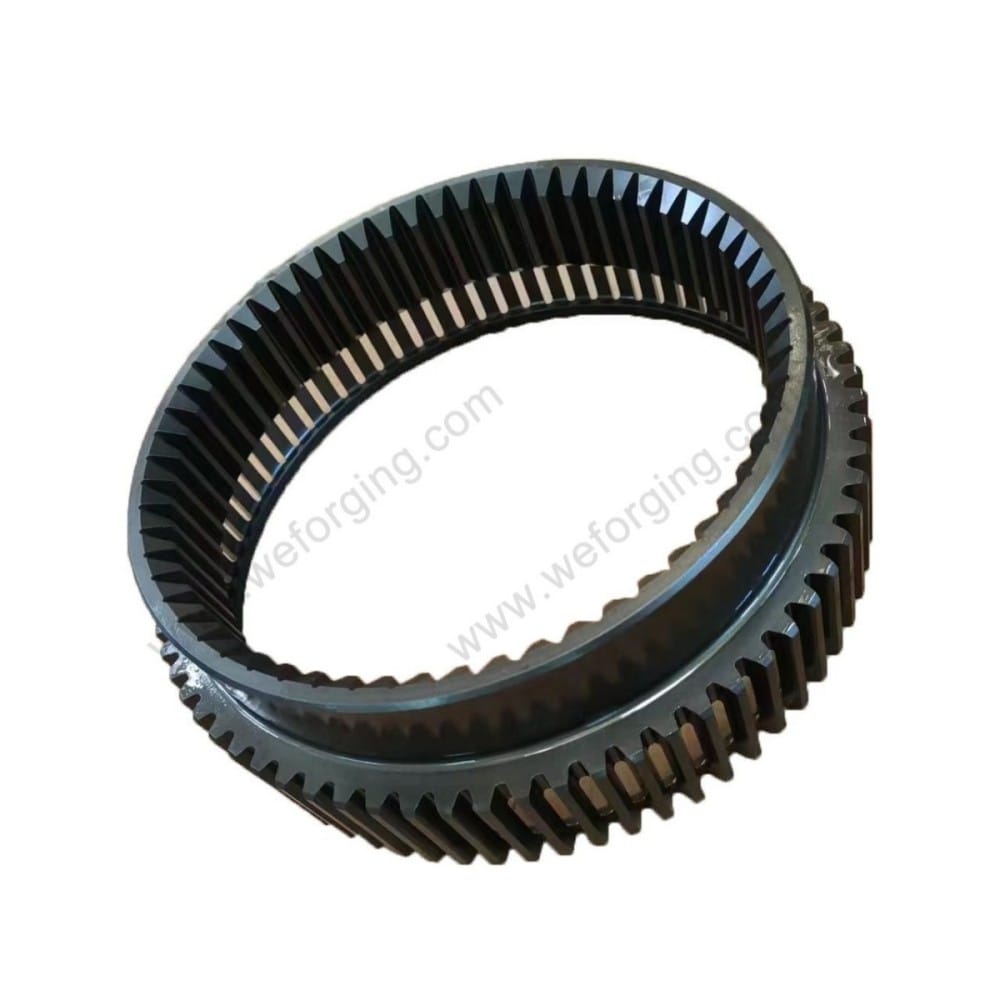
Why OEMs Prefer Forged Ring Gears
Forged ring gears are chosen by US, German, and UK OEMs for their ability to withstand extreme loads. The continuous grain flow eliminates porosity, shrinkage, and cracks found in cast components.
Benefits include:
– High torque capacity for planetary gearboxes
– Excellent fatigue resistance
– Stable tooth geometry after heat treatment
– Longer service life in mining, construction, and heavy machinery
– Ability to meet AGMA Class 8–12 accuracy levels
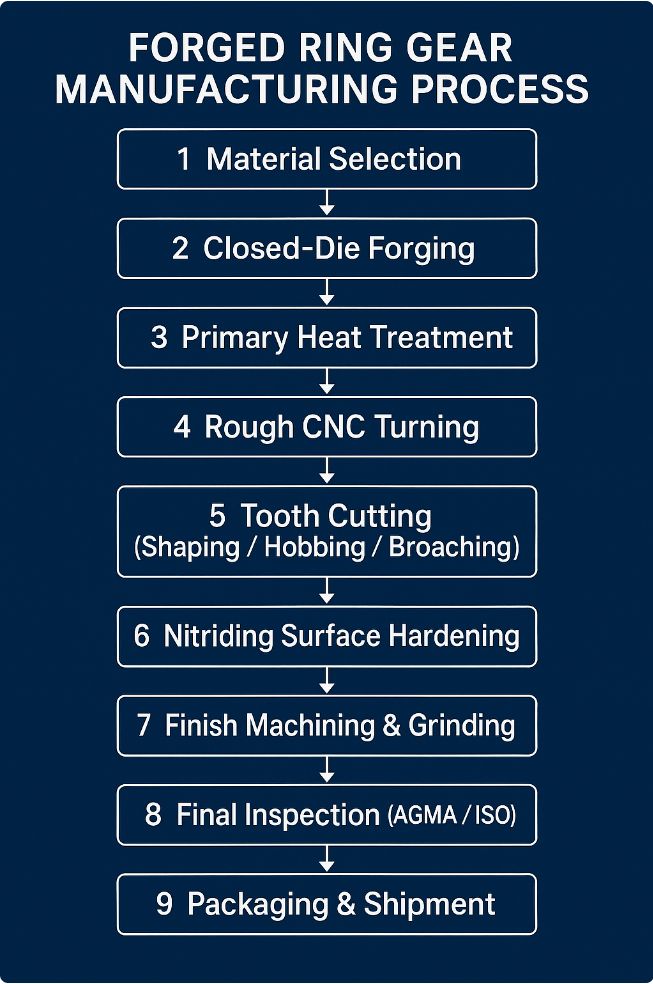
Forged Ring Gear Manufacturing Process
1. Material Selection (42CrMo / 38CrNiMoA / Alloy Steels)
Using AGMA-grade alloy steels such as 42CrMo, 20CrMnTi, and 38CrNiMoA to ensure strength, toughness, and heat-treat performance.
2. Closed-Die Forging of the Ring Gear Blank
Billets are heated to 1100–1200°C and forged into dense ring blanks with aligned grain flow and no porosity.
3. Primary Heat Treatment
Normalizing or quenching & tempering improves toughness, refines grain structure, and stabilizes the material for machining.
4. Rough CNC Turning & Pre-Machining
The blank is CNC-turned to establish reference surfaces, accurate bore/OD dimensions, and concentricity.
5. Gear Tooth Cutting (Shaping / Hobbing / Broaching)
Teeth are produced by shaping, hobbing, or broaching depending on size and profile. AGMA standards control accuracy and runout.
6. Nitriding Surface Hardening
Nitriding enhances surface hardness, wear resistance, and fatigue life with minimal deformation—critical for internal ring gears.
7. Finish Machining & Hard-Finishing (Grinding / Honing)
Finish machining corrects distortion and achieves tight tolerances.
Tooth grinding delivers low noise, smooth meshing, and AGMA Class 10–12 precision.
8. Final Inspection (AGMA / ISO)
Final inspection includes hardness testing, gear profile and lead analysis, runout and concentricity checks, magnetic particle or ultrasonic non-destructive testing, and full CMM dimensional measurement, ensuring complete compliance with AGMA standards and customer specifications.
9. Packaging & Shipment
Finished gears are coated with anti-rust oil, wrapped securely, and packed in export-grade wooden crates for safe delivery.
Quality Control
Quality inspections include:
- Ultrasonic and magnetic particle testing
- Tooth profile measurement
- Runout and concentricity check
- CMM measurement
- Hardness and metallographic tests
These steps guarantee AGMA accuracy and long-term reliability.
Applications
Forged ring gears are widely used in heavy-duty transmission systems that demand high torque, stable load distribution, and long service life. Their strength and durability make them essential components in the following applications:
1. Planetary Gearboxes
Forged ring gears support multi-stage torque multiplication and ensure stable load sharing within planetary gear trains.
(Crushers, conveyors, drilling systems)
Forged ring gears withstand heavy shock loads, abrasive dust, and long operating cycles typical of mining environments.
3. Construction Equipment
(Excavators, cranes, loaders)
They provide reliable torque transmission under variable loads and frequent impact conditions found in construction machines.
4. Slewing Bearings & Slewing Drives
Forged ring gears enable smooth rotational movement and handle high axial and radial forces in heavy-duty slewing mechanisms.
5. Wind Turbine Yaw Drives
They ensure accurate yaw positioning and resist fatigue caused by continuous directional adjustments in wind turbines.
Across these industries, forged ring gears deliver superior strength, durability, and long-term performance—making them a preferred choice for modern industrial machinery and high-demand power transmission systems
Why Choose Weforging for Forged Ring Gears
Weforging provides an integrated workflow covering forging, CNC machining, heat treatment, and full inspection. We supply custom forged ring gears from 200 mm to 2000 mm, meeting AGMA, ISO, and ASTM requirements.
Advantages include:
- Custom forged ring gears
- AGMA-compliant machining
- Reliable 42CrMo / 38CrNiMoA processing
- Stable lead times
- Export-grade packaging
- Support for OEM and project-based orders
Looking for Custom Forged Ring Gears?
Weforging supplies AGMA-compliant forged ring gears with complete in-house forging, CNC machining, heat treatment, and gear inspection.
If your project requires high-precision ring gears for planetary gearboxes, slewing drives, or heavy-duty industrial equipment, our engineering team can support you from design review to production.
Contact us to discuss your specifications.