
What Is Grain Structure in Metal?
Grain structure in metal is the internal arrangement of crystalline grains that controls mechanical behavior. Metal performance is not defined only by chemical composition — it is strongly influenced by grain structure. The internal arrangement of grains determines how a component resists fatigue, absorbs impact, and survives long-term mechanical stress.
Understanding grain structure in metal is essential when selecting manufacturing processes such as casting, machining, or forging. This guide explains how grain structure forms, how it affects mechanical strength, and why forging creates directional grain flow that improves performance in demanding industrial applications.
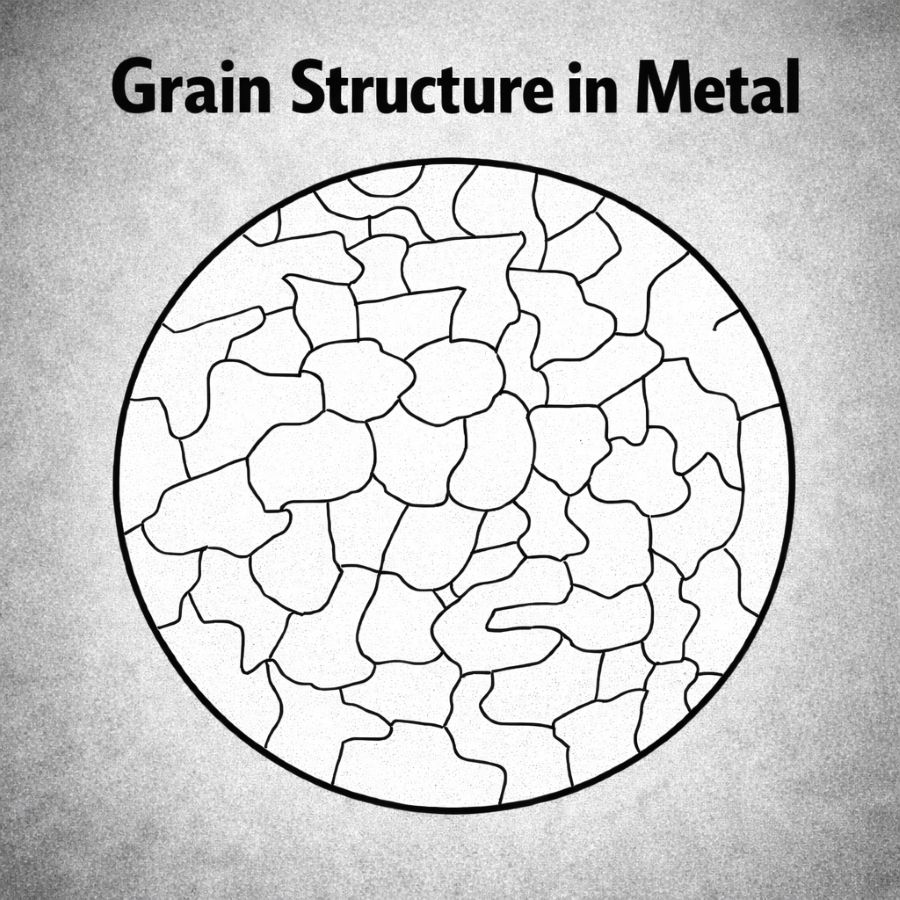
What Is Metal Grain Structure
A metal grain structure refers to the microscopic arrangement of crystalline regions formed during solidification. Each grain is a crystal with a unique orientation. When molten metal cools, atoms organize into ordered patterns, forming grains separated by grain boundaries.
These boundaries influence deformation behavior, crack growth, and fatigue resistance. Grain size, distribution, and orientation together determine how a metal behaves under load. Smaller grains generally increase strength, while aligned grains improve directional durability.
How Grain Structure Forms During Solidification
During cooling, molten metal solidifies through nucleation and crystal growth. In casting processes, this often produces a dendritic grain structure — tree-like crystal patterns that grow outward from cooling points.
Cooling rate directly influences grain size:
- Slow cooling produces coarse grains
- Rapid cooling produces fine grains
Dendritic structures may trap impurities and create uneven mechanical behavior. Because casting involves little or no plastic deformation, grain orientation remains random, limiting fatigue resistance compared to forged components.
Factors That Control Grain Structure in Metal
Grain structure in metal is mainly controlled by plastic deformation and thermal history. These factors determine how grains form and stabilize during processing.
Key controlling factors include:
- Plastic deformation
Forging or rolling stretches and reorients grains, often triggering recrystallization that refines the microstructure. - Deformation magnitude
Greater deformation typically produces finer and more uniform grain structures. - Temperature level
Heating temperature controls whether grains grow, shrink, or reorganize. - Holding time
Extended exposure at high temperature allows grains to coarsen. - Cooling rate
Rapid cooling preserves fine grain structures, while slow cooling promotes grain growth.
Together, deformation and thermal history define the final microstructure of a component.
Grain Structure in Common Engineering Metals
Steel
- Ferritic steel contains equiaxed ferrite grains and offers good ductility and corrosion resistance, but relatively lower strength.
- Austenitic steel forms stable equiaxed grains that provide high toughness and corrosion resistance.
- Martensitic steel develops a needle-like grain structure during rapid quenching, resulting in high hardness and wear resistance.
Aluminum
- Pure aluminum typically has fine equiaxed grains that support excellent formability and ductility, but lower strength.
- Aluminum alloys show grain structures that vary with composition and heat treatment.
- Strengthened alloys often develop complex microstructures that improve fatigue resistance and mechanical performance.
Copper
- Pure copper exhibits equiaxed grains that support high electrical and thermal conductivity. Grain size is sensitive to processing conditions and influences mechanical strength.
- Copper alloys such as brass develop more complex grain structures that improve machinability and structural performance.
Grain Structure of Steel vs Other Metals
The grain structure of steel behaves differently from aluminum or copper alloys due to phase transformations. Steel can reorganize its grains during heat treatment, allowing engineers to tailor strength and toughness.
Material responses vary:
- Carbon steels refine grains efficiently
- Aluminum alloys depend strongly on cooling rate
- Copper alloys exhibit high ductility and directional flow
These differences influence manufacturing decisions for load-bearing parts.
Grain Boundaries and Mechanical Strength
Grain boundaries act as barriers to dislocation movement. When stress is applied, dislocations must cross grain boundaries, increasing resistance to deformation. This is why fine-grained metals are typically stronger.
However, grain boundaries can also become crack initiation points under cyclic loading. Engineering performance depends on balancing grain size with boundary stability to optimize fatigue life.
Forged vs Cast Grain Structure
Performance Factor | Forged Grain Structure | Cast Grain Structure |
Grain orientation | Directional grain flow aligned with part geometry | Random grain orientation |
Internal integrity | Dense structure with minimal porosity | Higher risk of internal porosity |
Fatigue resistance | High fatigue resistance due to continuous grain flow | Lower fatigue resistance |
Impact strength | Higher impact performance | Lower impact strength |
Crack propagation | Cracks are slowed by aligned grain paths | Cracks spread more easily across grain boundaries |
Structural reliability | Highly stable under cyclic loads | Less stable under repeated stress |
Manufacturing mechanism | Plastic deformation reshapes internal grain architecture | Solidification creates grain structure without alignment |
This fundamental difference explains why forged grain structure delivers superior mechanical reliability compared to cast structure.
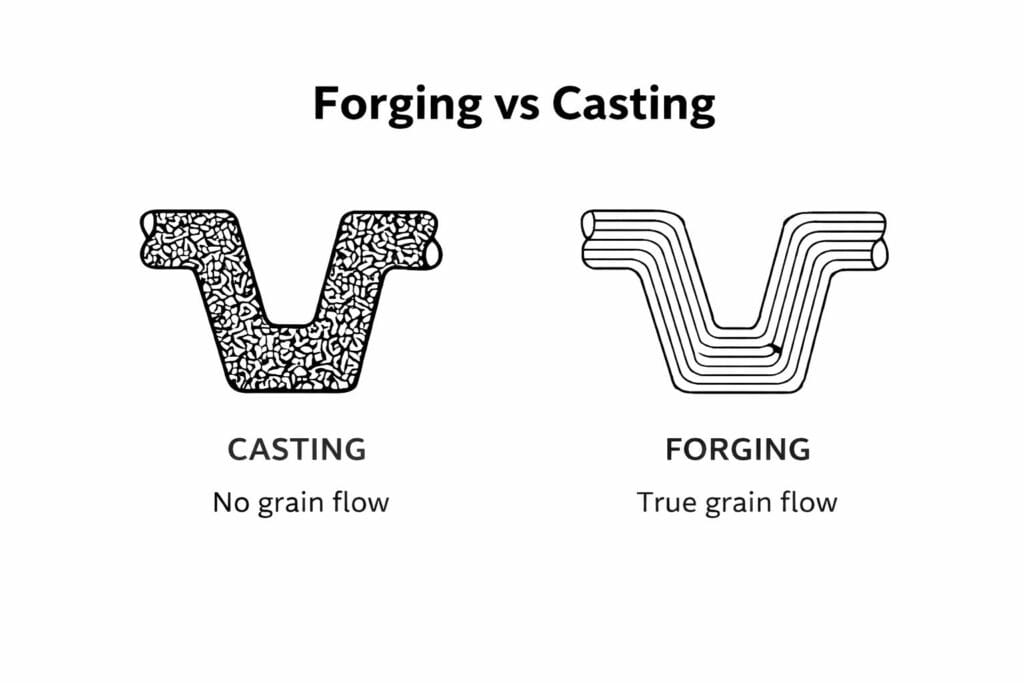
How Forging Changes Grain Flow
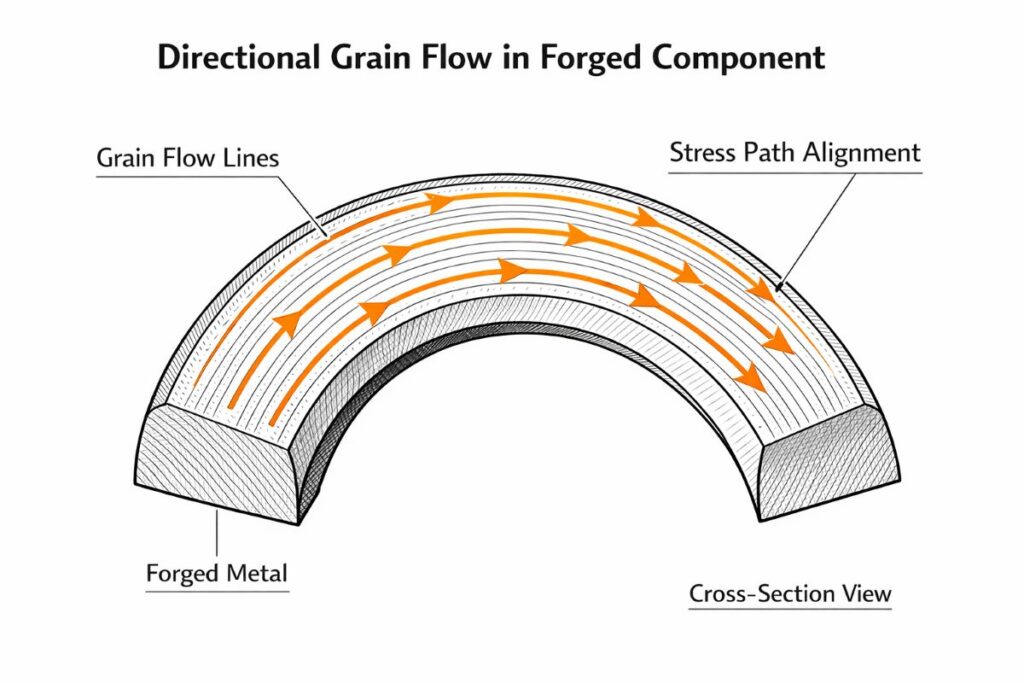
Different forging methods shape grain flow in different ways, but all rely on controlled plastic deformation to align internal structure with load paths.
- Closed-die forging
Metal is compressed inside shaped dies, forcing grains to follow the final geometry of the component. This produces highly directional grain flow that improves fatigue resistance and impact strength in complex parts. - Open-die forging
Repeated compressive deformation elongates grains along the working direction. While the geometry is less constrained, grain refinement and alignment still enhance structural stability. - Ring rolling
Grain flow follows the circular shape of the ring, creating continuous directional structure around the circumference. This improves load distribution and crack resistance in rotating components. - Precision forging
Controlled deformation with minimal machining preserves grain continuity near the surface, maximizing strength in critical stress regions.
Across all forging processes, strength is built into the internal grain architecture. The metal is not just shaped — its microstructure is engineered.
Why Material, Forging, and Heat Treatment Define Performance
Mechanical performance is established long before final machining begins.
Material selection, forging deformation, and heat treatment define the internal grain structure, strength distribution, and fatigue resistance of a component.
If any one of these stages is poorly controlled, no amount of precision machining can compensate for weak internal structure. Surface accuracy cannot correct coarse grains, internal porosity, or improper microstructure. These hidden defects directly reduce service life, load capacity, and long-term reliability.
Machining refines geometry —
but material, forging, and heat treatment engineer performance.
How Manufacturers Control Grain Structure
Modern manufacturers control grain structure through engineered process parameters that directly improve component reliability:
- Forging ratio control→ refines grain size and increases structural strength
- Controlled heating cycles→ prevents uneven grain growth and internal stress
- Recrystallization management→ restores uniform grain structure after deformation
- Precision heat treatment→ stabilizes microstructure for fatigue resistance
- Cooling rate regulation→ prevents cracking and improves durability
- Directional grain design→ aligns internal flow with load paths for higher performance
These controls allow manufacturers to produce stronger components without increasing material weight, ensuring predictable quality and long service life.
Conclusion
Grain structure optimization is not theoretical — it directly affects component reliability in real applications. Selecting the right forging process and heat treatment requires engineering expertise tailored to load conditions and material behavior.
If you are evaluating forged components or need technical input on grain flow design, our engineering team can provide process guidance and manufacturing consultation.
Contact us to discuss your project requirements.