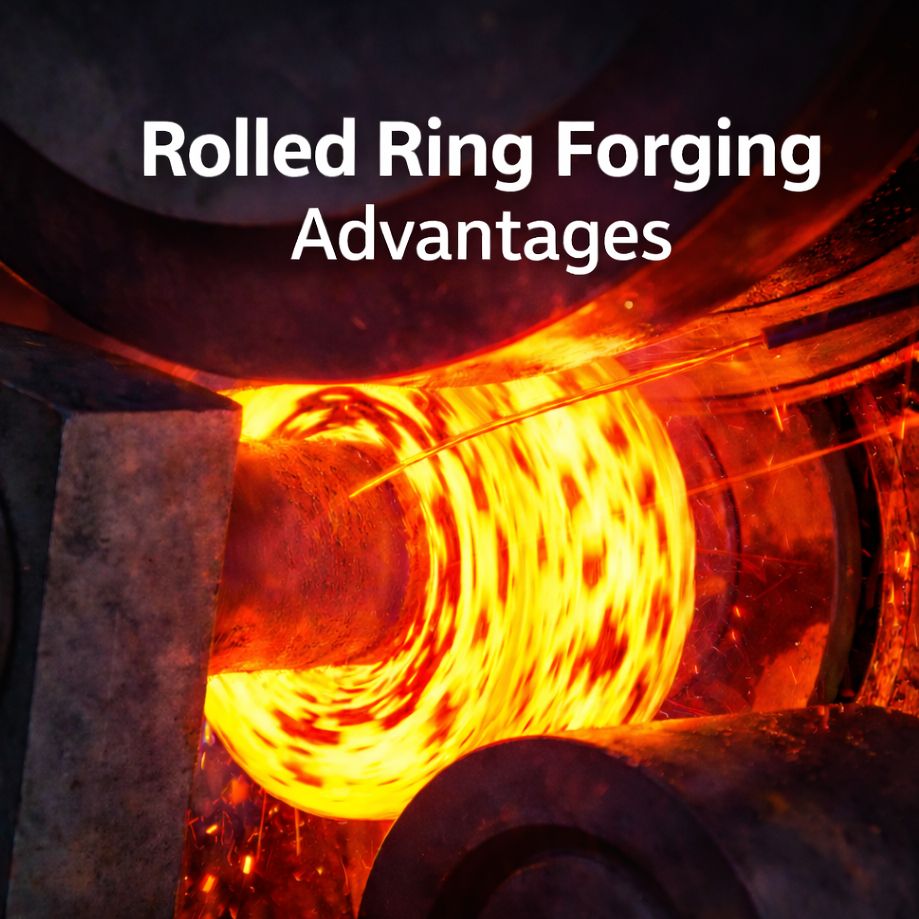
Rolled Ring Forging Advantages: Why OEMs Choose This Process
Rolled ring forging is a manufacturing process used to produce seamless rings with high strength, structural consistency, and long service life. During the rolled ring forging process, controlled rolling allows the material to flow continuously along the ring circumference, creating uniform grain structure and improving fatigue resistance compared with casting or conventional machining.
Today, more OEM manufacturers are choosing seamless rolled ring forging for critical applications such as bearings, gears, and large industrial rings. Understanding the advantages of rolled ring forging helps engineers and procurement teams select the most cost-effective and durable manufacturing solution.
What Is Rolled Ring Forging?
Rolled ring forging is a forging process in which a heated metal preform is pierced and expanded into a seamless ring through controlled rolling. During the rolled ring forging process, the material flows continuously along the ring circumference, creating a uniform grain structure that improves mechanical performance.
Unlike welded or cast rings, seamless rolled ring forging aligns grain flow with the final component geometry. This structural continuity significantly increases strength, fatigue resistance, and service life, making rolled ring forging ideal for high-load industrial applications such as bearings, gears, and large diameter rings.
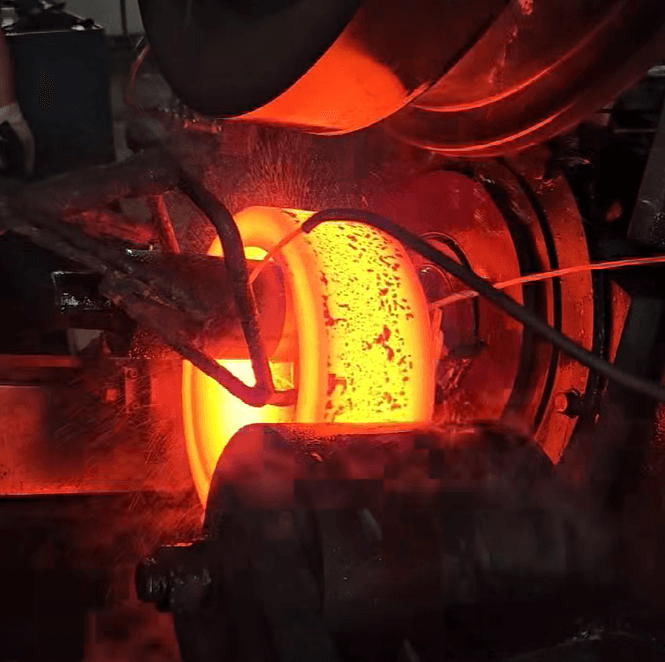
Rolled Ring Forging Process Explained
The rolled ring forging process involves several controlled stages to ensure dimensional accuracy and mechanical performance.
- Material selection
Steel grades or alloy materials are selected according to strength, hardness, and application requirements. - Heating stage
The billet is heated to the appropriate forging temperature to improve ductility and reduce deformation resistance. - Piercing and preforming
A central hole is created, forming the basic ring shape required for rolling. - Ring rolling expansion
The ring is placed between driven rolls. As pressure is applied, the diameter expands while the wall thickness decreases, creating uniform geometry. - Heat treatment and machining
After forging, heat treatment improves microstructure stability. CNC machining ensures precise dimensions and surface finish.
This process ensures repeatable quality and high structural integrity, which is critical for OEM production.
Materials Used in Rolled Ring Forging
Material selection plays a critical role in rolled ring forging performance. Different forged ring materials are chosen based on load requirements, operating conditions, and industry standards.
Common materials used in steel rolled ring forging include:
- Carbon steel
Widely used for general industrial rings due to good strength and cost efficiency. - Alloy steel
Offers improved toughness, wear resistance, and fatigue performance, making it suitable for heavy-duty applications. - Stainless steel
Provides corrosion resistance and is often selected for energy, chemical, and marine environments. - High-performance alloys
Nickel-based or special alloys are used for extreme temperature or high-pressure applications.
Selecting the right alloy rolled rings ensures long service life, structural reliability, and optimized manufacturing cost.
Top Rolled Ring Forging Advantages
The main advantages of rolled ring forging include improved strength, better fatigue performance, and higher manufacturing efficiency for industrial applications.
Superior grain flow and strength
Continuous grain flow follows the ring shape, resulting in stronger rolled forged rings compared with cast components.
Excellent fatigue resistance
Because internal defects are minimized, rolled rings perform better under cyclic loading.
High material utilization
Rolled ring forging reduces waste compared with machining from solid blocks, lowering material costs.
Reduced machining allowance
Near-net shaping decreases machining time and improves production efficiency.
Cost efficiency for large diameters
For large components, rolled ring forging offers a better strength-to-cost ratio than alternative methods.
Rolled Ring Forging vs Casting
Casting remains a common manufacturing method, but it differs significantly from rolled ring forging in terms of structure, performance, and long-term reliability. The following comparison highlights why many OEM manufacturers choose rolled ring forging for demanding industrial applications.
Aspect | Rolled Ring Forging | Casting |
Grain structure | Continuous grain flow | Random grain pattern |
Mechanical strength | Very high (forged structure) | Medium (cast structure) |
Defect risk | Low, fewer internal defects | Higher risk of porosity |
Fatigue performance | Excellent for cyclic loads | Limited under fatigue stress |
Dimensional consistency | High and stable | Medium, varies by process |
When long-term reliability, fatigue resistance, and structural consistency are required, rolled ring forging is generally preferred over casting for industrial components.
Rolled Ring Forging for Large Ring Gears
Rolled ring forging is widely used in the manufacturing of large ring gears for heavy machinery, wind power systems, and industrial transmissions. The continuous grain flow created during the rolling process improves tooth strength, fatigue resistance, and dimensional stability. Compared with cast or welded solutions, forged ring gears offer longer service life and more reliable performance under high loads.
Common Applications of Rolled Ring Forging
Rolled ring forging applications include:
- Construction machinery bearings
- Wind power rings and flanges
- Mining equipment components
- Gear transmission systems
- Heavy industrial rings and connectors
These industries require strong, durable components capable of handling high loads.
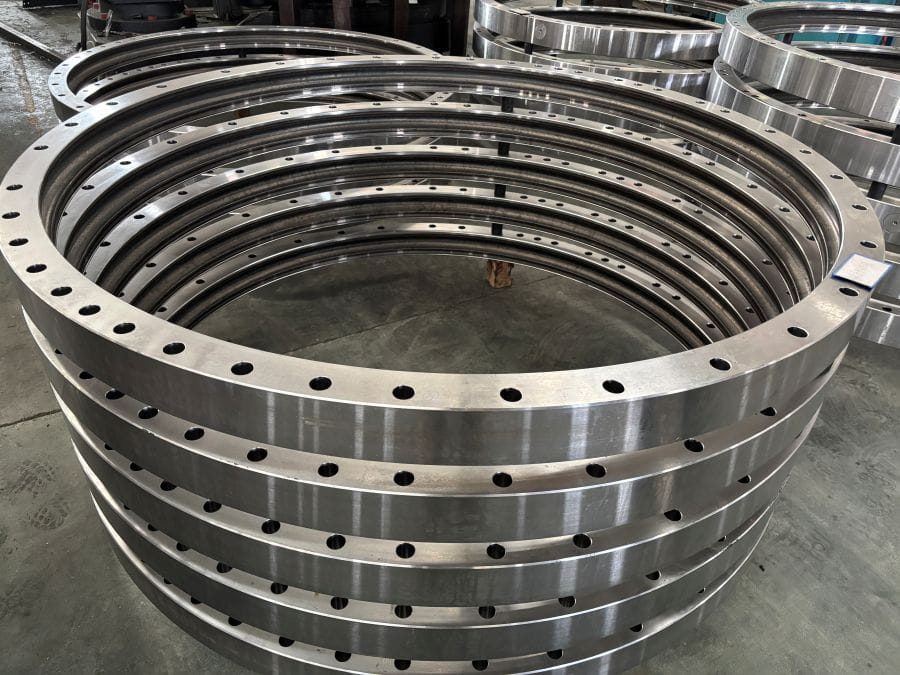
Rolled Ring vs Forged Ring: Key Differences Explained
A rolled ring is a specialized type of forged ring, but the two terms are not identical. While all rolled rings are forged, not all forged rings are produced using the rolled ring forging process. The main differences lie in manufacturing method, grain structure, and application performance.
The table below explains the key distinctions:
Comparison Aspect | Rolled Ring (Rolled Ring Forging) | General Forged Ring |
Manufacturing method | Pierced preform expanded through controlled rolling | Open-die forging, closed-die forging, or machining |
Grain flow | Continuous circumferential grain flow | Depends on forging direction |
Structural consistency | Very high | Medium to high |
Dimensional accuracy | Excellent for large diameters | Varies by process |
Fatigue resistance | Superior | Good |
Material efficiency | High (near-net shaping) | Medium |
Typical applications | Bearings, gears, large industrial rings | General forged components |
Because seamless rolled ring forging aligns grain flow with the final ring geometry, it provides better strength distribution and long-term reliability. This makes rolled ring forging especially suitable for large diameter rings and heavy-duty industrial applications where structural consistency is critical.
When Should You Choose Rolled Ring Forging?
Rolled ring forging is typically chosen when reliability and long-term performance matter more than the lowest unit price. Engineers and procurement teams often consider this process under the following conditions:
- High cyclic loads: Ideal for fatigue-sensitive components such as bearing rings and gear rings.
- Large diameter rings: Provides stable wall thickness and better dimensional consistency.
- Safety-critical applications: Seamless structure reduces internal defects and failure risk.
- OEM batch production: Ensures repeatable quality and predictable machining performance.
- High downtime cost: Helps reduce maintenance risk and unexpected failures.
When durability and lifecycle value are priorities, rolled ring forging is usually the safer and more reliable choice compared with casting or alternative forging methods.
Cost Factors Explained
The cost of rolled ring forging depends on multiple factors beyond the forging price itself. Buyers should evaluate total manufacturing value rather than unit cost alone.
- Material grade: Alloy selection affects strength, stability, and overall process cost.
- Ring size and geometry: Large diameters or complex profiles require tighter process control.
- Process stability: Better forging control improves yield and reduces scrap risk.
- Heat treatment: Necessary for achieving required mechanical properties and machining stability.
- Machining scope: CNC requirements and tolerance levels directly influence total cost.
- Inspection level: NDT and traceability increase cost but reduce quality risk.
Although higher control levels may raise initial cost, they often reduce lifecycle risk and provide better long-term value for OEM projects.
Why Choose Weforging for Custom Rolled Ring Forging?
Weforging combines forging, CNC machining, and testing under a dual-control quality system to ensure stable OEM production.
Key strengths include:
- 40+ years of forging experience
- Seamless rolled ring forging capability
- Large diameter rolled ring forging solutions
- Integrated machining and heat treatment
- OEM drawings accepted with strict quality inspection
As a custom rolled ring forging supplier, Weforging helps global OEM clients reduce risk and improve supply consistency.
Conclusion
Rolled ring forging combines strength, dimensional stability, and long-term reliability, making it one of the most trusted manufacturing processes for OEM industrial components. From improved grain flow and fatigue resistance to better material efficiency and consistent batch quality, this process helps engineers reduce technical risk while giving procurement teams greater supply confidence.
At Weforging, we integrate forging, CNC machining, and strict quality control to deliver seamless rolled ring forging solutions tailored to demanding applications. OEM drawings are welcome — send us your drawings or requirements for a free quotation, and our team will respond within 24 hours.