
What Is Gear Hobbing? Process, Advantages
Gear hobbing is one of the most common gear cutting processes for manufacturing external gears. It uses a rotating cutting tool called a hob to progressively generate teeth on a rotating gear blank.
Because the cutting motion is continuous, gear hobbing offers good production efficiency and repeatability. It is widely used for spur gears, helical gears, splines, sprockets, and other external toothed components.
This guide explains what gear hobbing is, how the process works, the main equipment and parameters involved, and when hobbing is suitable for custom gear manufacturing.
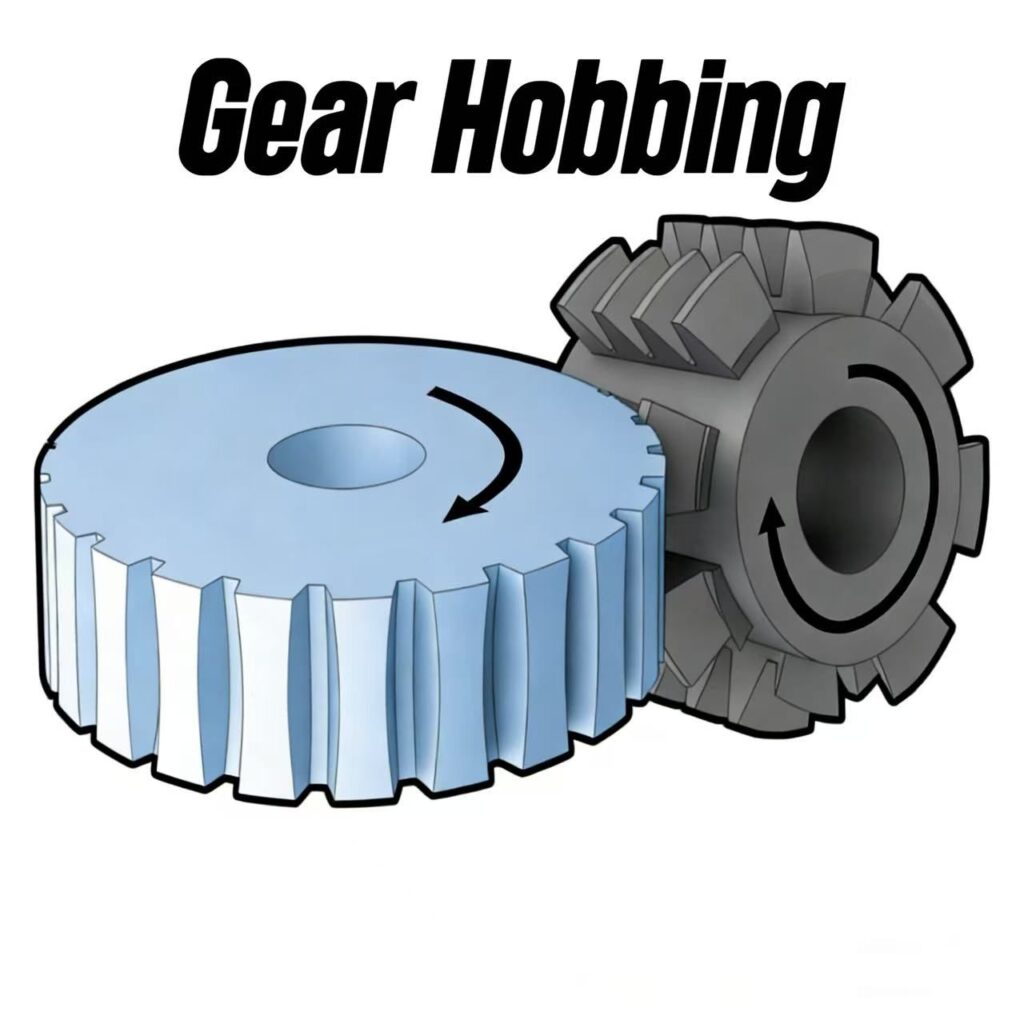
What Is Gear Hobbing?
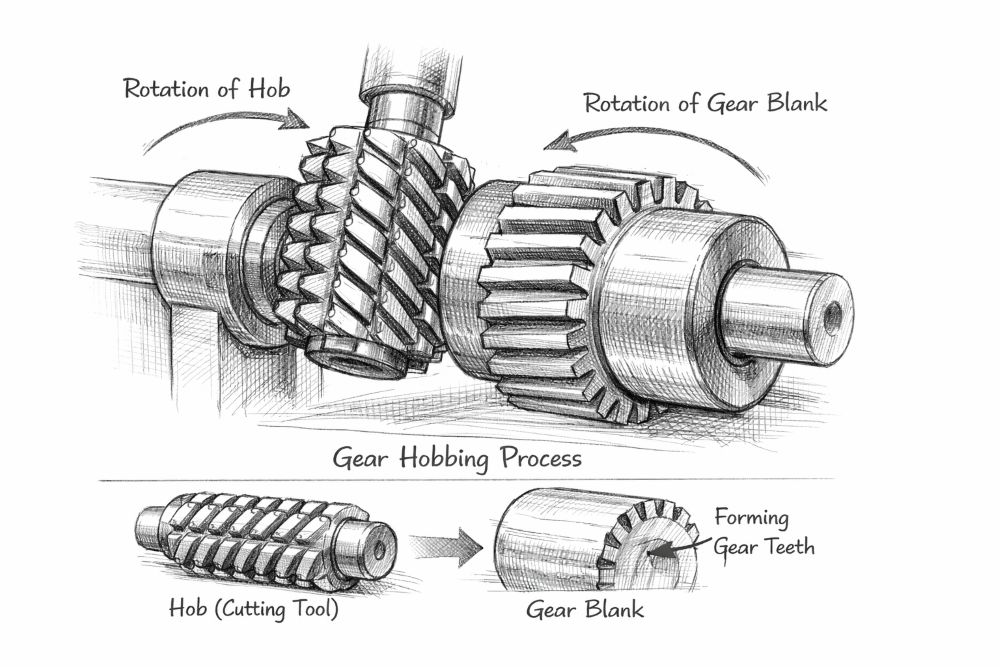
Gear hobbing is a gear cutting method in which a rotating cutting tool, known as a hob, gradually generates gear teeth on a cylindrical workpiece. Compared with form cutting, the tooth profile is produced through the relative motion between the tool and the blank instead of relying on a single fixed shape.
This generating principle allows the process to produce accurate tooth geometry while maintaining flexibility for different gear sizes and modules. As a result, gear hobbing is commonly used for manufacturing spur gears, helical gears, and worm gears in a wide range of industrial applications.
Because the cutting action is continuous, the process supports stable cutting conditions and consistent results across multiple parts, making it a practical choice for both small and large production runs.
How the Gear Hobbing Process Works
The gear hobbing process relies on synchronized rotation between the hob cutter and gear blank. The tooth profile is progressively generated rather than formed in a single cutting pass.
The typical process includes five stages:
1. Gear blank preparation
The blank is machined to establish the required outside diameter, bore, faces, and reference surfaces. Forged gear blanks are often used for heavy-duty gears.
2. Hob positioning
The hob cutter and gear blank are mounted and aligned according to the required gear geometry.
3. Synchronized rotation
The hob and workpiece rotate at a controlled ratio that determines tooth spacing and number of teeth.
4. Feed and cutting
The rotating hob feeds across the gear blank and progressively removes material.
5. Tooth generation
The combined rotation and feed motion generates the final tooth profile.
Depending on accuracy requirements, the gear may then undergo heat treatment, grinding, honing, deburring, or final inspection.
Gear Hobbing Machines and Their Role in Accuracy
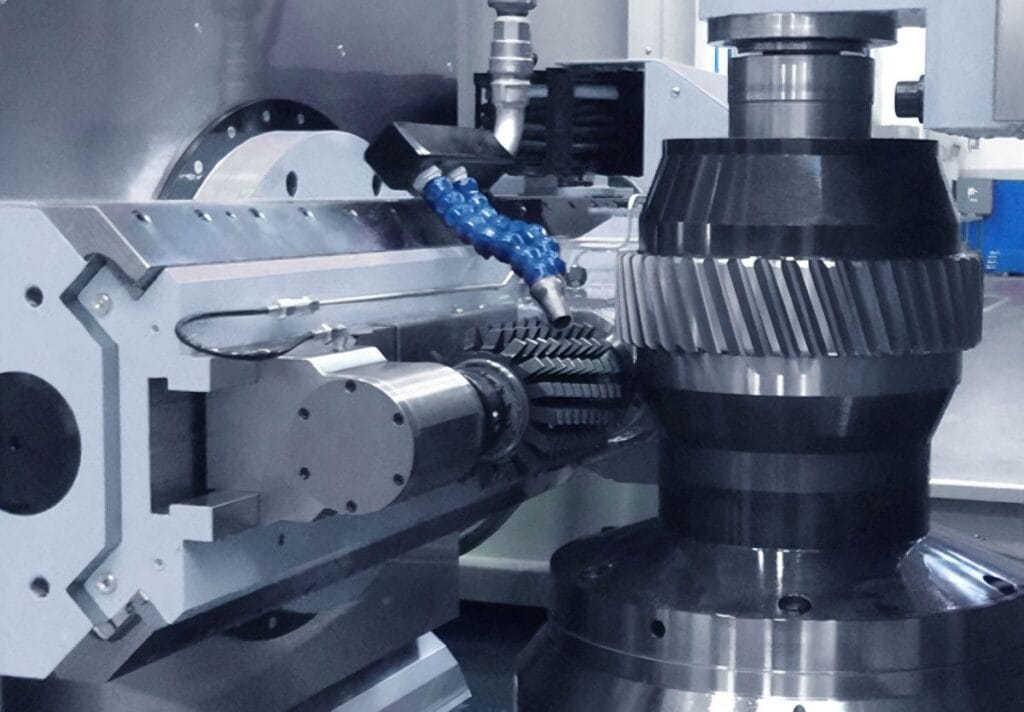
A gear hobbing machine controls the synchronized movement between the hob cutter and workpiece.
Modern CNC gear hobbing machines use electronic synchronization and multi-axis control instead of relying mainly on mechanical change gears. This makes it easier to produce different tooth counts, modules, face widths, and helix angles.
CNC control can improve:
- Setup repeatability
- Cutting parameter control
- Production consistency
- Process monitoring
- Changeover efficiency
However, CNC equipment alone does not guarantee gear quality. Gear blank accuracy, workholding, cutter condition, material, and subsequent heat treatment also affect the finished component.
What Are the Advantages of Gear Hobbing?
One of the main advantages of gear hobbing is its continuous cutting action. Multiple teeth are progressively generated as the cutter and workpiece rotate.
Key benefits include:
- High production efficiency
- Consistent tooth generation
- Good process repeatability
- Suitable for spur and helical gears
- Flexible CNC control
- Suitable for automated production
These characteristics make gear hobbing particularly useful for medium- and high-volume external gear manufacturing.
Gear Hobbing vs Gear Shaping
Gear hobbing and gear shaping are both common gear cutting methods, but they are used for different applications.
| Method | Typical Application |
|---|---|
| Gear Hobbing | External gears |
| Gear Shaping | Internal gears |
| Gear Milling | Small batch production |
It is generally preferred for external gears and high-volume production, while gear shaping is more suitable for internal gears or gears close to shoulders.
Typical Applications
Gear hobbing is widely applied in industries that require reliable power transmission and precise motion control. Common application areas include:
- Automotive systems – transmission gears, differential gears
- Industrial machinery – reduction gears and drive systems
- Construction equipment – motion and rotation components
- Energy equipment – mechanical transmission elements
The process is especially suitable for external gears produced in medium to high volumes, where consistency and efficiency are important considerations.
Gear Hobbing for Custom Gear Manufacturing
For a custom gear, hobbing is only one stage of the complete manufacturing process.
A typical production route may be:
Material Selection → Gear Blank → CNC Machining → Gear Hobbing → Heat Treatment → Finishing → Inspection
For heavy-duty gears, the process may start with a forged gear blank. Forging can provide a suitable starting structure for components subjected to high torque, impact, or repeated loading.
After preliminary machining and hobbing, heat treatment may be used to achieve the required hardness and mechanical properties.
High-accuracy gears may then require grinding or other finishing operations before final inspection.
Conclusion
Gear hobbing is an efficient and repeatable gear cutting process primarily used for external spur and helical gears. Its continuous generating motion makes it suitable for both custom and repeated gear production.
However, gear performance depends on more than the hobbing operation. Gear blank quality, machining accuracy, heat treatment, finishing, and inspection all influence the final result.
For heavy-duty applications, combining forged gear blanks, CNC machining, gear hobbing, heat treatment, and gear inspection provides better control over the complete manufacturing process—from the initial blank to the finished gear.