What Is Gear Shaping?
Gear shaping is a generating gear cutting process widely used in modern gear manufacturing for producing internal gears, ring gears, and complex gear geometries. As gear systems continue to evolve toward more compact layouts and application-specific designs, manufacturing methods that offer precise tooth generation and flexible tool access have become increasingly relevant. With its synchronized cutting motion and adaptability to confined spaces, gear shaping is commonly combined with rolled ring forgings to achieve accurate tooth profiles and stable dimensional results. This article provides a practical overview of the gear shaping process, explains how it works, and highlights its role in internal gear and large ring gear manufacturing.
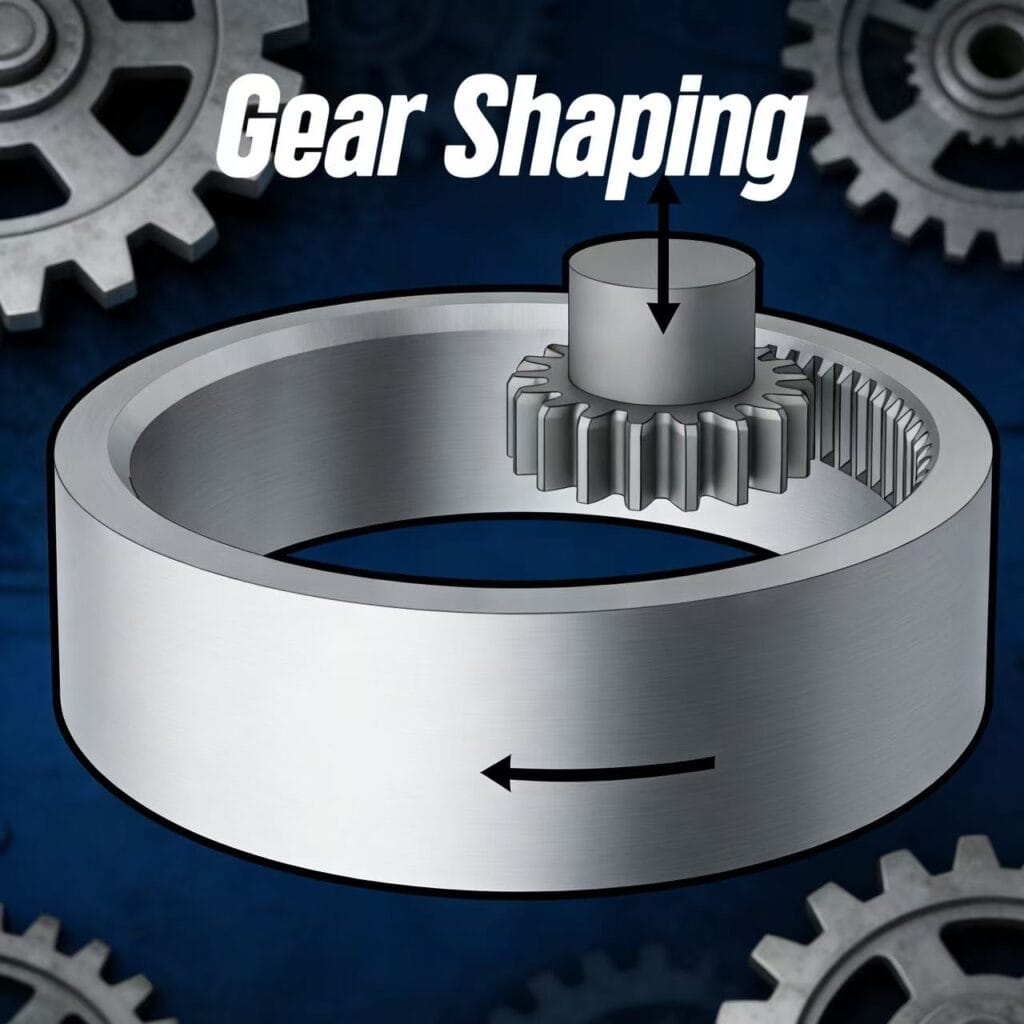
What Is Gear Shaping?
Gear shaping is a gear cutting method in which a reciprocating cutting tool, known as a gear shaper cutter, progressively generates gear teeth on a rotating workpiece. The cutter and the gear blank move in synchronized motion, allowing the tooth profile to be formed through relative movement rather than a fixed tool shape.
This generating principle enables accurate tooth geometry across a wide range of gear sizes and configurations. Gear shaping is commonly applied to internal gears, external gears with limited clearance, and ring gears where other cutting methods may be constrained by geometry.
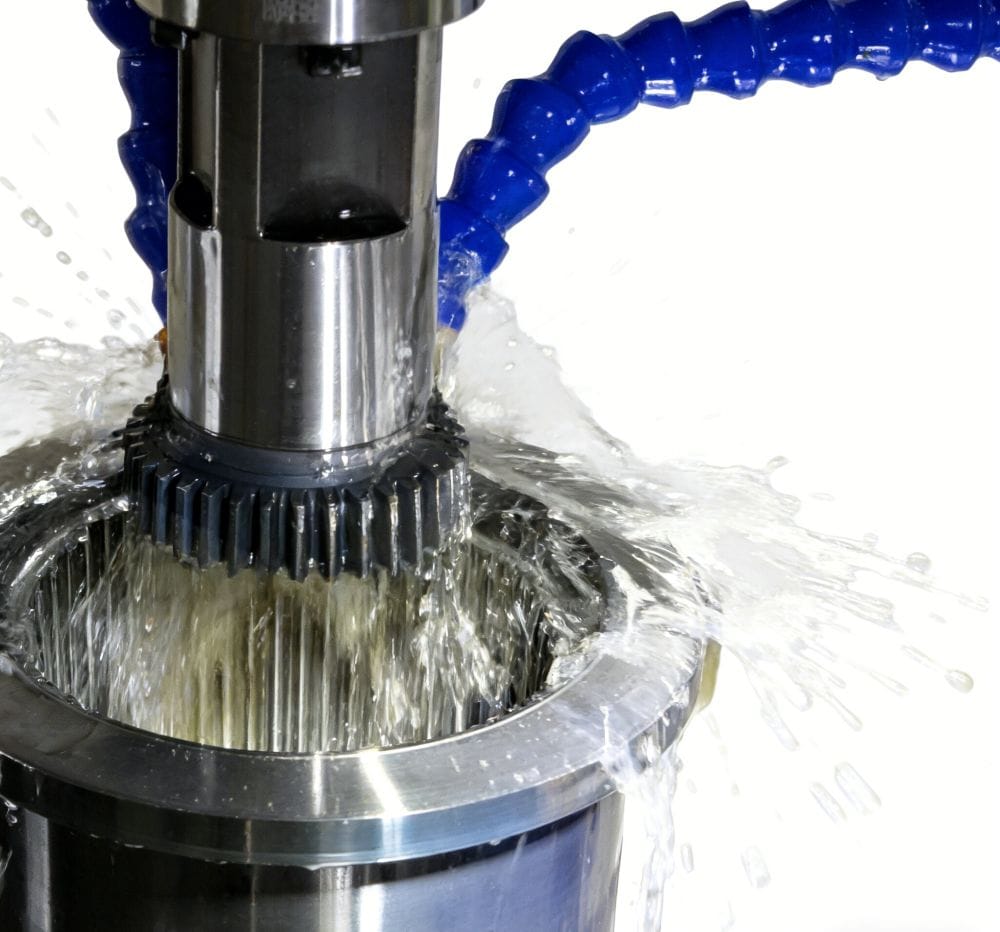
How the Gear Shaping Process Works
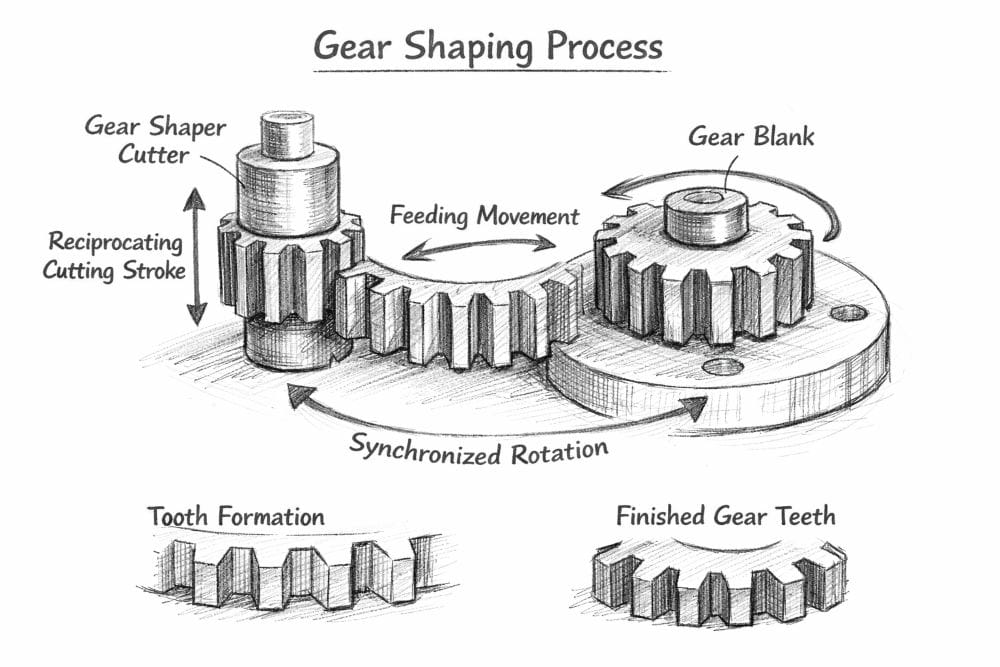
The gear shaping process relies on synchronized rotation between the cutter and the workpiece. As the cutter performs a controlled vertical cutting stroke, the gear blank rotates in a coordinated manner, allowing each tooth space to be generated evenly around the gear circumference.
During machining, parameters such as stroke length, cutting speed, and feed rate are selected to match the gear material, module, and tooth profile design. Through successive cutting strokes, the process develops the complete tooth depth and profile in a stable and controlled way, supporting consistent geometry and reliable dimensional results.
Advantages
Gear shaping provides strong advantages for applications involving internal gears, ring gears, and compact gear assemblies. Through its reciprocating cutting motion, the process enables precise tooth generation in confined spaces while maintaining controlled cutting conditions. In addition, gear shaping supports a wide range of gear modules and tooth profiles, making it suitable for custom designs and low-to-medium volume production. When used together with rolled ring forgings, the process helps achieve accurate internal tooth geometry and stable dimensional control, contributing to consistent performance in load-bearing and transmission systems.
Internal Gear Shaping and Ring Gear Manufacturing
One of the most important applications of gear shaping is internal gear manufacturing. The reciprocating cutting motion allows effective access to internal tooth spaces, making the process well suited for internal gear rings and planetary gear systems.
For large ring gears, gear shaping is commonly performed after producing seamless rolled ring forgings. The rolled ring provides a refined material structure, while shaping enables accurate internal tooth generation. In certain applications, additional surface considerations may be applied after shaping and heat treatment to support specific operating conditions, as part of overall performance optimization.
Gear Shaping vs Gear Hobbing
While both gear shaping and gear hobbing are generating gear cutting processes, they serve different structural requirements in gear manufacturing. Gear shaping is commonly applied to internal gears and ring gears, while gear hobbing is widely used for external gears with continuous cutting efficiency.
The table below summarizes the key differences between gear shaping and gear hobbing based on process characteristics and typical applications.
Comparison Aspect | Gear Shaping | Gear Hobbing |
Cutting Motion | Reciprocating cutting motion with synchronized rotation | Continuous rotational cutting motion |
Typical Gear Types | Internal gears, ring gears, and gears with limited tool access | External spur and helical gears |
Tool Accessibility | Suitable for confined spaces and internal tooth profiles | Suitable for open external gear geometries |
Production Characteristics | Supports flexible designs and custom specifications | Supports efficient and consistent external gear production |
Integration with Forgings | Commonly combined with rolled ring forgings for internal gear rings | Commonly applied after forged gear blanks for external gears |
Typical Applications | Planetary gear systems, internal gear rings, compact transmissions | Automotive gears, industrial drives, power transmission systems |
Typical Applications
Gear shaping is commonly applied in industries that require compact gear arrangements and precise motion control, including:
- Internal gear ringsfor planetary gear systems
- Large ring gears combined with rolled ring forgings
- Construction and mining equipment transmission systems
- Industrial machinery with space-constrained gear designs
When to Use Gear Shaping Services
From a procurement perspective, outsourcing gear shaping services is often a practical choice when one or more of the following conditions apply:
- Internal gears or ring gears are required, especially where tool access is limited
- Custom gear specifications, such as non-standard modules, tooth counts, or compact assemblies
- Low-to-mediumproduction volumes or project-based manufacturing programs
- Integrated process coordination, including rolled ring forging, CNC machining, heat treatment, and inspection
- Early engineering collaboration, where technical review supports manufacturability and cost alignment
In these cases, specialized gear shaping services help streamline sourcing decisions and support coordinated production planning.
Conclusion
Gear shaping is widely used for manufacturing internal gears and complex ring gear structures. When applied together with rolled ring forgings, the process supports accurate tooth geometry and consistent performance across industrial applications.
For projects involving internal gear rings or large ring gears, our engineering team is available to support technical discussion and preliminary evaluation based on your drawings or requirements.