
What Is the MOQ for Custom Forgings?
What is the MOQ for custom forgings? The answer depends on the part, process, and production requirements. While some forged components can be produced in quantities as low as a few pieces, others may require hundreds of parts to justify tooling and production costs.
For buyers evaluating small batch forging or low volume forging projects, MOQ is only one part of the decision. Factors such as tooling investment, material availability, part complexity, and required mechanical properties can all influence whether forging is the most practical manufacturing solution.
In this guide, we’ll explain what determines MOQ in forging, when small-quantity production is feasible, and how buyers can balance cost, performance, and long-term value when sourcing custom forged components.
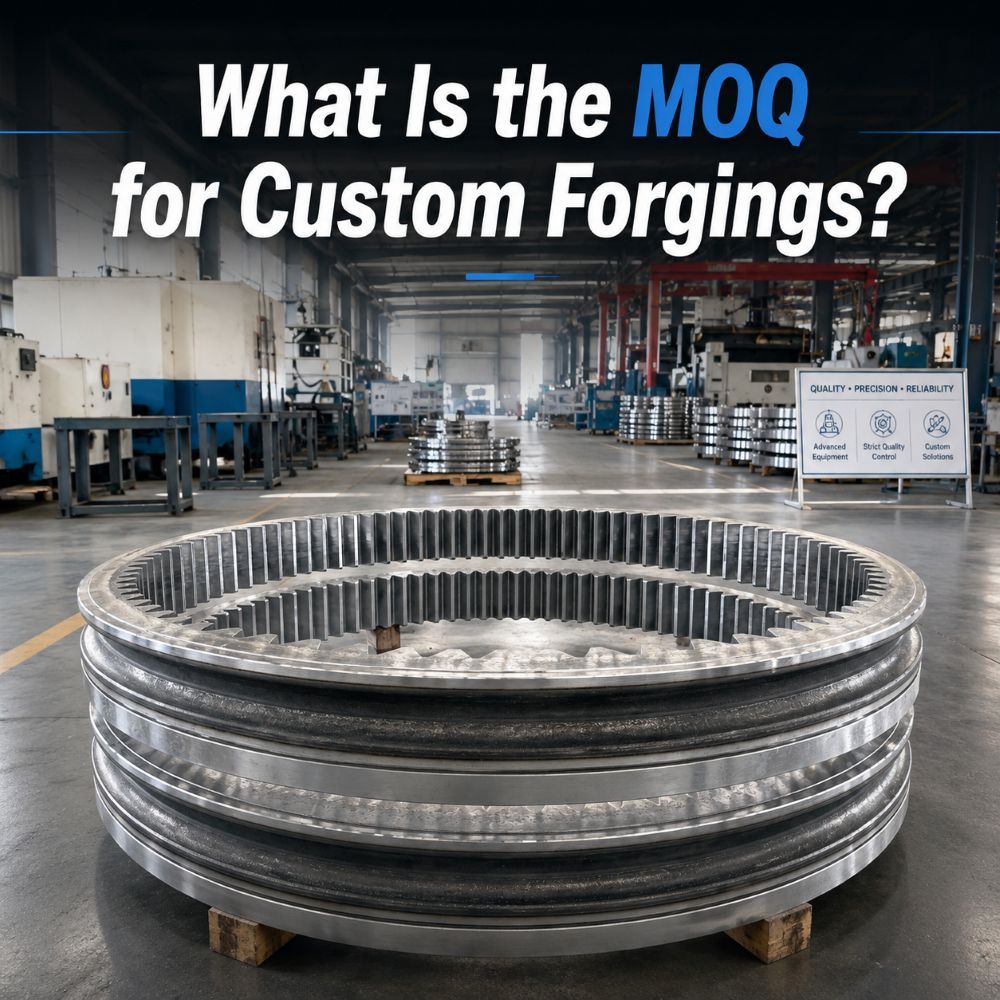
Why Do Custom Forgings Have MOQ?
Unlike standard off-the-shelf products, custom forgings often require dedicated tooling, process setup, and material preparation before production begins.
Even for relatively simple parts, suppliers may need to:
- Design and manufacture forging dies
- Purchase raw materials
- Set up forging equipment
- Plan heat treatment processes
- Prepare inspection documentation
These fixed costs exist regardless of whether a customer orders 50 parts or 5,000 parts.
As a result, most forging manufacturers establish minimum production quantities to ensure production remains economically viable.
However, MOQ should not be viewed as a strict limitation. Many projects can still be produced in small quantities when the application justifies the investment.
What Factors Determine the MOQ for a Forged Part?
Several factors influence the minimum order quantity for custom forged components.
Tooling Requirements
Closed-die forgings typically require custom tooling. The higher the tooling investment, the more parts are needed to spread the cost.
Material Availability
Certain alloy steels may only be available in large purchase quantities. This can influence production planning and MOQ requirements.
Part Geometry
Complex parts often require additional process steps, making small production runs less economical.
Heat Treatment and Inspection
Parts requiring ultrasonic testing (UT), magnetic particle testing (MT), CMM inspection, or specialized heat treatment may involve higher setup costs.
Production Scheduling
Forging facilities usually schedule production in batches. Larger quantities help optimize machine utilization and reduce overall manufacturing costs.
Typical MOQ Ranges for Different Forging Processes
MOQ varies significantly depending on the forging process because each method involves different tooling investments, setup requirements, and production efficiencies.
Forging Process | Typical MOQ | Why? |
Open Die Forging | 1–20 pcs | Minimal tooling investment, suitable for large or custom components |
Ring Rolling | 1–200 pcs* | Large rings can often justify low-volume or single-piece production |
Closed Die Forging | 100–1000 pcs | Higher die costs require larger production volumes to spread tooling expenses |
Hot Die Forging | 50–500 pcs | Balance between tooling investment and production efficiency |
In general, processes that require dedicated dies tend to have higher MOQs because tooling costs must be distributed across more parts.
However, ring rolling is often an exception. For large forged rings, especially those exceeding 1 meter (39 in.) in diameter, production quantities can be as low as a single piece due to the high value and performance requirements of the component.
It is also important to remember that MOQ is influenced not only by the forging process, but also by part size, material grade, machining requirements, heat treatment, and inspection specifications.
When Does Forging Become Cost-Effective?
One of the most common sourcing questions is whether forging makes economic sense for smaller quantities.
The answer depends on several factors, including part geometry, material utilization, mechanical property requirements, and expected production volume.
As a general guideline:
Quantity | Typical Recommendation |
Below 20 pcs | Machining from bar stock may be more practical |
20–100 pcs | Project evaluation required |
100–500 pcs | Forging often becomes viable |
500+ pcs | Forging generally offers better economics |
While machining may appear less expensive initially, forging can often reduce overall manufacturing costs by improving material utilization and reducing machining time.
Forging can also lower long-term operating costs by providing better strength, fatigue resistance, and durability.
For safety-critical components and heavily loaded applications, these performance advantages often justify the initial tooling investment.
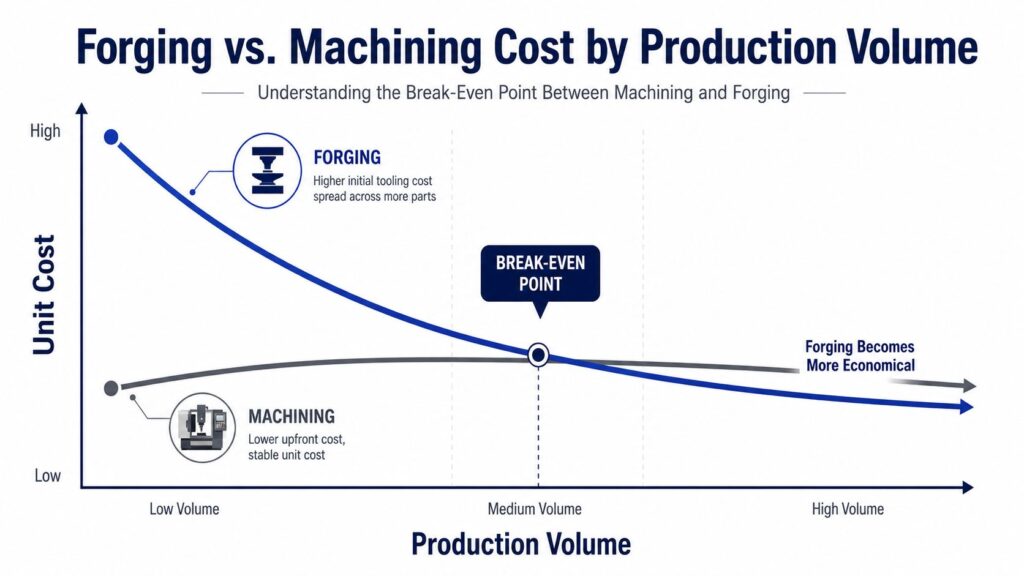
Forging vs Machining for Low-Volume Production
For low-volume projects, the decision is not simply about quantity. It is about balancing upfront cost, performance requirements, and long-term value.
Machining from bar stock is often the better choice when:
- Quantities are very low (typically below 20 pcs)
- Fast prototype development is required
- Design changes are still expected
- Tooling investment cannot be justified
Forging is often the better choice when:
- High strength or fatigue resistance is required
- The component operates under heavy loads or impact conditions
- Material utilization is important
- Future production volumes are expected to increase
One of the biggest advantages of forging is improved grain flow, which can significantly enhance fatigue life and structural integrity compared with machined parts made directly from bar stock.
In many industrial applications, the most practical solution is a combination of forging and CNC machining—using forging to create a high-strength near-net-shape blank and CNC machining to achieve final dimensions and tolerances.
How to Reduce Costs and Get a Better Forging Quote
Reducing MOQ and tooling costs is not only about negotiating price. The quality of information provided at the quotation stage can significantly influence manufacturing feasibility, tooling investment, and overall project economics.
To improve project efficiency and receive a more accurate quotation, buyers should consider the following:
Optimize Component Design
→ Simplifying unnecessary features can reduce tooling complexity and manufacturing costs.
Use Existing Tooling When Possible
→ In some cases, existing dies can be modified instead of developing completely new tooling.
Consolidate Annual Demand
→ Combining multiple orders into a larger production batch often lowers unit costs and improves production efficiency.
Start with Prototype Forgings
→ Prototype production allows design validation before committing to larger quantities or tooling investments.
To receive a faster and more accurate quotation, suppliers typically require:
- Annual demand
- Quantity per order
- Material specification
- Engineering drawings (2D or 3D)
- Heat treatment requirements
- Inspection requirements
- Application environment
Early engineering discussions can often identify opportunities to reduce tooling costs, improve manufacturability, and determine the most economical production approach before production begins.
Common Applications for Low-Volume Forgings
Low-volume forging is commonly used when component performance is more important than production volume. Even in small quantities, forging can provide superior strength, fatigue resistance, and service life compared with machined parts.
Typical applications include:
- Prototype and New Product Development → Validating designs before larger production runs.
- Large Forged Rings and Gear Components → High-value parts where performance justifies tooling costs.
- Shafts and Power Transmission Parts → Components subjected to heavy loads and cyclic stress.
- Custom OEM Components → Non-standard parts produced in limited quantities for specific applications.
These projects often prioritize reliability and performance over production volume, making forging a practical option even for relatively small orders.
Choosing the Right Supplier for Low-MOQ Forging Projects
MOQ is important, but it is not the only factor when selecting a forging supplier. For low-volume projects, technical support, process control, and production flexibility often matter more than the lowest price.
When evaluating a supplier, consider:
- Forging Capabilities → Can they produce the required part geometry and material grade?
- CNC Machining → Can critical dimensions and functional surfaces be finished in-house?
- Heat Treatment → Can required mechanical properties be achieved consistently?
- Inspection → Are CMM, UT, or MT inspections available when needed?
- Material Traceability → Can quality documents and material certificates be provided?
- Industry Experience→ Have they supported similar applications before?
A supplier that can manage forging, machining, heat treatment, and inspection within one coordinated process often provides more consistent quality, shorter lead times, and fewer supply chain issues.
Conclusion
There is no fixed minimum order quantity for custom forgings. MOQ depends on factors such as tooling costs, material requirements, manufacturing processes, and overall project objectives.
While forging is often associated with high-volume production, many industrial applications successfully use small batch forging and low volume forging solutions when performance, reliability, and service life are critical requirements.
If you are evaluating a new project, spare-part order, or prototype component, the best approach is often to review the drawing and production requirements before deciding between forging and machining.