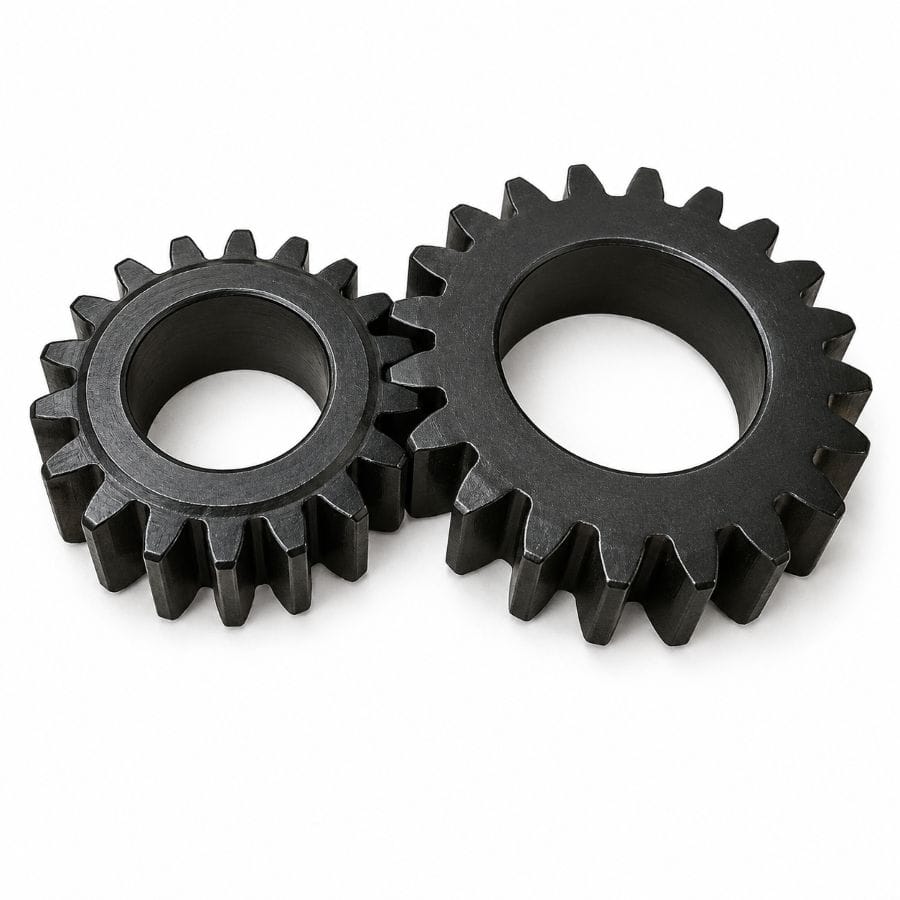
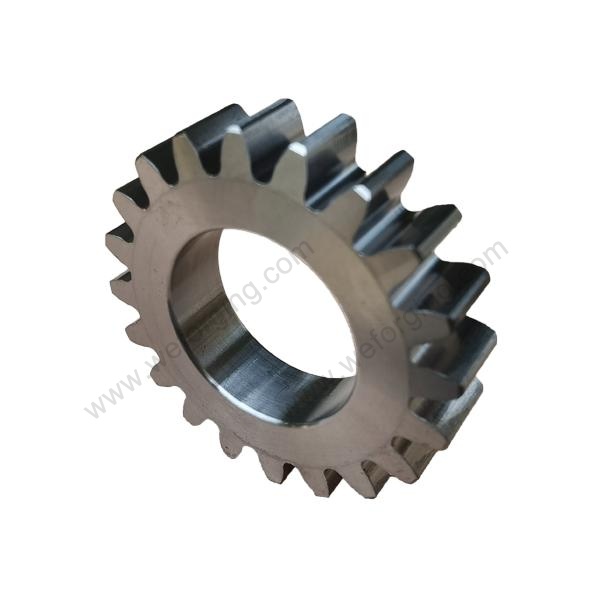
Forged Pinion Gear
Table of Contents
Forged Pinion Gear Manufacturer | Custom OEM Solutions
In heavy-duty transmission systems, forged pinion gears must withstand high torque, continuous load, and demanding operating conditions. The choice of manufacturing process directly affects durability, precision, and long-term cost.
At Weforging, we provide custom forged pinion gears through an integrated production system combining forging, CNC machining, heat treatment, and inspection. This ensures stable quality, reliable performance, and consistent batch repeatability for OEM applications.
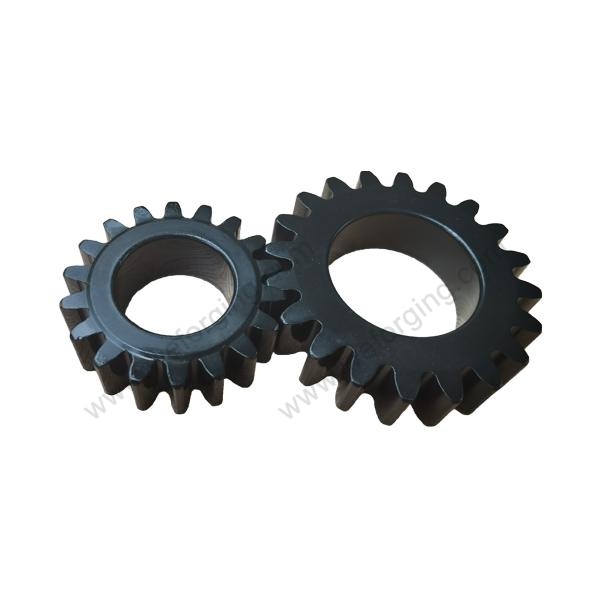
Design Features of Forged Pinion Gear
A forged pinion gear is produced as a dense, refined structure through controlled forging and machining processes. Compared with machined-from-bar or cast gears, forged gears provide improved strength, better fatigue resistance, and higher reliability under dynamic loads.
Materials & Heat Treatment
Forged pinion gears are produced from alloy steels selected based on torque requirements and wear conditions. Common materials include:
20CrMnTi / AISI 8620 – carburizing steel for hardened tooth surfaces
42CrMo / AISI 4140 – balanced strength and toughness
34CrNiMo6 – high fatigue performance under dynamic load
Heat treatment may include:
Carburizing and surface hardening
Quenching and tempering
Stress relieving for dimensional stability
All processes comply with ASTM, EN, or customer specifications.
Manufacturing Process
Each forged pinion gear is produced through a controlled workflow:
Material Selection – Premium alloy or carbon steel (42CrMo, 20CrMnTi, 8620, 4140).
Closed-Die Forging – Forms high-density gear blanks with refined grain structure.
CNC Turning & Milling – Ensures precise hub, bore, and reference dimensions.
Gear Hobbing or Grinding – Cuts accurate teeth and smooth profiles.
Heat Treatment – Carburizing, quenching, and tempering to improve hardness and wear resistance.
Inspection & Testing – Dimensional, hardness, and tooth contact verification.
Key Specifications of Forged Pinion Gear
| Item | Specification |
|---|---|
| Module Range | M1 – M20 |
| Gear Diameter | 50 – 800 mm |
| Number of Teeth | Customizable |
| Gear Accuracy | AGMA 8 – 10 / ISO 6 – 8 |
| Material | Alloy Steel (20CrMnTi / 8620 / 4140 / 34CrNiMo6) |
| Heat Treatment | Carburizing / Q&T / Surface Hardening |
| Manufacturing Process | Forging + CNC Machining + Gear Hobbing / Grinding |
Detailed tooth profile, backlash, and tolerances can be customized based on your drawings.
Precision & Machining Capability
We control critical machining parameters to meet OEM requirements:
- Gear accuracy: AGMA 8–10
- Concentricity: ≤0.02 mm
- Surface roughness: Ra ≤0.8 μm
- Tooth profile accuracy: controlled for smooth transmission
These capabilities ensure stable performance, reduced vibration, and long-term reliability.
Quality Control & Inspection
- Dimensional inspection (CMM)
- Ultrasonic testing (UT) and magnetic particle inspection (MPI)
- Hardness and metallographic testing
- Full material traceability with MTC
Applications
Forged pinion gears are applied in transmission systems that require high load capacity, stable alignment, and long service life. Typical applications include:
Industrial gearboxes — torque transfer in heavy-duty reduction and drive systems
Construction & mining machinery — excavators, crushers, and load-bearing transmission units
Automotive & commercial vehicles — differential assemblies and powertrain components
Wind and energy equipment — turbine gear systems under cyclic and variable loads
Marine & offshore machinery — corrosion-resistant drive mechanisms
General industrial equipment — conveyors, presses, and mechanical actuators
These applications demand forged components capable of resisting fatigue, wear, and impact under continuous operation.
OEM Custom Pinion Gear Manufacturing
Weforging provides OEM custom forged pinion gear manufacturing including:
Drawing-based production
Custom materials
Prototype to batch manufacturing
Engineering optimization
Why Choose Weforging
OEM clients choose Weforging for reliable and scalable manufacturing:
- 40+ years forging experience
- Integrated forging + CNC machining + heat treatment
- Stable batch quality for transmission components
- Export experience in EU and US markets
- Flexible production from prototype to mass volume
Our closed-loop production system ensures dimensional stability, consistent quality, and long service life.
Conclusion
Forged pinion gears are essential components in high-load transmission systems where strength, precision, and fatigue resistance are critical. Choosing a manufacturer with integrated forging and machining capability reduces sourcing risk and improves long-term performance.
Send your drawings to Weforging for a fast engineering review and reliable OEM production support.
What is a forged pinion gear used for?
Why choose forged pinion gears instead of machined gears?
What materials are commonly used for forged pinion gears?
What is the typical lead time for forged pinion gears?
Related products
- Gears and Shafts
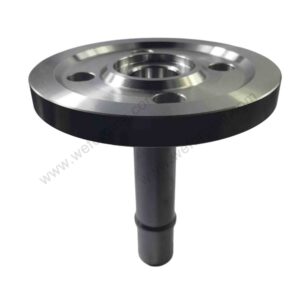
Forged Flanged Shaft
- Gears and Shafts
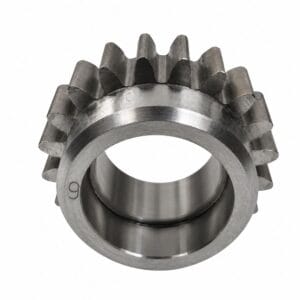
Forged Spur Gears
- Gears and Shafts
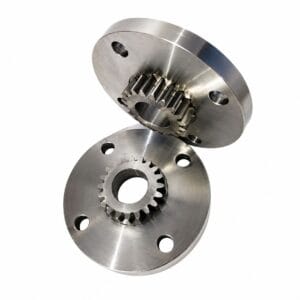
Forged Sun Gears for Planetary Systems
- Gears and Shafts
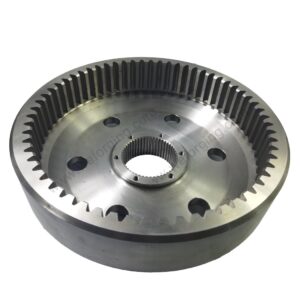
Forged Internal Ring Gears