
Roll Forging vs Closed Die Forging: Key Differences
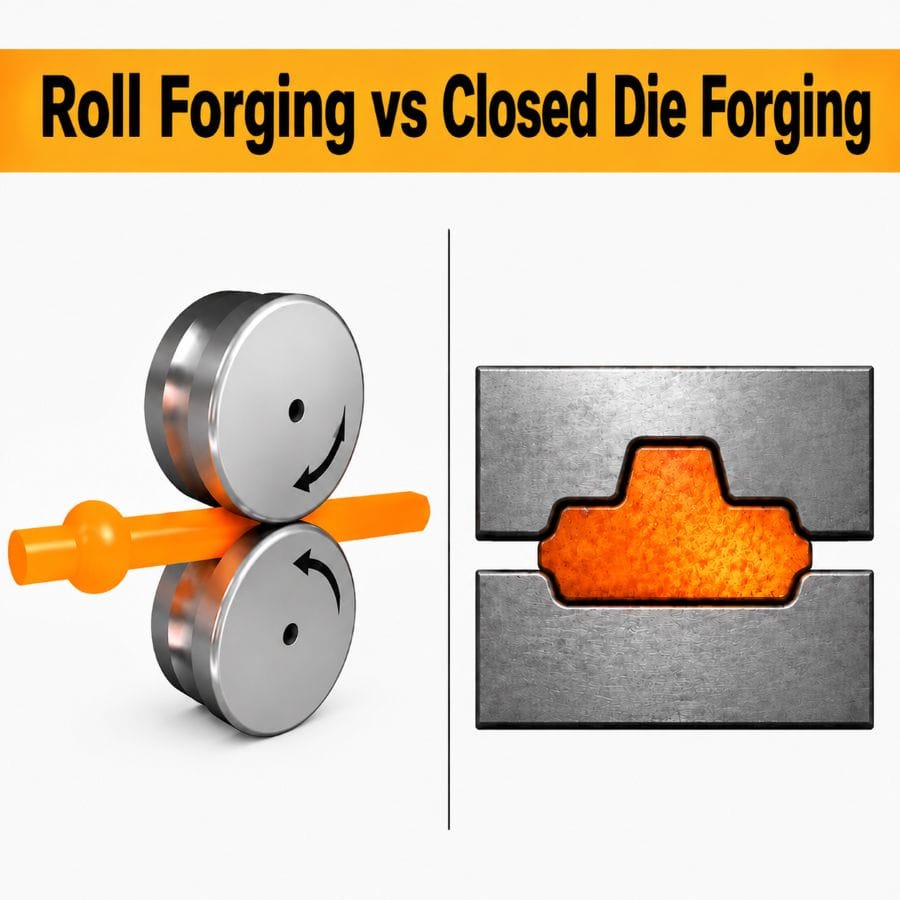
Roll forging and closed die forging are two different forging processes used to produce metal components with improved strength and durability. The main difference is how the material is formed: roll forging gradually shapes heated metal through rotating rolls, while closed die forging uses a shaped die cavity to create more complex geometries.
Choosing between roll forging and closed die forging depends on factors such as part design, production volume, material requirements, and final application. Each process offers unique advantages in terms of material efficiency, component complexity, and manufacturing cost.
This article explains the key differences between roll forging and closed die forging, including their processes, advantages, applications, and how to select the right forging method for your components.
What Is Roll Forging?
Roll forging is an incremental forging process that uses rotating rolls to gradually deform heated metal into the desired shape. During the roll forging process, the billet cross-section is reduced while its length increases, improving material utilization and maintaining favorable grain flow.
This forging method is commonly used for elongated components such as shafts, axles, and rods where consistent mechanical performance and production efficiency are required. However, for components with complex geometries, closed die forging may provide greater design flexibility.
What Is Closed Die Forging?
Closed die forging is a forging process that uses customized die cavities to shape heated metal under high pressure. The material flows into the die cavity, allowing manufacturers to produce forged components with complex geometries, improved dimensional control, and consistent mechanical properties.
Compared with roll forging, closed die forging provides greater flexibility for parts requiring detailed features and near-net-shape designs. It is commonly used for complex industrial components, hydraulic parts, transmission components, and other applications where strength and accuracy are important.

Roll Forging vs Closed Die Forging: Main Differences
Roll forging and closed die forging are two common forging methods with different forming processes and applications. The roll forging is suitable for components with simpler profiles and high material efficiency requirements, while closed die forging is better for complex geometries and tighter dimensional control.
Comparison Factor | Roll Forging | Closed Die Forging |
Forming Method | Continuous deformation using rotating rolls | Forming metal inside customized die cavities |
Component Complexity | Suitable for simpler profiles and elongated parts | Suitable for complex-shaped components |
Material Efficiency | Generally higher material utilization | Depends on part design |
Tooling Cost | Lower initial tooling cost | Higher tooling investment |
Applications | Shafts, axles, rods | Hydraulic parts, transmission parts, industrial forgings |
In general, roll forging focuses on production efficiency and material utilization, while closed die forging provides greater flexibility for complex components.
Advantages of Roll Forging
Roll forging offers several advantages for suitable component designs, particularly in material efficiency, mechanical performance, and production consistency.
- Higher Material Efficiency
The progressive deformation process helps reduce material waste and machining allowance, improving overall material utilization. - Improved Grain Flow and Mechanical Performance
Controlled deformation helps maintain favorable grain flow, contributing to consistent strength and reliable performance in suitable applications. - Efficient and Stable Production
Roll forging is suitable for shafts, axles, rods, and other components requiring repeatable production and stable manufacturing efficiency.
However, roll forging is mainly suitable for components with simpler geometries. Complex parts requiring detailed features and tighter dimensional control may be better suited for closed die forging.
Advantages of Closed Die Forging
Closed die forging offers several advantages for complex component designs, particularly in shape flexibility, dimensional control, and mechanical performance.
- Suitable for Complex Geometries
The use of customized die cavities allows manufacturers to produce components with complex shapes, integrated features, and near-net-shape designs. - Improved Dimensional Accuracy and Consistency
Controlled material flow inside the die helps achieve tighter dimensional control and consistent part quality. - Enhanced Mechanical Performance
The forging process improves internal structure and grain flow, providing reliable strength and durability for demanding applications.
However, closed die forging typically requires higher tooling investment and is most suitable when component complexity, performance requirements, and production volume justify the initial cost.
How to Choose Between Roll Forging and Closed Die Forging
The choice between roll forging and closed die forging depends on component design, production volume, material requirements, and machining needs. Roll forging is generally suitable for simpler profiles and efficient material utilization, while closed die forging is preferred for complex geometries and tighter dimensional requirements.
Choose Roll Forging | Choose Closed Die Forging |
Simpler or elongated component designs | Complex shapes and integrated features |
Higher material efficiency is required | Better dimensional control is needed |
Stable medium to high-volume production | Near-net-shape components are preferred |
Selecting the right forging process helps balance performance, cost, and production requirements. An experienced forging manufacturer can provide guidance based on the specific component application.
Is Roll Forging Cheaper Than Closed Die Forging?
Roll forging can be more cost-effective than closed die forging for suitable applications, mainly due to higher material utilization, lower initial tooling investment, and efficient production. However, the overall cost depends on component design, production volume, and machining requirements.
Roll forging may provide cost advantages when:
- Material efficiency is important
The progressive forming process can reduce material waste and machining allowance. - Medium to high production volumes are required
Stable production and repeatability can help reduce the cost per component. - The component has a simpler profile
Roll forging avoids the higher tooling investment often required for complex closed die forging.
For complex components requiring tight dimensional control or integrated features, closed die forging may provide better overall value despite higher tooling costs.
How to Choose the Right Forging Process?
The best forging process depends on the component design, performance requirements, production volume, and manufacturing goals. When comparing roll forging and closed die forging, engineers should consider the following factors:
- Component Geometry
Roll forging is suitable for simpler profiles and elongated components, while closed die forging is better for complex shapes and integrated features. - Production Volume and Cost
Higher production volumes may justify tooling investment, while material efficiency and machining requirements also affect overall cost. - Mechanical Requirements
Applications requiring high strength, fatigue resistance, or impact performance should consider the grain flow and internal structure created during forging. - Machining Requirements
Combining forging with CNC machining can achieve final dimensional accuracy while maintaining the mechanical advantages of forged components.
Forging Process Expertise at Weforging
Every forging project involves different requirements, from component geometry and material selection to production efficiency and final performance. At Weforging, we work with customers to evaluate suitable forging solutions based on their specific application needs.
Our capabilities include:
- Integrated Forging and Machining
We provide hot forging, ring rolling, and CNC machining capabilities, supporting the complete manufacturing process from forged blanks to finished components. - Engineering Support and Process Optimization
Our team assists with forging process selection, material evaluation, and design optimization to improve manufacturability, cost efficiency, and production reliability. - Quality-Controlled Manufacturing
With capabilities in tooling development, heat treatment, machining, and inspection, we help ensure consistent quality and stable production for industrial forged components.
Conclusion
Roll forging and closed die forging each provide advantages for different component requirements. Roll forging is well suited for parts requiring efficient material utilization and stable production, while closed die forging offers greater flexibility for complex geometries and tighter dimensional control.
The most suitable forging process depends on factors such as component design, performance requirements, production volume, and manufacturing cost. By evaluating these factors early in the project, engineers and purchasing teams can develop a more reliable and cost-effective forging solution.