
Roll Forging Process: Benefits and Industrial Uses
Introduction
Roll forging is a precision metal forming process that shapes heated billets between rotating rolls to produce uniform, high-strength components.It refines the grain structure, enhances fatigue resistance, and ensures dimensional accuracy.Compared with hammer or press forging, roll forging offers higher efficiency and consistent quality, making it widely used for shafts, gears, and flanges.
This article introduces the roll forging process, its main advantages, and typical industrial applications, showing why it remains a reliable solution for high-performance forged parts.
What Is Roll Forging?
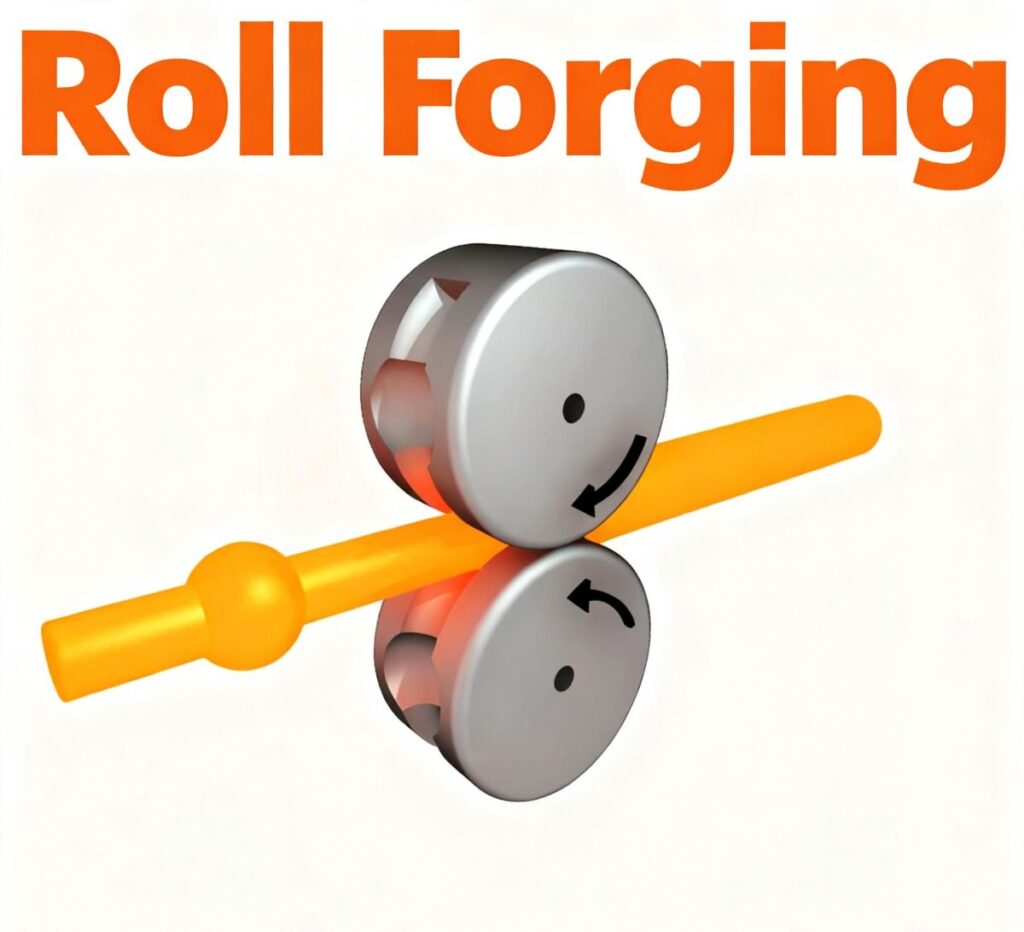
Roll forging is a semi-continuous metal forming process in which a preheated billet is progressively shaped between grooved rotating rolls. Each pass compresses and elongates the billet, gradually forming the required profile while maintaining controlled metal flow.
Unlike closed die forging, roll forging requires lower tooling investment and allows greater flexibility in profile design. Compared with open die forging, roll forging provides improved dimensional consistency and surface finish. This makes roll forging an efficient solution for producing long or rotational components with balanced strength, accuracy, and cost control.
Roll Forging Process Explained
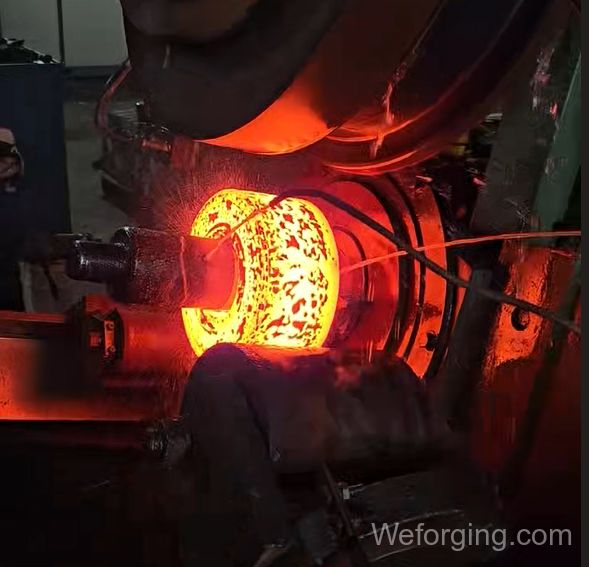
The roll forging process typically involves six key stages:
- Material Selection — Choose high-grade alloy, carbon, or stainless steel based on required mechanical performance.
- Heating — Billets are heated to 1050–1150°C for optimal plasticity and grain flow.
- Rolling Stage — The billet is shaped progressively between multiple rolls; deformation is distributed evenly to avoid internal defects.
- Heat Treatment — Controlled tempering or quenching enhances hardness, ductility, and fatigue strength.
- CNC Machining — Finishing processes ensure tolerance within ±0.01 mm and surface roughness Ra ≤ 1.6 µm.
- Testing — Each batch undergoes UT, MPI, hardness, and CMM dimensional testing in Weforging’s lab.
This combination of forging and CNC control delivers consistent microstructure, minimal residual stress, and superior repeatability.
Common Materials Used in Roll Forging
Material selection plays an important role in roll forging because it directly affects strength, fatigue resistance, machinability, and long-term durability.
Common materials used in roll forged components include:
- Carbon Steel
Widely used for shafts, flanges, and gear blanks because of its good forgeability and cost-performance balance. - Alloy Steel
Grades such as 42CrMo and 4140 provide higher strength and fatigue resistance for gears, axles, and heavy-duty components. - Stainless Steel
Commonly used for valve parts, pump shafts, and marine applications requiring corrosion resistance. - Aluminum & Copper Alloys
Suitable for lightweight or conductive components requiring good machinability and surface finish.
Material selection is typically based on mechanical performance, service environment, and post-forging machining requirements.
Comparison Between Roll Forging and Other Forging Methods
Roll forging differs from open die forging and closed die forging in deformation control, material efficiency, and dimensional repeatability.
Forging Method | Process Characteristics | Typical Applications | Key Advantages |
Roll Forging | Heated billet gradually shaped between rotating rolls. | Shafts, flanges, gear blanks. | High efficiency, fine grain flow, cost-effective. |
Open Die Forging | Free deformation between flat dies. | Large shafts, rings, heavy equipment. | Flexible for large parts, good mechanical properties. |
Closed Die Forging | Metal pressed into precision dies under high pressure. | Complex, high-precision components. | High dimensional accuracy, repeatability. |
Press Forging | Slow, controlled pressing with high force. | Heavy-duty structural components. | Dense structure, stable mechanical behavior. |
Understanding these differences helps engineers and procurement teams select the optimal forging process for specific applications.
Common Products Made by Roll Forging
Roll forging is ideal for components requiring high strength, accuracy, and load-bearing performance, such as:
- Transmission Shafts:Provide stable torque and fatigue resistance in automotive systems.
- Gear Blanks:Ensure concentricity and precision during gear cutting.
- Flanges & Rings: Used in wind turbines, petrochemical pipelines, and marine systems.
- Couplings & Pins: Deliver mechanical stability under impact and rotation.
- Bearing Races:Support rotational accuracy and extended lifespan.
Advantages of Roll Forging
The advantages of roll forging go far beyond production efficiency. Each benefit contributes to stronger materials, lower costs, and stable performance.
1️⃣ Optimized Material Utilization – The gradual deformation between rolls achieves up to 90% efficiency, reducing waste and machining time.
2️⃣ Refined Grain Flow and Strength – Continuous rolling aligns the metal grain along the load path, improving tensile and fatigue resistance.
3️⃣ Dimensional Stability and Repeatability – Controlled deformation and CNC finishing ensure precise geometry and consistent tolerances in every batch.
4️⃣ Cost and Energy Efficiency – Moreover, roll forging uses less energy than press forging while maintaining high throughput for mass production.
5️⃣ Enhanced Sustainability – In addition, the process minimizes scrap and supports sustainable manufacturing through efficient heat and material control.
Applications of Roll Forging
Roll forging is widely used for rotational and load-bearing components requiring stable grain flow, high strength, and dimensional consistency.
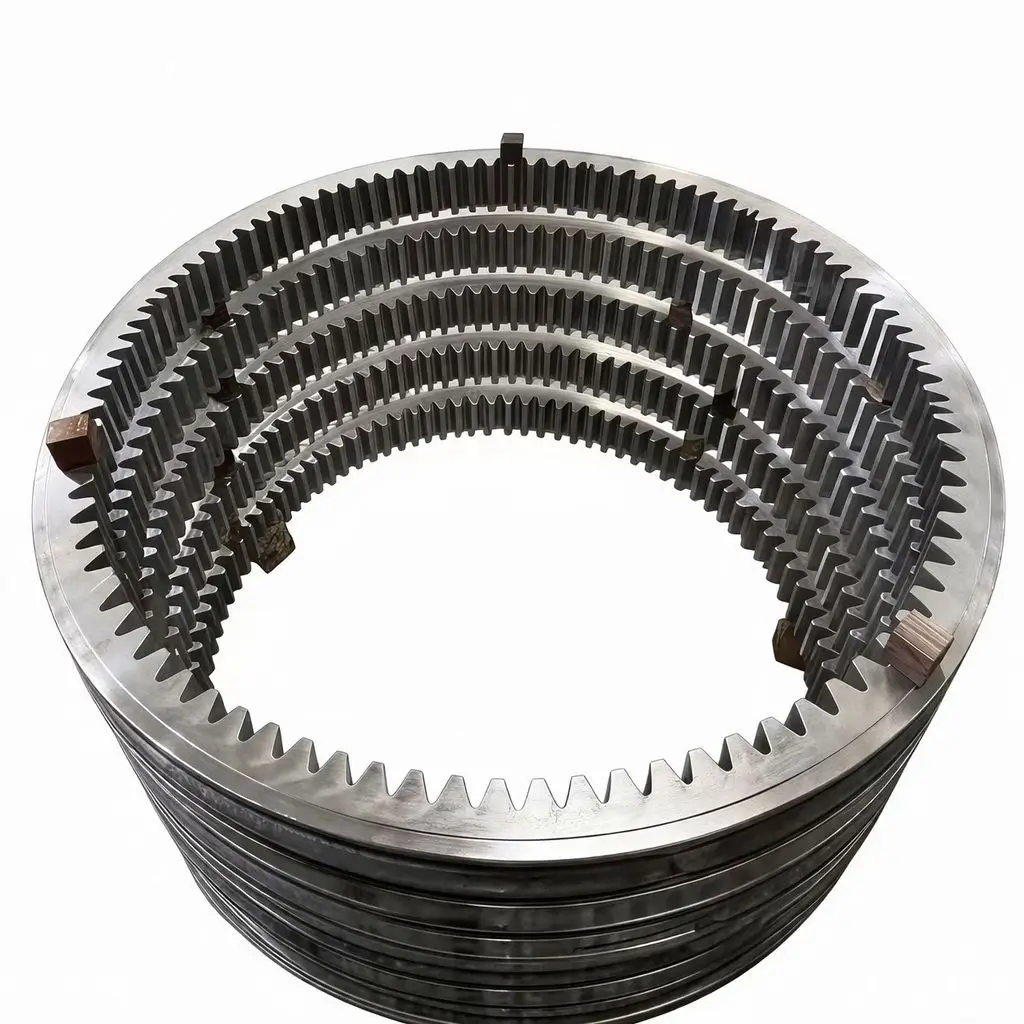
- Bearing Rings & Gear Rings
Used for bearing races, inner and outer rings, and large gear rings requiring fatigue resistance and stable mechanical performance. - Flanges & Couplings
Applied in transmission systems, hydraulic equipment, and wind energy components requiring reliable torque transfer. - Drive Shafts & Pinions
Roll forged shafts and pinions help improve alignment accuracy while reducing machining allowance and material waste. - Heavy-Duty Rotational Components
Commonly used in excavators, construction machinery, and industrial equipment operating under high load conditions.
Why Choose Weforging for Roll Forging
Selecting a roll forging supplier is not only about forming capability. For OEM projects, process control, machining coordination, and batch consistency are equally important.
At Weforging, roll forging is integrated with CNC machining, heat treatment, and inspection to support stable production quality.
- Forging + CNC Coordination
Controlled machining allowances help improve dimensional accuracy and downstream machining efficiency. - Material Traceability
Production parameters are documented from billet selection to final inspection for stable mechanical performance. - OEM Production Support
We support prototypes, batch production, and long-term OEM manufacturing programs. - Inspection and Quality Control
UT, MPI, hardness testing, and CMM inspection are performed according to project requirements.
Conclusion
Roll forging remains essential in modern manufacturing, combining controlled deformation, precision machining, and testing to produce components with long-term strength and stability.From automotive shafts to wind turbine flanges and gear blanks, roll forged parts ensure reliable performance across demanding applications.
At Weforging, we deliver complete solutions integrating forging, CNC machining, heat treatment, and inspection under ISO and AGMA standards.If you are looking for a trusted roll forging partner, send us your drawings or specifications. Our engineers will provide technical support and quotations promptly.
Contact Weforging to start your custom roll forging project.