
Rolled Steel Rings: Manufacturing Methods & Selection Guide
By Weforging Technical Team | Published November 10, 2026
Rolled steel rings are used in industrial gearboxes, bearing assemblies and heavy machinery, where material properties, ring geometry and dimensional accuracy affect component performance.
Depending on the application, steel rings can be produced by seamless ring forging, bending and welding steel sections, or cutting annular blanks from plate. Each method has different implications for material integrity, manufacturing cost and subsequent machining.
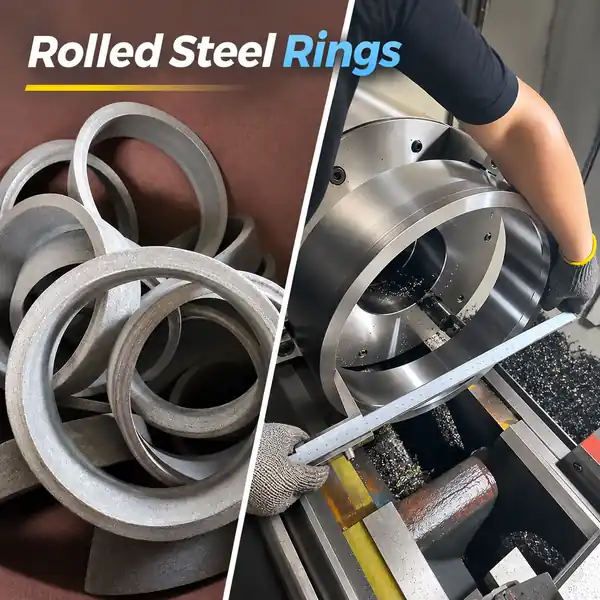
For heavily loaded components, seamless rolled ring forgings are often preferred because they provide a continuous ring structure without a welded joint. However, forging quality alone does not determine the accuracy of the finished component.
Ring dimensions, heat-treatment distortion and machining allowance must also be considered. This article examines how these factors influence manufacturing selection and the production of finished steel ring components.
What Are Rolled Steel Rings?
Rolled steel rings are annular steel components produced by rolling or related metal-forming processes. They include rings formed by bending steel sections and seamless rings manufactured through hot forging and ring rolling.
Unlike welded steel rings, seamless rolled ring forgings are formed from pierced steel preforms without welded joints. The forging process produces continuous ring blanks suitable for subsequent heat treatment and machining.
These forged rings are used for gear blanks, bearing components, flanges and other industrial applications. Depending on OEM requirements, they can be supplied as forged blanks, heat-treated rings, rough-machined parts or finished CNC-machined components.
Rolled Steel Rings: Forged, Welded or Plate-Cut?
Industrial steel rings can be manufactured through seamless ring forging, rolling and welding, or plate cutting. Each method has different implications for material properties, structural integrity, manufacturing cost and subsequent machining. The appropriate choice depends on the component’s geometry, loading conditions and final requirements.
Seamless Rolled Ring Forging
In seamless ring rolling, a heated steel preform is pierced to create a central opening. The ring is then rolled to increase its diameter while controlling wall thickness and height.
The process produces a continuous ring without a welded joint. During deformation, the metal flow develops along the ring geometry, although the final grain-flow pattern depends on the forging route and deformation conditions.
Seamless rolled ring forgings are commonly used for bearing rings, ring gear forgings and other industrial components requiring controlled material properties and subsequent precision machining.
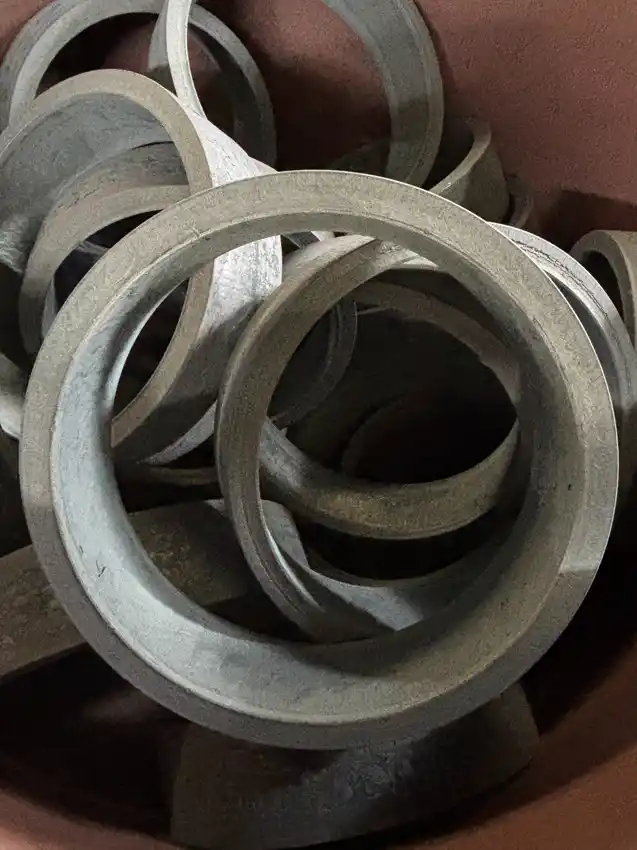
The image on the right shows SAE 8620H alloy steel ring gear forging blanks before machining. These seamless forged rings are produced for transmission components, where ring cross-section, material condition and machining allowance must be considered before subsequent CNC machining.
Rolled and Welded Steel Rings
Rolled and welded steel rings are made by bending steel bar, plate or structural sections into a circular shape and joining the ends by welding.
This method can be economical for large-diameter structural rings, particularly when the design permits a welded joint and the required section can be formed from commercially available material.
However, weld quality, heat-affected zones, residual stress and any required post-weld heat treatment must be considered. The welded joint may also require additional inspection, depending on the application.
Plate-Cut Steel Rings
Plate-cut steel rings are produced by cutting an annular shape from steel plate, followed by machining where necessary.
They are often practical for low-volume components, relatively thin sections or applications where plate material properties meet the design requirements.
For thick rings, however, cutting a large central opening can generate substantial material waste. Plate-cut rings also retain the material characteristics associated with the original plate production route.
Manufacturing Method Comparison
| Factor | Seamless Ring Forging | Rolled & Welded | Plate-Cut |
| Joint | No welded joint | Welded joint | No welded joint |
| Material flow | Developed by forging | Depends on starting stock | Retains plate characteristics |
| Heavy cyclic loading | Suitable when properly specified | Requires weld and fatigue assessment | Requires material and fatigue assessment |
| Material utilization | Can reduce waste for thick rings | Depends on section | Can be low for thick rings |
| Low-volume cost | Tooling and setup dependent | Often competitive | Often competitive |
The best manufacturing method depends on the complete design requirements rather than ring diameter or purchase price alone. For heavily loaded transmission and rotating components, material properties, joint integrity and subsequent machining requirements should be evaluated together.
When Should a Steel Ring Be Seamless Forged?
Seamless ring forging is often considered for steel rings subjected to repeated torque, bending or fatigue loading, particularly when a welded joint is undesirable. However, the decision should be based on the component’s operating conditions, material requirements and final geometry rather than forging alone.
For example, large ring gear blanks used in heavy machinery must withstand repeated torque transmission and local stress concentrations. Bearing rings and other rotating components may also require controlled material properties throughout the ring section.
Before selecting seamless rolled ring forgings, engineers should evaluate three factors:
- Loading conditions: Cyclic loading, torque, bending and fatigue requirements determine whether a continuous, weld-free ring structure is appropriate.
- Material and section geometry: Steel grade, toughness, forging reduction and ring cross-section influence the required mechanical properties and forging feasibility.
- Manufacturing and inspection: Heat treatment, machining allowance, final tolerances and inspection requirements must be considered before the forging blank is produced.
Seamless forging does not automatically guarantee better performance. Steel quality, forging conditions, heat treatment and inspection remain essential.
For heavily loaded transmission components, the main advantage is the ability to combine a continuous forged structure with a manufacturing route planned around the finished component’s requirements.
How Do Ring Dimensions Affect Manufacturing Selection?
Ring diameter alone does not determine manufacturing feasibility. Wall thickness, axial height and cross-section geometry also affect whether a steel ring can be produced efficiently through seamless ring forging.
Large-diameter, thin-wall rings require careful control of forming stability and roundness, while thick-section rings place greater demands on preform dimensions, material deformation and equipment capacity. The achievable geometry depends on the steel grade, forging equipment and forming conditions.
For OEM components, custom forging begins with a review of the finished drawing to determine suitable forged ring blank dimensions. A poorly matched blank may require excessive material removal, while insufficient stock can make subsequent machining difficult.
This is particularly important for large gear rings and bearing components, where the forged section must provide enough material for the final bore, outside diameter and locating faces.
How Do Heat Treatment and Machining Affect Final Accuracy?
For precision rolled steel rings, dimensional control does not end when forging is completed. Heat treatment and machining can introduce further changes that must be considered during process planning.
Large or uneven ring sections may respond differently during heating and cooling. Depending on the material, geometry and heat-treatment route, the ring may experience changes in roundness, flatness or overall dimensions. Machining can also redistribute residual stresses, particularly when substantial material is removed from one side of the section.
For this reason, the forging blank should not be designed solely around the nominal finished dimensions.
Why Machining Allowance Matters
Machining allowance must account for expected forging variation, heat-treatment distortion and the material removal needed to establish accurate locating surfaces.
Insufficient allowance can leave unmachined areas or prevent the final dimensions from being achieved. Excessive allowance increases machining time, tool consumption and material cost.
The appropriate allowance depends on ring size, material, manufacturing route and specified tolerances. It should be established based on process capability and actual production experience rather than a single fixed value.
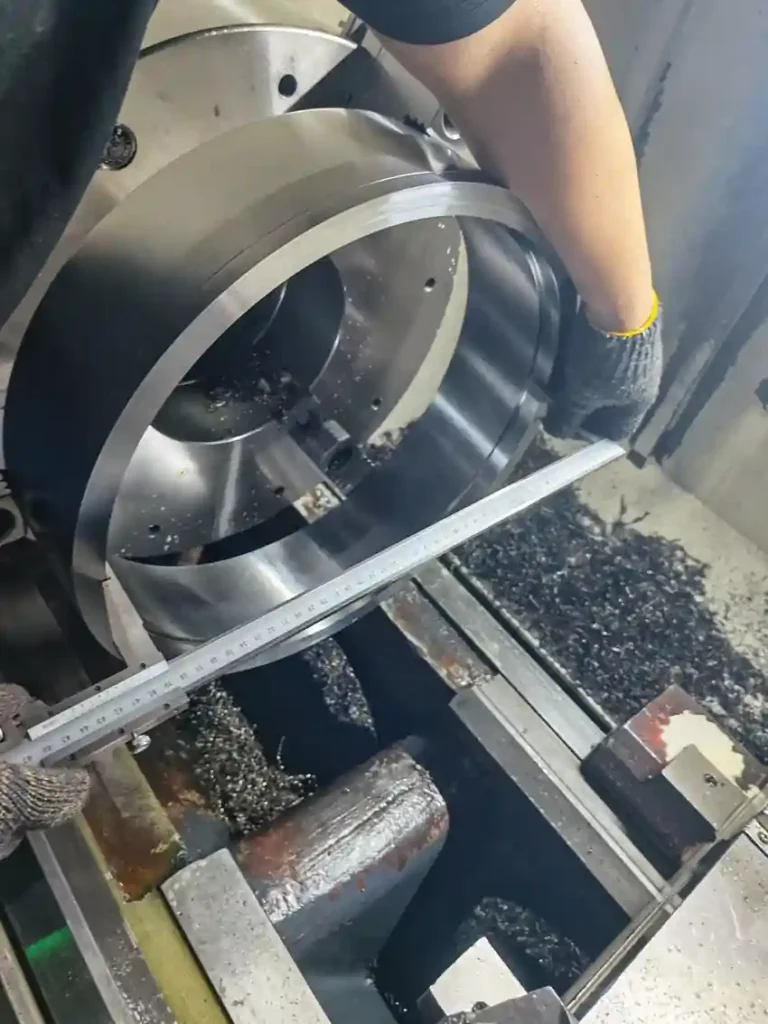
During rough machining, dimensional checks help verify the remaining stock before subsequent operations. The image shows an in-process dimensional check on a rough-machined steel ring at Weforging. Such checks help identify potential stock-removal issues before finish machining.
Machining Datum and Distortion Control
For rings requiring tight geometric tolerances, the machining sequence is as important as the forging dimensions.
A typical process may include rough machining to establish reference surfaces, followed by stress relief or heat treatment where specified, and then finish machining of critical features.
During finishing, the locating method and clamping force must be controlled to avoid distorting thin-wall or large-diameter rings. Excessive clamping force may temporarily deform the workpiece, causing dimensional changes after it is released.
Where required by the drawing, final geometric inspection should verify the ring under the specified measurement conditions rather than relying only on dimensions measured while clamped.
For gear rings and bearing components, inspection may include bore dimensions, roundness, runout, coaxiality and the geometric relationship between locating faces, depending on the drawing requirements.
At Weforging, forging, heat treatment, CNC machining and inspection can be coordinated according to the agreed manufacturing route. This allows the forging blank and subsequent machining operations to be planned around the finished component requirements.
Inspection Requirements for Industrial Rolled Steel Rings
Inspection requirements for industrial rolled steel rings depend on the component’s application, material and manufacturing route. For seamless rolled ring forgings, dimensional inspection alone may not be sufficient.
Depending on the drawing and agreed quality requirements, inspection may include:
- Chemical composition: Confirming the specified steel grade and material heat number.
- Mechanical testing: Verifying tensile strength, yield strength, elongation and impact properties where required.
- Hardness testing: Verifying specified hardness requirements after heat treatment.
- Ultrasonic testing (UT): Evaluating internal discontinuities according to the agreed acceptance criteria.
- Magnetic particle testing (MT): Detecting relevant surface and near-surface discontinuities in suitable ferromagnetic materials.
- Dimensional inspection: Verifying machined dimensions and specified geometric tolerances.
For large alloy steel ring gear blanks, coordinate measuring machine (CMM) inspection can be used to verify specified dimensions and geometric features before subsequent manufacturing operations.
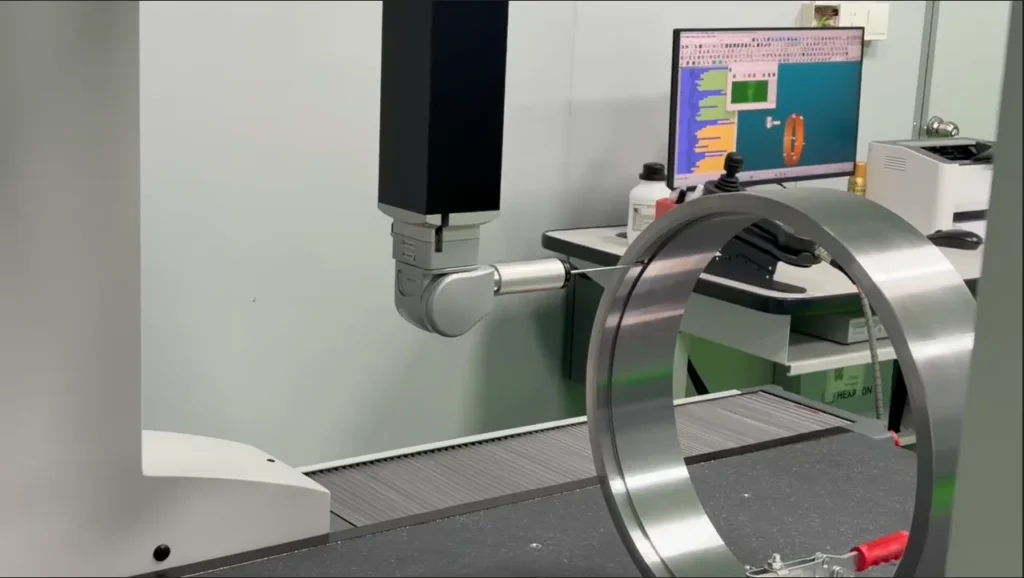
The image shows CMM inspection of a large alloy steel ring gear at Weforging before gear tooth machining. This inspection helps verify the machined ring geometry against the drawing requirements at the relevant production stage.
For critical OEM components, traceability should connect the material heat number with the forging batch, heat-treatment records and inspection results.
Weforging supports material verification, mechanical testing, dimensional inspection and relevant nondestructive testing according to the agreed quality plan.
How to Specify Rolled Steel Rings for OEM Manufacturing
For custom rolled steel rings, a drawing showing only the outside diameter, inside diameter and height is rarely sufficient to determine the most suitable manufacturing route.
Engineers and OEM buyers should also specify the intended application, material requirements, heat-treatment condition and final machining requirements.
Before requesting a quotation, the following information is useful:
- Finished component drawing:Dimensions, tolerances, critical surfaces, machining datums and geometric requirements.
- Material specification:Steel grade, applicable standard and required mechanical properties.
- Operating conditions:Loading, temperature and relevant fatigue or wear requirements.
- Heat treatment:Required condition, hardness range and specified testing.
- Delivery condition:As-forged ring blanks, heat-treated forgings, rough-machined rings or fully CNC-machined components.
- Inspection and traceability:Required test reports, nondestructive testing and batch documentation.
- Production quantity:Prototype, small batch or recurring OEM production.
Where the manufacturing route is not specified, the supplier should review the component drawing, loading conditions and machining requirements before recommending a suitable production method.
For heavily loaded industrial components, involving the forging and machining supplier early in the design review can help identify excessive machining allowances, difficult-to-machine features and potential inspection constraints.
Conclusion: Selecting the Right Rolled Steel Ring
Rolled steel rings can be manufactured through different routes, but the right choice depends on the component’s loading conditions, geometry, material requirements and final machining needs.
For heavily loaded industrial components, seamless rolled ring forging can provide a suitable starting blank for subsequent heat treatment and precision machining.
The most practical approach is to evaluate the finished component first, then determine the forging blank, machining allowance and inspection plan.
Weforging supplies custom rolled ring forgings as forged blanks, rough-machined rings or finished CNC-machined components, according to OEM drawings and agreed quality requirements. Need custom rolled ring forgings for an OEM project? Send Weforging your component drawing, material specification and required delivery condition for a manufacturing feasibility review.