
Hot Forging Services for High-Strength Steel Components
Hot forging is a precision metal-forming process that shapes heated metals under controlled pressure. At Weforging, we integrate forging, CNC machining, and testing to produce forged steel and alloy steel forging components with high strength, toughness, and dimensional stability. The hot forging process refines the grain structure, enhances mechanical performance, and ensures consistent quality across large production batches. It is widely applied in automotive, energy, and heavy equipment industries, where reliability and precision are critical.

Hot Forging Capabilities & Specifications
Our hot forging capabilities cover a wide range of sizes, materials, and precision requirements for OEM components.
Closed Die Forging (Die Forging)
- Weight Range: 0.05 kg – 150 kg
- Suitable for precision components with defined geometry and tighter tolerances
Rolled Ring Forging
- Max Diameter: Up to 3000 mm
- Ideal for large ring-shaped components with continuous grain flow
General Capabilities
- Machining Tolerance: IT7–IT9
- Heat Treatment Options: Q&T / Induction Hardening
- Typical Lead Time: 30–45 days depending on size and complexity
- Flexible MOQ: From 1 piece for custom components
Types of Hot Forging Processes
Hot forging is not a single manufacturing method. Depending on component size, geometry, and production volume, different hot forging processes are applied to achieve optimal material flow and dimensional control.
Open Die Forging
Open die forging is used for large, custom steel components where flexibility in shape and size is required. Without fully enclosed dies, material can be progressively forged to achieve refined grain flow and high structural integrity.
This process is commonly applied to shafts, rings, blocks, and heavy-duty components produced in low to medium volumes.
👉 Learn more about open die forging capabilities.
Closed Die Forging
Closed die forging utilizes shaped dies to form components with defined geometries and tighter repeatability. It is suitable for medium to high production volumes where consistent shape and near-net dimensions are required, such as gear blanks, couplings, and precision connectors.
👉 Learn more about closed die forging capabilities.
Rolled Ring Forging
Rolled ring forging is a specialized hot forging process for large ring-shaped components. By expanding the ring diameter while reducing wall thickness, this method improves material utilization and grain flow continuity. It is widely used for flanges, bearing rings, and slewing ring blanks.
👉 Explore our rolled ring forging solutions.
Hot Forging Process
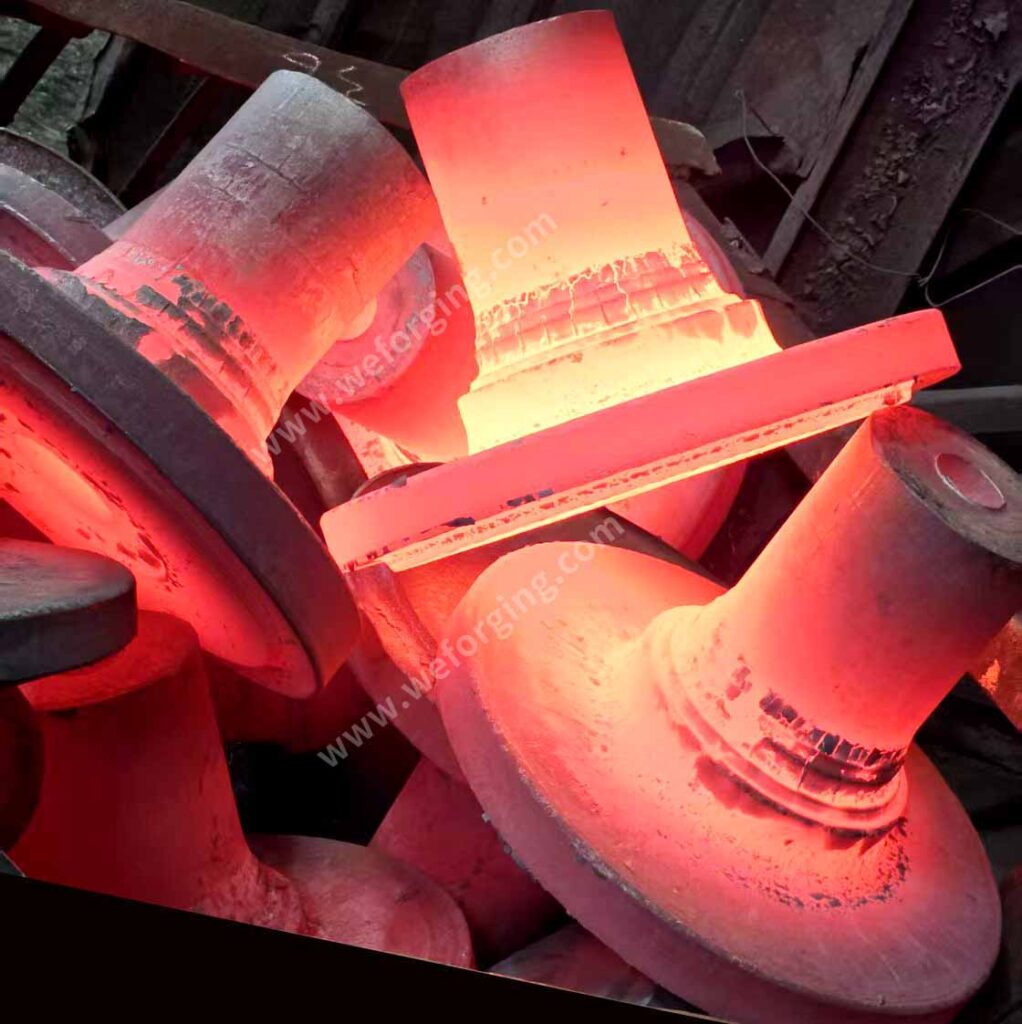
The hot forging process begins by heating alloy or carbon steel billets to between 1,050°C and 1,250°C. Once the billet reaches the optimal forging temperature, it is transferred to a hot forging press or hammer machine where it is shaped under high pressure. Controlled deformation allows the metal to flow uniformly, refining the microstructure and eliminating internal defects.
After forging, processes such as trimming, shot blasting, and CNC machining are performed to achieve precise dimensions. Finally, heat treatments like quenching, tempering, or normalizing further enhance the part’s strength and toughness.

Materials Used in Hot Forging
Weforging manufactures hot forged steel components using a wide range of materials including:
Alloy Steels (42CrMo, 35CrMo, 4140, 4340, 8620H) — For high-load parts like shafts, gears, and flanges.
Carbon Steels (40Cr, 20CrMnTiH) — Excellent machinability and toughness for general engineering.
Stainless Steels (304L, 316) — Corrosion-resistant for marine and energy systems.
Aluminum and Copper Alloys — Lightweight and conductive for aerospace and electrical components.
All materials are tested and certified under ISO, DIN, and AGMA standards, ensuring stable performance and long service life.
Typical Hot Forged Components
Hot forging is commonly selected for components that require high load capacity, fatigue resistance, and long-term reliability. At Weforging, hot forged parts are often supplied as forged blanks or combined with CNC machining for precise dimensional control.
Typical hot forged components include:
Shafts and drive shafts for power transmission systems
Forged rings and bearing rings for rotating assemblies
Flanges and pressure-rated connectors
Gear blanks and hubs for heavy-duty gearboxes
Large structural blocks for machining-intensive applications
These components are widely used in OEM equipment where material strength and internal structural integrity are critical to performance.

Hot Forging Temperature Chart
| Material | Temperature Range | Heating Method |
|---|---|---|
| Carbon Steel (C45, 1045) | 1100–1250 °C | Induction / Furnace |
| Alloy Steel (42CrMo / 4140) | 1050–1200 °C | Furnace → Soaking |
| Stainless Steel (304 / 316L) | 1180–1250 °C | Gas furnace / High-temp |
| Aluminum Alloys | 400–480 °C | Short-cycle heating |
| Copper / Brass | 650–900 °C | Induction preferred |
| Titanium Alloys | 900–950 °C | Controlled-atmosphere |
Hot forging is typically performed above the recrystallization temperature of metal, allowing deformation without work hardening.
Advantages of Hot Forging
Hot forging delivers a strong balance of strength, efficiency, and consistency for demanding applications.
- Refined Grain Structure
Grain flow aligns with stress direction, reducing defects and improving fatigue resistance. - Efficient Material Use
Near-net shaping lowers material waste and machining cost. - Stable Dimensions
Controlled processes ensure consistent tolerances and repeatable quality. - Wide Material Range
Suitable for carbon steel, alloy steel, and stainless steel. - Enhanced Performance
Heat treatment improves strength, toughness, and wear resistance.
Why Choose Weforging for Hot Forging
Weforging provides integrated hot forging services for OEM and industrial applications requiring strength, dimensional control, and process reliability.
Key reasons OEM customers choose Weforging include:
Integrated forging and CNC machining
In-house coordination enables controlled machining allowances, shorter lead times, and consistent dimensional results.Large and custom forging capability
Supports large cross-sections, extended lengths, and non-standard geometries for heavy-duty applications.Dimensional control and inspection
Defined tolerances verified through in-process measurement, dimensional inspection, and material testing.Material and standards alignment
Carbon, alloy, and stainless steels aligned with ASTM, DIN, and EN standards.Export-oriented OEM experience
Proven support for international projects with consistent quality and documentation.
| Aspect | Hot Forging | Cold Forging |
|---|---|---|
| Working Temperature | 1,050°C – 1,250°C (high-temperature plastic zone) | Room temperature or ≤150°C (ambient forming) |
| Material Flow | Excellent metal flow; refined grain structure | Limited deformation; restricted flow |
| Strength Characteristics | High strength and good ductility after heat treatment | Higher initial hardness but lower ductility |
| Surface Finish | Oxidized surface; requires post-machining | Smooth surface; minimal machining required |
| Dimensional Accuracy | Moderate precision; suitable for larger or complex parts | High precision; ideal for small fasteners |
| Typical Components | Shafts, flanges, gears, couplings | Bolts, nuts, pins, fasteners |
| Energy Consumption | Higher (requires heating) | Lower (formed at room temperature) |
Applications & Industries
Hot forging is widely used in high-performance industries where strength, reliability, and durability are critical.
- Automotive Industry
Forged components such as axles, crankshafts, and gear blanks deliver high fatigue strength and long service life for drivetrain systems. - Energy & Oil & Gas
Hot forging is used to produce flanges, couplings, and valve components that perform reliably under high pressure and extreme temperatures. - Agricultural Machinery
Forged gear hubs, shafts, and connecting parts ensure durability under continuous vibration, shock, and heavy loading conditions. - Heavy Machinery & Construction
Forged parts such as shafts and bearing housings provide high load capacity and impact resistance for demanding environments.
Conclusion & Contact
Hot forging remains one of the most efficient and reliable methods for manufacturing high-strength, precision-engineered parts.
At Weforging, our integrated system of forging, CNC machining, and testing ensures consistent quality and global delivery standards.
📞 Looking for a reliable forging company?
Click the inquiry button below to get a real-time quote or upload your drawings.
Our engineering team will provide technical guidance and a tailored quotation for your project.