Forging vs Casting: Which Is Better?
In metal manufacturing, forging and casting represent two widely used processes with distinct performance characteristics. In forging, heated metal is pressed into shape under high force, producing refined grain flow and high mechanical strength. By contrast, casting involves melting metal and filling a mold cavity, allowing for complex shapes but with lower structural performance under heavy loads. The main differences lie in grain structure, defect formation, and long-term durability.
This guide compares forging and casting in terms of process fundamentals, key technical differences, industry applications, lifecycle value, and how to choose the right method for your specific component requirements.
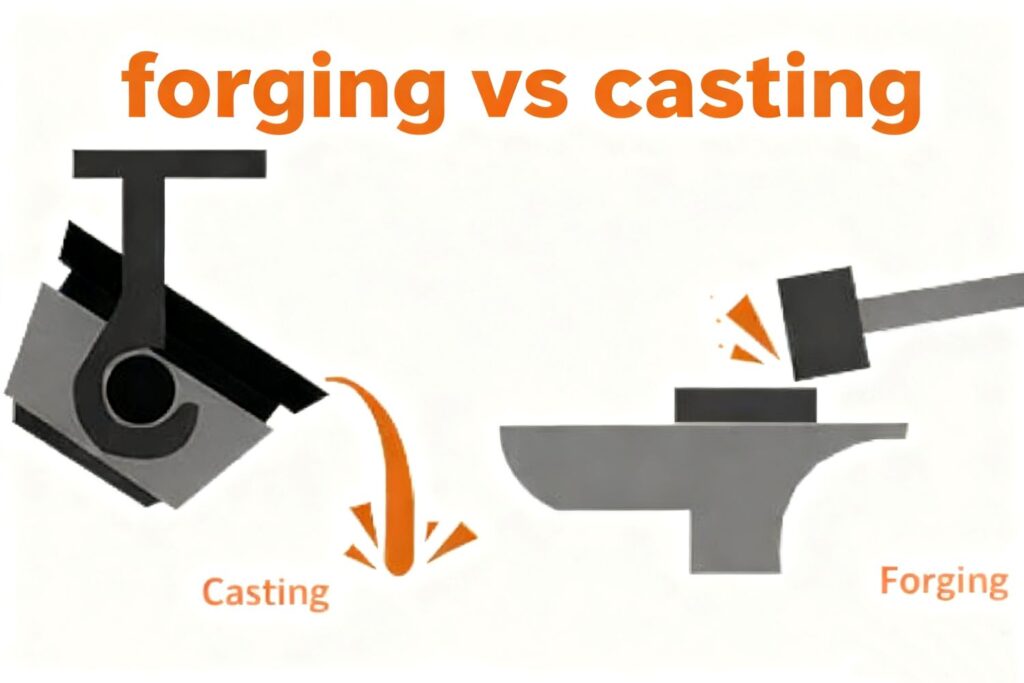
When comparing forging vs casting, forging is generally the better option for industrial components that require high strength, fatigue resistance, and long service life. Forging shapes metal through compressive deformation, refining grain structure and improving performance under cyclic and heavy loads.
Casting forms parts by pouring molten metal into molds, offering greater flexibility for complex shapes. However, internal porosity and non-uniform grain structure may reduce fatigue and impact resistance.
For components such as shafts, gears, rings, and flanges, forging is typically preferred when structural integrity and reliability are critical. Casting is more suitable for complex, lower-load applications where design flexibility and initial cost are priorities.
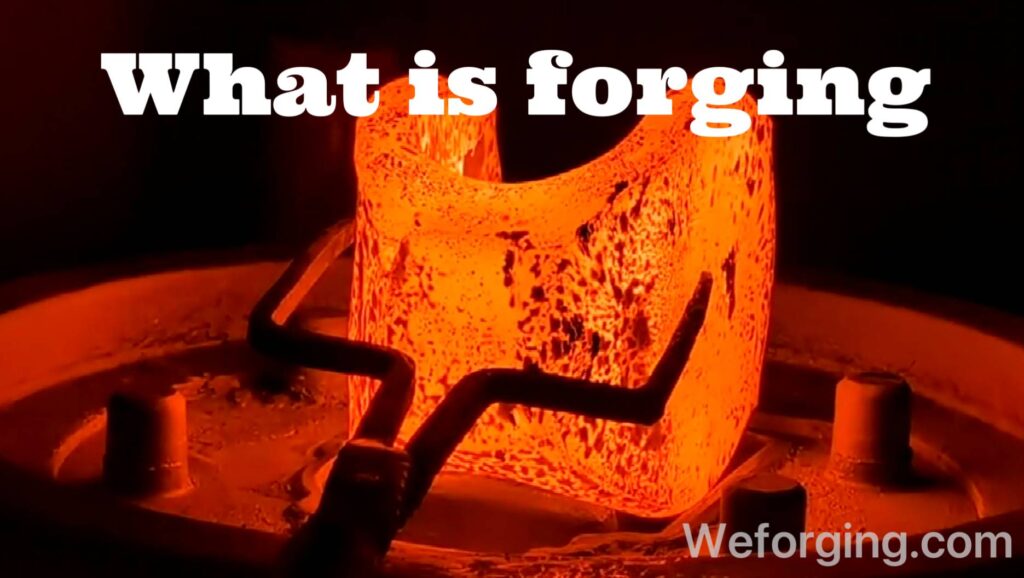
Forging is a precision forming process that shapes metal through compressive forces at elevated or ambient temperatures. During the process, metal is plastically deformed under pressure, refining its internal grain structure and improving overall strength.
Common types include open-die forging, closed-die forging, and upset forging, each designed for different geometries and load requirements. The metal forging process ensures directional grain flow that follows the part’s shape, providing superior fatigue resistance and structural integrity.
Modern forging facilities—such as Weforging’s Rolled Ring Forging Workshop—use automated hammers, hydraulic presses, and advanced temperature control systems to achieve consistent metallurgical quality across every production batch.
What Is Casting?
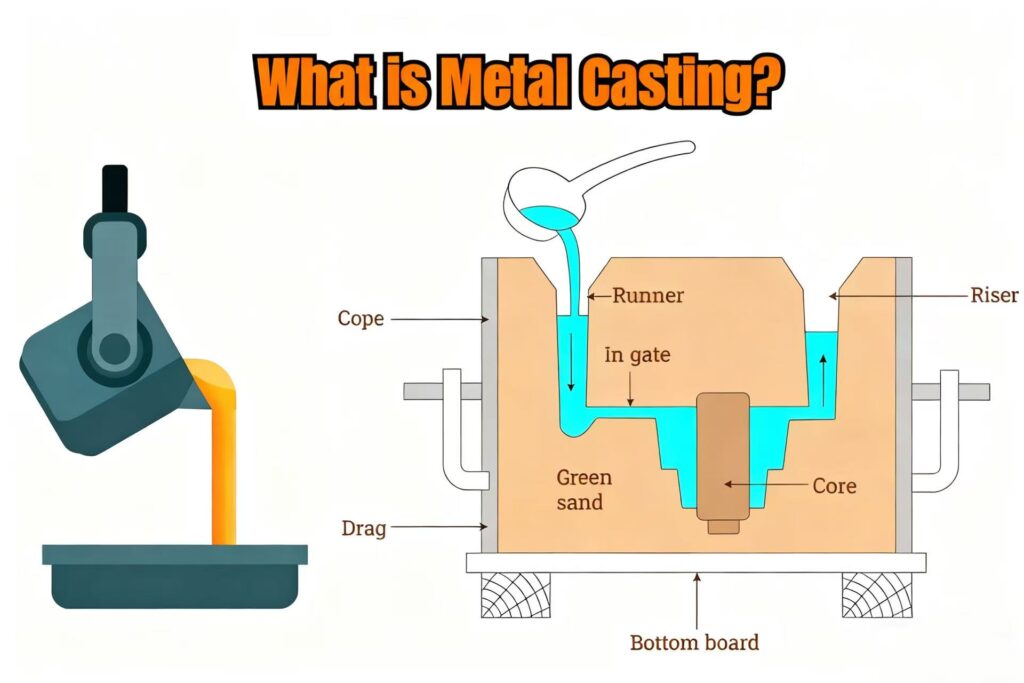
Casting forms metal by melting it and pouring the liquid material into a mold cavity, where it solidifies into the desired shape. This metal casting process enables excellent flexibility in producing complex geometries and large components with intricate internal details.
Typical methods include sand casting, investment casting, and die casting, depending on part requirements and production scale. While casting achieves smooth contours and near-final shapes, the internal grain growth occurs randomly during solidification. As a result, additional machining and inspection are required to ensure dimensional precision and material uniformity.
In industries that prioritize geometry complexity and cost efficiency, cast steel components are widely used for housings, covers, and decorative elements.
Forging vs Casting — Key Technical Differences
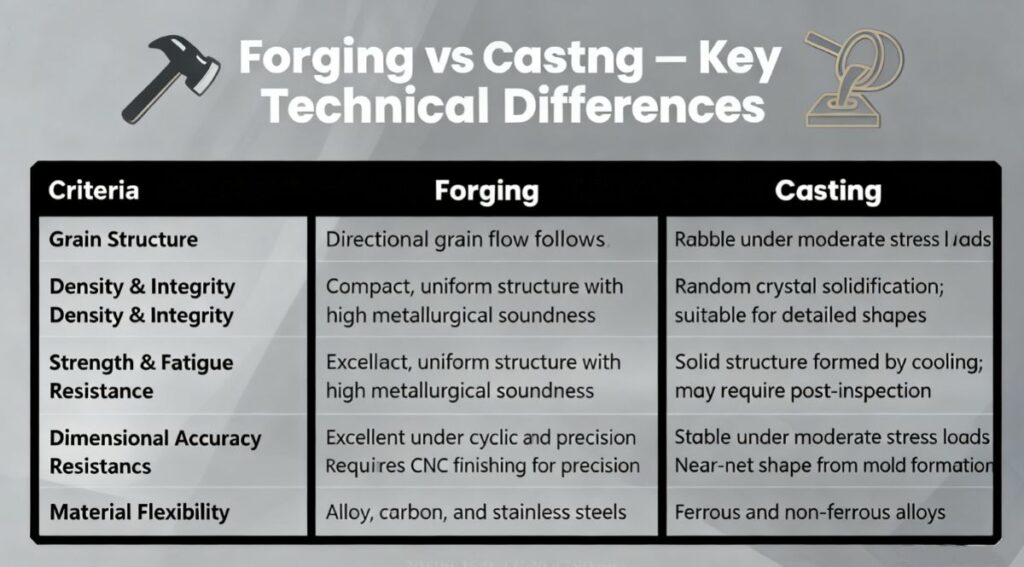
The difference between forged and cast steel lies in how the material’s structure is formed. Forging refines the internal grain flow through controlled deformation, resulting in superior strength and fatigue resistance. Casting, however, relies on molten metal solidification, which can sometimes lead to internal porosity, shrinkage cavities, or uneven grain distribution. These defects may reduce mechanical integrity and make cast parts more prone to cracking or deformation under heavy loads. While casting excels at creating complex shapes, its microstructural reliability is generally lower than that of forged components—especially in applications requiring high stress endurance and long-term durability.
Forged Steel vs Cast Steel: Performance Comparison
When comparing forged steel vs cast steel, the key difference lies in internal structure and mechanical performance. Forged steel is shaped through compressive deformation, which refines grain flow and eliminates internal voids, resulting in higher strength, better fatigue resistance, and improved impact toughness.
Cast steel is formed by pouring molten metal into molds, allowing greater freedom for complex geometries. However, the solidification process may introduce internal porosity and non-uniform grain structure, which can reduce fatigue life under cyclic or high-stress conditions. For industrial components such as shafts, gears, rings, and load-bearing parts, forged steel is generally preferred when reliability and long-term performance are critical.
Forging vs Casting: Cost and Lifecycle Considerations
When evaluating forging vs casting cost, casting often appears more economical due to lower tooling costs and greater flexibility for complex shapes. This makes casting suitable for low-load components or applications where initial manufacturing cost is the primary concern.
However, forging typically provides lower total lifecycle cost for critical industrial components. Forged parts offer longer service life, higher resistance to fatigue and impact, and reduced risk of in-service failure, which can significantly lower maintenance, replacement, and downtime costs over time. For OEM applications that prioritize reliability and long-term performance, forging is often the more cost-effective solution when lifecycle factors are considered.
Forging vs Casting Applications Across Industries
- Automotive Industry – shafts, connecting rods, and gear blanks provide high fatigue resistance under torque and vibration.
- Energy & Oil & Gas – flanges, couplings, and valve components deliver reliability in high-pressure systems.
- Heavy Machinery – rotor shafts and drive components ensure long-term performance under heavy loads.
- Construction & Agriculture – Forged arms, joints, and suspension parts maintain strength in continuous operation.
Across these industries, forged components offer longer service life, dimensional consistency, and enhanced mechanical stability—helping OEMs maintain operational safety and efficiency.
Why Forging Offers Superior Lifecycle Value
Forging delivers outstanding strength and dimensional precision by refining grain flow and removing internal imperfections commonly seen in castings—such as porosity, shrinkage cavities, and uneven density. Unlike casting, which may contain hidden inclusions that reduce long-term reliability, forging creates a dense, uniform structure with superior fatigue resistance and impact performance.
At Weforging, we offer comprehensive engineering solutions to help clients upgrade cast components into high-performance forged parts. Each product undergoes precise heat treatment, hardness verification, and ultrasonic inspection to ensure mechanical stability and full compliance with ISO 9001:2015, DIN, and AGMA standards—delivering consistent quality from prototypes to mass production.
Conclusion
When comparing forging vs casting, the choice depends on performance needs. Forging provides superior strength, fatigue resistance, and dimensional accuracy—ideal for critical parts such as shafts, rings, and flanges.
With in-house forging + CNC machining + testing, Weforging delivers custom solutions that meet international standards.
Click the inquiry button below to upload your drawings or request a real-time quote. Our engineers will respond with a detailed, professional consultation.