Hot Forging Production Lines: A Buyer’s Guide
Hot forging is one of the most widely used metal-forming processes for producing high-strength components such as shafts, gear blanks, flanges, and rings. For buyers, understanding how a hot forging production line operates is valuable—not to purchase equipment, but to better assess a supplier’s production capability, consistency, and manufacturing strength. Factors such as automation level, heating method, forging-press capacity, and heat-treatment expertise all contribute to the overall performance of forged components. This guide provides procurement teams and engineers with a clear framework for evaluating forging suppliers with confidence.
What Is a Hot Forging Production Line?
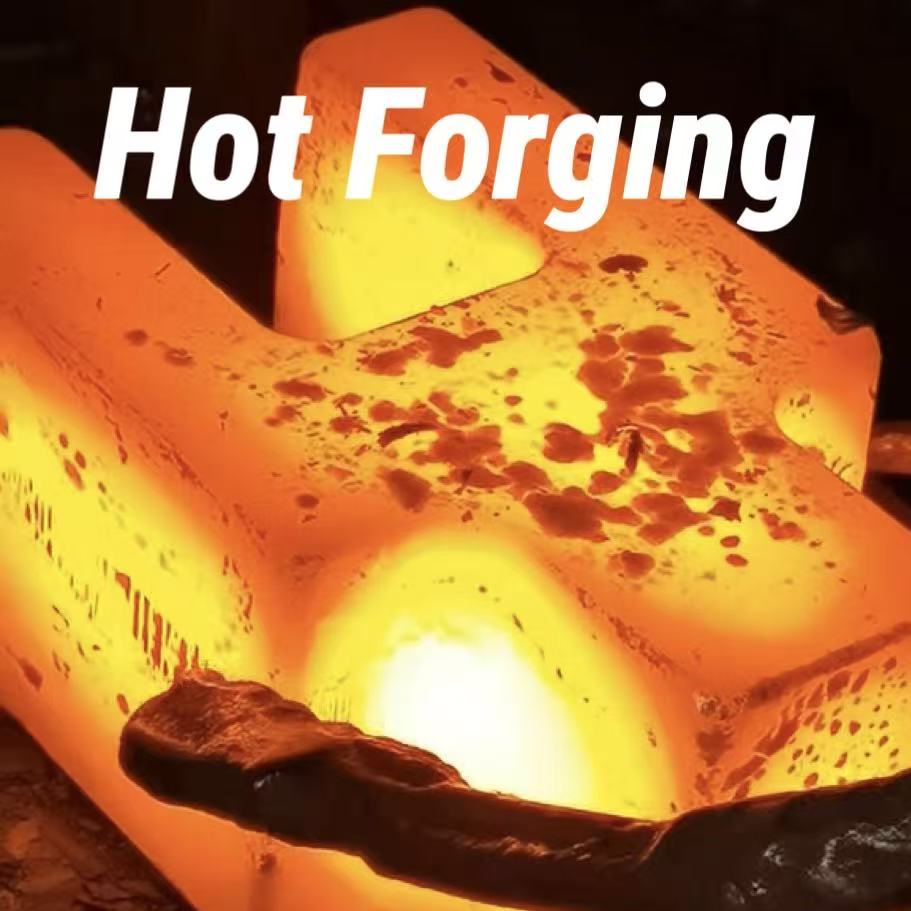
A hot forging production line is an integrated system that heats steel billets to forging temperature and gradually forms them into high-strength components through controlled deformation. It typically includes billet cutting, induction or furnace heating, forging presses, automated handling, heat treatment, and CNC machining. Furthermore, by combining these processes in a coordinated workflow, a hot forging production line delivers consistent quality, enhanced efficiency, and dependable performance for various industrial applications.
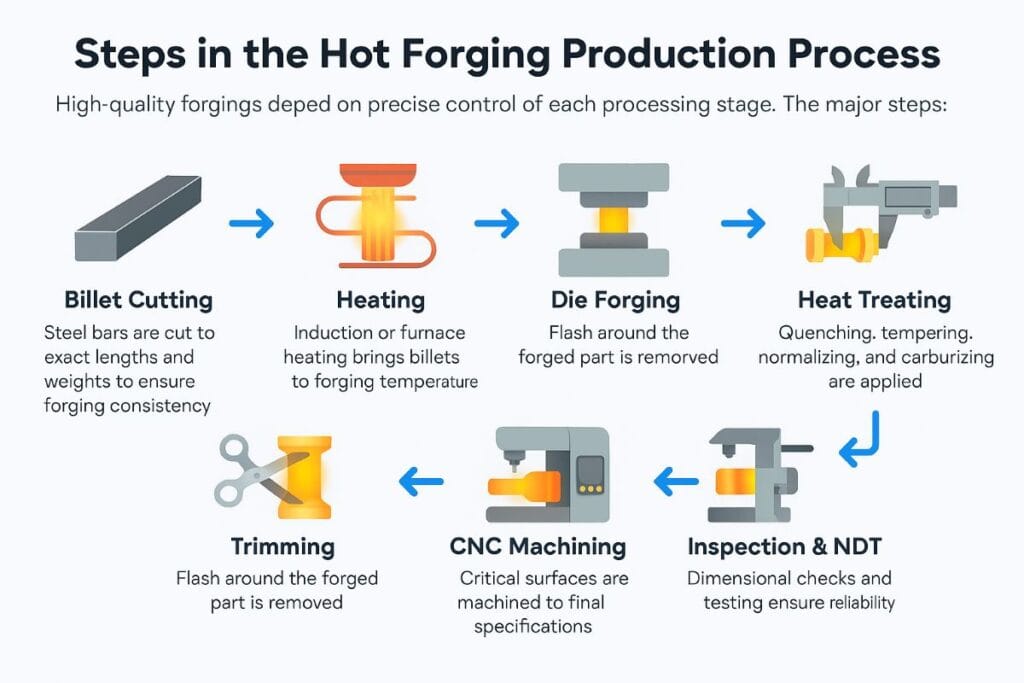
Key Stages of the Hot Forging Process
1. Billet Cutting
Steel bars are cut to precise lengths and controlled weights to achieve uniform deformation during the hot forging process. Accurate billet sizing improves material utilization and supports stable forming performance.
2. Heating
Billets are heated using induction systems or furnace heating, bringing the material to 1100–1250°C. A uniform internal temperature provides ideal forming conditions and contributes to consistent forging quality.
3. Die Forging
The heated billet is placed into a closed or open die and formed through controlled pressure, resulting in near-net geometry, refined grain flow, and high structural integrity. This stage largely defines the mechanical properties of the finished part.
4. Trimming
Excess flash formed during die forging is removed to ensure accurate geometry, reduce machining allowance, and prepare the forging for subsequent heat treatment and CNC machining.
5. Heat Treating
Processes such as quenching, tempering, normalizing, and carburizing are applied to enhance hardness, toughness, fatigue strength, and overall durability. Effective heat treatment supports long-term performance in gears, shafts, rings, and structural parts.
6. CNC Machining
After forging and heat treating, critical surfaces, holes, and tight tolerances are finished through CNC machining. This ensures accuracy, proper fit, and repeatability for OEM assembly requirements.
7. Inspection & NDT
Thorough inspections are performed, including dimensional checks, hardness testing, magnetic particle inspection (MPI), ultrasonic testing (UT), and material certification. These processes confirm that each forging meets required performance and application standards.
Why Automation Matters in Hot Forging
Automation plays a key role in modern forging production. Automated hot forging lines provide more consistent dimensional accuracy and stable mechanical properties across batches. Furthermore, they enhance production efficiency and improve overall process stability. In addition, higher automation ensures predictable delivery performance and smoother coordination across the supply chain. As a result, procurement teams benefit from greater confidence in product quality and long-term supply reliability.
Forged Parts Commonly Produced
Hot forging is ideal for medium‑ and heavy‑duty components requiring high strength and fatigue resistance. Typical forged parts include:
- Shafts and stepped shafts
- Gear blanks, pinions, and ring gears
- Bearing rings and rolled rings
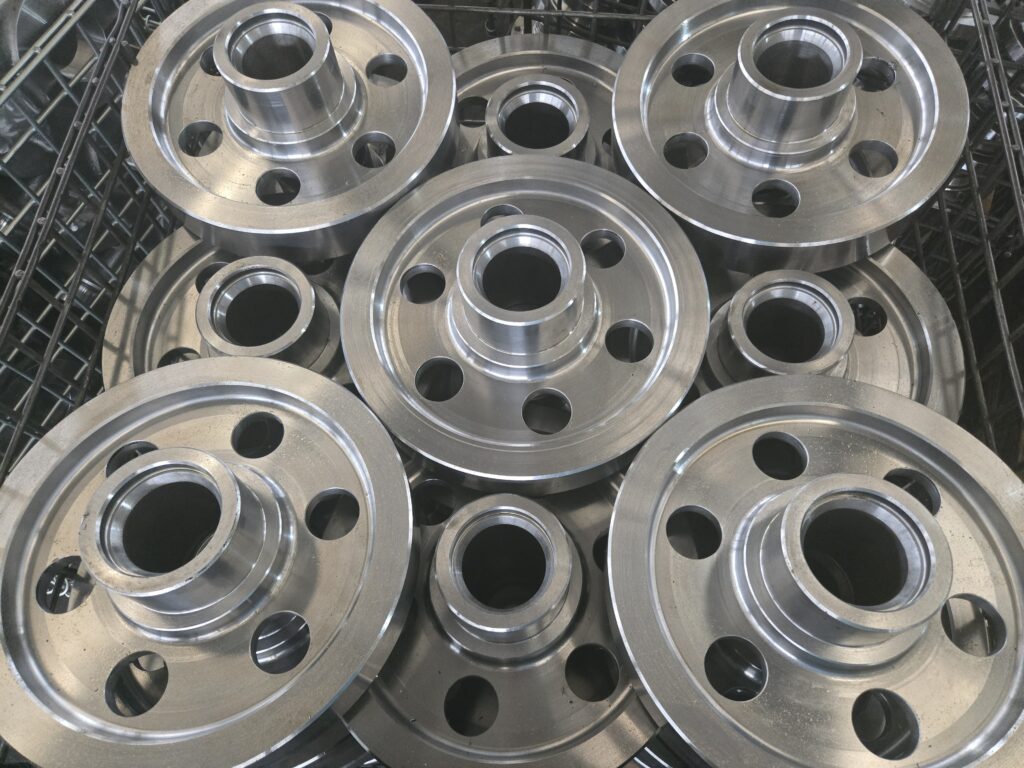
- Flanges, hubs, and couplings
- Mining and construction machinery parts
- Automotive drivetrain components
How Buyers Should Evaluate a Forging Supplier
1. Complete Process Chain
A reliable forging supplier integrates forging, heat treating, and machining within one facility. This unified workflow enhances coordination throughout production and helps maintain stable, repeatable quality.
2. Material Capability
The supplier should demonstrate strong expertise in processing materials such as 42CrMo, 4140, 20CrMnTi, SCM440, stainless steel, and various alloy steels. In addition, consistent batch performance reflects solid process control and material understanding.
3. Automation Level
Higher automation contributes to greater product uniformity and improved production efficiency. Furthermore, it supports predictable delivery performance—an important advantage for OEM procurement planning.
4. Heat Treatment Expertise
In-house quenching, tempering, normalizing, and carburizing allow components to achieve the required mechanical properties with high repeatability. As a result, forged parts can meet performance expectations across diverse applications.
5. Quality Control & Certification
Reliable suppliers typically maintain ISO 9001 and perform UT/MPI testing, hardness inspections, and CMM dimensional checks. These measures establish well-documented, consistent quality throughout production.
6. Delivery Capability
A capable forging supplier can support prototyping, small-batch production, and large-scale manufacturing. This level of flexibility helps customers plan their supply chain with confidence and maintain stable long-term operations.
Weforging as Your Trusted Partner
Weforging Manufacturing operates complete hot forging production lines capable of producing shafts, gear blanks, flanges, ring forgings, and large seamless rolled rings up to 5000 mm. Our strengths include:
- Closed-die & open-die forging
- Rolled ring forging
- In-house heat treatment (quenching, tempering, carburizing)
- CNC machining & gear cutting
- NDT testing (UT/MPI/CMM)
- EN10204 3.1 certification
- Strong experience with OEM customers in Europe and North America
Conclusion
Hot forging production lines play an essential role in producing high-strength components for a wide range of industrial applications. For buyers, selecting a capable forging supplier—rather than focusing solely on equipment—supports consistent quality, dependable performance, and long-term value.
If you require forged shafts, rings, flanges, gear blanks, or custom components, our engineering team can review your drawings and provide timely, professional quotations to support your project needs.