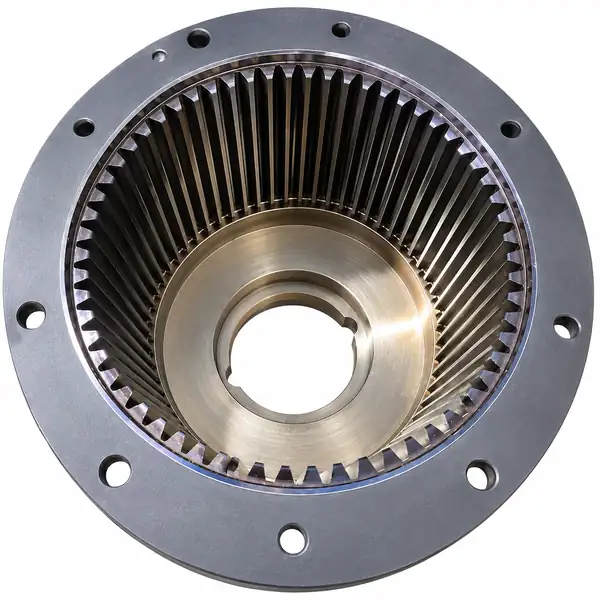
Custom Ring Gear
Table of Contents
Custom Ring Gear | Forging & Precision Machining
Weforging manufactures custom ring gears for multi-stage speed-control actuators used in marine, yacht, cruise ship and petrochemical equipment. Starting with closed-die forged blanks, we combine CNC machining, internal gear shaping and corrosion-resistant surface treatment to supply finished components to OEM drawings.
For this ring gear, GEOMET® zinc-flake coating is applied to the external surfaces after machining, while the internal gear teeth remain uncoated. This allows corrosion protection and gear-meshing requirements to be addressed separately.The machining process also accounts for deformation control and geometric tolerances associated with the actuator’s dual bearing-seat arrangement.
From the initial forging to final dimensional inspection, Weforging coordinates the manufacturing stages required to deliver a finished ring gear rather than a forged blank alone.
Custom Ring Gears for Multi-Stage Actuators
This custom internal ring gear is manufactured for a multi-stage speed-control actuator consisting of a ring gear, sun gear, planet gears, bearings and transmission shafts.
The internal teeth mesh with the planet gears, while the machined mounting features position the ring gear within the assembly. Depending on the actuator design, the ring gear may be fixed or form part of a rotating transmission arrangement.
For this application, the manufacturing requirements extend beyond the internal tooth profile. The relationship between the gear teeth, mounting surfaces and reference dimensions must be maintained to meet the specified assembly tolerances.
Weforging manufactures these components according to the actuator manufacturer’s drawings, with the forging geometry, machining sequence and inspection requirements planned around the finished part. The same manufacturing approach supports other custom industrial transmission components used in OEM power transmission systems.
From Closed-Die Forging to Finished Ring Gear
The manufacturing process begins with a closed-die forged ring gear blank. At this stage, the component has the required basic ring geometry but retains machining allowances for the internal teeth, mounting features and other specified surfaces.
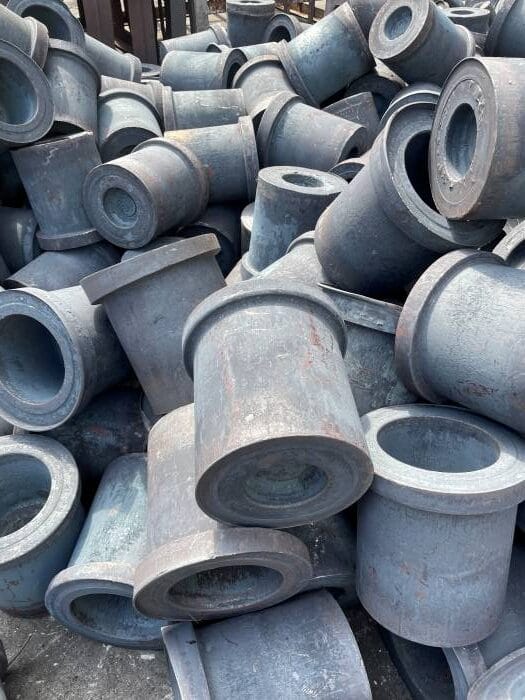
Forged Ring Gear Blank
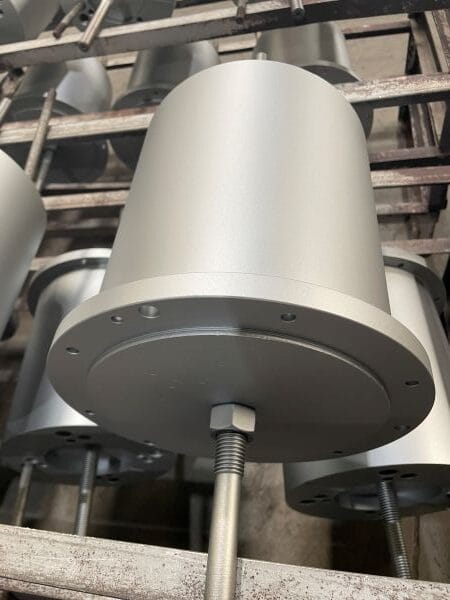
Finished Coated Ring Gear
Rather than treating forging and machining as separate operations, the blank geometry is planned with the subsequent machining process in mind. Sufficient machining allowance is needed to establish the required reference surfaces and produce the finished dimensions without unnecessary material removal.
The production sequence for this ring gear is:
- Closed-die forgingof the ring gear blank
- CNC turning and machining of reference surfaces
- Internal gear shaping
- Dimensional and gear-feature inspection
- Selective GEOMET® coating and oven curing
- Final inspection and delivery
Material selection, heat treatment and any additional operations are determined by the OEM drawing and agreed production requirements.
For more details about the initial forging stage, see our Custom Ring Gear Forgings page.
CNC Machining and Internal Gear Shaping
After forging, the ring gear blank undergoes CNC machining to establish the reference surfaces and dimensions needed for internal gear shaping. The machining sequence is planned around the relationship between the internal teeth and the mounting features of the finished component.
Machining Datums and Setup Alignment
The bore, outer diameter and end faces are machined according to the specified datum structure. Where multiple setups are required, alignment is checked to limit positional errors between operations.
This is particularly important when the finished ring gear must fit within an actuator housing and maintain the specified relationship between its internal teeth and mounting features.
Internal Gear Shaping
The internal teeth of this custom ring gear are produced by gear shaping. The machining video shows the actual cutting process at Weforging, with the shaping cutter working inside the ring gear to generate the required tooth profile.
The machining setup must provide sufficient cutter clearance while maintaining the specified relationship between the internal teeth and the previously machined reference surfaces. Tooth geometry and dimensional requirements are controlled according to the OEM drawing.
Key Machining Considerations
- Setup alignment: Align the workpiece with the established machining datums before gear shaping.
- Tool clearance: Allow sufficient cutter travel within the deep internal cavity.
- Tooth geometry: Control the tooth profile and specified dimensions according to the OEM drawing.
Runout and Geometric Tolerance Inspection
After internal gear shaping and machining of the bearing seats, the ring gear is inspected for the geometric relationships specified on the OEM drawing.
Depending on the datum structure, inspection may include bearing-seat diameters, coaxiality, radial runout, axial runout and the position of the internal teeth relative to the mounting features.
Deformation Control for Dual Bearing Seats
This custom ring gear is designed for a multi-stage speed-control actuator with two bearing seats. Machining-induced deformation can affect the alignment of these bearing locations and the specified geometric tolerances.
To minimize distortion caused by residual stress, clamping forces and material removal, Weforging plans the machining sequence, workholding and setup alignment around the bearing-seat geometry. Critical dimensions are checked during machining to maintain the required coaxiality, runout and bearing-fit tolerances.
GEOMET® Zinc-Flake Coating for Corrosion Protection
This finished ring gear uses GEOMET® zinc-flake coating to protect its external steel surfaces in corrosive operating environments. The coating is applied after CNC machining and internal gear shaping, followed by oven curing.
Unlike a fully coated component, the internal gear teeth are left uncoated. This selective treatment separates the corrosion-protection requirements of the exposed surfaces from the dimensional and contact requirements of the gear teeth.
Selective Coating of External Surfaces
The coating is restricted to the specified external surfaces. The internal teeth are excluded from the coating area, and the coating boundaries are controlled according to the approved surface treatment requirements.
This avoids introducing a coating layer directly onto the internal tooth profile. Any mounting surfaces that require masking or special dimensional control are identified during process planning.
Coating Thickness and Oven Curing
The OEM drawing specifies a surface treatment thickness of 0.01–0.08 mm (10–80 μm) for this custom ring gear. The corrosion-resistant coating is applied to the designated external surfaces, while the internal gear teeth remain uncoated.
After application, the coated components undergo oven curing to form the protective layer. The photo shows actual ring gear components with a black coating finish, arranged on production racks following surface treatment.
Key Surface Treatment Controls
Coating thickness: Follow the project-specific thickness requirements.
Selective application: Keep the internal gear teeth free from coating.
Curing and finish: Control the curing process and inspect the finished coating for coverage and visible defects.
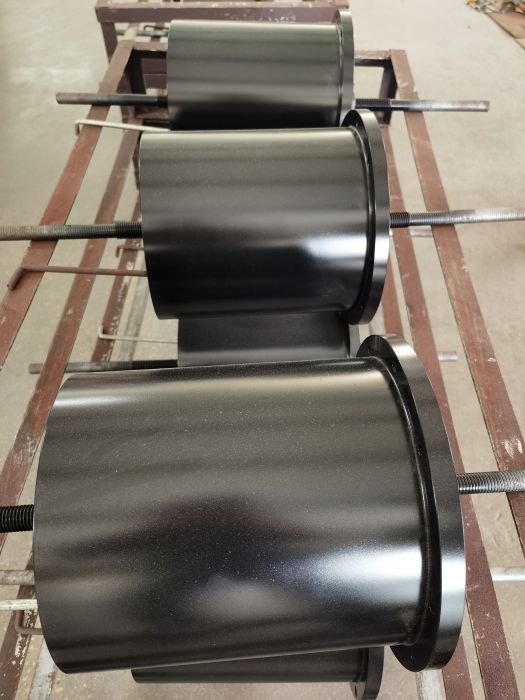
720-Hour Salt Spray Resistance Verified by Testing
The GEOMET® zinc-flake coating achieved 720 hours of salt spray resistance in testing, meeting the technical requirements specified in the OEM drawing.
The coating was applied to the designated external surfaces and oven-cured according to the approved process. Both the surface treatment and corrosion resistance met the customer’s drawing specifications.
Ring Gear Applications in Marine and Corrosive Environments
Weforging’s custom ring gears have been used in multi-stage speed-control actuators for marine equipment, cruise ships, yachts and petrochemical applications.
These environments introduce corrosion risks that differ from those encountered in enclosed industrial transmission systems. Salt-laden air, humidity and exposure to corrosive substances can place additional demands on exposed steel components.
Marine, Cruise Ship and Yacht Equipment
In marine-related actuator assemblies, the ring gear must meet the required transmission geometry while the external surfaces receive protection against corrosion.
The selective GEOMET® coating used on this component provides corrosion protection to the specified outer surfaces without coating the internal gear teeth.
Petrochemical Equipment
Actuators used in petrochemical equipment may be exposed to humid or chemically aggressive surroundings. Material selection, surface treatment and component design must be evaluated against the actual operating environment.
For these projects, Weforging manufactures the ring gear according to the specified mechanical, dimensional and coating requirements rather than applying one standard finish to every application.
Inspection Before and After Surface Treatment
For a finished ring gear, inspection cannot end when the internal teeth have been machined. The component must meet its specified dimensions before coating, and the treated surfaces must remain within the agreed requirements after coating and curing.
Weforging organizes inspection around the manufacturing stages rather than relying on a single final measurement.
First-Part and Gear Geometry Inspection
The first completed ring gear is inspected against the OEM drawing before repeat production. Critical checks may include tooth geometry, reference diameters, mounting dimensions, radial runout and axial runout, according to the specified tolerances.Particular attention is given to the dimensional relationship between the two bearing seats, including the specified coaxiality and runout requirements.
Inspection After GEOMET® Coating
Following coating and oven curing, the finished component is checked for coating coverage, appearance and the specified thickness requirements. Coating boundaries are also reviewed to confirm that the internal gear teeth remain untreated.
Where coating could affect a mounting interface or critical dimension, the relevant features are checked against the final drawing requirements.
Material and Production Traceability
Material certificates, forging batches, machining records and inspection results are maintained according to the agreed quality plan. Additional coating reports or independent testing can be included when specified by the OEM.
One Supplier from Forging to Finished Ring Gear
Producing a corrosion-protected internal ring gear requires coordination between forging, machining, gear cutting and surface treatment.
The forging blank must provide sufficient machining allowance. The CNC process must establish suitable reference surfaces for internal gear shaping. Once the teeth and mounting features have been machined, the coating process must protect the specified external surfaces without covering the internal teeth.
These operations are closely related. A change in blank geometry, machining datum or coating boundary may affect a later manufacturing stage.
Weforging coordinates the manufacturing route from the initial forging through finished-part inspection, reducing the need for OEM buyers to manage separate suppliers for each operation.
Our machined forgings manufacturing services support customers who require components delivered beyond the forged-blank stage.
Custom Ring Gear Manufacturing to OEM Drawings
Weforging manufactures custom ring gears to OEM drawings rather than offering a fixed range of standard gear sizes.
For multi-stage actuators, the drawing review covers the internal gear geometry, mounting dimensions, machining datums and required surface treatment. Material selection and any heat treatment requirements are evaluated according to the operating loads and customer specifications.
For quotation and manufacturing review, customers can provide:
- 2D drawings and 3D models
- Material grade and heat treatment requirements
- Module, tooth count, pressure angle and gear tolerances
- Mounting dimensions and geometric tolerances
- GEOMET® coating specifications and coating boundaries
- Salt spray test requirements and acceptance criteria
- Estimated order quantity and delivery requirements
Where required, samples can be manufactured and inspected for approval before repeat production.
Beyond this finished ring gear, Weforging manufactures custom forged gears and shafts for OEM transmission assemblies, including gear shafts, internal ring gears and other drawing-specific components. Send Us Your Drawing to discuss a finished custom ring gear for your actuator or industrial transmission project.
Can Weforging supply fully machined custom ring gears?
Why is gear shaping used for this internal ring gear?
Does GEOMET® coating cover the internal gear teeth?
Has the ring gear coating passed salt spray testing?
What information is needed to quote a custom ring gear?
Related products
-
Gears and Shafts
Custom Drive Sleeve
-
Gears and Shafts
Forged External Spur Gears
-
Gears and Shafts
Forged Sprocket Wheel
-
Gears and Shafts
Forged Pinion Gear