
Advantages of Forging: Why Forged Parts Perform Better
Advantages of Forging are especially important for components that require high strength, reliability, and long service life. Compared with casting and machining, forging improves metal grain flow and material integrity, resulting in better mechanical performance.
For industries such as mining, wind energy, and heavy equipment, forged components help reduce failure risks under repeated loads and harsh conditions.
This article explains why forging is often selected over casting and machining, and how it improves component performance and lifecycle value.
What Is Metal Forging?
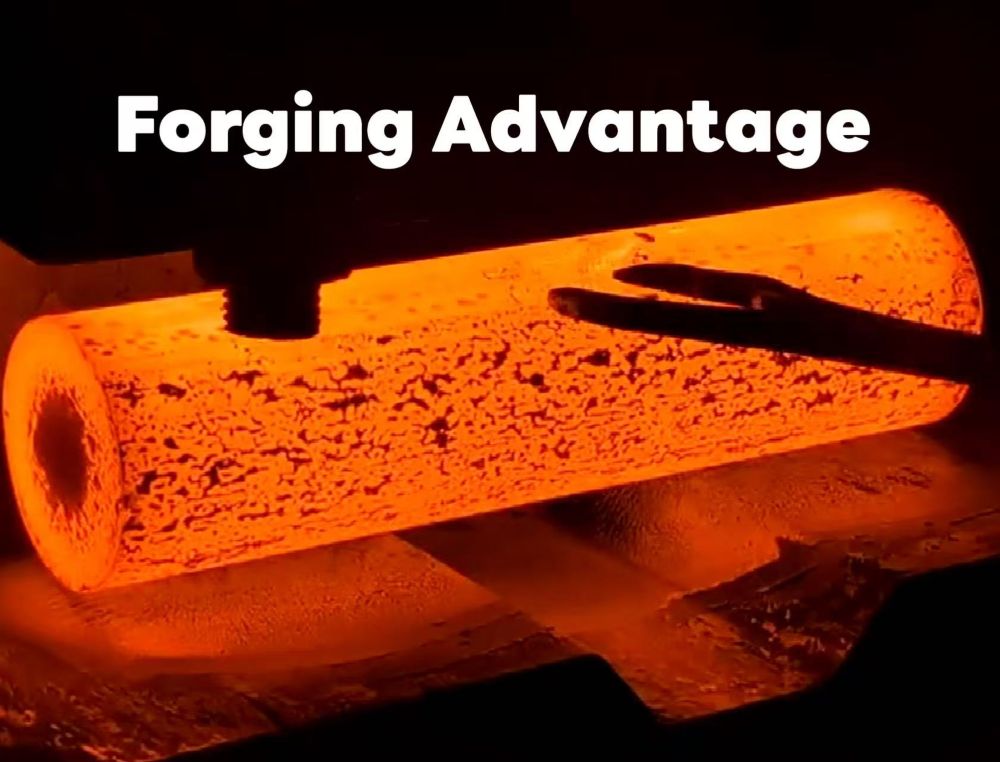
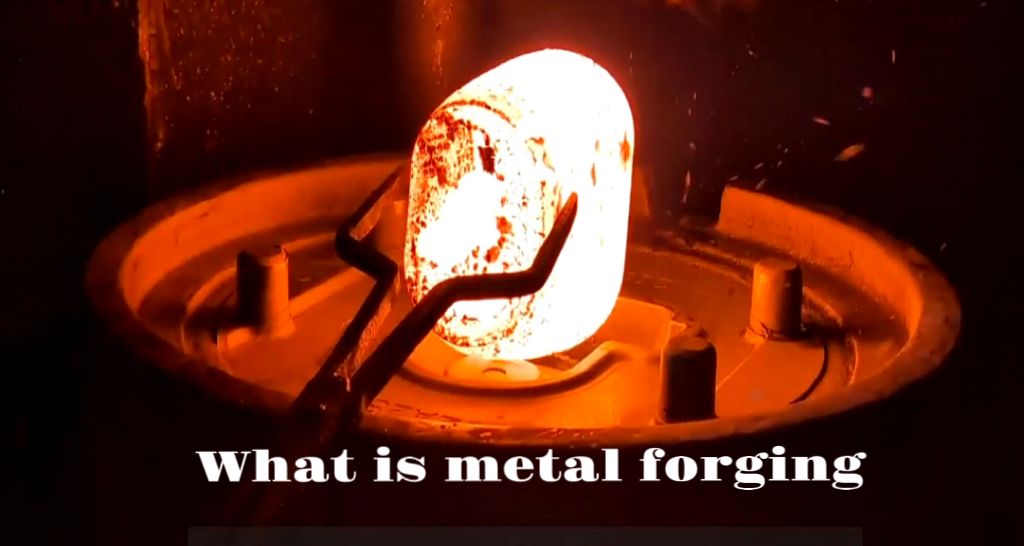
Forging is a metal forming process in which heated billets are pressed or hammered into shape. During deformation, the material grain structure realigns to match the part’s geometry, eliminating porosity and weak points.
There are several common forging methods:
- Open-die forging – For large shafts and rings
- Closed-die forging – For precision near-net-shape parts
- Hot forging – Performed above recrystallization temperature
- Cold forging – For high-volume fasteners and hardware
Whether manual or automated, the forging process produces components that are stronger than parts made by casting or machining alone.
7 Key Advantages of Forging for Industrial Components
Forging offers significant advantages for industrial components where strength, durability, and reliability are essential. Through controlled deformation, the forging process improves metal structure and mechanical properties, helping manufacturers produce parts that perform better under demanding conditions.
For industries such as mining, wind energy, heavy equipment, and industrial machinery, forged components are widely used because they can handle high loads, repeated stress, and long operating cycles.
1. Improved Grain Flow and Material Integrity
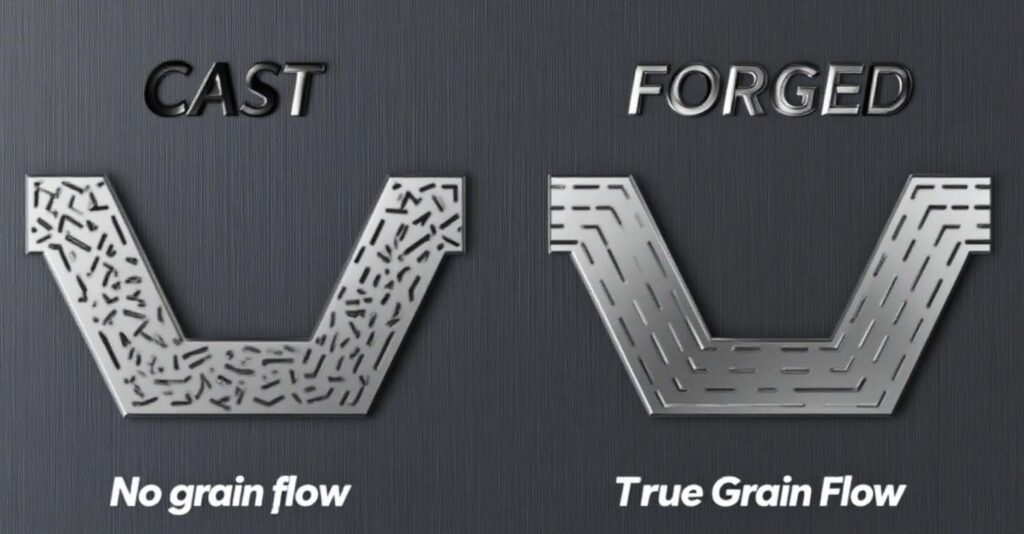
One of the biggest advantages of forging is improved grain flow. During deformation, the metal grain structure follows the shape of the component, creating better internal consistency and strength.
Key benefits include:
- Improved material integrity
- Reduced internal defects
- Better resistance to impact and repeated loading
- More reliable performance in critical applications
This makes forged components suitable for shafts, gears, flanges, and structural rings that require long-term durability.
2. Higher Strength and Load Capacity
Forging improves the mechanical properties of metal through controlled deformation. Compared with many other manufacturing methods, forged parts provide higher strength and better resistance to heavy loads.
Main advantages include:
- Higher tensile strength
- Improved yield strength
- Better impact resistance
- Higher load-bearing capability
These properties make forging a preferred choice for heavy machinery, industrial transmissions, and structural components exposed to demanding working conditions.
3. Better Fatigue Resistance and Longer Service Life
Many industrial components operate under continuous stress, vibration, and repeated loading. Forging helps improve fatigue resistance by creating a stronger internal structure with fewer weak points.
Forged components provide:
- Longer service life
- Reduced risk of fatigue cracks
- Better performance under cyclic loading
- Lower maintenance requirements
This is especially important for mining equipment, wind turbines, and other applications where component failure can result in costly downtime.
4. Reduced Internal Defects Compared with Casting
Compared with casting, forging creates a denser and more uniform material structure through mechanical deformation.
Forging helps reduce common casting-related issues, including:
- Porosity
- Shrinkage cavities
- Uneven grain distribution
- Internal weak points
For safety-critical components, improved structural reliability is one of the main reasons engineers choose forging over casting.
5. Better Strength-to-Weight Ratio
Forging allows engineers to achieve high mechanical performance while optimizing component weight.
The main advantages include:
- Higher strength with optimized material usage
- Improved durability without unnecessary weight increase
- Better performance in demanding applications
This makes forged components valuable in industries such as automotive, robotics, and renewable energy, where both strength and efficiency are important.
6. More Consistent Performance in Production
For OEM customers, stable quality across different production batches is critical. A controlled forging process helps maintain consistent material properties and predictable component performance.
A reliable forging process provides:
- Stable mechanical properties
- Repeatable production quality
- Better dimensional consistency after machining
- Easier quality control and traceability
When combined with CNC machining, heat treatment, and inspection, forging becomes a complete manufacturing solution for industrial components.
7. Lower Lifecycle Cost for Critical Components
Although forging may require higher initial tooling investment, the overall lifecycle value is often better for high-performance applications.
Forged components can help reduce total cost through:
- Longer service life
- Fewer unexpected failures
- Reduced replacement frequency
- Lower maintenance costs
For OEM customers, choosing forging is often not only a manufacturing decision but also a long-term reliability strategy.
Forging vs Casting: Why Forged Parts Are Stronger
Forging and casting are both widely used metal manufacturing processes, but they create different material structures.
| Factor | Forging | Casting |
|---|---|---|
| Internal structure | Dense structure with controlled grain flow | Possible porosity and shrinkage |
| Grain direction | Follows component geometry | Random grain structure |
| Fatigue resistance | Higher | Generally lower |
| Impact resistance | Better | Depends on casting quality |
| Load capability | Suitable for heavy loads | Limited by defects and structure |
The main advantage of forging over casting is improved internal material integrity.
While casting focuses on achieving complex shapes, forging focuses on improving mechanical performance and reliability.
For components exposed to high stress, vibration, or repeated loading, forging is often the preferred solution.
Why Forging Is Stronger Than Casting and Machining
The primary advantage of forging lies in its ability to enhance internal material structure rather than simply shaping it.
Key benefits include:
- No internal voids → Better fatigue life
- Grain flow follows shape → Higher impact resistance
- Controlled deformation → Improved load distribution
- Reduced weak points → Lower failure risk
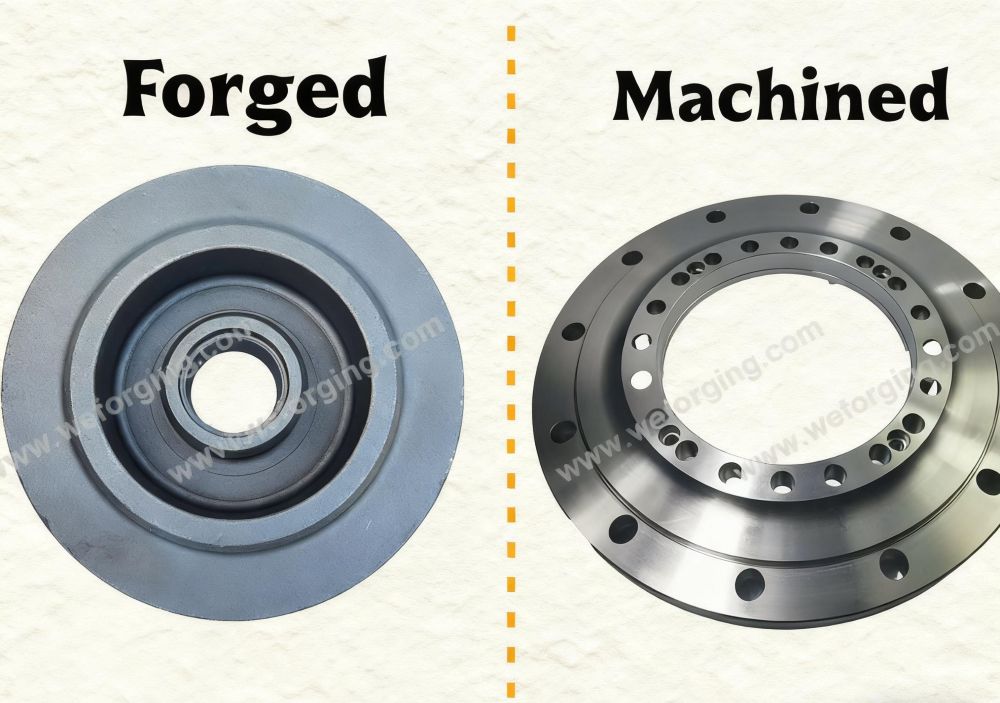
Unlike machining, forging improves the internal structure of the material rather than simply removing material from bar stock.
For safety-critical components such as shafts, gears, and flanges, these advantages translate into longer service life and improved operational reliability.
Advantages of Forging Over Machining
Machining removes material to shape a component. While machining achieves precision, it does not improve base material strength.
The advantages of forging over machining include:
✔ Superior strength-to-weight ratio
✔ Less material waste and better cost efficiency
✔ Improved fatigue performance in dynamic conditions
✔ Ability to withstand shock, torque, and pressure
In many industries, forged blanks are CNC machined to final dimensions — combining forging strength and machining precision in one component.
Read more about forged vs machined components
Advantages of Forging Process for OEM Applications
Across major industries, the advantages of forging process translate into measurable product reliability:
Industry | Forged Components | Performance Benefit |
Automotive | Crankshafts, control arms | High impact & fatigue resistance |
Wind energy | Turbine shafts, forged flanges | Load stability under cyclic stress |
Hydraulic systems | Cylinder ends, piston rods | No porosity, leak-free sealing |
Mining | Drill heads, gear hubs | Shock-load durability |
Construction | Tie rod ends, steering knuckles | Safe under heavy mechanical load |
The advantage of forging is structural, not just dimensional:
- Grain flow alignment increases tensile strength
- Work hardening strengthens surface layer
- Deformation removes inclusions and internal defects
- Compatible with heat treatment for higher hardness
These characteristics cannot be achieved by casting or fully machined bar stock.
When Should You Choose Forging?
Choose forging when your application requires:
✔ High strength-to-weight ratio
✔ Zero porosity and structural integrity
✔ Reliable performance under load
✔ Long-term fatigue resistance
✔ Custom shapes with repeatable tolerance
If the part must not fail, forging is the correct choice.
Conclusion
The advantage of forging lies in its ability to produce stronger, safer, and more durable components than casting or machining alone. With better grain structure, mechanical strength, and fatigue resistance, forging remains the preferred process for critical industrial applications.
For OEM-grade forged components—shafts, flanges, gears, cylinder parts—selecting forged rather than cast or machined parts significantly improves performance and service life.