
Drop Hammer Forging: Process, Parts & OEM Applications
By Weforging Technical Team
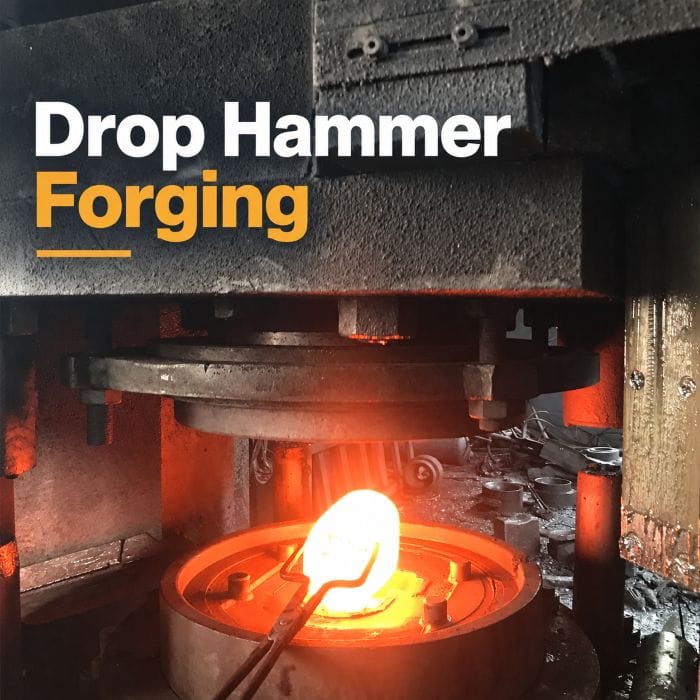
Drop hammer forging is a hot forging process that uses repeated hammer blows to form heated metal inside shaped dies. It is commonly used for repeat-production industrial components where strength, material flow and consistent forged geometry are important.
For OEM buyers, process selection depends on more than whether a part can be forged. Therefore, part geometry, material, mechanical properties, production quantity, tooling, heat treatment, machining and drawing requirements all influence the manufacturing route.
This guide explains how drop hammer forging works, which parts are suitable, how it compares with press forging, and what buyers should define when sourcing custom forged components.
At Weforging, forging, heat treatment, CNC machining and inspection can be integrated within one manufacturing route from raw material to finished OEM component.
Key Takeaways
- Drop hammer forging uses repeated blows to control material flow through successive die impressions. The process can produce repeatable forged shapes before heat treatment and final machining.
- Drop hammer forging is generally better suited to repeat production than very low-volume parts. Geometry, material, mechanical requirements, part size, tooling cost and annual quantity should be evaluated before the process is selected.
- Drop hammer forging and press forging apply force differently. The choice should be based on part geometry, material flow, forging size, production volume and equipment capability rather than assuming one method is better for every part.
- Many forged OEM components require more than forging alone. Heat treatment establishes the required material condition, while CNC machining creates precision bores, threads, bearing surfaces and other finished features. Integrating these processes can simplify production control and traceability.
What Is Drop Hammer Forging?
Drop hammer forging is a hot forging method in which repeated hammer blows progressively force heated metal into shaped die cavities. In impression-die production, each blow moves the material closer to the required forged geometry.
Drop hammer forging is commonly used for impression-die or closed die forging production, but these terms describe different aspects of the forging process. The relationship between them is explained below.
Depending on part geometry, the workpiece may pass through preforming, blocking and finishing impressions. During these stages, each impression helps control material distribution and die filling before the final forged geometry is produced.
For OEM projects, drop hammer forging should be selected as part of the complete manufacturing route rather than as an isolated forming operation. The forged blank must also provide the geometry and machining allowance required for subsequent heat treatment and CNC machining.
See our Closed Die Forging process for more detail on die design, material flow and forged-part production.
How Are Drop Hammer Forging, Hammer Forging and Closed Die Forging Related?
Hammer forging uses impact energy to deform metal. Drop hammer forging is a type of hammer forging in which repeated blows progressively form the heated workpiece. Closed die forging, by contrast, describes a forming method in which metal flows within shaped die cavities.
A closed-die component can therefore be produced on a drop hammer, but presses and other suitable forging equipment can also be used for closed die forging.
For OEM sourcing, this distinction matters because the forging method and equipment should be selected from the finished-part requirements rather than treating drop hammer forging as the default route for every forged component.
How Does the Drop Hammer Forging Process Work?
A reliable drop hammer forging process begins before the first hammer blow. Material grade, billet weight, heating temperature, die design and forging sequence all influence material flow and the consistency of the forged blank.
First, steel is cut to the required billet weight and heated to the specified forging range. Where necessary, the billet is preformed before repeated hammer blows force the material into the die cavities. After forging, excess flash is trimmed. For finished OEM components, subsequent operations may include heat treatment, CNC machining and inspection according to the drawing.
From Steel Billet to Finished OEM Component
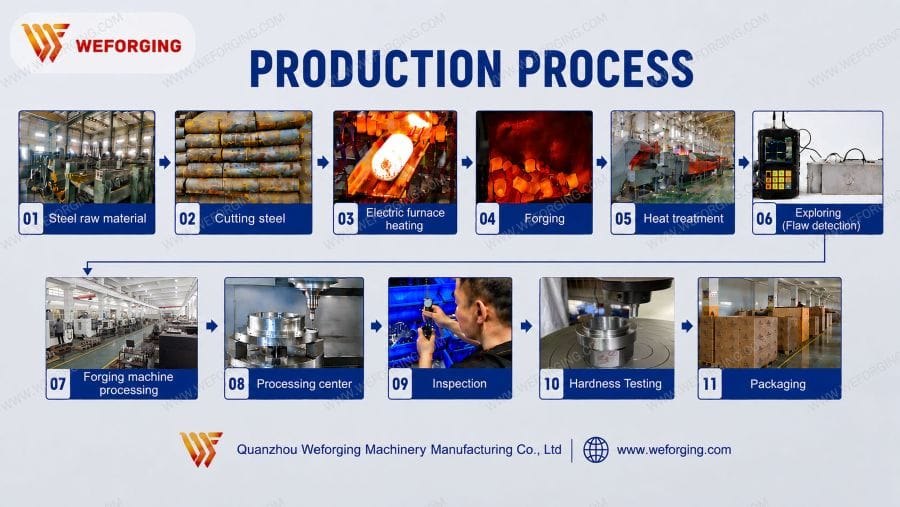
A typical integrated manufacturing route can be summarized as:
Material Confirmation → Billet Cutting → Heating → Preforming → Drop Hammer Forging → Trimming → Heat Treatment → CNC Machining → Inspection → Finished Component
Not every part requires every step, and the sequence may vary with material, geometry and drawing requirements. For this reason, Weforging considers downstream heat treatment, machining and inspection requirements when developing the forged blank and tooling. This allows the operations to be coordinated within one manufacturing route.
What Parts Are Suitable for Drop Hammer Forging?
Drop hammer forging is generally suited to repeat-production components with sufficient volume to justify tooling and with geometry that benefits from a forged preform. Typical examples include gear blanks, shafts, couplings, flanges, brackets, connectors, pins and other load-bearing components.
For example, in power transmission equipment, forged blanks can be used for gears, gear shafts and drive components that later receive precision machining. In mining and heavy machinery, forged components may be selected for parts exposed to impact, cyclic loading or demanding mechanical service, depending on the drawing and material requirements.
However, not every component should be forged. Very small quantities, simple geometries or parts dominated by machined features may sometimes be more economical to produce from bar stock or by another process.
Drop hammer forging is more likely to be suitable when:
- Repeat production can justify dedicated tooling.
- The geometry benefits from a forged preform rather than extensive stock removal.
- Section changes or load-bearing features can be formed effectively in dies.
- Mechanical requirements support a forged manufacturing route.
- Final CNC machining can be planned from a stable forged blank.
This part-specific process selection is relevant to forged components used in Mining Ground Support, Heavy Machinery and other industrial equipment.
Drop Hammer Forging vs Press Forging
Drop hammer forging and press forging can both produce closed-die forged components, but they apply force and deform the workpiece differently.
Factor | Drop Hammer Forging | Press Forging |
Force application | Repeated impact blows | Gradual or continuous pressure |
Metal deformation | Rapid, through successive impacts | Progressive under sustained pressure |
Die filling | Developed through repeated blows | Controlled through the press stroke |
Forming action | Multiple impacts may be used to complete the impression | Deformation develops through controlled press movement |
Neither process is universally better. For OEM components, the forging method should be selected from the finished-part drawing, required material flow, production volume and available forging capacity. Buyers should therefore define the finished component requirements first rather than specifying a hammer or press before the manufacturing route has been evaluated.
Why Do Drop Forged Components Need CNC Machining?
Drop forged components need CNC machining when the finished drawing requires precision features or tolerances that forging cannot produce directly. In practice, forging creates the basic geometry and distributes material into the required shape, while CNC machining establishes the final precision features.
CNC machining is commonly used for:
- Precision bores
- Internal and external threads
- Bearing seats and sealing surfaces
- Datum and locating faces
- Tight-tolerance assembly features
Therefore, the manufacturer should consider machining requirements before finalizing the forging die. Machining allowance, datum surfaces and clamping requirements can influence the design of the forged blank.
For OEM projects, coordinating forging and CNC machining within one manufacturing route helps align the forged blank, machining allowance and final drawing requirements before production is released. Weforging combines these operations for Machined Forgings and finished OEM components rather than rough forgings alone.
What Should OEM Buyers Specify in a Drop Forging RFQ?
A drop forging RFQ should define the finished component requirements, not only the forging operation. The drawing, material, mechanical properties, heat treatment, machining, inspection and expected production volume can all influence the manufacturing route.
Requirement | What Should Be Defined |
Material | Material grade and applicable specification |
Mechanical properties | Tensile, yield, hardness and impact requirements where applicable |
Heat treatment | Required condition or final property target |
Drawing & dimensions | Finished-part drawing, critical dimensions, tolerances and datums |
Machining | Finished features and machining allowance |
Surface | Coating, corrosion protection or other surface requirements |
Inspection | Dimensional and mechanical testing requirements |
Quantity | Prototype quantity, batch size and expected annual volume |
Traceability | Material heat number, production batch, heat-treatment and inspection records where required |
Where the manufacturing method is not fixed, the finished-part drawing should be the starting point. From this starting point, the supplier can evaluate forging feasibility, machining allowance, tooling requirements and the appropriate manufacturing route before quotation or tooling development.
How Are Drop Forged Parts Inspected and Tested?
Inspection and testing should verify that the drop forged part meets the material, mechanical-property and dimensional requirements defined by the drawing and application. Therefore, the component requirements should determine the inspection plan rather than applying the same tests to every forging.
Typical verification may include:
- Material verification: material identification and chemical composition where required
- Mechanical properties: hardness, tensile, yield and Charpy impact testing where specified
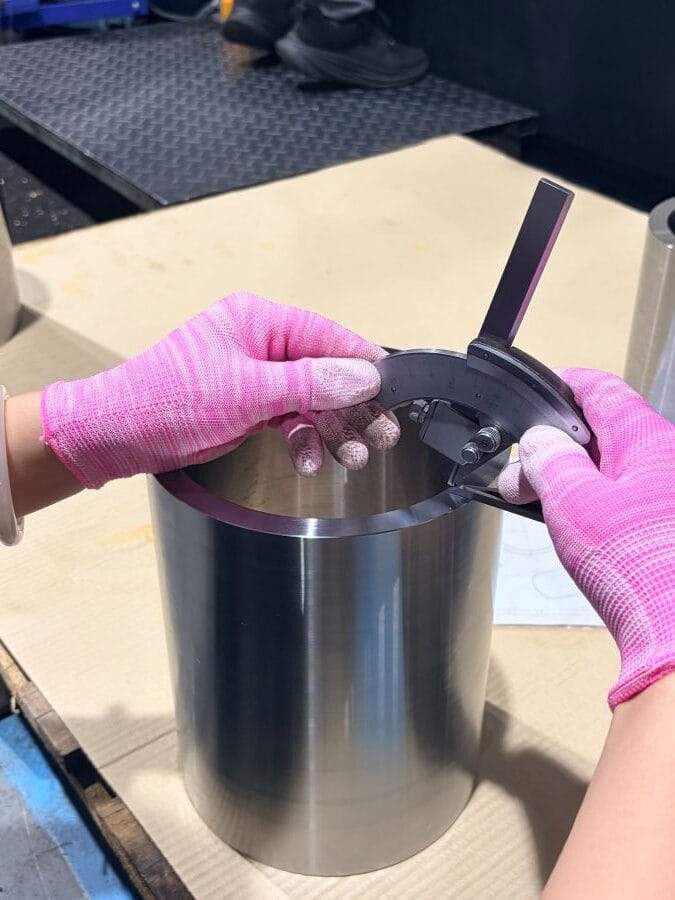
- Dimensional inspection: critical dimensions, tolerances and machined features
- Functional gauges: thread gauges or dedicated feature gauges where applicable
- CMM inspection: critical geometry, position and dimensional relationships where required
Where traceability is required, Weforging links the material heat number, production batch, heat-treatment records and inspection results to the finished component.
The purpose is not to add as many tests as possible, but to verify three things: the correct material was used, the specified mechanical properties were achieved, and the finished geometry meets the drawing.
At Weforging, dimensional inspection and mechanical-property verification can be coordinated with forging, heat treatment and CNC machining, allowing inspection records to follow the same controlled manufacturing route.
From First Article to Repeat Production
An acceptable first article does not by itself prove that the manufacturing process is ready for repeat production. Instead, first-article verification should confirm both the finished component and the manufacturing process before batch production begins.
At Weforging, the operator first inspects the part during production. After the first finished component is completed, quality personnel independently recheck it. Where the drawing specifies mechanical properties, the laboratory then performs the required testing before batch production begins.
If results do not agree, production should not simply continue. In that case, quality personnel first review the measurement method, gauge, machining program or manufacturing process and correct the cause where necessary.
Once approved, the first article and its associated process records provide a controlled reference for subsequent production batches. For OEM buyers, repeat production depends not only on approving one acceptable part, but on controlling the process used to produce the next batch.
Choosing the Right Manufacturing Route
Drop hammer forging can be an effective process for strong, repeatable industrial components, but it should be selected around the part geometry, material, performance requirements and expected production volume rather than used as a default solution.
For OEM projects requiring finished components, forging, heat treatment, CNC machining and inspection should be planned as one manufacturing route. This helps control the transition from forged blank to finished part and supports consistency in repeat production.
Weforging can review the complete manufacturing route from the finished-part drawing rather than evaluating the forging operation alone. Send us your drawing, material requirements and expected quantity for a manufacturing review.